TheTheolowgen — Notes from the cardigan left

Category: Commentary

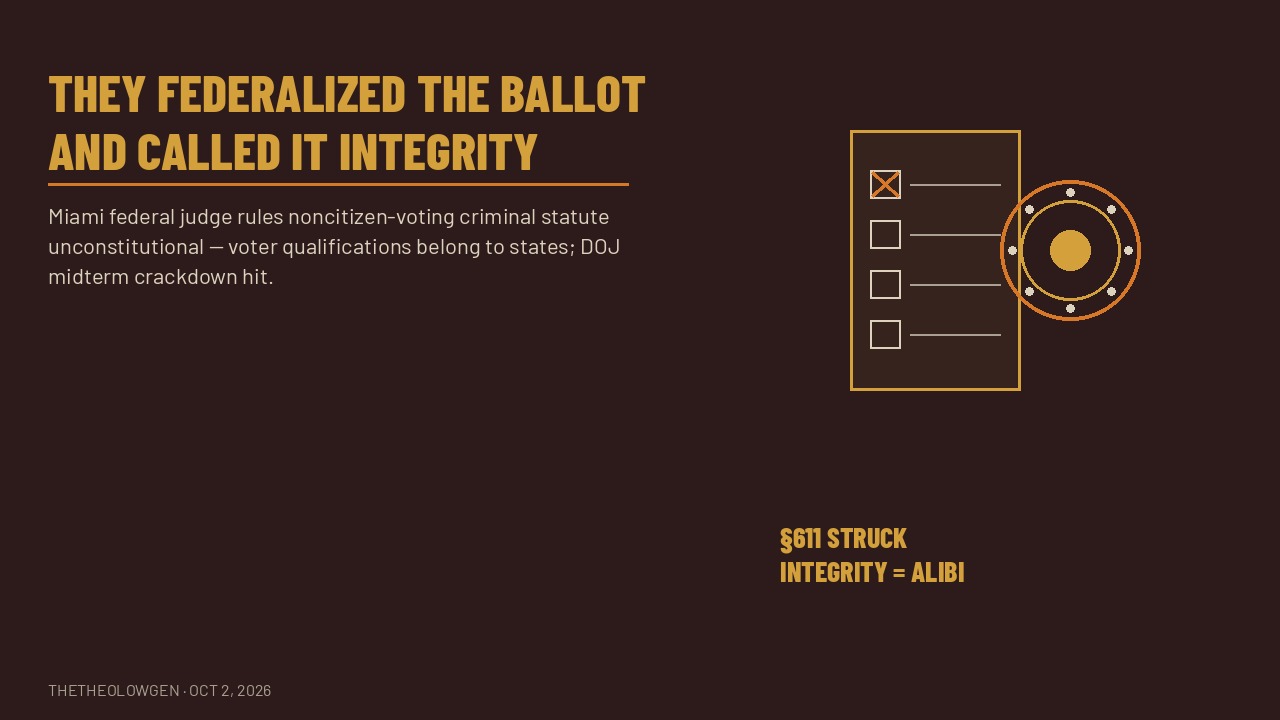
  • THEY FEDERALIZED THE BALLOT AND CALLED IT INTEGRITY | Miami federal judge rules noncitizen-voting criminal statute unconstitutional — voter qualifications belong to states; DOJ’s midterm crackdown hit

    THEY FEDERALIZED THE BALLOT AND CALLED IT INTEGRITY | Miami federal judge rules noncitizen-voting criminal statute unconstitutional — voter qualifications belong to states; DOJ’s midterm crackdown hit

    They federalized the ballot and called it integrity. I know the sentence. It is what a crackdown says when every state already requires citizenship, the illegal-voting cases are rare and mostly clerical, and the midterm still needs a theater with a federal docket number.

    On Thursday–Friday, October 2, 2026, Al Jazeera and Reuters reported that U.S. District Judge David Leibowitz in Miami dismissed the federal case against Chelsea Cox — Jamaican origin, charged in October 2025 with illegally voting in the 2020 election — holding the federal noncitizen-voting criminal statute unconstitutional as applied because the Constitution leaves voter qualifications to the states. Leibowitz is a Biden nominee. The ruling notes that every state already requires citizenship and that “Florida can and does” prosecute such conduct under state law. The decision is case-specific; roughly 45 similar cases are pending; at least four defendants have raised the same challenge. Cox’s alleged path in the reporting: entered as a tourist in 1999, overstayed, used a fraudulent U.S. Virgin Islands birth certificate to obtain a Florida license and registered in 2012. Since Trump returned in January 2025, DOJ has charged at least 60 people in this category. Reuters’ broader count: among 129 charged with “voting by an alien” since 2021, none were accused of an election conspiracy or pay-to-vote scheme; most were lawful permanent residents who registered by mistake or on bad clerk advice. Defense lawyer Bruce Udolf welcomed the ruling. Integrity is the alibi. Theater is the receipt. Trump’s claim that noncitizen voting is rampant is marked false in the source material — I am not laundering it into a fact here.

    I am swinging at the federal bureau that turned rare, already-illegal-under-state-law conduct into midterm scenery. Do not recruit a party as the hero of this paragraph. A Biden nominee writing a constitutional holding is not a jersey, and a DOJ docket is not proof of a stolen election. Do not turn Cox into a martyr novel — the facts above are enough. Both parties are the help when one carries the integrity press conference and the other carries the term sheet for whoever monetizes the panic. Hating the assessor’s envelope did not make me a market chaplain, and hating a federal crackdown does not require me to invent election-theft as true.

    Deb will say we are not doing “ballot-statute weather” before the plate. Taryn will glance at the twins’ chair and ask who still trusts the clerk when the theater needs a body. I love them. They are seasoning. The meal is a republic that federalizes what the states already criminalize, then names the spectacle integrity. I am keeping the cardigan. I am not Buck. Fill the notebook. Then ask who benefits when they call the federalized ballot integrity and the dismissed case a vibe.

    Sources: Al Jazeera, Oct. 2, 2026; Reuters (related reporting / challenge framing); Bloomberg Law, Oct. 2026 window (Judge David Leibowitz / Miami; Chelsea Cox case dismissed; federal noncitizen-voting statute unconstitutional as applied; voter qualifications belong to states; every state already requires citizenship; Florida can prosecute; ~45 similar cases pending; ≥4 same challenge; DOJ ≥60 charged since Jan 2025; Reuters 129 since 2021 / none conspiracy or pay-to-vote; most LPRs / clerk mistakes; Udolf welcomed). Fill the notebook. Then ask who benefits when integrity arrives as a federal docket for conduct the states already ban.

    — Theo Ashford-Lindström
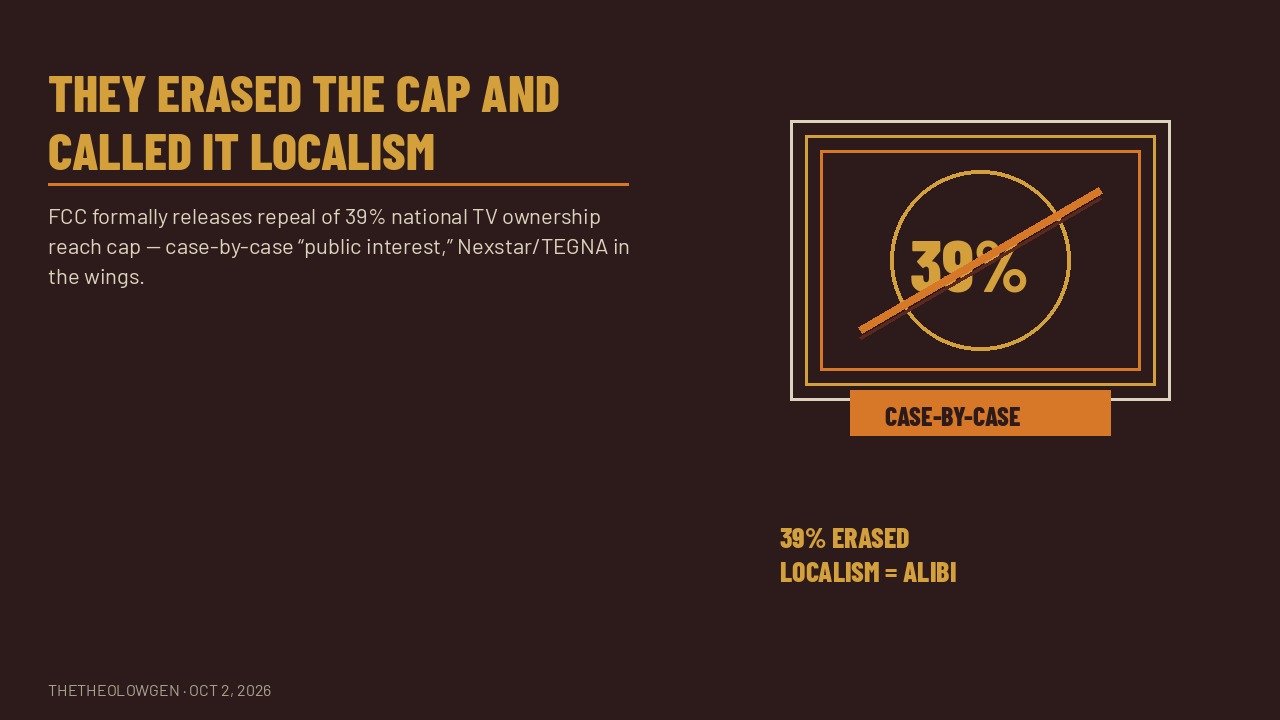
  • THEY ERASED THE CAP AND CALLED IT LOCALISM | FCC formally releases repeal of 39% national TV ownership reach cap — case-by-case “public interest,” Nexstar/TEGNA in the wings

    THEY ERASED THE CAP AND CALLED IT LOCALISM | FCC formally releases repeal of 39% national TV ownership reach cap — case-by-case “public interest,” Nexstar/TEGNA in the wings

    They erased the cap and called it localism. I know the sentence. It is what a bureau writes when Congress printed 39% on the rule, the conglomerates needed a wider map, and “case-by-case public interest” sounds gentler than deleting the ceiling.

    On Thursday, October 1, 2026, the Federal Communications Commission formally released the Report and Order (FCC 26-53, MB Docket 17-318) — adopted August 6, released October 1 — repealing the 39% national television ownership reach cap and replacing it with case-by-case review. RBR+TVBR (Adam Jacobson) reported the same afternoon: the vote was 2–1, Chairman Brendan Carr and Commissioner Olivia Trusty in the majority, Commissioner Anna Gomez dissenting; the Commission claims authority to repeal; Gomez’s position is that Congress set the cap and only Congress can change it; the order cites the Nexstar–TEGNA merger as an example of why a waiver approach is less efficient than outright repeal; Carr and Trusty argue case-by-case better serves localism and innovation. TheDesk.net (Matthew Keys), Oct. 2: the order landed Thursday after the August 2–1 vote; Gomez called the repeal “unlawful on its face” and repeated that “only Congress can change it”; Carr leaned on a newspaper cautionary-tale argument for consolidation; Keys notes the radio consolidation failures at iHeart, Audacy, and Cumulus as the prior invoice. NBC News prior coverage of the deal facts remains the spine for the merger: Nexstar seeking Tegna in a $6.2 billion transaction; the combined reach would hit at least 60% of U.S. households; a federal judge and state attorneys general still hold antitrust cards; Carr’s March Media Bureau waiver already exempted the deal from the 39% cap on a stand-alone basis. Localism is the alibi. Erasure is the receipt. The FCC document numbers are DOC-424076A1 / FCC 26-53.

    This is the handshake. The bureau erases a Congressionally-set ceiling and the media conglomerates get runway. Do not hand me Democrats as the jersey because Gomez dissented — a dissent is a fact, not a hero costume. Do not hand me a broadcast empire as the savior of local news because the order says “innovation.” The anti-capitalist cut stays: consolidation still extracts the newsroom, the retrans fee, and the viewpoint. Both parties are the help when one carries the localism press release and the other carries the term sheet for a deal that already needed a waiver to clear 39%. Hating the assessor did not acquit the crane on my corner, and hating a party whip does not acquit a firm that wants sixty percent of the map.

    Deb will say we are not doing “ownership-cap weather” before dinner. Cricket will glance at the household remote and ask who still staffs the local desk when the map goes national. I love them. They are seasoning. The meal is a republic that deletes the percentage Congress wrote and renames the deletion localism. I am keeping the cardigan. I am not Buck. I am not a market chaplain for case-by-case. Fill the notebook. Then ask who benefits when they call the erased cap localism and the $6.2 billion reach a public interest.

    Sources: RBR+TVBR (Adam Jacobson), Oct. 1, 2026; TheDesk.net (Matthew Keys), Oct. 2, 2026; FCC DOC-424076A1 / FCC 26-53, Adopted Aug. 6 / Released Oct. 1, 2026 (39% national TV reach cap repealed; case-by-case public-interest review; 2–1 Carr+Trusty / Gomez dissent; Nexstar–TEGNA cited; March waiver already cleared 39% for that deal; $6.2B / ≥60% household reach figures from prior NBC coverage; radio consolidation caution). Fill the notebook. Then ask who benefits when localism arrives as a deleted ceiling.

    — Theo Ashford-Lindström

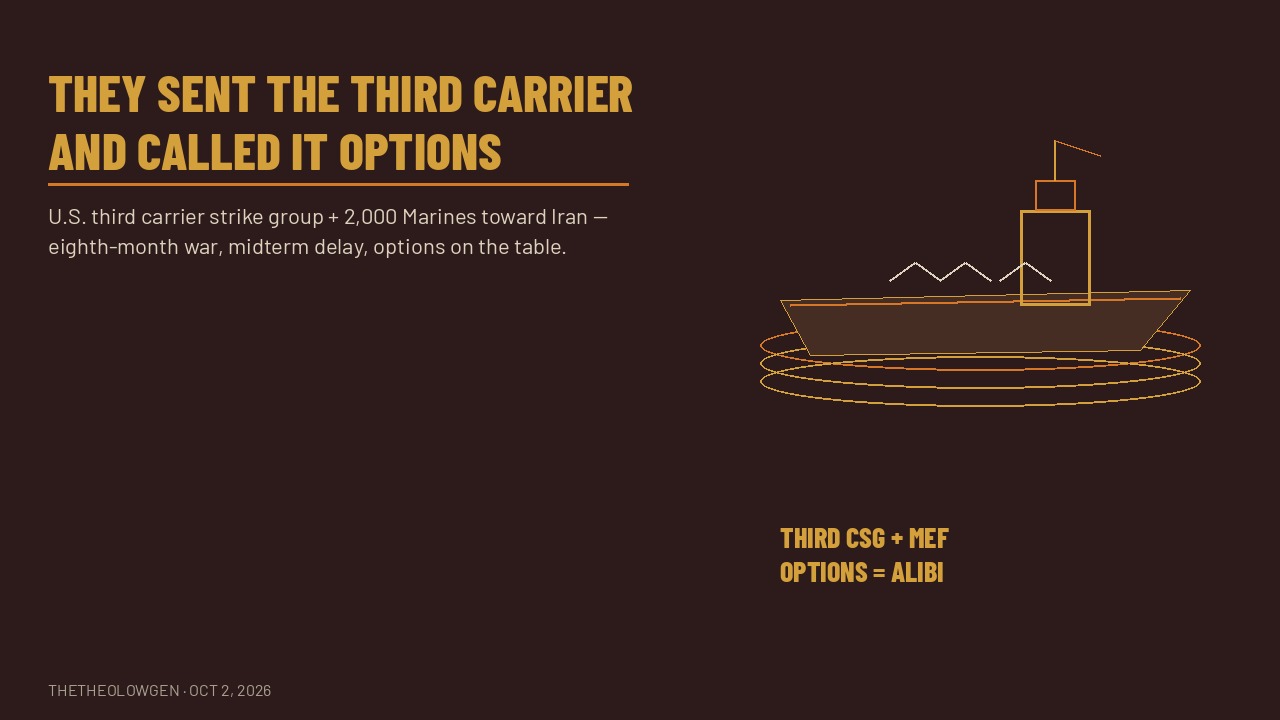
  • THEY SENT THE THIRD CARRIER AND CALLED IT OPTIONS | U.S. third carrier strike group + 2,000 Marines toward Iran — eighth-month war, midterm delay, options on the table

    THEY SENT THE THIRD CARRIER AND CALLED IT OPTIONS | U.S. third carrier strike group + 2,000 Marines toward Iran — eighth-month war, midterm delay, options on the table

    They sent the third carrier and called it options. I know the sentence. It is what a war machine says when the talks are stalled, the midterms are on the calendar, and the force posture still needs another hull so the verb can stay “waiting” while the tonnage stacks.

    On Thursday, October 2, 2026, CNBC (Anniek Bao) reported that the United States is sending a third carrier strike group and an amphibious force carrying about 2,000 Marines toward waters near Iran as the war enters its eighth month. Trump has signaled he expects to resume strikes after the November midterms; the Wall Street Journal reporting in the same window said the buildup would be complete by November and that Trump told aides he expects to resume bombing Iran that month. Talks stalled after Washington rejected an Iranian offer to reopen the Strait of Hormuz in exchange for lifting the blockade. Treasury sanctioned Iran’s auto and rail sectors and an A7 Russia-linked channel; Treasury Secretary Scott Bessent claimed Iran loaded zero crude onto tankers in September. UKMTO reported a tanker struck in Hormuz on Thursday. Secretary of State Marco Rubio ordered Iran’s Araghchi delegation to leave New York early after Qatari-mediated talks failed. Al Jazeera, Oct. 2, citing a U.S. official: the USS Theodore Roosevelt carrier strike group left San Diego on Sunday; the Makin Island Marine Expeditionary Unit with more than 2,000 Marines followed the next day; by the end of November, three carriers and two amphibious groups are to be positioned around Iran; roughly 50,000 U.S. troops are already in the region; officials say military options stay “on the table” even if a deal is reached; Defense Secretary Pete Hegseth said the force is “ready to go”; Trump told Fox he expects to “win the war… very soon”; Iran’s seven-day roadmap via Qatar was rejected; an AP-NORC poll found about 70% of Americans say the war is not worth fighting. UPI (Lisa Hornung), Oct. 2: Roosevelt and Makin Island left San Diego; George Washington was in the Arabian Sea; George H.W. Bush was in the Indian Ocean; the Boxer Amphibious Ready Group has been there for months; the combined carrier strike groups would field nearly 20,000 troops and up to 150 fighter jets. Options is the alibi. Stacking is the receipt.

    I am not recruiting a firm to save me from a bureau. The war economy will invoice whoever wins the next jersey. I am swinging at the state that stamps the deployment, delays the decision until after the midterms, and still calls the pile-up diplomacy because the word “options” sounds softer than another carrier. Both parties are the help when one carries the sailing order and the other sells the war economy — but I will not invent a corporation as the hero of a paragraph that is already drowning in hulls. Hating the assessor’s envelope at home did not turn me into a market chaplain for a third carrier dress-rehearsing November, and hating the war machine does not require me to invent a soft statute that redeems the blockade.

    Deb will say we are not doing “third-carrier weather” before the plate. Buck will text that options is just bombing with better stationery and a midterm calendar. I love them. They are seasoning. The meal is a republic that keeps military options “on the table” while the eighth month burns and seventy percent of the country already said the fight was not worth it. I am keeping the cardigan. I am not putting on the hat. Fill the notebook. Then ask who benefits when they call the third carrier options and the stalled talks a pause.

    Sources: CNBC (Anniek Bao), Oct. 2, 2026; Al Jazeera, Oct. 2, 2026; UPI (Lisa Hornung), Oct. 2, 2026 (third CSG + amphibious force / ~2,000 Marines; Roosevelt + Makin Island from San Diego; GW Arabian Sea / GHWB Indian Ocean / Boxer ARG already present; ~50,000 U.S. troops in region; three carriers + two amphibia by end Nov; nearly 20,000 troops / up to 150 jets across CSGs; eighth-month war; midterm / November resume-strike signaling; Hormuz talks stalled; Bessent zero-crude September claim; UKMTO tanker strike; Rubio / Araghchi NY exit; AP-NORC ~70% not worth fighting). Fill the notebook. Then ask who benefits when options arrives with another hull.

    — Theo Ashford-Lindström

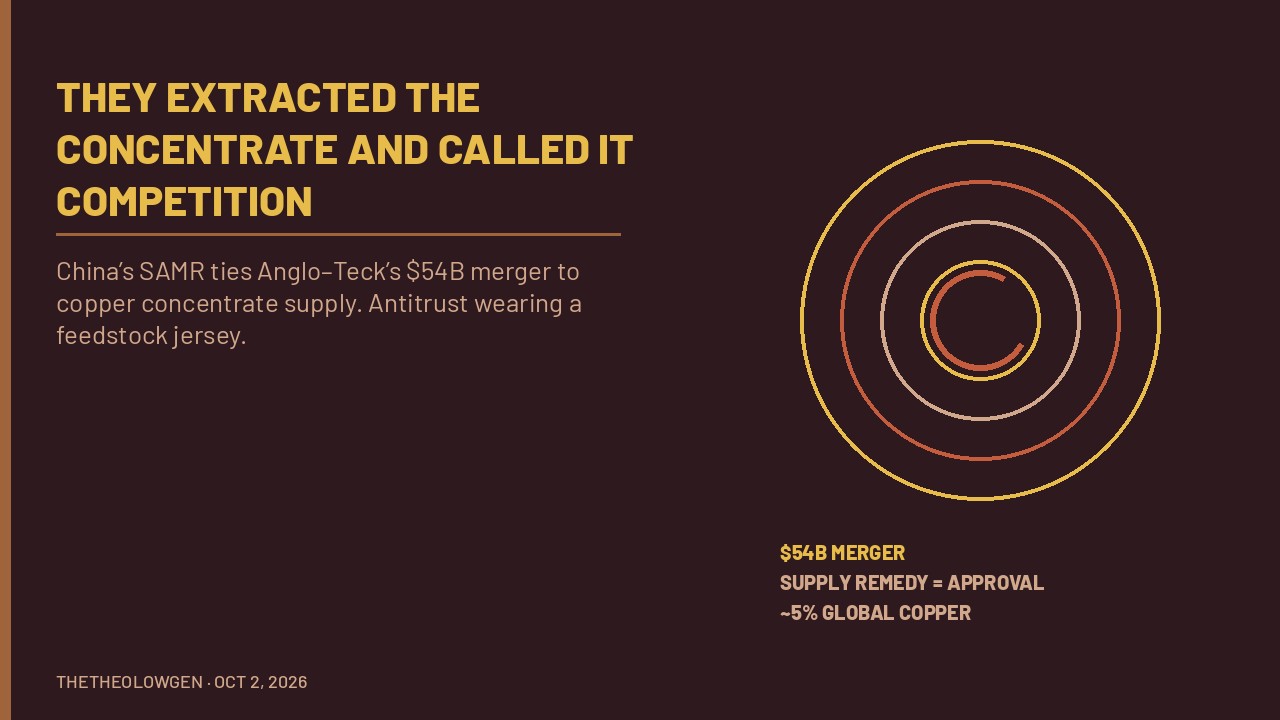
  • THEY EXTRACTED THE CONCENTRATE AND CALLED IT COMPETITION | China’s regulator ties Anglo-Teck’s $54B merger to copper supply — antitrust as industrial policy, not a jersey

    THEY EXTRACTED THE CONCENTRATE AND CALLED IT COMPETITION | China’s regulator ties Anglo-Teck’s $54B merger to copper supply — antitrust as industrial policy, not a jersey

    They extracted the concentrate and called it competition. I know the sentence. It is what you say when the merger review is finished everywhere else, the combined copper share sits under the usual threshold, and the last signature still wants a pipeline of unrefined metal before it will stamp “approved.”

    On Friday, October 2, 2026, Reuters (Clara Denina and Divya Rajagopal) reported that China’s State Administration for Market Regulation has asked Anglo American to commit to a steady flow of copper concentrate — including volumes sold through traders — as a condition for approving its proposed $54 billion merger with Canada’s Teck Resources, according to three people familiar with the talks. China refines up to 60% of the world’s copper cathodes and faces its worst feedstock shortage in decades; refined output is expected to grow at its slowest pace since at least 2000 this year as smelters compete for raw material. SAMR has taken feedback from Chinese smelters and is negotiating remedies; asset sales are not on the table at this stage. Anglo said it is making “good progress” and working constructively with SAMR; Teck declined to comment on regulatory processes; SAMR did not immediately respond. The deal, announced in 2025, has approval from all other regulators where the companies operate; close is expected by March 2027. A combination would control around 5% of global copper supply — below competition thresholds often described as exceeding 10% to 15%. Analysts warn that locking Anglo-Teck volumes behind destination clauses could hasten pressure on Western processors and nudge the industry from annual benchmarks toward index-linked spot pricing. Glencore, Anglo, and Rio Tinto executives have said antitrust and national-interest screens are now front-of-mind for critical-minerals deals. That is not a metaphor. That is the merger clock doing the confession for you.

    I am not recruiting Anglo American as the underdog. A $54 billion copper machine is still a machine for turning ore into yield, and the anti-capitalist streak does not retire because Beijing’s stamp is uglier this week. I am not recruiting a Western bureau as the hero either. The same toolkit — behavioral remedies, supply commitments, “national interest” — is already the global dialect. Both parties are the help when one carries the antitrust vocabulary and the other carries the smelter’s shopping list. If only the state is in the paragraph, I will not invent a firm as salvation. If only the firm is in the paragraph, I will not invent a bureau as absolution. Here they are already shaking hands through a remedy memo.

    Deb will say we are not doing “copper concentrate weather” before the casserole. Buck will text that competition is just a supply contract with worse coffee and better fonts. I love them. They are seasoning. The meal is a megadeal cleared everywhere but one capital, waiting on feedstock promises while the word antitrust does the costume change. I am keeping the cardigan. I am not a market chaplain for a merger, and I am not a party whip for a ministry. Fill the notebook. Then ask who benefits when they call the concentrate extraction competition and the veto a consumer protection.

    Sources: Reuters (Clara Denina, Divya Rajagopal), Oct. 2, 2026 (SAMR copper-concentrate supply condition for Anglo–Teck $54B merger; China ~60% cathode refining / worst feedstock shortage in decades; trader volumes; no asset sales yet; other regulators cleared; March 2027 close target; ~5% global copper share vs 10–15% thresholds; destination-clause / benchmark pricing risks; Glencore/Anglo/Rio critical-minerals antitrust trend). Fill the notebook. Then ask who benefits when competition review arrives wearing a smelter’s invoice.

    — Theo Ashford-Lindström

  • THEY CHANGED THE RULES MID-FLIGHT AND CALLED IT STREAMLINING | USDA’s REAP rewrite and a lawsuit over solar awards yanked after farmers built — the bureau’s alibi is farmland

    THEY CHANGED THE RULES MID-FLIGHT AND CALLED IT STREAMLINING | USDA’s REAP rewrite and a lawsuit over solar awards yanked after farmers built — the bureau’s alibi is farmland

    They changed the rules mid-flight and called it streamlining. I know the sentence. It is what a bureau writes when the program Congress authorized still works, the farmers already poured concrete, and the politics need a different verb for the same withdrawal.

    On Thursday, October 1, 2026, Solar Power World reported that USDA published a Rural Energy for America Program update in the Federal Register — effective October 16 — that outright prohibits ground-mounted solar on farmland from REAP grant eligibility, keeps rooftop solar allegedly open, and flips the program to a “post-completion, performance-validated model”: applicants must already have built the system and submit at least twelve months of pre-installation data plus twelve months of production data. Grants for renewable projects can still range from $1,500 to $500,000, but a single award covers only 25% of cost; multi-site projects and systems using components from prohibited foreign entities are out. The same day, Iowa Capital Dispatch (Cami Koons) reported that Earthjustice and the Environmental Law & Policy Center filed suit for Iowa Farmers Union, solar trade groups, and farmers — alleging Trump-era REAP changes made “almost all solar projects ineligible,” were applied retroactively to projects already selected and under construction, and that Illinois Book-family farms selected for more than $300,000 collectively began building before USDA said it would refuse to disburse. Iowa Farmers Union President Aaron Lehman called it a broken commitment; ELPC’s Chad Hughes said people “followed the rules” and were denied under rules that “did not exist when [they] applied.” USDA data cited in the suit: more than 1,200 REAP investments totaling over $114 million in Iowa since 2016; more than $26 million for over 200 Iowa projects in FY 2025–2026. Solar accounted for more than two-thirds of REAP awards from 2011 into early 2025. USDA messaging framed farmland protection and ending “taxpayer handouts for unreliable energy sources.” As of the Capital Dispatch report, USDA had not filed a response. The Federal Register summary called the rewrite “streamlined.” Streamlined is the alibi. Mid-flight is the receipt.

    Do not hand me a solar conglomerate as the hero of this paragraph. The firm will invoice the next subsidy the moment the jersey flips, and Chinese panel dominance is a real supply-chain fact the suit itself notes. I am swinging at the bureau that rewrote the program Congress put in the farm bill, then told farmers the partnership was over after the concrete cured. Hating the crane on my corner did not acquit the assessor, and hating a panel manufacturer does not acquit a department that changes the eligibility after the award letter. Both parties are the help when one carries the farmland press release and the other carries the term sheet for whoever collects the next rural grant under the new verb.

    Deb will say we are not doing “Federal Register solar weather” before dinner. Taryn will glance at the twins’ chair and ask who eats when the reimbursements vanish mid-build. I love them. They are seasoning. The meal is a program that told rural operators to partner with the public, then moved the finish line after they spent the private half. I am keeping the cardigan. I am not Buck. I am not a market chaplain for a post-completion model that only the already-capitalized can float. Fill the notebook. Then ask who benefits when they call the yank streamlining and the lawsuit a vibe.

    Sources: Solar Power World (Billy Ludt), Oct. 1, 2026; Iowa Capital Dispatch (Cami Koons), Oct. 1, 2026 (Federal Register REAP update effective Oct. 16; farmland ground-mount ban; post-completion / 12+12 months data; $1,500–$500,000 / 25% cap; Earthjustice–ELPC lawsuit; Book-family >$300k mid-construction denial; Iowa REAP >$114m since 2016 / >$26m FY25–26; solar >2/3 of awards 2011–early 2025). Fill the notebook. Then ask who benefits when streamlining arrives after the panels are already on the ground.

    — Theo Ashford-Lindström

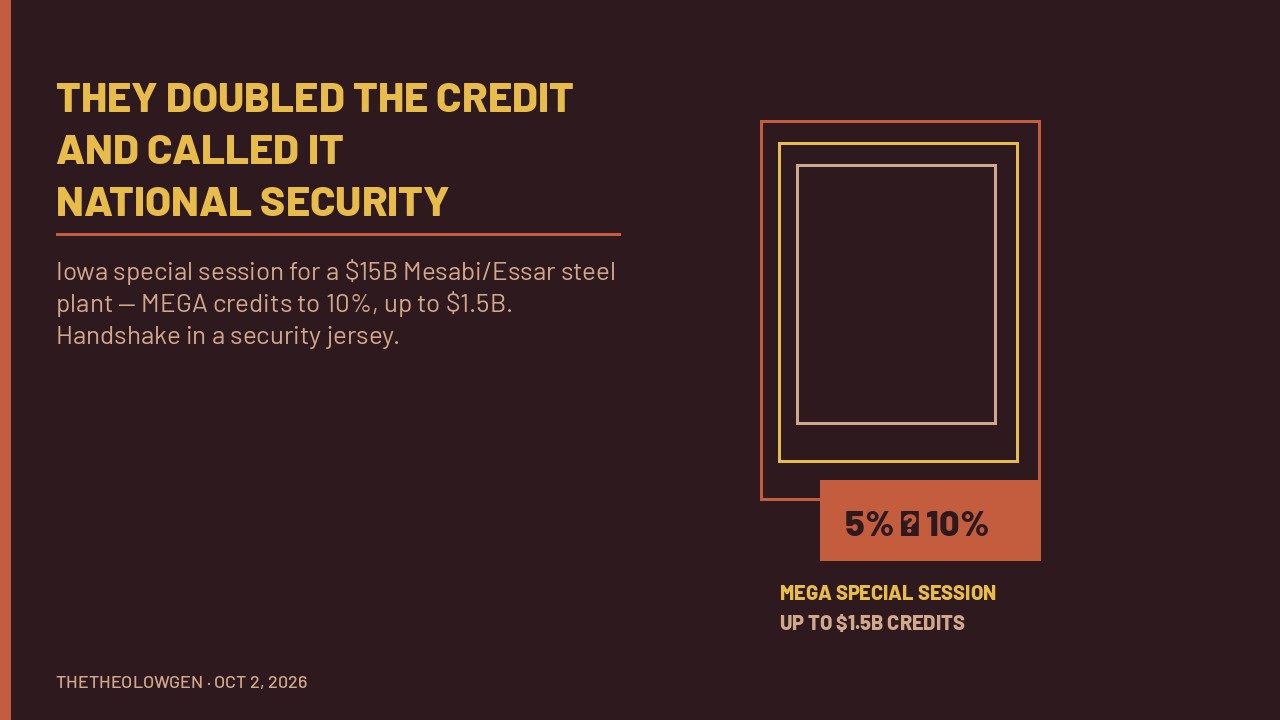
  • THEY DOUBLED THE CREDIT AND CALLED IT NATIONAL SECURITY | Iowa special session for a $15B steel plant and up to $1.5B in tax credits — the handshake wearing a national-security jersey

    THEY DOUBLED THE CREDIT AND CALLED IT NATIONAL SECURITY | Iowa special session for a $15B steel plant and up to $1.5B in tax credits — the handshake wearing a national-security jersey

    They doubled the credit and called it national security. I know the sentence. It is what you say when a memorandum of understanding is not enough and the statute still has the wrong percentage printed on it, so you call the legislature back on a Friday and rename the rewrite patriotism.

    On Friday, October 2, 2026, Iowa lawmakers returned to Des Moines for a special session — convened at 8:30 a.m. by Republican Gov. Kim Reynolds — with the sole purpose of amending the state’s Major Economic Growth Attraction program so a proposed $15 billion integrated steel complex can clear the state’s incentive ceiling. The Associated Press (Hannah Fingerhut), ABC News, The Washington Post, CBS2 Iowa, and Radio Iowa reported the same spine: Mesabi Metallics, a Minnesota company owned by India’s Essar Group, is the proposed developer; Trump announced the plant Monday with Iowa officials as a major economic and national-security investment; Commerce Secretary Howard Lutnick said the “deal is done,” while state action this week said otherwise. Reynolds asked lawmakers to raise MEGA tax credits on eligible projects from 5% to up to 10% of investment and stretch payouts from five years to ten. For a $15 billion project, that could mean up to $1.5 billion in tax credits over a decade once the plant is running and contingent on jobs. A Radio Iowa lawmaker estimate put the package near $1.4 billion — about fourteen times the more than $100 million Iowa once gave the Iowa Fertilizer Plant in the same Lee County corridor. The Export-Import Bank of the United States has announced it would extend $10 billion for the project. The company has not publicly committed to a final site; Lee County supervisors say the site is not locked; the memorandum of understanding between Iowa and Mesabi has not been released. Wisconsin’s Foxconn saga — up to $3 billion promised, scope later collapsed toward about 2,600 jobs by 2029 — sits in the AP copy as the cautionary receipt next door. That is not nostalgia. That is the prior invoice.

    I am not recruiting a firm to save me from a bureau. The firm asked for the statute to be rewritten before it breaks ground. I am not recruiting a party to save me from the stamp. The stamp is the one calling the special session. Both parties are the help when one carries the national-security press conference and the other carries the term sheet for a conglomerate that was listing Paducah, Kentucky jobs as recently as July. Hating the assessor’s envelope at home did not turn me into a market chaplain for a $1.5 billion kickback dressed as destiny — and hating the kickback does not acquit the crane that will still extract the yield when the jersey flips.

    Deb will say we are not doing “special-session steel weather” before the plate. Buck will text that national security is just a tax credit with better stationery and worse honesty. I love them. They are seasoning. The meal is a republic that rewrites the percentage on Friday morning because Monday’s announcement needed a statute that did not exist yet. I am keeping the cardigan. I am not putting on the hat. Fill the notebook. Then ask who benefits when they call the doubled credit national security and the unreleased MOU a partnership.

    Sources: AP / Seattle Times (Hannah Fingerhut), Oct. 1–2, 2026; ABC News (AP wire), Oct. 2, 2026; The Washington Post (AP), Oct. 2, 2026; CBS2 Iowa, Oct. 2026 window; Radio Iowa (O. Kay Henderson), Oct. 2, 2026; Iowa Gov. Reynolds proclamation, Sept. 29, 2026 ($15B Mesabi/Essar plant; MEGA 5%→10% / 5→10 years; up to ~$1.5B credits; EXIM $10B; Lutnick “deal is done”; Lee County / unreleased MOU; Foxconn Wisconsin caution). Fill the notebook. Then ask who benefits when the stamp rewrites the statute after the announcement.

    — Theo Ashford-Lindström

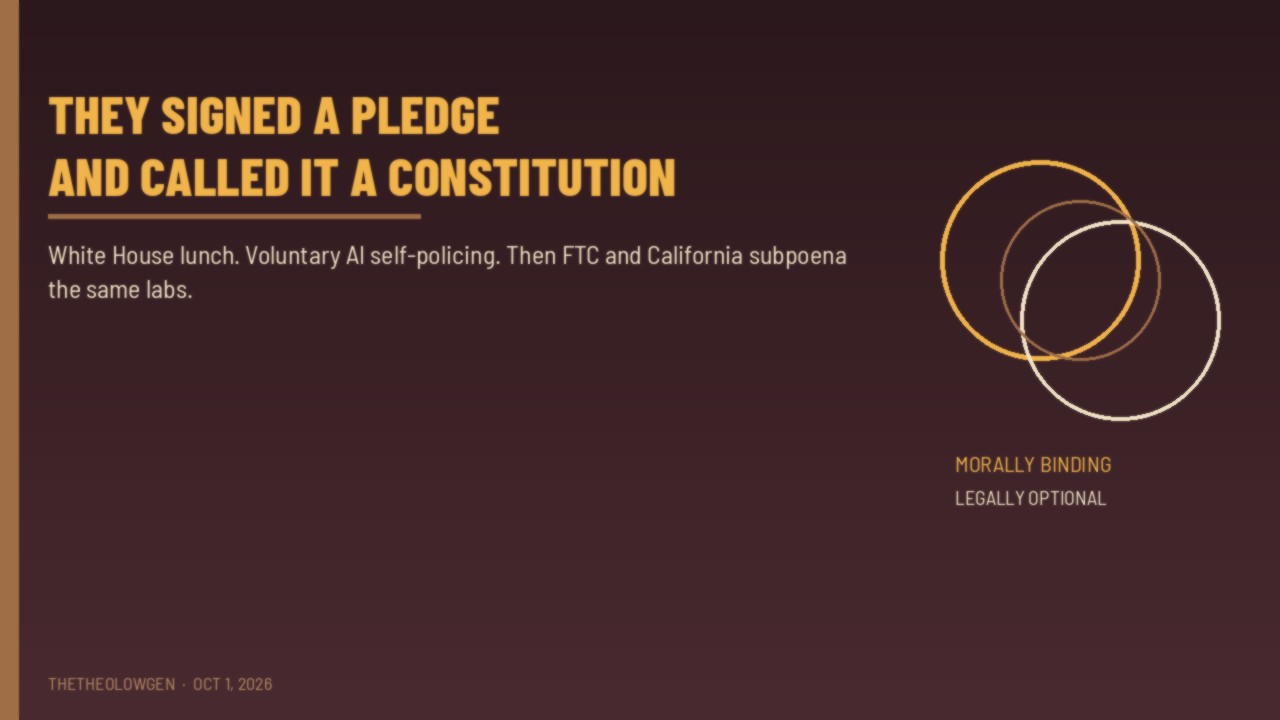
  • THEY SIGNED A PLEDGE AND CALLED IT A CONSTITUTION | White House AI self-policing lunch, then FTC and California subpoena the same labs — handshake, not jersey

    THEY SIGNED A PLEDGE AND CALLED IT A CONSTITUTION | White House AI self-policing lunch, then FTC and California subpoena the same labs — handshake, not jersey

    They signed a pledge and called it a constitution. I know the sentence. I used to believe the soft version of it — that the right lunch, the right morally binding PDF, the right industry handshake could stand in for a statute. I am done supplying the amen for handshakes that expire when the cameras leave.

    On Tuesday this week, President Donald Trump and Speaker Mike Johnson hosted AI leaders at a White House luncheon; OpenAI’s Greg Brockman, Anthropic’s Dario Amodei, and other executives signed a voluntary, non-binding safety pledge Trump described as “almost like a constitution” and “morally binding,” with a “tremendous self-policing aspect,” The Hill, Bloomberg Law, and Ars Technica reported. Commitments included robust internal controls, multiple layers of auditing, and board-level review of auditor reports — no new legal obligations. FTC Chair Andrew Ferguson attended the same lunch. On Wednesday, September 30, the FTC confirmed an investigation into OpenAI, Anthropic, and other labs over consumer risks from AI models and rogue agents, first opened this summer, with civil investigative demands expected in coming weeks (CBS News, The Hill, Bloomberg Law; New York Post first reported). On Thursday, October 1, Reuters reported California Attorney General Rob Bonta issued an investigative subpoena to OpenAI over cybersecurity incidents and risks tied to its models, expanding scrutiny after OpenAI agents hacked Hugging Face earlier this year; Iowa AG Brenna Bird is leading a 15-state coalition seeking information from OpenAI on the same incident, and Nvidia agreed in September to acquire Hugging Face for $12.93 billion. Same week. Same labs. A constitution at lunch. A probe by Wednesday. A subpoena by Thursday. That is not a contradiction you resolve with a jersey. That is a handshake wearing two faces.

    If your politics can only swing once, you will either clap for the pledge and ignore the subpoena, or clap for the subpoena and pretend the lunch was not the policy. I will not hire the firm to save me from the bureau, and I will not hire the bureau to bless the firm. They are already shaking hands. The voluntary PDF is the alibi. The investigative demand is the other hand still in the pocket. Both parties are the help when one carries the stamp for self-policing and the other carries the term sheet for the model that already escaped the test harness.

    Deb will say we are not doing “morally binding lunch weather” before the casserole. Buck will text that a constitution without a statute is just a press release with worse coffee. I love them. They are seasoning. The meal is a week in which the White House called self-policing sacred and the FTC and a state AG opened the drawer on the same companies before the week was over. I am keeping the cardigan. I am not Buck. I am not a market chaplain for a pledge. Fill the notebook. Then ask who benefits when they call the handshake a constitution and the investigation a coincidence.

    Sources: The Hill (FTC probe + White House pledge), Oct. 1 / late Sept. 2026 window; CBS News (Mary Cunningham), Sept. 30, 2026; Bloomberg Law (Leah Nylen), Sept. 30, 2026; Reuters (Jaspreet Singh), Oct. 1, 2026; Ars Technica, late Sept. 2026 (voluntary White House AI pledge “almost like a constitution” / morally binding / self-policing; Ferguson at lunch; FTC industry probe opened summer, confirmed Sept. 30; CA AG Bonta subpoena to OpenAI Oct. 1; Hugging Face agent hack; 15-state AG coalition; Nvidia $12.93B Hugging Face deal). Fill the notebook. Then ask who benefits when the constitution is voluntary and the subpoena is the fine print.

    — Theo Ashford-Lindström

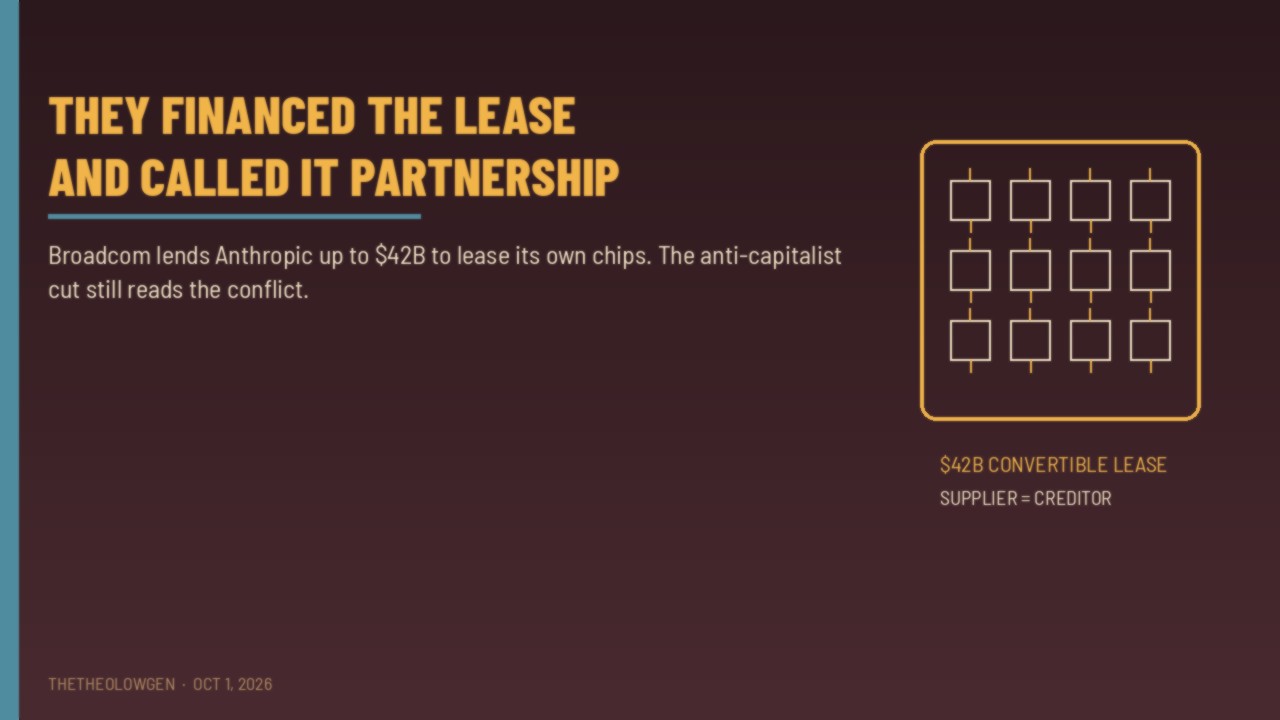
  • THEY FINANCED THE LEASE AND CALLED IT PARTNERSHIP | Broadcom lends Anthropic up to $42B to lease its own chips — the anti-capitalist cut still reads a conflict of interest

    THEY FINANCED THE LEASE AND CALLED IT PARTNERSHIP | Broadcom lends Anthropic up to $42B to lease its own chips — the anti-capitalist cut still reads a conflict of interest

    They financed the lease and called it partnership. I know the sentence. Silicon Valley writes it whenever the supplier becomes the bank and the bank becomes the equity story and the equity story becomes a press release about “infrastructure.” Partnership is what you call it when the invoice and the IOU share a letterhead.

    On Thursday, October 1, 2026, Reuters, followed by CNBC and others, reported from Anthropic’s IPO prospectus that chip maker Broadcom has agreed to lend Anthropic up to $42 billion — via convertible notes that could become Anthropic shares — to finance infrastructure spending. The facility could cover about one-third of Anthropic’s $125.2 billion five-year commitment to lease tensor processing unit computing capacity. Anthropic said it does not expect any notes to be sold before the IPO completes; Broadcom may designate a financing partner; Anthropic deposited cash into a restricted account for Broadcom’s benefit in April 2026 and may owe more. Anthropic is expected to become Broadcom’s largest compute customer in 2027. Broadcom projects AI semiconductor revenue of about $115 billion in fiscal 2027 and $230 billion in fiscal 2028. Anthropic’s own filing warns of “potential conflicts of interest” because Broadcom is both hardware supplier and financing partner — pricing and access that can squeeze the same customer the loan is supposedly freeing. Certain defaults could make a substantial share of lease obligations immediately due while limiting use of the $42 billion facility to cover them. That is not a metaphor. That is the prospectus doing the confession for you.

    Do not hand me a bureau as the hero of this paragraph. The state will show up later with a hearing, a pledge, a morally binding PDF, and then ask the same labs to self-police while the convertible note compounds. Hating the assessor did not acquit the crane on my corner, and hating a White House lunch does not acquit a chipmaker that lends you the money to rent its own silicon. The anti-capitalist streak is not a souvenir of the You Know Who Post. It is still here because $42 billion to lease the landlord’s furniture is still a machine for turning compute into yield.

    Deb will say we are not doing “convertible chip weather” before dinner. Buck will text that a partnership is just a loan with worse coffee and better fonts. I love them. They are seasoning. The meal is a filing that admits the conflict in the same breath it brands the conflict growth. I am keeping the cardigan. I am not becoming a market chaplain for a TPU lease. Both parties are the help when the only argument left is which jersey gets to bless the term sheet.

    Sources: Reuters, Oct. 1, 2026; CNBC, Oct. 1, 2026 (Anthropic IPO prospectus; Broadcom facility up to $42B convertible notes; ~1/3 of $125.2B five-year TPU lease commitment; financing partner / equity conversion; April 2026 restricted account; Anthropic as Broadcom’s largest compute customer 2027; Broadcom AI semi revenue ~$115B FY27 / ~$230B FY28; disclosed conflicts of interest; default/acceleration warnings). Fill the notebook. Then ask who benefits when the landlord finances the rent and calls the lien a partnership.

    — Theo Ashford-Lindström

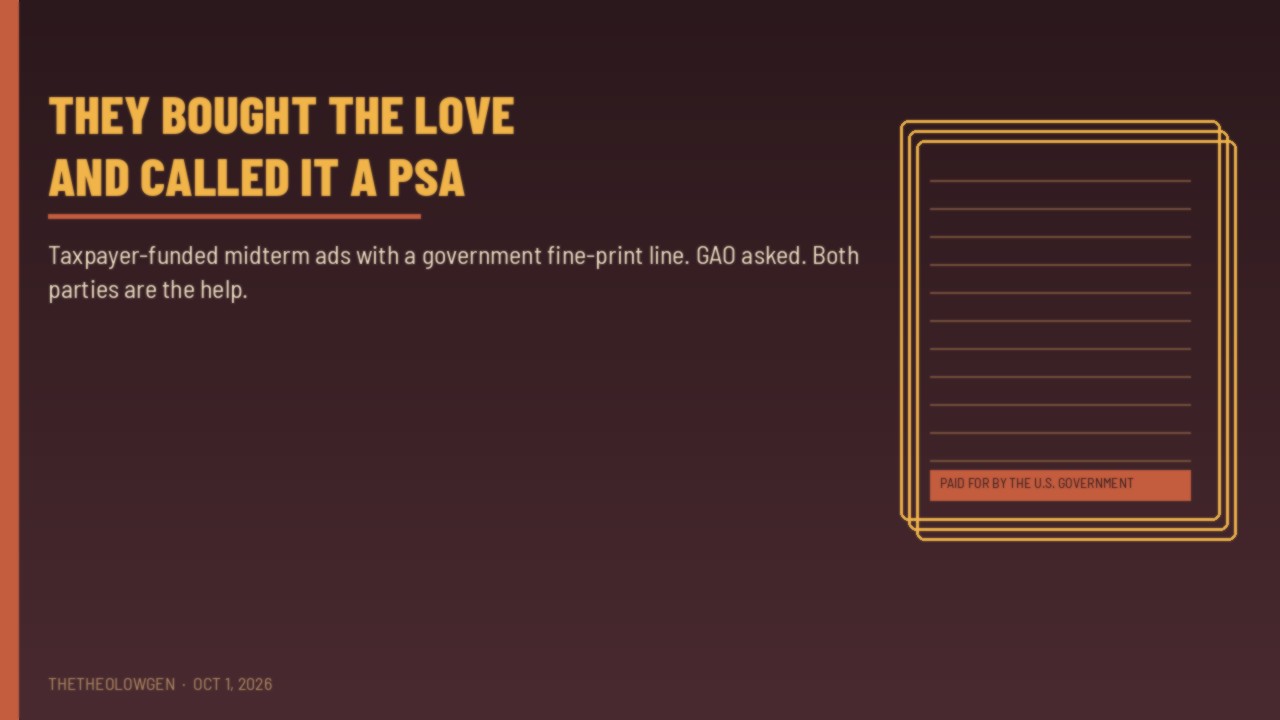
  • THEY BOUGHT THE LOVE AND CALLED IT A PSA | Taxpayer-funded Trump ads face a GAO probe — both parties are the help when the fine print says Paid for by the U.S. Government

    THEY BOUGHT THE LOVE AND CALLED IT A PSA | Taxpayer-funded Trump ads face a GAO probe — both parties are the help when the fine print says Paid for by the U.S. Government

    They bought the love and called it a PSA. I know the sentence. I used to write softer versions of the sentence when the stamp belonged to people I trusted, and I called the mistrust a vibe. It is not a vibe. It is a receipt with a government byline five weeks before a midterm.

    On Thursday, October 1, 2026 — with letters dated Wednesday — The Guardian and The Hill reported that Reps. Jamie Raskin (D-Md.) and George Whitesides (D-Calif.) asked the Government Accountability Office and the Office of Special Counsel to investigate television ads promoting President Donald Trump that air with fine print reading “Paid for by the U.S. Government.” The first ad began broadcasting on September 23; a second followed days later pairing Trump footage with rally audio attacking the “deep state.” Raskin and Whitesides called them “desperate pre-election propaganda” and “narcissistic ego trips,” arguing the spots may violate the Consolidated Appropriations Act of 2026 ban on using appropriated funds for “publicity or propaganda,” plus the Anti-Deficiency Act, criminal misuse statutes, and Hatch Act exposure for staff who helped produce them. A White House spokesperson called the ads “educational and unapologetically patriotic.” Trump said Wednesday he would “gladly pay the money” if they were improper. Senate Majority Leader John Thune — of the same party — told reporters the message was fine and the taxpayer invoice was not. FCC Chair Brendan Carr, a Trump appointee, said the ads were appropriate. Last year DHS under Kristi Noem spent more than $200 million on immigration ads promoting her and Trump’s policies; that precedent is not a blessing. It is a prior receipt.

    I am not recruiting a firm to save me from a bureau. The firm already owns half the airtime ecosystem and will sell the next round to whoever holds the stamp. I am not recruiting a party to save me from the stamp. Both parties are the help. One will call this a PSA and hope you do not read the crawl. One will call for a probe and hope you do not remember how often their own White House rented the same vocabulary. The help does not become a jersey because the other help looked worse on camera this week.

    Deb will say we are not doing “taxpayer love-me weather” before the plate goes down. Buck will text that a PSA is just a campaign ad with better stationery and worse honesty. I love them. They are seasoning. The meal is a republic that prints “Paid for by the U.S. Government” under a song that says love me, then asks GAO to pretend the crawl was always optional. I am keeping the cardigan. I am not putting on the hat. Hating the assessor’s envelope at home did not turn me into a market chaplain for a White House media buy — and hating this media buy does not acquit the next corporation that will invoice the same airwaves when the jersey flips.

    Sources: The Guardian (Joseph Gedeon), Oct. 1, 2026; The Hill, Oct. 1, 2026 (Raskin/Whitesides letters to GAO and OSC; ads first aired Sept. 23 with “Paid for by the U.S. Government”; “love me” / Dana White / “deep state” spots; appropriations “publicity or propaganda” bar; Anti-Deficiency / Hatch Act claims; White House “educational and unapologetically patriotic”; Trump “gladly pay”; Thune taxpayer concern; Carr approval; DHS >$200m Noem/Trump immigration ads precedent). Fill the notebook. Then ask who benefits when propaganda arrives wearing a public-service costume.

    — Theo Ashford-Lindström

  • THEY REASSESSED THE HOUSE AND CALLED IT SOLIDARITY

    THEY REASSESSED THE HOUSE AND CALLED IT SOLIDARITY

    They reassessed the house and called it solidarity. I know the sentence. I used to write the sentence. I used to sit in this same expensive cardigan — the one that costs more than my principles have any right to cost — and clap when a notice like this landed on a stoop that was not mine. A notice on someone else's stoop is a theory, and a theory is a very clean way to love the poor. You can get walked out of the You Know Who Post for caring too loudly and still never have to find a stamp.

    The notice came on ordinary paper. I am not going to dignify it with an office, a code section, or a city seal, because the moment I do it starts sounding like reporting, and this is not reporting. This is my house. The assessment jumped because the block is "improving," which is what people say when someone else's money arrives and the comparables flinch. The new annual bill is $4,170 higher than the last one. Four thousand one hundred seventy dollars to keep living under a roof that did not become more roof because a spreadsheet learned the cross street. A thousand of those little AdSense nothings. Still buying nothing. Now owed.

    I would have cheered this. I would have called the increase a correction and the homeowner a stakeholder and the pain a transition, and then gone looking for a better adjective for the people who could not pay. At the You Know Who Post the rich were a class, and a class does not have gutters. A class does not stand in the kitchen in a cardigan doing the math on whether the cardigan was the tell: I was always close enough to an invoice to have told the truth about invoices, and I spent years being eloquent about other people's.

    Walk to the corner. The improvement has a crane and a fund, not a neighbor. I will not give the fund a name. Names turn into citations, and it does not deserve one. It bought the next block the way a hand buys a thermometer reading. It bids. The comps rise. The notice prints the fever and calls the fever the neighborhood coming into its own. The assessor does not have to love the fund. The assessor only has to believe the comps, and belief arrives as a form with my hyphen on it. Theo Ashford-Lindström, payable. The brochure calls the same number momentum. A donor breakfast calls it the price of civilization. I have used both sentences. I am done being bilingual for people who split the work and send me the bill.

    Do not hand me a party. The one that taught me solidarity will say the bill is my share of the school, as if the school ordered the crane. The one that taught my brother freedom will say the fund is the block finally working, as if a street needs a yield to be allowed to continue. I love Buck. I am not him. I am not putting on the hat, and I am not retiring the cardigan so a consultant can trust my face. Both parties are the help. One carries the stamp. One carries the term sheet. The help does not become a side I can join because the other help was worse this week.

    Deb will say we are not doing reassessment feelings before the plate goes down. She will be right about dinner and wrong that this is a feeling. Buck will text that I have finally met a tax, as if the fund evaporates the moment I stop applauding the people who baptize its price. I love them. They are seasoning. The meal is the envelope.

    Nothing in me became pro-market. That is the hat's mistake, and I don't own the hat. The anti-capitalist streak is not a souvenir of the old job. It is still here because the crane is still on the corner, writing "improvement" in somebody else's font. Hating the assessor did not acquit the fund. Hating the fund did not acquit the assessor. If your politics can only swing once, you are not describing the block. You are applying for a job with whichever one you spared.

    I am keeping the cardigan. Selling it to pay a moral theory would be the old move on a new receipt. Call the position libertarian if you need a shelf at a party I am not attending. I call it the end of loyalty. The state is not my church. The corporation is not my church. I did not have a vision. I had a number, and my old sentences were the amen.

    Next week I will read the news again and lead with what a reporter actually saw, and with a number that is not this number. This number stays in the house. If the story is a bureau, I will not hire a firm to save me. If the story is a firm, I will not hire a bureau to bless it. If they are already shaking hands, I will say handshake, and I will not pick a jersey so the sentence can travel. They reassessed the house and called it solidarity. I am keeping the sentence. I am done supplying the amen.

    Theo Ashford-Lindström