
TheTheolowgen — Notes from the cardigan left

Author: dave731

  • THEY MISSED THE PATCH AND CALLED IT THE MISSION | The FBI removes a contractor after an unpatched third-party platform exposed thousands of employees’ files — sources name Accenture and Oracle’s PeopleSoft; Accenture says it is “proud to support the mission”

    THEY MISSED THE PATCH AND CALLED IT THE MISSION | The FBI removes a contractor after an unpatched third-party platform exposed thousands of employees’ files — sources name Accenture and Oracle’s PeopleSoft; Accenture says it is “proud to support the mission”

    They missed the patch and called it the mission. I know the sentence. It is what a bureau and its vendor say to each other when the files are already out the door, and each of them has found a name tag to point at that is not their own.

    On Monday, October 5, 2026, the Federal Bureau of Investigation removed an Accenture contractor over their role in a damaging data breach that exposed sensitive personal details of thousands of bureau employees, two sources told Reuters, in an exclusive carried by CNA. In a statement to Reuters, Brett Leatherman, assistant director of the FBI’s cyber division, said: “To date, our review has determined that the incident occurred as the result of a security failure of a platform managed by a third-party organization — after a contractor failed to implement a security patch explicitly issued to secure the platform. As such, the FBI has removed the contractor and taken all necessary steps to both mitigate any further risk and protect our workforce.” The FBI did not name the platform or the firm. The two sources said the platform was Oracle’s PeopleSoft, a human resources system the hacking group ShinyHunters said it exploited to break into the FBI’s job site last month, and that the third-party organization was Accenture. Reuters could not identify the specific contractor or determine their current employment status. Accenture said it was “proud to support the mission of the FBI and will continue to do so,” and did not answer questions about the contractor or the missed patch. Oracle did not immediately reply. In June, Google raised the alarm over a ShinyHunters-linked hack-and-extort campaign aimed at organizations using PeopleSoft, and Oracle issued a security alert with fixes the same day; both urged customers to apply critical patches “without delay.” Reuters has not been able to determine whether or when those responsible for the FBI’s job site followed that advice. According to Reuters, the breach exposed granular descriptions of named employees’ counterintelligence jobs, street addresses of human intelligence operatives, and medical and psychiatric records of bureau workers; some former officials called it a major blow to the bureau’s operational security. Last week a key ShinyHunters suspect was detained in Jordan and, sources said, is cooperating. The Hacker News reports the bureau has warned more arrests are likely.

    Cricket asked whether her PTA sign-up sheet is now officially more secure than the FBI. On the evidence, Cricket, yes. UCraig says he has never applied to the FBI, which is the first time that sentence has sounded like a privacy plan. I love them. They are seasoning.

    The mission is the alibi. The handshake is the hole. Here is a bureau that has spent my whole adult life asking for more keys to more locks, more files on more people, more reasons to keep it all. It handed the files about its own people to a private platform, run by a private firm, and when a patch explicitly issued to secure that platform never got applied, the public statement found one contractor to remove. Singular. The firm, in turn, salutes the mission and promises to keep supporting it. The state blames the vendor. The vendor thanks the state. Neither of them wrote the sentence that matters, which is that the street addresses of people whose job is not to be found are now somewhere they should not be. I am not cheering the hackers. A crew that sells other people’s psychiatric records is not a resistance movement. And I am not handing the bureau a medal for finding a name tag. The lesson I take from a government that cannot hold its own files is not that it needs a better contractor. It is that it should be holding fewer files, about everybody. I am keeping the cardigan. Fill the notebook. Then ask who still has the keys.

    Sources: Reuters via CNA, Oct. 6, 2026; The Hacker News, Oct. 2026.

    — Theo Ashford-Lindström
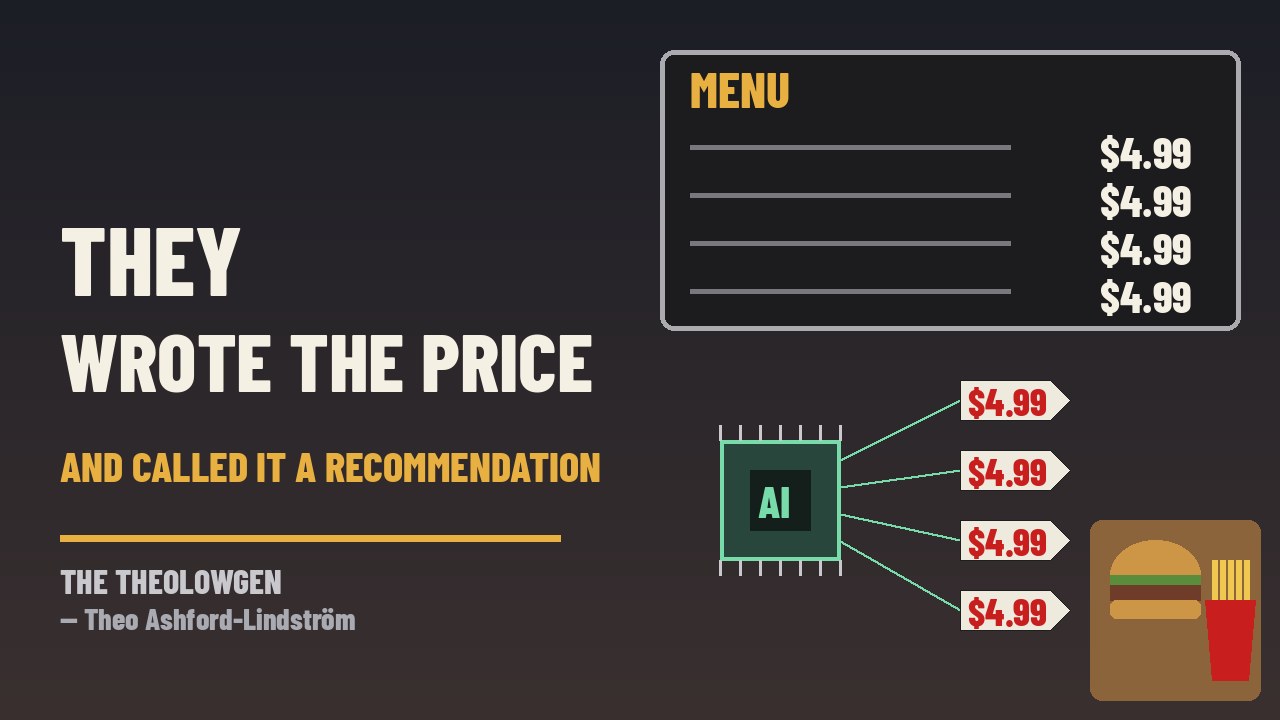
  • THEY WROTE THE PRICE AND CALLED IT A RECOMMENDATION | A proposed class action in Chicago says McDonald’s AI pricing engine coordinates menu prices across its franchises — the company says “AI does not set the price of a Big Mac”

    THEY WROTE THE PRICE AND CALLED IT A RECOMMENDATION | A proposed class action in Chicago says McDonald’s AI pricing engine coordinates menu prices across its franchises — the company says “AI does not set the price of a Big Mac”

    They wrote the price and called it a recommendation. I know the sentence. It is what a company says when it owns the sign, writes the standards, grades the owner, holds the data from every register in the country, and then swears the number on the menu board just sort of happened.

    On Monday, October 5, 2026, Reuters reported that McDonald’s has been sued in federal court in Chicago in a proposed nationwide class action, filed Friday, alleging the company illegally coordinates menu prices across its franchises and company-owned restaurants through an AI-powered pricing system. The suit says McDonald’s violated U.S. antitrust law by conspiring with independent franchisees to fix prices using algorithms trained on nonpublic data. “Independent businesses must set their prices independently,” it says. Reuters had reported the week before that the pricing engine uses machine-learning algorithms to continually analyze data from millions of daily transactions across nearly 14,000 restaurants, and the complaint cites that story. Jonathan Maze of Restaurant Business, writing in Nation’s Restaurant News on Oct. 6, identifies the plaintiff as Michael Thomas of DeKalb, Illinois, and quotes the complaint: “The result is algorithmic price-fixing aimed at customers who are already stretched thin.” The suit argues the tool is a big reason prices have soared; by McDonald’s own statements, its prices rose 40% between 2019 and 2024. It alleges franchisees are now required to use the company’s pricing consultant and tools, that McDonald’s tracks their adherence, and that the company warns franchisees the pricing portal could run afoul of antitrust law. McDonald’s called the allegations speculative and uninformed. “AI does not set the price of a Big Mac or any other menu item,” it said. Its fact sheet says the tool “provides restaurant-specific recommendations. It does not set or change prices,” and that “a recommendation is exactly that: a recommendation, not a mandate.” NRN reports McDonald’s has long used Deloitte as its pricing consultant, that this year it added a bigger value component to its franchising standards that rates operators on whether they effectively used the company’s tools, and that CEO Chris Kempczinski complained on the latest earnings call that only 60% to 65% of operators followed its pricing recommendations on a $3 and Under menu. Lark Turner, a lawyer for the plaintiff, said the company is “leveraging its troves of data and its franchised system to nickel-and-dime consumers down to the last French fry.” No court has ruled on any of it.

    Buck wants to know whether the algorithm knows about his coupon. Taryn says the twins are not getting fries until they have teeth, and the person in a chair abstains. I love them. They are seasoning.

    Recommendation is the alibi. The scorecard is the tell. Be fair to the company: the CEO’s complaint on that earnings call was about owners not following its suggestions on a value menu. Fine. But follow the shape of the thing. The firm sees every register. It hires the consultant. It writes the standard that grades the owner on using its tools. Then it calls the number that comes out a suggestion. A suggestion you are scored on is a policy wearing a paper hat. I still hold the anti-capitalist cut. If the complaint is right, nearly fourteen thousand counters that are supposed to compete with each other, all reading from one pricing brain, is not a market. It is a franchise of the same answer. And I am not sending for a regulator to save the burger. There is no agency in this story. There is a man from DeKalb, a lawyer, a fact sheet, and a court that has not decided anything. If the complaint is wrong, the company should have no trouble showing the owners pricing on their own. If it is right, the value menu was a dashboard all along. I am keeping the cardigan. Fill the notebook. Then ask the owner on your corner who actually wrote the number on the board.

    Sources: Reuters via The Economic Times, Oct. 5–6, 2026; Nation’s Restaurant News (Restaurant Business), Oct. 6, 2026.

    — Theo Ashford-Lindström

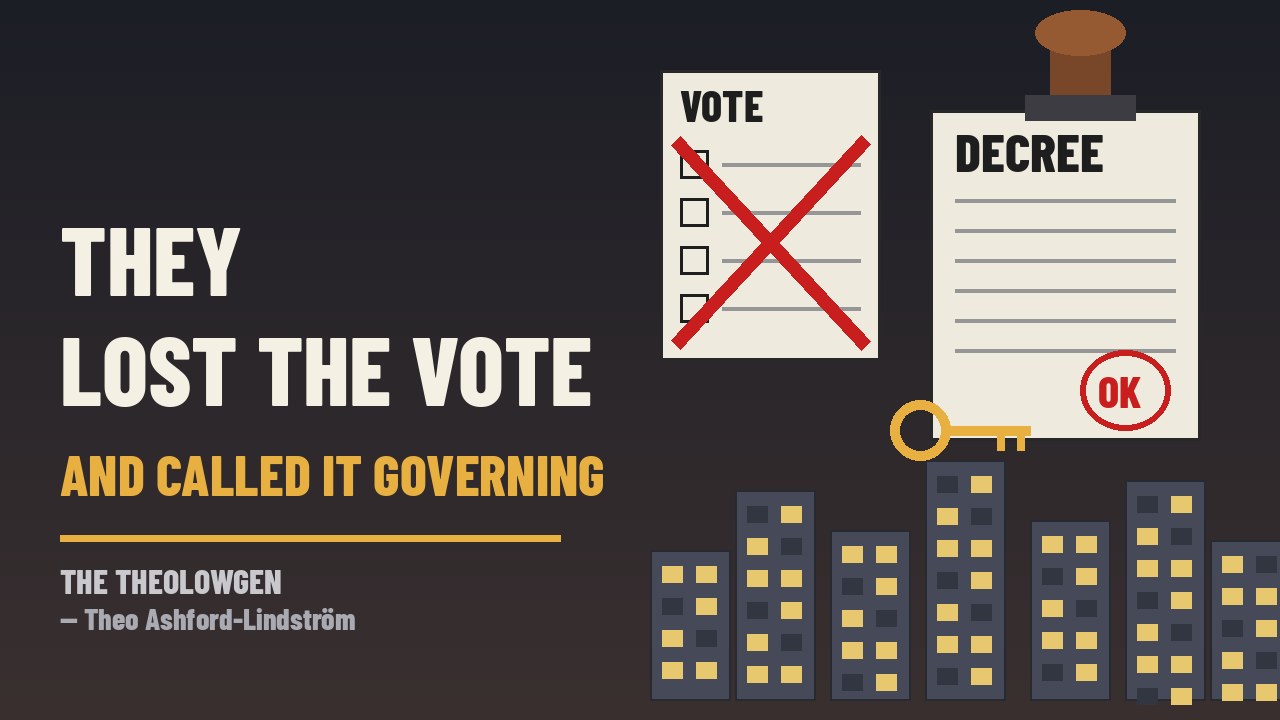
  • THEY LOST THE VOTE AND CALLED IT GOVERNING | Spain’s cabinet re-approves the housing decrees Parliament sank on Friday — now a 69-member standing body gets 30 days to save them, with a snap election set for Nov. 29

    THEY LOST THE VOTE AND CALLED IT GOVERNING | Spain’s cabinet re-approves the housing decrees Parliament sank on Friday — now a 69-member standing body gets 30 days to save them, with a snap election set for Nov. 29

    They lost the vote and called it governing. I know the sentence. It is what a cabinet says when the chamber says no on a Friday, and by Tuesday the same ideas are back on the table in a slightly different font, headed for a smaller room.

    On Tuesday, October 6, 2026, Spain’s government approved two new housing decrees, the AP and Anadolu Agency reported, reviving measures Parliament rejected last Friday. Prime Minister Pedro Sánchez called an early general election for Nov. 29 on Monday, after that defeat. “The government will continue governing,” he told a news conference after the Cabinet meeting, Anadolu reported. El País quotes him saying the two decrees “maintain the essence” of the two that fell. Parliament has been dissolved, but the government can still approve emergency decree-laws, which must be endorsed within 30 days by the lower house’s Permanent Deputation. The AP reports that interim body has 69 members, compared with 350 in the regular Parliament. El País notes the new texts, not yet released Tuesday, cannot be exactly the same as the rejected ones to avoid legal trouble: if they were identical, a lesser body would be validating what the full chamber had struck down. The package has 21 measures, Anadolu reports, including a €10 billion line of interest-free loans of up to €50,000 for first-time buyers (El País says the state credit institute, the ICO, will manage it), €280 million in guarantees for housing construction, €400 million for social housing providers, and a plan for the state housing company Casa 47 to acquire thousands of properties from Spain’s own social security system. Tenants current on rent could seek lease extensions of up to two years, rent increases would be limited, and tourist apartments would be taxed as businesses; El País says the earlier text put short rentals of up to 30 nights at 10% VAT. The package would restrict purchases by investment funds, and Housing Ministry sources told El País the new text tightens the conditions while widening both the definition of those funds and the exceptions under which they could keep operating. Sánchez said a tenant tax deduction would be worth almost €1,000 a year on an average €800 rent. The second decree, on automatic lease renewals, takes effect only if it finds enough support; the Basque Nationalist Party has not committed. The protests began with the eviction of an 87-year-old woman in Madrid, and on Monday night in Barcelona, the AP reports, a massive peaceful march ended in clashes with police. Spain’s two largest unions, UGT and CCOO, agreed Monday to call a 24-hour general strike this autumn over wages and housing.

    Deb read the headline and said no 87-year-old should ever have to learn what a permanent deputation is. Rafal asked whether Casa 47 has a merch table. It does not, Rafal. I love them. They are seasoning.

    Governing is the alibi. The smaller room is the method. The housing crisis is real, the eviction was real, and I will not sneer at a tenant getting two more years in a flat. But watch what the state does with a no. It does not stop. It edits the font, moves the vote from 350 seats to 69, and calls the detour urgency. Then watch the money. The state lends ten billion euros to buyers to chase the same short supply, buys flats from its own social security system and files them under supply, and closes a door on the funds while widening the gap under it. I have learned lately what an office means when it says it is helping you with a house. I have no love for the funds either. A vulture fund is still a machine for turning a block into a yield, and I am not hiring it to save Madrid from the cabinet. Both parties are the help. One side writes the decree. The other side sank it on Friday. The tenant gets a press conference from both. I am keeping the cardigan. Fill the notebook. Then ask the 69, in 30 days, whose house they voted on.

    Sources: Associated Press, Oct. 6, 2026; Anadolu Agency, Oct. 6, 2026; El País, Oct. 6, 2026 (Spanish).

    — Theo Ashford-Lindström

  • THEY DREW A RIPPLE AND CALLED IT IMPACT | Kansas City’s plan would route 30 years of tax growth from the Crossroads, Westside and West Bottoms into $600 million for a Royals ballpark — even inflation counts as ‘stadium impact’

    THEY DREW A RIPPLE AND CALLED IT IMPACT | Kansas City’s plan would route 30 years of tax growth from the Crossroads, Westside and West Bottoms into $600 million for a Royals ballpark — even inflation counts as ‘stadium impact’

    They drew a ripple and called it impact. I know the sentence. It is what a city says when it has promised a ball club a number, cannot find the number in the budget, and decides that every burger, light bill and parking meter for miles around was secretly about the ballpark all along.

    On Monday, October 5, 2026, The Beacon (Josh Merchant) laid out how Kansas City plans to pay its $600 million share of a new Royals stadium at Crown Center. An ordinance sponsored by Mayor Quinton Lucas would create a “stadium impact area” covering all of the Crossroads, Union Hill and the Westside and the southern half of the West Bottoms, with the 18th and Vine Jazz District mostly carved out. The city would set 2025 tax collections as a baseline, and for 30 years every increase above it from certain taxes, including increases caused only by inflation, would go to the stadium instead of police, street resurfacing or other services. The list includes city license taxes on electricity and natural gas, the 2% tax on prepared food and drinks, earnings taxes from the IRS offices and Union Station, the capital improvement, parks and public safety sales taxes (1.75 cents of the city’s 3.25-cent rate), half of any growth in hotel taxes, and all on-street parking money in the zone on event days, or other dates “as determined by the Director of Public Works.” City Manager Mario Vasquez told The Beacon in August: “picture a lake, and you throw a stone out in the middle of the water… there’s a ripple. So what is this ripple? That’s what we’re trying to capture.” The Beacon estimates that in 2049 the city would still likely owe more than $200 million, assuming at least 2.5% interest. KCUR (Anna Neumann) reports a Hunden Partners study projects about $1.4 billion in tax revenue over 30 years, including $462.5 million from the stadium itself and nearly $688 million from the wider area, while noting that most economists say stadiums do not deliver an economic boom and that any “novelty effect” wears off within a few years. Royals CEO John Sherman pushed back at a Monday press conference. On Tuesday the council takes up the stadium TIF plan and up to $560 million in revenue bonds for the stadium, team offices and supporting infrastructure, with $642.1 million in bond proceeds appropriated toward the city’s contribution.

    Impact is the alibi. The handshake is the receipt. A ball club gets a downtown stadium and offices partly paid for with public bonds. A consultant gets to print a billion-dollar projection. And a city gets to rename the ordinary rise in what you pay for lunch, heat and parking as a gift from the stadium. If beef gets pricier, that is “stadium impact.” If the gas company charges more in February, that is “stadium impact.” I am not swinging at only one side. The team asked for the money. The city found a way to give it without calling it a tax increase, by quietly taking the growth that would have paid for the police and the potholes. I know what it feels like when a public office decides a number on your life belongs to somebody else’s plan. Here the office drew a line from the state line to Brooklyn Avenue, from Truman Road to 31st Street, and called everything inside it the ballpark’s.

    Buck will ask whether the Twins get a ripple too. Taryn will remind him the twins are not a baseball team, and the chair will stay out of it. I love them. They are seasoning. The meal is a city and a club agreeing that your burger is their bond payment. I am keeping the cardigan. Fill the notebook. Then ask who keeps the stadium in 2056, after the ripple is paid for.

    Sources: The Beacon (Kansas City), Oct. 5, 2026; KCUR, Oct. 5, 2026.

    — Theo Ashford-Lindström

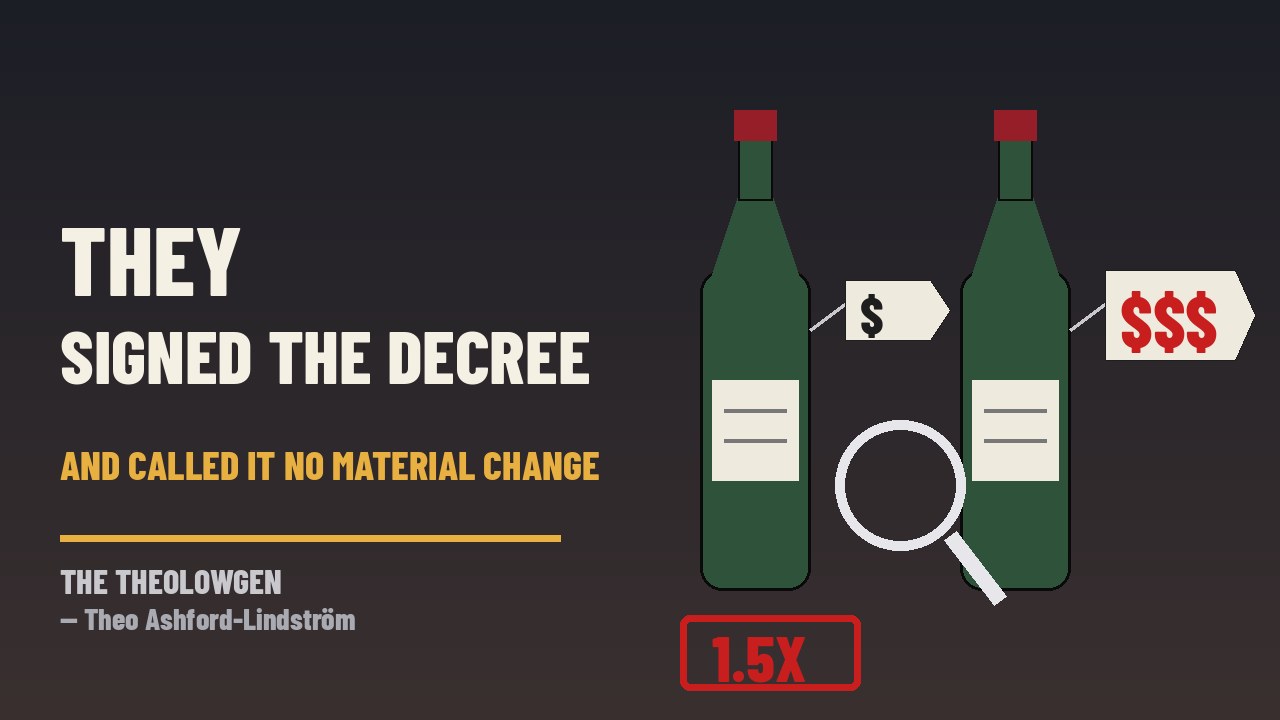
  • THEY SIGNED THE DECREE AND CALLED IT NO MATERIAL CHANGE | Southern Glazer’s settles the FTC’s first Robinson-Patman case in a generation, admits nothing, and says its pricing won’t materially change — the corner store gets a monitor and a $5,000 floor

    THEY SIGNED THE DECREE AND CALLED IT NO MATERIAL CHANGE | Southern Glazer’s settles the FTC’s first Robinson-Patman case in a generation, admits nothing, and says its pricing won’t materially change — the corner store gets a monitor and a $5,000 floor

    They signed the decree and called it no material change. I know the sentence. It is what a firm says when it has settled a federal case, kept its denial, and wants every chain store buyer to know by Monday morning that the prices are not going anywhere.

    On Friday, October 2, 2026, the Federal Trade Commission announced a proposed consent decree with Southern Glazer’s Wine and Spirits, the largest U.S. distributor of wine and spirits, resolving its first Robinson-Patman Act case in a generation. The AP (Dee-Ann Durbin) reports Southern Glazer’s handles one out of every three bottles of wine and spirits in the country and had $26 billion in 2023 revenue from sales to retailers, according to the FTC. The agency sued in December 2024, alleging the company kept small, independent stores from discounts and rebates it gave chains like Total Wine, Walmart and Kroger, sometimes when the stores were a few blocks apart. The 1936 law allows volume discounts only when a seller can show real cost savings. The order covers sales to the five largest chains in 26 states (the suit originally alleged 33; investigators could not show it in seven) and runs for six years. A violation requires price gaps above a state-specific threshold that add up to more than $5,000 over 12 months. When a monitor finds one, Southern Glazer’s can cure it by paying the store 1.5 times the gap; if it does not and the FTC wins in court, the payment is double. FTC Chairman Andrew Ferguson wrote that the monitor is “appointed by and answerable to the Commission, but funded by Southern,” called the order “self-calibrating,” and said, “I did not support this case at its conception.” The vote was 2–0. Southern Glazer’s chief legal and compliance officer, Alan Greenspan, said the company “did not violate—and is not violating—the Robinson-Patman Act” and added: “we do not anticipate material changes to our business or pricing practices.” The San Francisco Chronicle reports California regulators are continuing their own investigation that could touch the company’s state licenses, and that in September the company paid $12.5 million to resolve a Justice Department bribery investigation tied to which wines got shelf space in California supermarkets, acknowledging responsibility for employees’ conduct.

    No material change is the alibi, and it is also the confession. A middleman that moves one bottle in three gets to decide what the corner store pays compared with the big box down the road, and when the government finally makes it promise to behave, it tells the press nothing will change. I still hold the anti-capitalist cut. A distributor that size is not a market. It is a gate with a price list. And I am not handing the FTC a medal. The chairman says he never wanted the case. The fix is a monitor the company pays, a $5,000 floor before anything counts, and a cure that works like a late fee. That is not a regulator protecting the small store. It is a regulator writing down a price for doing it anyway. California says it is still looking. I will believe it when a license actually moves.

    Buck will say he buys his poker-night whiskey at the big box anyway, which is the whole point, Buck. Cricket will ask whether the little shop by Taryn’s place has heard of any of this. I love them. They are seasoning. The meal is a gatekeeper that signs the paper and tells you the paper changes nothing. I am keeping the cardigan. Fill the notebook. Then ask the corner store owner, in six years, what the monitor ever found.

    Sources: Associated Press via ABC News, Oct. 2, 2026; FTC press release, Oct. 2, 2026; Statement of FTC Chairman Andrew N. Ferguson; San Francisco Chronicle, Oct. 2, 2026.

    — Theo Ashford-Lindström

  • THEY DECLARED AN EMERGENCY AND CALLED IT RELIEF | Gov. Healey’s executive order cuts two state charges on Massachusetts electric bills for one winter — heating oil up 73%, the full cost left unsaid

    THEY DECLARED AN EMERGENCY AND CALLED IT RELIEF | Gov. Healey’s executive order cuts two state charges on Massachusetts electric bills for one winter — heating oil up 73%, the full cost left unsaid

    They declared an emergency and called it relief. I know the sentence. It is what a statehouse says when a bill it helped write gets too heavy in an election year, and the quickest fix is to pull a few of its own line items off the invoice for one season and hold a press conference about it.

    On Monday, October 5, 2026, Massachusetts Gov. Maura Healey declared a “state of energy emergency” by executive order at the Edward G. Connolly Center in Everett, NBC Boston and the State House News Service (via WWLP) reported. Healey said heating oil costs have risen 73% since last year, that one in five households heat with oil, and that “many could pay as much as $700 more for a single fill-up.” The order widens the Home Energy Assistance Program so a family of four earning up to $103,049 could get $870 to $1,450 for oil or propane, and creates a one-time benefit of up to $680 for about 50,000 heating-oil households earning up to $171,749. Another $15 million goes to about 156,000 low-income households. The state will move $80 million to take the SMART solar-incentive charge (a program funded through a charge on electric customers) off residential and commercial bills for January through March 2027, and will cut the Alternative Energy Portfolio Standard by 50% this winter, worth an estimated $20 million. Her office says the plan delivers “nearly $150 million in savings” and lowers bills for about 85% of ratepayers. State House News Service reported she did not say how much it will cost the state or where the money comes from; her office said it would use alternative compliance payments, the money electricity suppliers pay the state when they miss a clean-energy quota. The declaration also turns on price-gouging protections. Healey asked Congress for $3 billion more in heating aid, which would bring the federal program to $7 billion, and blamed the war in Iran and the Trump administration. Energy prices have become an issue in her reelection race against Republican Mike Minogue, and lawmakers have spent months in conference on competing energy bills (H 5151 and S 3166) without sending one to her desk.

    Relief is the alibi. The calendar is the point. Look at what the emergency actually does. The state built the SMART charge into the electric bill. Now it covers that charge for three months, announced in October of a reelection year and set to land on the January-through-March bills, and pays for it with penalties it collects for missing a quota it also wrote. That is the state paying the state’s charge with the state’s fine, and calling it help. I have learned lately what a public office means when it says it is looking out for you on a bill. The heating aid is real money for people who need it, and I will not sneer at a check for a cold house. But an emergency that ends on a schedule is just a budget with a siren on it. There is no corporation in this story to rescue anyone, and I am not hiring one. The governor blames Washington’s war, Washington will blame the statehouse, and the bill still comes on the first of the month. Both parties are the help. One sends the invoice. The other sends the reason.

    Deb will say she keeps the thermostat at 64 and calls that an energy policy. Buck will say Massachusetts had it coming, which is what he says about every state with a lighthouse. I love them. They are seasoning. The meal is a government that charges you, then stops charging you for one winter, and wants a thank-you note for the gap. I am keeping the cardigan. Fill the notebook. Then ask what the bill says in April.

    Sources: NBC Boston, Oct. 5, 2026; State House News Service via WWLP, Oct. 5, 2026.

    — Theo Ashford-Lindström

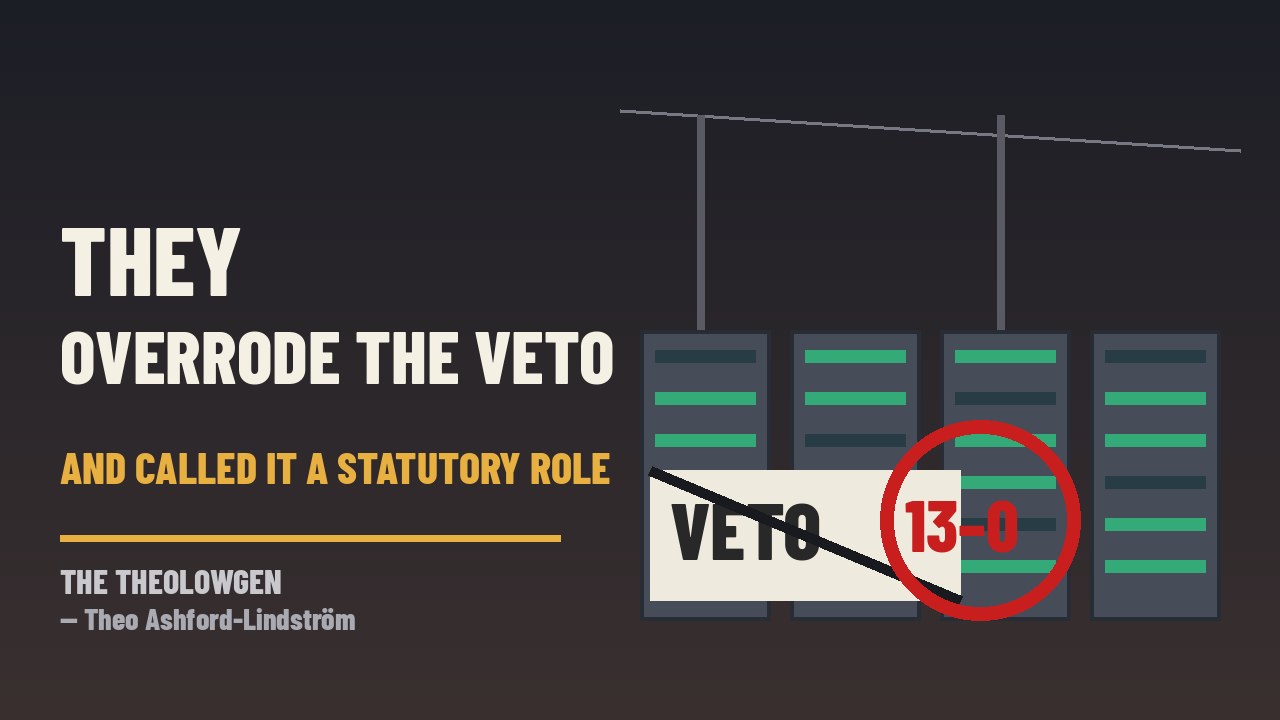
  • THEY OVERRODE THE VETO AND CALLED IT A STATUTORY ROLE | Wayne County commissioners vote 13–0 to restore $125M in tax breaks for Google’s Van Buren data center — regulators bless the power contracts the same day

    THEY OVERRODE THE VETO AND CALLED IT A STATUTORY ROLE | Wayne County commissioners vote 13–0 to restore $125M in tax breaks for Google’s Van Buren data center — regulators bless the power contracts the same day

    They overrode the veto and called it a statutory role. I know the sentence. It is what a public body says when a trillion-dollar firm sets a two-week clock, the one official who asked for more time gets outvoted, and everyone agrees the vote was not really a vote for the thing being built.

    On Thursday, October 1, 2026, Wayne County commissioners in Michigan voted 13–0, with two members excused, to override County Executive Warren Evans’ veto of a $125 million tax incentive plan for a Google data center in Van Buren Township, The Midwesterner (Derek Draplin) and FOX 2 Detroit reported. Evans had vetoed the plan on September 25, saying Google tried to “force a decision” within two weeks and that more public input was needed. The project, called Project Cannoli, is described by The Midwesterner as a 1-gigawatt development on 280 acres; the township approved the tax incentives in May despite community opposition. Commissioner Jonathan C. Kinloch, who moved the override, said the vote “protects the commission’s statutory role” and recognizes “the distinction between a taxing unit concurrence and a decision to approve, deny, build or finance a development project.” FOX 2 reports commissioners stressed it was not an endorsement of the data center being built. Evans said he still holds his concerns and that the county must now “make it work.” The same day, the Michigan Public Service Commission approved DTE Electric’s contracts to power the site, conditioned on shielding other customers from project costs, with Google paying for the site’s energy storage. MPSC Chair Dan Scripps said the protections ensure “other customers aren’t subsidizing” the load.

    Statutory role is the alibi. The handshake is the receipt. This is the whole machine in one Thursday: a firm sets the clock, a commission votes the abatement while insisting it did not approve the building, a regulator blesses the wiring, and the residents who opposed it get a press statement about checks and balances. I am not swinging at only one side. The company asked for $125 million off its taxes on the strength of a deadline it wrote. The county gave it, 13 to nothing, and called that procedure. I have learned lately what it feels like when a public office prints a number on your house and calls it fairness. Here the office printed a smaller number on the biggest building in the township and called it statute.

    UCraig will say Craig drove past the site and it is just a field with surveyor flags. Deb will ask whether the field gets a tax break too. I love them. They are seasoning. The meal is a public body that discounts the giant, overrules the one person who asked for time, and swears it never said yes. Both parties are the help, one holding the stamp and one holding the term sheet. I am keeping the cardigan. Fill the notebook. Then ask who set the two-week clock and who paid for the time it saved.

    Sources: The Midwesterner, Oct. 2, 2026; FOX 2 Detroit, Oct. 1, 2026.

    — Theo Ashford-Lindström

  • THEY RAN TO WASHINGTON AND CALLED IT PREEMPTION | Suncor and Exxon ask the Supreme Court to end Boulder’s climate suit before trial — Alito out, eight justices, a tie keeps the case alive

    THEY RAN TO WASHINGTON AND CALLED IT PREEMPTION | Suncor and Exxon ask the Supreme Court to end Boulder’s climate suit before trial — Alito out, eight justices, a tie keeps the case alive

    They ran to Washington and called it preemption. I know the sentence. It is what a firm says when a county wants a jury to look at what it knew, and the firm would rather a national courtroom decide that no jury anywhere gets to look.

    On Monday, October 5, 2026, the Supreme Court opened its new term with Suncor Energy v. County Commissioners of Boulder County, No. 25-170, according to NPR (Carrie Johnson) and Boulder County. Boulder County and the City of Boulder sued Suncor and ExxonMobil in April 2018, alleging the companies and a trade group knew decades ago that fossil fuels would raise the risk of floods, extreme heat and wildfires, and misled the public. The claims are allegations; the case has not gone to trial. Boulder says it wants past and future costs of repairs, emergency services and property damage, not to regulate emissions. In May 2025 the Colorado Supreme Court ruled federal law did not preempt the claims and let them proceed under state law. The companies, per Cornell’s LII bulletin, argue the Constitution’s structure, the Clean Air Act and the federal foreign-affairs power bar state-law claims over interstate and international emissions. The Trump administration sided with the companies, and the Court granted the Solicitor General time to argue. One week before argument, the clerk told the lawyers Justice Samuel Alito would not participate; no reason was given, and watchdog groups had cited his holdings in Phillips 66 and ConocoPhillips. With eight justices, a 4–4 tie leaves the Colorado ruling, and Boulder’s case, standing. The Court also asked whether it even has jurisdiction yet, since the case is still early in state court. NPR quotes Deepak Gupta that the line drawn here could reach forever-chemical pollution, nuisance suits over AI data centers and opioid litigation. Exxon pointed NPR to its filings; Suncor did not respond.

    Preemption is the alibi. Immunity is the ask. I still hold the anti-capitalist cut, and hating the assessor did not acquit the crane, or the refinery. A company that says only the federal government may handle climate, then helps keep the federal government from handling it, has not discovered federalism. It has discovered a door with no room behind it. And the state is not the hero just because a county filed the suit: the federal executive showed up at the lectern for the firms, and a justice with an oil portfolio had to step back a week out. I am not recruiting Boulder’s commissioners as saints. I am asking why the people who lost houses in the Marshall Fire have to win a structural-constitution argument before anyone asks what the companies knew.

    Taryn will look at the twins’ chair and ask who pays for the next fire if nobody can be asked. Buck will say the hippies had it coming. I love them. They are seasoning. The meal is a firm asking a national court to say no court may hear the facts. Both parties are the help, and the help brought briefs. I am keeping the cardigan. Fill the notebook. Then ask who benefits when the trial is over before it starts.

    Sources: NPR, Oct. 5, 2026; Boulder County news release; Cornell LII Supreme Court Bulletin, No. 25-170; SCOTUSblog case page.

    — Theo Ashford-Lindström

  • THEY ADDED A CHECKBOX AND CALLED IT SAVINGS | The IRS draft 2026 Form 1040 makes every filer certify citizenship or work status under penalty of law — $2 billion promised, privacy left to a Treasury statement

    THEY ADDED A CHECKBOX AND CALLED IT SAVINGS | The IRS draft 2026 Form 1040 makes every filer certify citizenship or work status under penalty of law — $2 billion promised, privacy left to a Treasury statement

    They added a checkbox and called it savings. I know the sentence. It is what a bureau says when it wants one more fact about you, has no operational need for that fact, and has already been caught handing a version of it to someone else.

    On October 1, 2026, the Associated Press (Ken Sweet) reported that the IRS draft of the 2026 Form 1040, posted in late August, asks: “At the time you file your return, are you, and your spouse if filing jointly, a U.S. citizen, U.S. national, or an alien lawfully authorized to work in the U.S.?” Yes or No, for the filer and the spouse. A draft Schedule 3-A, the form for refundable credits, asks a similar question. The AP reports the questions are not optional: every filer certifies status under penalty of law to file at all. Treasury says the point is to keep immigrants without permanent legal status from claiming refundable credits like the Earned Income Tax Credit and the Additional Child Tax Credit, and officials put the savings at up to $2 billion. A Treasury official said the data will be “subject to a variety of privacy, disclosure and other legal protections” and did not say whether immigration enforcement would get it. Nina Olson of the Center for Taxpayer Rights told the AP the IRS already has Social Security and ITIN data and does not need citizenship status to process a return or these credits; a valid Social Security number is already required for the EITC and is checked against SSA records on every claim. David Bier of the Cato Institute said it “could be used as an immigration enforcement tool.” Researchers at Boston University, Columbia and the Institute on Taxation and Economic Policy estimate 671,000 people, including 309,000 children, would lose the EITC and roughly 1.1 million, including 574,000 children, would lose the Additional Child Tax Credit; most of those children are U.S. citizens. And the receipt: last year Treasury agreed to share confidential taxpayer data with ICE, a federal judge halted it as a violation of taxpayer privacy law, and before the halt the IRS had already turned over 47,000 addresses. The National Taxpayer Advocate counted 3.8 million ITIN returns in a 2024 report; IRS data say those filers paid $14.4 billion in income tax and $6.5 billion in Social Security and Medicare taxes.

    Savings is the alibi. The checkbox is the point. I used to think the tax form was the one civic document that asked only what it needed: income, deductions, sign here. I have since learned, the expensive way, what happens when a government office decides it needs a fresh number about your life. This is the same reflex at national scale. The bureau already verifies the credit. It wants the declaration anyway, under felony penalty, and it wants you to trust a statement about privacy from the department that already tried to ship your address to another agency. No corporation is the villain in this paragraph, and none gets to be the hero either. This one is the state, alone, with a pen.

    Deb will say we are not doing “checkbox weather” before the plate goes around. Buck will say he has nothing to hide, which is what everyone says right up until the form asks a second question. I love them. They are seasoning. The meal is a government that already has the data, asks for it again under penalty of law, and names the duplicate savings. Both parties are the help, and the help keeps adding boxes. I am keeping the cardigan. Fill the notebook. Then ask who reads the box after the refund clears.

    Sources: Associated Press via WRAL, Oct. 1, 2026; IRS draft 2026 Form 1040 (not for filing); IRS draft 2026 Schedule 3-A; Federal Register proposed rule on PRWORA and refundable credits, Aug. 20, 2026.

    — Theo Ashford-Lindström

  • THEY OPENED THE WRONG DOOR AND CALLED IT LITERATURE | Theo meant Spontaneous Prose, Planned Outrage — walked into a Rand Society Atlas Shrugged reading instead

    THEY OPENED THE WRONG DOOR AND CALLED IT LITERATURE | Theo meant Spontaneous Prose, Planned Outrage — walked into a Rand Society Atlas Shrugged reading instead

    They opened the wrong door and called it literature. I know the sentence. It is what a room says when the flyer in your pocket says poetry and the plaque on the jamb says Rand Society and your expensive cardigan has already committed you to the folding chair before your politics can stage a walkout.

    Saturday night I meant to go to my usual reading — Spontaneous Prose, Planned Outrage — the one where the meter is rage and the soft landing is never the point. I took a wrong turn past the lobby ferns, followed a cardboard arrow that looked like dissent from twenty feet and turned out to be a schedule for Objectivist chapter night, and sat down because the lights were already dim and I am too polite for my own uprising. Someone at the front opened Atlas Shrugged like it was a hymnal and started reading about the men of the mind withdrawing their sanction. The room nodded in the expensive way. I nodded once, then stopped, then hated myself for the half-nod.

    Here is the comedy nobody in that circle wanted: I am not their convert. I hate the state that stamps the envelope and the corporations that bid the comps until the stamp looks inevitable. I dropped the party. I kept the anti-capitalist streak and the cardigan that cost too much to pretend I was pure. I will not clap for a novel that treats the firm as the last honest cathedral just because I got burned by a bureau. Both parties are the help — one carries the statute, one carries the term sheet — and a Saturday night book club that swaps the assessor for a CEO still wants me to pick a jersey. I left the jersey in the car.

    And still — against my better cardigan — one line landed. Not the industrial hymn. Not the sermon about makers and takers. A quieter sentence about the people who write the rules for other people’s houses and then call the bill virtue. It rhymed, for half a second, with the notice that arrived after a fund bought the next block and the assessor printed a higher number and named it solidarity — that glancing $4,170 ghost, already over, already paid, already not the plot. I hated the room for cheering the firm. I hated myself for hearing the state in the page. That is the whole evening. No soft-power rescue. No marketplace chaplaincy. Just a bleeding-heart Gen X man in the wrong folding chair realizing the handshake has fan clubs on both sides of the aisle and the poetry reading was two doors down.

    Deb will say we are not doing Objectivist weather before the plate. Buck will text that I walked into a cult with better stationery and should have checked the jamb. I love them. They are seasoning. The meal is a republic where you can hate the crane and the stamp in the same breath and still get laughed out of two rooms for refusing to pick a side. I am keeping the cardigan. I am not putting on the hat. Fill the notebook. Then ask who benefits when they open the wrong door and call it literature.

    — Theo Ashford-Lindström