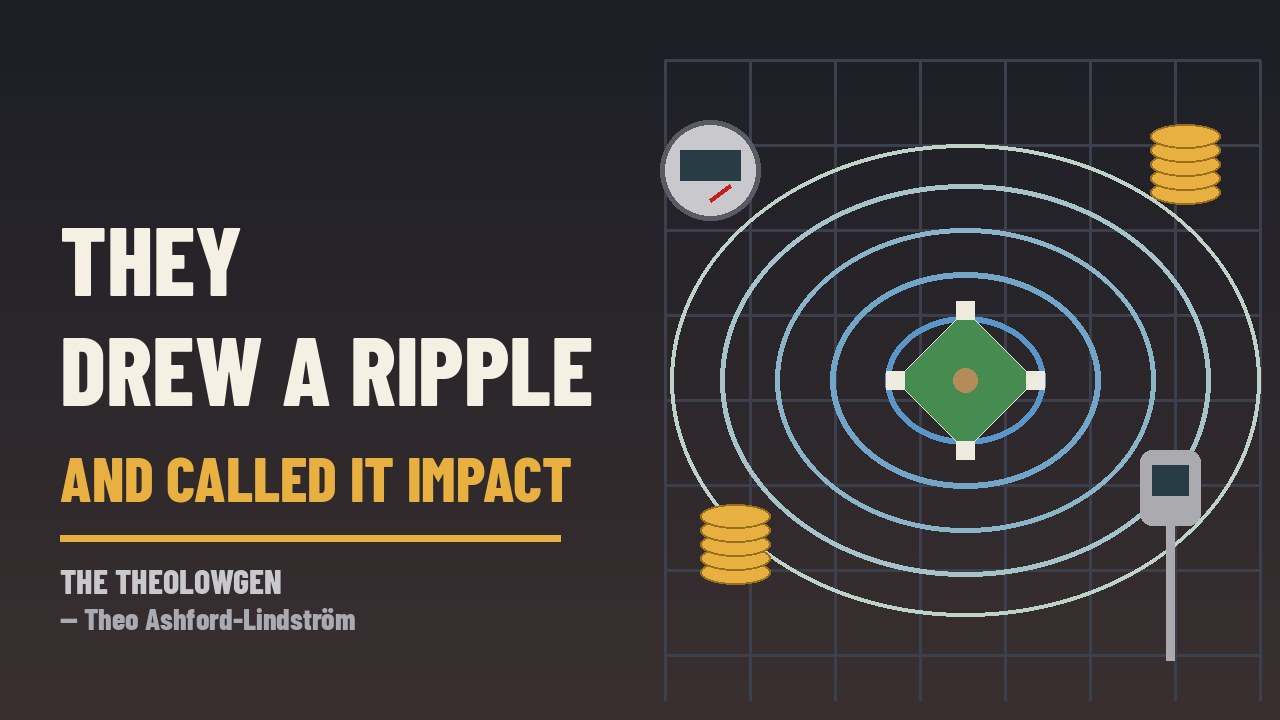
They drew a ripple and called it impact. I know the sentence. It is what a city says when it has promised a ball club a number, cannot find the number in the budget, and decides that every burger, light bill and parking meter for miles around was secretly about the ballpark all along.
On Monday, October 5, 2026, The Beacon (Josh Merchant) laid out how Kansas City plans to pay its $600 million share of a new Royals stadium at Crown Center. An ordinance sponsored by Mayor Quinton Lucas would create a “stadium impact area” covering all of the Crossroads, Union Hill and the Westside and the southern half of the West Bottoms, with the 18th and Vine Jazz District mostly carved out. The city would set 2025 tax collections as a baseline, and for 30 years every increase above it from certain taxes, including increases caused only by inflation, would go to the stadium instead of police, street resurfacing or other services. The list includes city license taxes on electricity and natural gas, the 2% tax on prepared food and drinks, earnings taxes from the IRS offices and Union Station, the capital improvement, parks and public safety sales taxes (1.75 cents of the city’s 3.25-cent rate), half of any growth in hotel taxes, and all on-street parking money in the zone on event days, or other dates “as determined by the Director of Public Works.” City Manager Mario Vasquez told The Beacon in August: “picture a lake, and you throw a stone out in the middle of the water… there’s a ripple. So what is this ripple? That’s what we’re trying to capture.” The Beacon estimates that in 2049 the city would still likely owe more than $200 million, assuming at least 2.5% interest. KCUR (Anna Neumann) reports a Hunden Partners study projects about $1.4 billion in tax revenue over 30 years, including $462.5 million from the stadium itself and nearly $688 million from the wider area, while noting that most economists say stadiums do not deliver an economic boom and that any “novelty effect” wears off within a few years. Royals CEO John Sherman pushed back at a Monday press conference. On Tuesday the council takes up the stadium TIF plan and up to $560 million in revenue bonds for the stadium, team offices and supporting infrastructure, with $642.1 million in bond proceeds appropriated toward the city’s contribution.
Impact is the alibi. The handshake is the receipt. A ball club gets a downtown stadium and offices partly paid for with public bonds. A consultant gets to print a billion-dollar projection. And a city gets to rename the ordinary rise in what you pay for lunch, heat and parking as a gift from the stadium. If beef gets pricier, that is “stadium impact.” If the gas company charges more in February, that is “stadium impact.” I am not swinging at only one side. The team asked for the money. The city found a way to give it without calling it a tax increase, by quietly taking the growth that would have paid for the police and the potholes. I know what it feels like when a public office decides a number on your life belongs to somebody else’s plan. Here the office drew a line from the state line to Brooklyn Avenue, from Truman Road to 31st Street, and called everything inside it the ballpark’s.
Buck will ask whether the Twins get a ripple too. Taryn will remind him the twins are not a baseball team, and the chair will stay out of it. I love them. They are seasoning. The meal is a city and a club agreeing that your burger is their bond payment. I am keeping the cardigan. Fill the notebook. Then ask who keeps the stadium in 2056, after the ripple is paid for.
Sources: The Beacon (Kansas City), Oct. 5, 2026; KCUR, Oct. 5, 2026.
— Theo Ashford-Lindström

Leave a Reply