
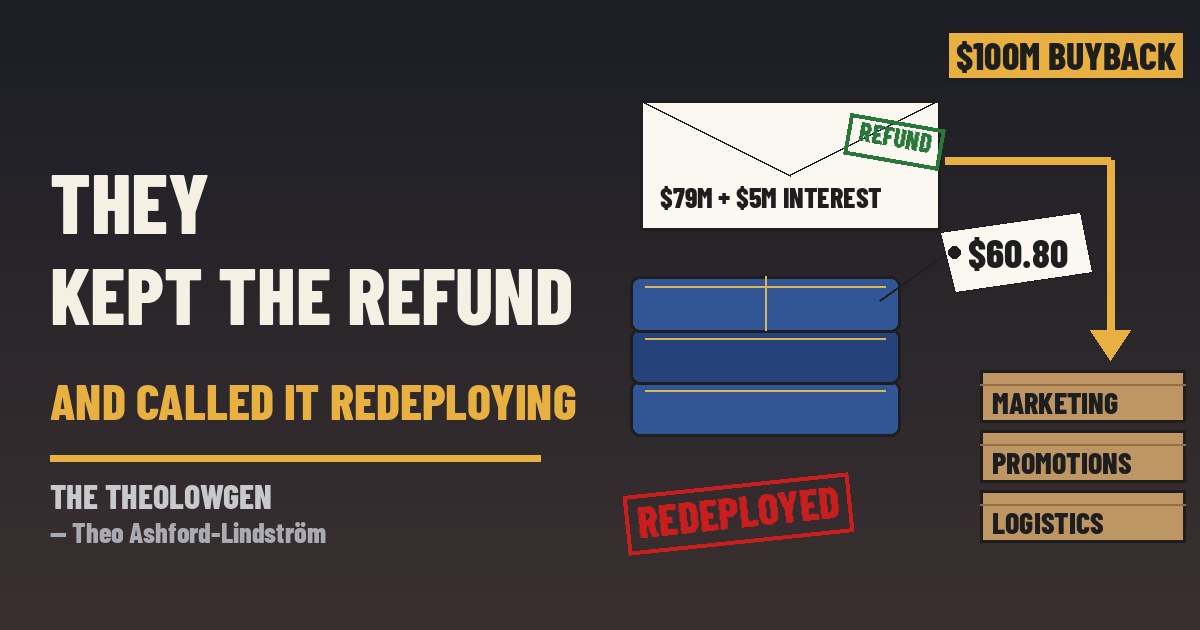
They kept the tariff refund and called it redeploying. I know the sentence. It is what a company says when it charged you for a tax, the tax turned out to be illegal, the government mailed the money back to the company, and the company needs a verb for keeping it that sounds like a truck leaving a warehouse.
Here is the record, and the lawsuit part of it is an allegation, so I will treat it like one. On Oct. 20, 2026, Deborah Brucker of Santa Ana — a Levi’s customer for more than forty years, per her complaint — filed a proposed nationwide class action against Levi Strauss & Co. in federal court in San Francisco, case 3:26-cv-12214, and Hoodline reported it Oct. 22. The background is not in dispute: in February the Supreme Court ruled 6-3 that the International Emergency Economic Powers Act did not authorize the sweeping tariffs, and the government began refunding them, with interest, to the companies that paid them directly — not to the shoppers who absorbed them at the register. The complaint says that on April 7, 2025, The Wall Street Journal reported CEO Michelle Gass saying the company would be “surgical” with price hikes; that executives then told investors Levi was taking “targeted pricing action” to “offset the impact of tariffs”; that by early 2026 the Ribcage Straight Ankle women’s jeans were up $10 to $108 and the original-fit men’s jeans up $5 to $84.50; and that “Levi made no announcement of the increases to consumers.” Brucker says she paid $60.80 for a pair of 501s on or about Oct. 11, 2025. On a July 8, 2026, earnings call, the complaint quotes management on the roughly $80 million refund: “It’s substantial. We haven’t figured out what to do with it, because that’ll depend on the environment and a whole bunch of things.” Then they figured it out. Levi’s own Oct. 7 earnings release reports $79 million in refunds booked against cost of goods and $5 million in interest, says the refunds contributed 490 basis points of gross-margin expansion, and quotes CFO Harmit Singh: “We made the decision to redeploy a majority of our tariff refund benefit back into the business during Q3 and Q4 to support future growth.” About $60 million for the year — $25 million in the third quarter, “including additional promotion and marketing expenditures,” and about $35 million in the fourth. Supply Chain Dive reports a third of that goes to distribution and logistics, the rest split between marketing and promotions. The same release raised full-year profit guidance and announced a plan for a $100 million accelerated share repurchase. The complaint notes that FedEx and UPS, which acted as importers of record, have begun passing their tariff refunds through to the customers who paid the duties. It asks for restitution and a constructive trust over the refunds, and Hoodline reports it also seeks unspecified punitive damages.
Now the defense. Levi’s declined to comment on the filing, Hoodline reports, citing the San Francisco Chronicle. Its public position is the earnings release and the call: Singh told analysts, per Supply Chain Dive, “We believe this balanced approach strengthens our competitive position, supports near-term growth and keeps us on track to deliver our annual algorithm of mid-single-digit revenue growth with a clear path to 15% operating margins over time.” And the law is genuinely unsettled. No court has ruled that a company must share a tariff refund with its customers or roll back prices, Hoodline notes; the refund program pays importers, not shoppers; and nothing in the complaint has been proven. Levi’s will get to argue that a price is a price, set by a market, and that nobody bought a pair of jeans with a tariff line on the receipt.
Deb has owned the same pair of jeans since the Carter administration and says she paid for them once, at a store that no longer exists. Buck wants to know if the refund covers the knee. I love them. They are seasoning.
“Redeploying” is the alibi. The $60.80 is the story. Sit with it until it confesses. The tariff was the state’s crime; I have opened enough envelopes from a government this year to know what it feels like to pay a number somebody else picked. But hating the tariff does not acquit the price tag. A company stood up in front of investors, said the price increases were there to offset the tariff, collected them from the people who wear the product, and then, when the tariff came back with interest, discovered that the money had always really been a growth initiative. That is not a supply chain. That is a toll booth that keeps the coins after the road is declared illegal. And do not tell me Washington will fix it. Washington wrote the tariff, lost in court, and mailed the refund to the importer of record, which is the state’s way of saying it has never met you. The anti-capitalist in me does not need the suit to win to see the shape of it; a court can decide whether it is unjust enrichment. I can decide what it looks like. It looks like the same dollar getting paid twice and thanked once. The cardigan stays. Fill the notebook. Then ask, out loud, how many other price tags in your closet are still wearing a tax that no longer exists.
Sources:
- Brucker v. Levi Strauss & Co., Class Action Complaint, U.S. District Court, N.D. Cal., Case 3:26-cv-12214, filed Oct. 20, 2026 (via Cotchett, Pitre & McCarthy)
- Hoodline, Eileen Vargas, “Levi’s Sued Over $79 Million in Tariff Refunds It Never Gave Back to Shoppers,” Oct. 22, 2026
- Levi Strauss & Co., “Levi Strauss & Co. Reports Third-Quarter Results,” Oct. 7, 2026
- Supply Chain Dive, Antone Gonsalves, “Levi’s to use part of $80M tariff refund for supply chain,” Oct. 12, 2026
— Theo Ashford-Lindström

Leave a Reply