
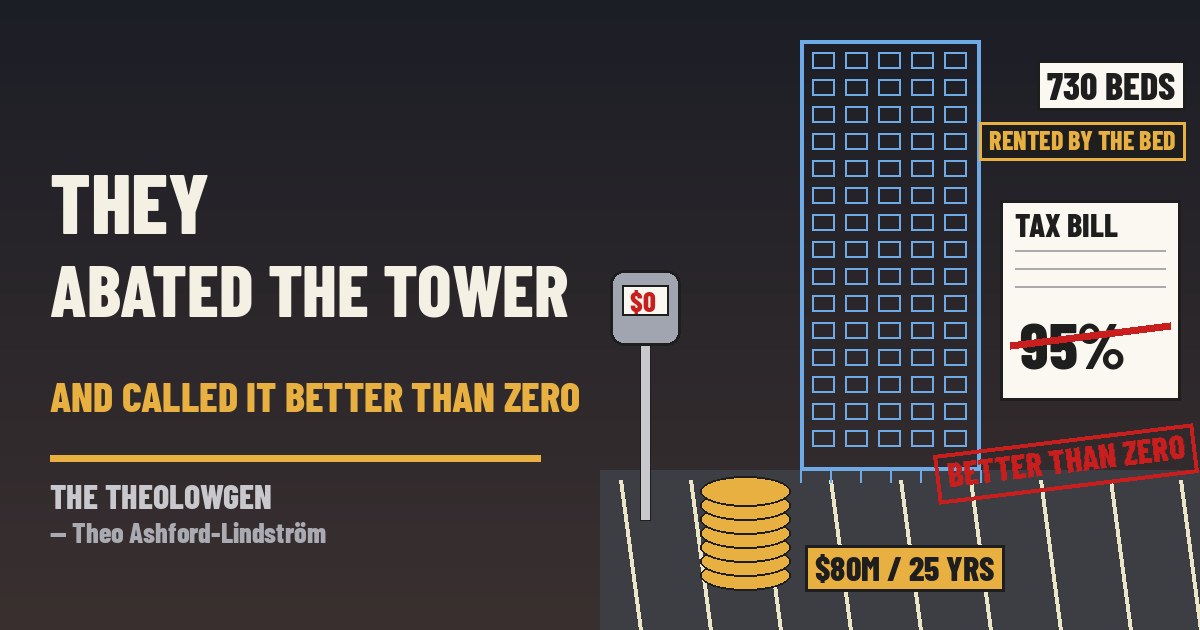
They abated the tower and called it better than zero. I know the sentence. It is what a city says when it has decided to forgive most of a building’s taxes for a quarter-century and wants you to compare the deal not to what the building would owe, but to the parking lot it replaces, because next to a parking lot everything is a bargain.
Here is the record. On Wednesday, Oct. 21, 2026, Baltimore’s Board of Estimates — the mayor-controlled spending board, five members — voted unanimously for a payment in lieu of taxes that The Banner reports will abate $80 million over the next 25 years for the University of Maryland, Baltimore’s North Quad, the first piece of a planned “college town.” The development is led by Wexford Science & Technology: a $160 million, 15-story building in the 600 block of West Lexington Street with 404 units and 730 beds for graduate students, rented by the bed, plus about 16,000 square feet of retail. It is the first award under Downtown RISE, a new PILOT program the Baltimore Development Corporation says was authorized by the General Assembly and signed by Gov. Wes Moore; the law took effect in April 2026 for ten years, and it lets a project replace city property tax with a negotiated annual payment if the developer can “demonstrate financial necessity.” The Banner says the program can erase up to 95 percent of property taxes for 25 years in exchange for an annual fee that’s substantially less; the Capital Gazette puts it as up to 95 percent of the taxes on the property’s increased value. It is the same program the city is using to negotiate a PILOT for the towers proposed to replace the Harborplace pavilions. A South Quad may come later and may ask for its own. The plan around it includes a gathering space that could feature a pub and an outdoor entertainment venue, and courts for pickleball or tennis. The Capital Gazette notes the deal contains no labor agreements for workers.
Now the defense. The site is a parking lot that pays no property tax, said Jeremy Watson, a senior vice president at the development corporation. “Without this deal,” he said, “the building doesn’t get built and the city keeps collecting what it gets today, which is zero.” Then he quoted Kevin O’Leary of “Shark Tank” — “My money is my military. I send it out, every dollar, to capture and bring back more soldiers” — and said the abatement brings back “2.43 soldiers” for each one. Council President Zeke Cohen said the show’s investors would be disappointed if the board were not “pushing and scrutinizing.” The meeting started late because Comptroller Bill Henry and university officials were hammering out an assurance that UMB — a nonprofit that does not pay property taxes on most of its land — would keep these parcels on the tax rolls when the PILOT ends. President Bruce Jarrell committed to it, speaking of a vision from Lexington Market down Eutaw Street “right to the Eutaw gate of the Orioles.” Henry said he would like that in writing. Joan Jacobson of With Us For Us, a coalition of advocacy groups and unions, said the discount was too steep and too long: “labor agreements and a small, brief tax discount would better benefit the city.”
Deb wants to know if she can rent Buck’s old room by the bed. Buck says the room has one bed and it is his. I love them. They are seasoning.
“Zero” is the alibi. The 95 is the story. Sit with it until it confesses. Every abatement in America is sold against the empty lot, and the empty lot always loses, because it cannot speak at the hearing. But the honest comparison is not the lot. It is every other building on that street paying full freight to the same city — and I say that as a man who has opened his own envelope and knows exactly what full freight feels like — while this one gets to call its discount a favor. Look at the shape of the handshake. A state legislature writes the program. A governor signs it. A city development corporation runs the math. A board that the mayor controls votes it through. A university that belongs to the state system and pays no tax on most of its land partners with a private developer to build a tower that rents students by the bed. The public is on every side of the table and still somehow ends up as the party that gives. And when somebody asks for labor agreements, the room quotes a reality show about rich people buying slices of small businesses. Both parties are the help. One signs the bill in Annapolis. One holds the term sheet on Lexington Street. The comptroller holds a promise he wants in writing. The cardigan stays. Fill the notebook. Then ask, out loud, who in Baltimore gets to pay five cents on the dollar for 25 years, and why it is never the rowhouse.
Sources:
- The Baltimore Banner, Emily Opilo, “Baltimore approves 25-year tax savings for UMB ‘college town’ project,” Oct. 21, 2026
- Capital Gazette / Baltimore Sun, Chevall Pryce and Jessica Baugh, “Baltimore approves 25-year tax break for $160M development despite concerns,” Oct. 21, 2026
- Baltimore Development Corporation, “Downtown RISE PILOT” program page
— Theo Ashford-Lindström

Leave a Reply