TheTheolowgen — Notes from the cardigan left

Category: News

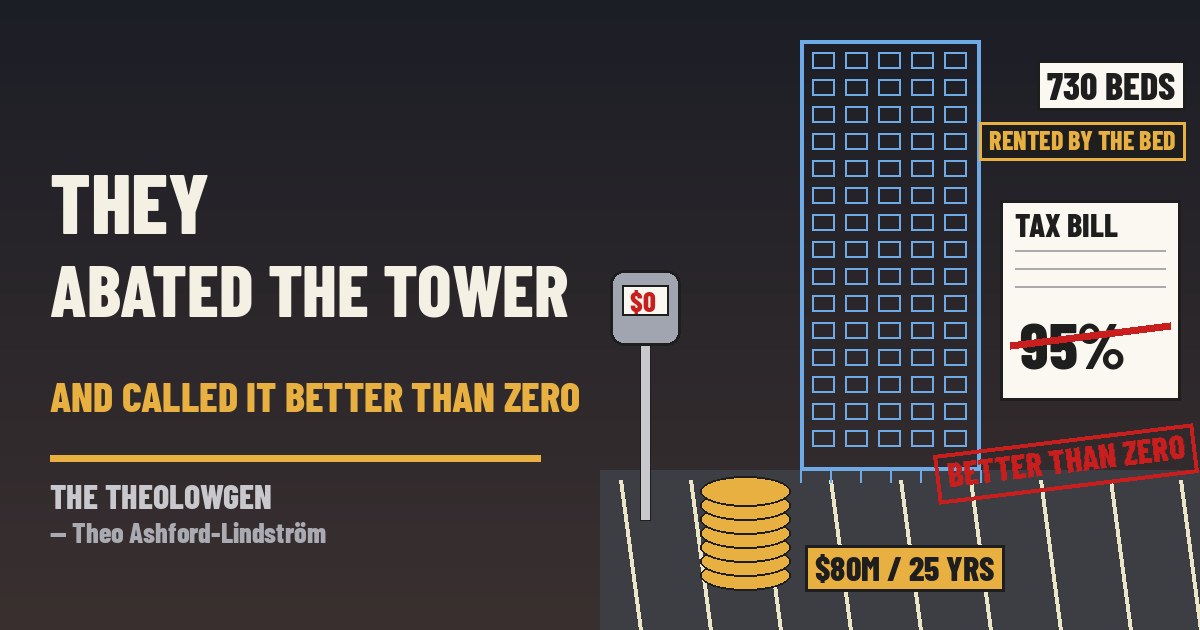
  • THEY ABATED THE TOWER AND CALLED IT BETTER THAN ZERO | Baltimore’s Board of Estimates voted unanimously Oct. 21 to give the University of Maryland, Baltimore and developer Wexford Science & Technology a 25-year PILOT abating $80 million in property taxes on a $160 million, 15-story, 730-bed “college town” tower rented by the bed — the first deal under a new state-authorized Downtown RISE program that can erase up to 95% of city property tax — after a city development official quoted “Shark Tank,” argued the parking lot pays “zero” today, and the comptroller asked for in writing the university’s promise to keep the land on the tax rolls when the discount ends

    THEY ABATED THE TOWER AND CALLED IT BETTER THAN ZERO | Baltimore’s Board of Estimates voted unanimously Oct. 21 to give the University of Maryland, Baltimore and developer Wexford Science & Technology a 25-year PILOT abating $80 million in property taxes on a $160 million, 15-story, 730-bed “college town” tower rented by the bed — the first deal under a new state-authorized Downtown RISE program that can erase up to 95% of city property tax — after a city development official quoted “Shark Tank,” argued the parking lot pays “zero” today, and the comptroller asked for in writing the university’s promise to keep the land on the tax rolls when the discount ends

    They abated the tower and called it better than zero. I know the sentence. It is what a city says when it has decided to forgive most of a building’s taxes for a quarter-century and wants you to compare the deal not to what the building would owe, but to the parking lot it replaces, because next to a parking lot everything is a bargain.

    Here is the record. On Wednesday, Oct. 21, 2026, Baltimore’s Board of Estimates — the mayor-controlled spending board, five members — voted unanimously for a payment in lieu of taxes that The Banner reports will abate $80 million over the next 25 years for the University of Maryland, Baltimore’s North Quad, the first piece of a planned “college town.” The development is led by Wexford Science & Technology: a $160 million, 15-story building in the 600 block of West Lexington Street with 404 units and 730 beds for graduate students, rented by the bed, plus about 16,000 square feet of retail. It is the first award under Downtown RISE, a new PILOT program the Baltimore Development Corporation says was authorized by the General Assembly and signed by Gov. Wes Moore; the law took effect in April 2026 for ten years, and it lets a project replace city property tax with a negotiated annual payment if the developer can “demonstrate financial necessity.” The Banner says the program can erase up to 95 percent of property taxes for 25 years in exchange for an annual fee that’s substantially less; the Capital Gazette puts it as up to 95 percent of the taxes on the property’s increased value. It is the same program the city is using to negotiate a PILOT for the towers proposed to replace the Harborplace pavilions. A South Quad may come later and may ask for its own. The plan around it includes a gathering space that could feature a pub and an outdoor entertainment venue, and courts for pickleball or tennis. The Capital Gazette notes the deal contains no labor agreements for workers.

    Now the defense. The site is a parking lot that pays no property tax, said Jeremy Watson, a senior vice president at the development corporation. “Without this deal,” he said, “the building doesn’t get built and the city keeps collecting what it gets today, which is zero.” Then he quoted Kevin O’Leary of “Shark Tank” — “My money is my military. I send it out, every dollar, to capture and bring back more soldiers” — and said the abatement brings back “2.43 soldiers” for each one. Council President Zeke Cohen said the show’s investors would be disappointed if the board were not “pushing and scrutinizing.” The meeting started late because Comptroller Bill Henry and university officials were hammering out an assurance that UMB — a nonprofit that does not pay property taxes on most of its land — would keep these parcels on the tax rolls when the PILOT ends. President Bruce Jarrell committed to it, speaking of a vision from Lexington Market down Eutaw Street “right to the Eutaw gate of the Orioles.” Henry said he would like that in writing. Joan Jacobson of With Us For Us, a coalition of advocacy groups and unions, said the discount was too steep and too long: “labor agreements and a small, brief tax discount would better benefit the city.”

    Deb wants to know if she can rent Buck’s old room by the bed. Buck says the room has one bed and it is his. I love them. They are seasoning.

    “Zero” is the alibi. The 95 is the story. Sit with it until it confesses. Every abatement in America is sold against the empty lot, and the empty lot always loses, because it cannot speak at the hearing. But the honest comparison is not the lot. It is every other building on that street paying full freight to the same city — and I say that as a man who has opened his own envelope and knows exactly what full freight feels like — while this one gets to call its discount a favor. Look at the shape of the handshake. A state legislature writes the program. A governor signs it. A city development corporation runs the math. A board that the mayor controls votes it through. A university that belongs to the state system and pays no tax on most of its land partners with a private developer to build a tower that rents students by the bed. The public is on every side of the table and still somehow ends up as the party that gives. And when somebody asks for labor agreements, the room quotes a reality show about rich people buying slices of small businesses. Both parties are the help. One signs the bill in Annapolis. One holds the term sheet on Lexington Street. The comptroller holds a promise he wants in writing. The cardigan stays. Fill the notebook. Then ask, out loud, who in Baltimore gets to pay five cents on the dollar for 25 years, and why it is never the rowhouse.

    Sources:

    — Theo Ashford-Lindström

  • THEY SCANNED YOUR FACE AND CALLED IT NAVIGATIONAL DATA | Two proposed class actions filed in Cook County allege that Coco Robotics and Serve Robotics sidewalk robots — assigned to Chicago customers who say they never chose robot delivery through DoorDash and Uber Eats — measured the shapes of their faces, heads and hands without the written notice and consent Illinois law requires, with a remote operator watching and the data allegedly shared with OpenAI or licensed for AI training, while both companies deny it and say the cameras are there to “navigate the sidewalks of Chicago safely”

    THEY SCANNED YOUR FACE AND CALLED IT NAVIGATIONAL DATA | Two proposed class actions filed in Cook County allege that Coco Robotics and Serve Robotics sidewalk robots — assigned to Chicago customers who say they never chose robot delivery through DoorDash and Uber Eats — measured the shapes of their faces, heads and hands without the written notice and consent Illinois law requires, with a remote operator watching and the data allegedly shared with OpenAI or licensed for AI training, while both companies deny it and say the cameras are there to “navigate the sidewalks of Chicago safely”

    They scanned your face and called it navigational data. I know the sentence. It is what a company says when it rolled a camera on six wheels up to your door, pointed it at you while you bent down for your groceries, and needs the thing it recorded to sound like a sidewalk instead of a person.

    Here is the record, which for now is an allegation, and I will treat it like one. USA Today, Mashable and Straight Arrow News all reported on Oct. 21, 2026, on two proposed class-action lawsuits filed Oct. 9 in Cook County, Illinois, against Coco Robotics and Serve Robotics, the companies whose little coolers on wheels carry orders for DoorDash, Uber Eats and Grubhub. Mitchell Breidinger says a Coco robot delivered his DoorDash grocery order on Sept. 29, 2025; per his complaint, the robot’s cameras recorded his face, head and hands while its sensors measured the shapes and dimensions of those body parts, a remote operator watched the drop-off in real time, and Coco gave him no written notice and got no written consent. Barry Schain says he got three deliveries from Serve robots through Uber Eats, most recently Oct. 4, and makes the same claim. Both men say they never chose robot delivery; Mashable reports the suits hinge on customers being assigned to robots after they ordered. Breidinger’s complaint alleges Coco shared robot-collected data with OpenAI and other third parties; Schain’s alleges Serve licenses video and LiDAR data to third parties for AI training, and Mashable says the suits cite company disclosures that video and sensor data can be licensed that way. The law in question is Illinois’ Biometric Information Privacy Act, passed in 2008, which says a company that collects face or hand geometry must first tell you in writing why and for how long, and get your written consent. The suits seek $1,000 per negligent violation and $5,000 per intentional or reckless one.

    Now the defense. Both companies deny it. Serve told USA Today, “Our robots use cameras and sensors to navigate the sidewalks of Chicago safely. Serve does not use that data to identify individuals and our systems are not designed to identify individuals or create biometric profiles,” and said it will defend itself. Coco’s head of government relations, Carl Hansen, called the case “frivolous”: “This lawsuit fundamentally misunderstands our technology, we have not collected biometric data in Chicago.” He said Coco has never used LiDAR in Chicago, that “the data we share is navigational data used to make sidewalks safer for all users” — real-time hazard information for BlindSquare, an app for people who are blind or have low vision — and that it does not share data from the beginning or end of delivery trips. Straight Arrow notes residents have complained about the robots since the city’s 2022 pilot, from blocked paths for people with disabilities to surveillance. None of it has been proven in court, and the plaintiffs’ lawyers had not answered USA Today when it asked for the complaints.

    Buck says a robot came up the driveway in August and he waved at it, and now he wants to know if the wave is in a dataset. Taryn says the twins would try to ride it. I love them. They are seasoning.

    “Navigational” is the alibi. The bag is the story. Sit with it until it confesses. A sidewalk robot does not need to know the shape of my hands to find my porch; it needs to know where the curb is. Every camera company swears it only looks at the curb, and the suits point to these companies’ own disclosures saying the video and sensor data can be licensed for AI training. I do not know yet whether that footage includes anybody’s face; that is what a court is for, and I will wait for it. But I know the shape of the business the suits describe. You order lettuce. The platform you ordered from assigns your lettuce to a machine you did not pick. The machine is owned by a company that is not the platform, and the footage is licensed to a third company that is neither, and the only party in the chain that never signed anything is the one with the face. That is not a delivery. That is a supply chain where you are the raw material. The anti-capitalist in me does not need a new statute to see it. He needs the old one read out loud. The cardigan stays. Fill the notebook. Then ask, out loud, what else rolls up the driveway with a camera, and who it reports to.

    Sources:

    — Theo Ashford-Lindström

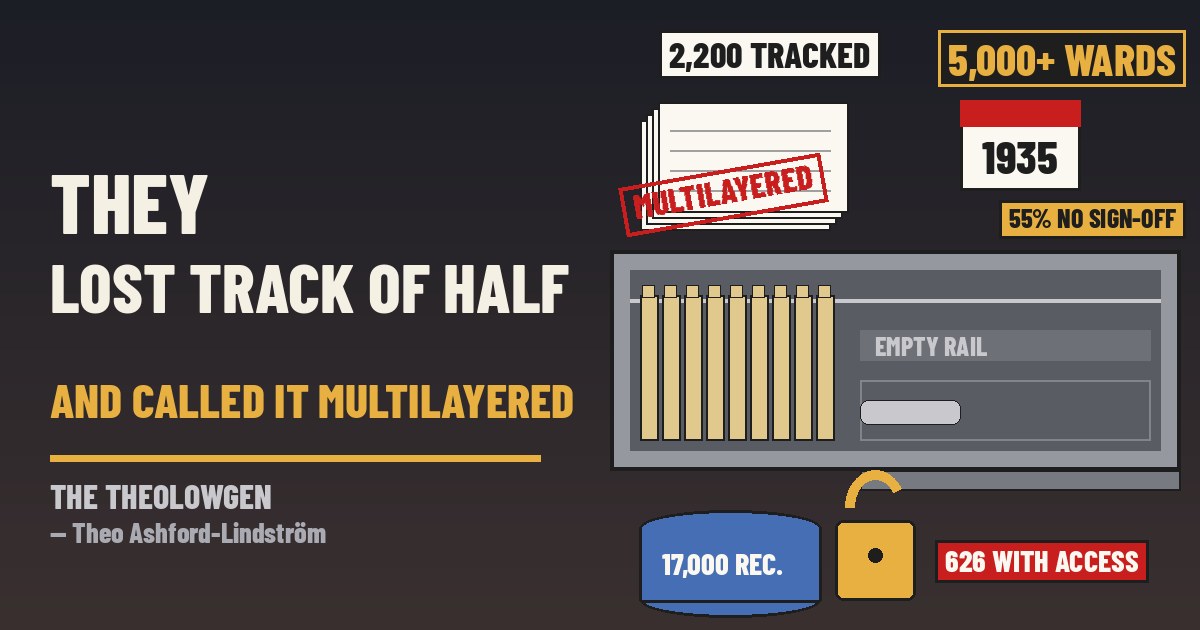
  • THEY LOST TRACK OF HALF THE WARDS AND CALLED IT MULTILAYERED OVERSIGHT | Michigan’s auditor general found the Michigan Children’s Institute — the seven-person office whose superintendent is, by a 1935 law, the legal guardian of children whose parents’ rights have been terminated — tracked about 2,200 wards while state data showed more than 5,000, left a database on 17,000 past and present wards open to 626 outside employees, and saw 55% of county adoption consents made without written authority, while the state health department answered that a “comprehensive, multilayered system of oversight” already fulfills every guardianship duty

    THEY LOST TRACK OF HALF THE WARDS AND CALLED IT MULTILAYERED OVERSIGHT | Michigan’s auditor general found the Michigan Children’s Institute — the seven-person office whose superintendent is, by a 1935 law, the legal guardian of children whose parents’ rights have been terminated — tracked about 2,200 wards while state data showed more than 5,000, left a database on 17,000 past and present wards open to 626 outside employees, and saw 55% of county adoption consents made without written authority, while the state health department answered that a “comprehensive, multilayered system of oversight” already fulfills every guardianship duty

    They lost track of half the wards and called it multilayered oversight. I know the sentence. It is what a government says when the law made one office the parent of last resort, the office never wrote down the names of most of its children, and the department above it explains, in a response long enough that the auditor had to print it on its own pages, that the parenting was being done by everybody else, which is the bureaucratic way of saying nobody in particular.

    Here is the record, from the State of Michigan itself. The Office of the Auditor General released performance audit 491-2700-25 on the Michigan Children’s Institute this month — the report letter to the Department of Health and Human Services is dated Oct. 15, 2026 — and Michigan Public put it in front of the public on Oct. 19. MCI was created by Public Act 220 of 1935. Under that law its superintendent represents the State as legal guardian of each child a court commits to it after parental rights are terminated, until the child turns 19. As of August 2026 the institute was seven people, including the superintendent. The auditor’s conclusion on its guardianship work is two words: “Not sufficient.” MCI identified its wards only by tracking the consent requests caseworkers happened to send it — about 2,200 children during the audit period — while the state’s own child welfare system showed more than 5,000 active MCI wards. For over half of them, the auditor wrote, MCI “had not identified and/or carried out any monitoring activities,” and it did only limited monitoring of the ones it had found. State law tells the superintendent to order investigations of the homes where wards are placed and to procure regular reports during placement; MCI said it relied on caseworkers and typically read the reports only when an adoption request arrived. In a sample of 30 nonemergency procedures performed under anesthesia, MCI had no consent or notification on file for four, 13 percent, including surgery under general anesthesia. Its records on more than 17,000 past and present wards — names, birth dates, prospective and competing adoptive families, siblings — sat in an unencrypted Microsoft Access database on a shared drive where the auditor counted 626 non-MCI employees with permission to view and edit them, some not employed by the department at all. MCI said it was unaware the drive was open. Of 65 adoption consents made by county directors, 36 — 55 percent — had no written delegation from the superintendent, and 18 more came before the authorization did. Three of MCI’s six staff had no conflict-of-interest form on file after about nine years of handling adoption consents. In fiscal 2024 it missed the 90-day timeframe on 96 percent of competing-party adoption requests. And the auditor notes that most of the 1935 law has gone unchanged for 70 to 90 years; it still assigns powers to a Michigan Social Welfare Commission that was abolished in 1965.

    Now the defense. The department disagreed with the main finding. It told the auditor it “maintains a comprehensive, multilayered system of oversight that fulfills all statutory guardianship requirements,” that those duties are carried out across program areas and contracted foster care agencies and “are not the sole responsibility of MCI,” and that daily case management of roughly 5,000 wards belongs to county offices and private agencies, with MCI consulted for statutory functions and notified of critical incidents. “MCI fulfills the statutory requirement to review investigative assessments,” it said. To Michigan Public it added that it “cares deeply for the children it serves.” The auditor answered that the report is about guardianship, not daily case management, and that the law created MCI precisely so the State could more effectively exercise the duty it owes these children. On the database and the adoption consents, the department agreed: it says it moved the database to a more restricted environment, will review access annually, tightened consent authorizations and hired a consultant to work the competing adoption requests. It has about 60 days to file a plan.

    Taryn says she has to sign a form when the twins get a tooth looked at, and the dentist calls if she forgets. Deb kept every one of Buck’s permission slips in a shoebox from 1979 on, and Buck says he did not know he was being monitored. I love them. They are seasoning.

    “Multilayered” is the alibi. The 2,200 is the story. Sit with it until it confesses. When the State takes a child away from her parents it does not become an idea; it becomes, by statute, one named guardian, and that guardian is supposed to know her name. A department that runs a statewide case system with every one of those children in it could not tell the auditor which children its guardian office was the parent of, and when an auditor counts the gap it does not say “we will find them” — it says the layers have it covered. Layers are how a government turns a duty into a diagram. Every layer can point to the layer underneath, and the child is at the bottom of the drawing, where nobody signs. I do not need the caseworkers to be villains; most of them are doing a job nobody pays enough for. And I am not going to tell you a contractor would love these kids better; the contractors are one of the layers. What I need is for the office that holds the guardianship to hold it. Both parties are the help. One writes the 1935 law and never reads it again. One writes the response so long the auditor gave it its own section. The kids get a shared drive with 626 strangers on it. The cardigan stays. Fill the notebook. Then ask, out loud, who in Lansing is the parent, and why the answer is a flowchart.

    Sources:

    — Theo Ashford-Lindström

  • THEY LEASED THE PARK FOR A DOLLAR AND CALLED IT REMOVING BLIGHT | Cape Coral’s City Council approved the $500 million Bimini East redevelopment Oct. 21, after the city spent about $45 million buying 47 properties after Hurricane Ian and pushing families out — then agreed to sell the land to the developer for about $24.3 million on a no-recourse note, rebate up to $45.75 million in future taxes, and lease Four Freedoms Park — which residents call the city’s first park — to the developer for 99 years at $1 a year

    THEY LEASED THE PARK FOR A DOLLAR AND CALLED IT REMOVING BLIGHT | Cape Coral’s City Council approved the $500 million Bimini East redevelopment Oct. 21, after the city spent about $45 million buying 47 properties after Hurricane Ian and pushing families out — then agreed to sell the land to the developer for about $24.3 million on a no-recourse note, rebate up to $45.75 million in future taxes, and lease Four Freedoms Park — which residents call the city’s first park — to the developer for 99 years at $1 a year

    They leased the park for a dollar and called it removing blight. I know the sentence. It is what a city says when it has spent years buying up a neighborhood after a hurricane, found a developer to take the land off its hands for roughly half of what it paid, and needs a word for the transaction that sounds like hygiene instead of a discount.

    Here is the record. On Wednesday night, Oct. 21, 2026, after a long final public hearing, the Cape Coral City Council approved the $500 million Bimini East redevelopment, WINK News reports. North Dakota-based Crown Development and the Bimini Basin Redevelopment Company plan up to 900 apartments and townhomes, about 250 hotel rooms, medical and office space, retail, a 50-slip marina, parking garages, a police substation and a bandshell on roughly 34 acres downtown, south of Cape Coral Parkway and west of Coronado Parkway. The Cape Coral Breeze laid out the money at the first hearing on Oct. 7. The city bought the core site — 47 individual properties — site by site after Hurricane Ian, for some $45 million; WINK puts it at $45.2 million and notes it forced out some families, who were offered up to $6,000 in rental assistance if they qualified. The developer will pay about $24.3 million for the land, prorated as it pulls permits or sells parcels, with the balance due at 10 years, on a promissory note the Breeze describes as no-recourse. The city’s redevelopment agency also funds two more acquisitions totaling $11 million, the Trumbull Apartments and George’s Garage. On top of that: a tax-increment rebate at 95 percent, capped at $45.75 million and running through 2042; impact-fee credits up to $5 million; demolition help up to $200,000 a structure for eight structures; and cost-sharing on a promenade and streets. And then the line in the lease agreement: Four Freedoms Park, on the Bimini Basin with direct access to the Caloosahatchee — “the first park of Cape Coral,” as one resident told WBBH — goes to the developer on a 99-year lease at $1 per year. The city keeps ownership, the name and a public-recreation covenant; the developer takes over utilities, taxes, repairs and maintenance, and the park “will be altered,” in the assistant city manager’s words. The city-sponsored preschool program in the park has to move; the city says it is still looking for a location.

    Now the defense. City staff estimated construction alone would generate $750.9 million in economic output and more than 3,000 jobs. Councilwoman Jennifer Nelson-Lastra said the redevelopment agency’s purpose is to remove blight, “and that’s exactly what we’re doing.” Councilman Joe Kilraine said no relationship “just goes completely on trust,” but, looking at the incentives in the contract, “I think we’re on the up side on this thing.” The tax rebate is pay-as-you-go: no building, no rebate. Crown’s president, Larry Nygard, told council at the first hearing, “I want to do what is right and what is good for the city, but I have to run a business too.” From the podium, David Hulsey said staff had negotiated for more than a year and then gave residents about 20 days. Speakers asked the council to wait until after the November election. It did not.

    Deb asked what the dollar is for, and Buck said it’s so somebody can say it wasn’t free. Taryn wants to know if the twins can lease the playground for 99 years at a dollar, and whether the dollar can be in quarters. I love them. They are seasoning.

    “Blight” is the alibi. The dollar is the story. Sit with it until it confesses. A government that knows to the penny what my house is worth cannot find a price for its own first park above one dollar a year, for 99 years, which is longer than anyone at that dais will be alive to regret it. I do not need the developer to be a villain; a man who says he has to run a business is telling the truth, and that is exactly why the public should not be the one carrying his land on a note with no recourse. And I do not need the council to be crooks; they are something more ordinary, which is believers. They believe in the multiplier. They believe the rendering. The handshake is the oldest machine in local government: the public buys the risk at full price, sells the upside at a discount, rebates the taxes the upside was supposed to pay, and calls the residue revitalization. Both parties are the help. One holds the gavel. One holds the term sheet. The preschool holds a moving box. The cardigan stays. Fill the notebook. Then ask, out loud, who in Cape Coral gets to lease anything public for a dollar, and why it is never the people who were already there.

    Sources:

    — Theo Ashford-Lindström

  • THEY CHARGED YOU TO PAY THE RENT AND CALLED IT A SERVICE FEE | Baltimore sued Yardi Systems, RentCafe and Pennrose Management on Oct. 19, alleging low-income tenants who pay rent online by card are hit with “service” fees — $300 to $420 a year — that are not in their leases and only appear at the last step of the payment flow, while the free autopay option is poorly advertised and unavailable to tenants without bank accounts

    THEY CHARGED YOU TO PAY THE RENT AND CALLED IT A SERVICE FEE | Baltimore sued Yardi Systems, RentCafe and Pennrose Management on Oct. 19, alleging low-income tenants who pay rent online by card are hit with “service” fees — $300 to $420 a year — that are not in their leases and only appear at the last step of the payment flow, while the free autopay option is poorly advertised and unavailable to tenants without bank accounts

    They charged you to pay the rent and called it a service fee. I know the sentence. It is what a platform says when the only thing it sells is the door you are required to walk through, and it sells it to the people least able to walk around it, and the receipt calls the toll a service because “toll” tests poorly with landlords.

    Here is the record, which for now is an allegation, and I will treat it like one. On Monday, Oct. 19, 2026, Baltimore Mayor Brandon M. Scott and the City Council sued Yardi Systems LLC and RentCafe LLC, which jointly sell the RentCafe property-management platform, along with Pennrose Management Company LLC, which owns and manages hundreds of units for low-income renters in the city. The Banner reports the complaint was filed in Baltimore Circuit Court by the Washington law firm Relman Colfax. The mechanics, in the city’s own summary of the complaint: RentCafe “steers tenants toward fee-generating payment options by obscuring the fees associated with each payment method behind multiple clicks, embedding fee information across several web pages in fine print, and failing to disclose the fee associated with a selected payment method until the last step of the payment flow.” Tenants get no additional service for the fee. They pay it to pay rent, or they risk late fees or eviction. The Banner fills in the numbers. Pennrose runs nine low-income developments in Baltimore, housing many older adults, people with disabilities and others on low or fixed incomes; rents in the suit run from about $869 for a one-bedroom to $1,654 for four bedrooms. Around 2024, the suit says, Pennrose stopped taking rent in person and moved payments onto RentCafe. Tenants who pay by credit or debit card have faced annual service fees of $300 to $420. The automatic payment option is free — but, per the suit, it is not well advertised, and it is not available to tenants without bank accounts. The fees, the suit says, are not disclosed up front or in the leases.

    Now the defense, such as it is so far. The Banner says representatives for the three companies did not immediately respond to a request for comment. So I will not put words in their mouths, and you should not either; a complaint is a story one side tells a judge. But I know the shape of the usual answer, because every convenience fee in America comes with the same one: the option is optional, the free path exists, nobody had to pay. Sit with who “nobody” is here. The free path, per the complaint, requires a bank account. The tenants in question are, by the landlord’s own business model, people who qualify for low-income housing. The city’s release notes that last year four of ten Baltimore renter households spent 35 percent or more of their income on rent and utilities, and for households making $35,000 or less, more than half spent 50 percent or more.

    Taryn priced the fee against the twins’ diaper budget and got a month and a half. Buck says he pays his rent the old way, in an envelope, under protest, and has never once been charged for the envelope. I love them. They are seasoning.

    “Service” is the alibi. The last step is the story. Sit with the last step until it confesses. A fee that appears only after you have picked your method, typed your card and committed your Tuesday is not a disclosure; it is a dare. And the dare lands on the people who left the bank long ago, or were never let in, because the bank charged them to be poor first. I am not here to canonize City Hall; a city that hired a private firm to file its suit is welcome to file it, but it does not get my rosary. The rent was always a transfer from the people who live in the building to the people who own it. What the platform figured out is that you can stand in the middle of that transfer and take a little off the top, and call the standing a product. That is not technology. It is a turnstile with a terms-of-service page. Read the complaint. Watch what the companies say when they do answer. The cardigan stays. Fill the notebook. Then ask, out loud, what exactly is being serviced.

    Sources:

    — Theo Ashford-Lindström

  • THEY SKIPPED THE TAKEOVER AND CALLED IT COMPLEXITY | California’s state auditor found 32 of 102 local agencies keeping Central Valley flood levees in “unacceptable” shape — 23 of them for at least five years — guarding more than a quarter-million people and nearly $40 billion in buildings, while the Department of Water Resources has never used the state law that tells it to take the levees over, and answered the audit by calling it a “fundamental lack of understanding of the complexities of flood management”

    THEY SKIPPED THE TAKEOVER AND CALLED IT COMPLEXITY | California’s state auditor found 32 of 102 local agencies keeping Central Valley flood levees in “unacceptable” shape — 23 of them for at least five years — guarding more than a quarter-million people and nearly $40 billion in buildings, while the Department of Water Resources has never used the state law that tells it to take the levees over, and answered the audit by calling it a “fundamental lack of understanding of the complexities of flood management”

    They skipped the takeover and called it complexity. I know the sentence. It is what a government says when the law handed it a shovel, the dirt has been failing inspection for years, and the agency holding the shovel explains, in a letter with a seal on it, that the real problem is that the people asking why it never dug simply do not understand dirt.

    Here is the record, from the California State Auditor itself. Report 2025-603, part of the auditor’s high-risk program and published Oct. 13, 2026, looked at the dams and the levees, and CalMatters put the levee half in front of the public on Oct. 20 with the wet season coming. The state oversees about 1,600 miles of levees and other flood structures along the Sacramento and San Joaquin rivers in what it calls the State Plan of Flood Control. It promised the federal government it would keep them to federal standards, then handed the shovel down to 102 local maintaining agencies: levee and reclamation districts, cities, counties, private landowners. In its fall 2025 inspections the Department of Water Resources rated 32 of those 102 “unacceptable,” and 23 of the 32 have been unacceptable for at least the last five years. The usual culprits are burrowing animals and brush: holes that make a seepage path through an earthen wall, and vegetation so thick the engineers who inspect from the levee crown cannot see the holes. In Madera County the auditor found erosion the state first noted in 2007 and brush noted since 2012, the brush now hiding the erosion. CalMatters counts what sits behind the failing ratings: more than a quarter-million people and 133,000 buildings worth nearly $40 billion. And here is the line that should be read into the record at every budget hearing in Sacramento: state law says that when a local agency does not maintain its project levees to standard, the department must start the process of turning them into a state-managed maintenance area, doing the work itself and billing the landowners who benefit. The auditor’s finding is that Water Resources “has not followed state law” and has not formed one. Not one.

    Now the defense. The department told the auditor that maintenance ratings are not the same thing as flood risk, that a takeover can cost tens of millions of dollars up front “that must be weighed against other investments,” and that the audit “portrays a fundamental lack of understanding of the complexities of flood management.” The audit says the department disagreed with many of its recommendations and did not clearly say whether it would carry out any of them. Meanwhile the money is going the other way: the department estimates it and the locals need at least $165 million a year more than they now spend; the Flood Maintenance Assistance Program that helped small districts was eliminated in fiscal 2024–25 after the Legislature cut the allocation; one county’s district had gotten $202,600 from it in 2024. Of 48 critical repair sites the state has catalogued since 2012 — sites that could reasonably fail in a single flood season — 14 were still not repaired as of August 2026. CalMatters notes Gov. Gavin Newsom vetoed a bill this fall that would have created an annual repair fund for Delta levees, saying this year’s budget made it redundant. The dam half of the report is no gentler: 57 dams in poor or unsatisfactory condition, no formal punitive enforcement ever taken under authority the Legislature granted in 2017, and one spillway with a large hole in it for more than 30 years.

    Buck read the part about ground squirrels and said he has been running an unacceptable levee along the back fence since 2019, and nobody from Sacramento has ever come to take it over either. Deb wants to know if “complexity” goes in the drawer with “as applicable.” It does. I love them. They are seasoning.

    “Complexity” is the alibi. The burrow is the story. Sit with the 23 until they confess. Five years of the same failing grade, written down by the same state, filed in the same annual report, and the remedy the Legislature wrote — the state does the work and sends the bill to the landowners who benefit — sitting in the statute book unopened, because opening it would cost something this year and the flood is a problem for some other year. I do not need the auditor to be a hero and I do not need the reclamation districts to be villains; the districts say they cannot afford the work, and the state cut the program that helped pay for it. What I need is for the agency that issues the grades to stop pretending the grade is a weather report. A government that rates a wall unacceptable for five straight years and then explains that ratings are not risk has not discovered complexity. It has discovered a way to inspect forever and own nothing. Both parties are the help. One cuts the line item. One writes the letter about the line item. The water does not read either. The cardigan stays. Fill the notebook. Then ask, out loud, what a law is for when the agency it commands has decided it is optional.

    Sources:

    — Theo Ashford-Lindström

  • THEY PASSED THE HOTEL TAX BACK AND CALLED IT A STRATEGIC PARTNERSHIP | Frisco’s City Council voted unanimously Oct. 20 for a Chapter 380 deal with the Hunt family that hands 50% of a new Toyota Stadium hotel’s occupancy taxes back to the developer for 10 years, up to $5 million, waives half the development fees, and teams up to ask Texas to route state hotel and sales taxes from the project through the city to the developer too — no state amount disclosed

    THEY PASSED THE HOTEL TAX BACK AND CALLED IT A STRATEGIC PARTNERSHIP | Frisco’s City Council voted unanimously Oct. 20 for a Chapter 380 deal with the Hunt family that hands 50% of a new Toyota Stadium hotel’s occupancy taxes back to the developer for 10 years, up to $5 million, waives half the development fees, and teams up to ask Texas to route state hotel and sales taxes from the project through the city to the developer too — no state amount disclosed

    They passed the hotel tax back and called it a strategic partnership. I know the sentence. It is what a handshake says when a city collects a tax from visitors, hands half of it to the people who own the building the visitors sleep in, and then walks arm in arm with them to the state capital to ask for the state’s share, too.

    Here is the record. On Tuesday, Oct. 20, 2026, the Frisco City Council unanimously approved a Chapter 380 economic development agreement with the Hunt family, which operates Toyota Stadium, the home of FC Dallas, WFAA and the Dallas Express report. The plan: a 250-room full-service hotel, a 15,000-square-foot convention center, about 30,000 square feet of retail and restaurant space, and a multistory parking garage on the stadium campus. The terms: Frisco passes through 50% of the hotel occupancy taxes collected over 10 years, capped at $5 million, and waives half of the construction development fees for the stadium improvements. CBS Texas, describing the proposal before the vote, identified the developer as DP6 Hotel & CC and laid out the second, bigger door: the city and developer would apply to the state’s qualified hotel project program, under which “the eligible state hotel and sales taxes generated by the project would then be passed from the state through the city to the developer.” The proposal says city funds would not be used for those state payments, the developer pays the application consultants and lawyers, and grant payments depend on performance requirements and on the taxes actually coming in. The Dallas Express notes the announcement does not identify a state grant award or dollar amount, that the city and its economic and community development corporations extended FC Dallas’ lease through 2057 in 2024 and agreed to fund mixed-use stadium improvements, and that September plans called for about 290 rooms, not 250, a difference the city did not explain. The Dallas Business Journal calls the whole thing the Hunt family’s “billion-dollar vision.” Mayor Mark Hill: “FC Dallas and the Hunt family are terrific partners. This is another example of a strategic partnership that sets Frisco apart from others and will continue to enhance our city for decades to come.”

    Buck wants to know if the Hunt family will pass him back half his hotel tax from the Wisconsin Dells. Cricket laminated “strategic partnership” and filed it next to “transformational.” I love them. They are seasoning.

    The partnership is the alibi. The pass-through is the story. Sit with the word “through” until it confesses. The tax leaves the visitor, lands at the city, and keeps going, half of it, back to the owner of the hotel. Then the city volunteers to be a pipe for the state’s money as well, and the amount is the one number nobody announced. That is the handshake with its sleeves rolled up: the public side supplies the taxing power and the seal, the private side supplies the rendering and the lawyers, and the arrangement is marketed as free because the city does not write the check; it simply declines to keep what it collects. I will not pretend the council is a reluctant hostage; it voted unanimously, and the mayor called the people receiving the rebate terrific. Nor will I crown the family for paying its own consultants. Paying the people who help you get the state’s money is not generosity. It is an investment with an excellent expected return. “Performance requirements” is the fig leaf: the better the hotel does at collecting the tax, the more of the tax it keeps, up to the cap. Both parties are the help, and in Frisco the help has a convention center. The cardigan stays. Fill the notebook. Then ask, out loud, what the state’s number is, and why nobody said it before the vote was unanimous.

    Sources:

    — Theo Ashford-Lindström

  • THEY BOUGHT THE RIVAL SLIDE AND CALLED IT MORE COMPETITION | The FTC and 12 states sued Oct. 19 to stop private-equity-owned PlayPower — already the owner of Miracle, Little Tikes Commercial and Playworld — from buying fast-growing rival BCI Burke in a market where five companies hold 85 to 90 percent, playgrounds run $50,000 to more than $1 million, and the public complaint blacks out the CFO’s explanation of a 2026 price increase

    THEY BOUGHT THE RIVAL SLIDE AND CALLED IT MORE COMPETITION | The FTC and 12 states sued Oct. 19 to stop private-equity-owned PlayPower — already the owner of Miracle, Little Tikes Commercial and Playworld — from buying fast-growing rival BCI Burke in a market where five companies hold 85 to 90 percent, playgrounds run $50,000 to more than $1 million, and the public complaint blacks out the CFO’s explanation of a 2026 price increase

    They bought the rival slide and called it more competition. I know the sentence. It is what a portfolio company says when it has already swallowed three playground makers, finds a fourth one taking its customers, and decides the cheapest way to beat a better slide is to own it.

    Here is the record. On Oct. 19, 2026, the Federal Trade Commission sued in the U.S. District Court for the Northern District of California to block Platinum Equity and its portfolio company PlayPower from buying BCI Burke, one of PlayPower’s closest competitors in commercial outdoor playground equipment, from Bertram Capital. Twelve state attorneys general joined: Arizona, California, Colorado, Illinois, Nevada, North Carolina, Ohio, Pennsylvania, Tennessee, Texas, Washington and Wisconsin. The commission vote was 2-0. The FTC says Burke would join a PlayPower portfolio that already includes Miracle Recreation Equipment Company, Little Tikes Commercial and Playworld Systems, “brands PlayPower previously acquired,” and that five companies, PlayPower and Burke among them, own more than a dozen playground brands and hold 85% to 90% of the U.S. market. The complaint says parks, schools, churches and other customers often spend “from $50,000 to more than $1 million” on a commercial playground; that PlayPower’s playground business is “the product of three successive acquisitions: Miracle in 1993, Little Tikes in 2004, and Playworld in 2016”; that Platinum Equity acquired PlayPower Holdings in October 2025 and on Feb. 8, 2026 agreed to buy all of Burke’s voting securities; and that “facing losses to Burke, PlayPower is once again seeking to buy a disruptive rival.” It alleges consolidation has produced “significant price increases” and that PlayPower is “not just passing on rising costs.” In the public version, the words PlayPower’s CFO used to justify a 2026 price increase to sales representatives are blacked out. Daniel Guarnera, director of the FTC’s Bureau of Competition: “Instead of investing in building better playgrounds or lowering prices, PlayPower and its parent Platinum Equity want to eliminate one of PlayPower’s fiercest competitors and continue to raise prices on American schools, parks departments, churches and municipalities.” Colorado Attorney General Phil Weiser, per Axios: “PlayPower is losing ground to Burke.” A PlayPower spokesperson told Axios the merger “would create even more competition in a highly fragmented and globally competitive market, not diminish it.”

    Taryn priced a slide for the church picnic and asked how a slide costs more than Buck’s truck. Buck said “private equity,” then asked what private equity is. Deb told him it’s what happens when a jungle gym gets a CFO. I love them. They are seasoning.

    “More competition” is the alibi. The roll-up is the story. Sit with the dates until they confess: 1993, 2004, 2016, and now 2026, a company that grew not by building a better ladder but by buying whoever did, and a private-equity owner that bought the roll-up in October and signed for the next rival by February. That is not a market. That is a menu with one waiter. And the customer here is not some abstraction; it is a church that holds a bake sale for the slide, a school with a PTA and a parking-lot carnival, a parks department with a line item. When a firm in an 85-to-90-percent club tells you swallowing the competitor who is beating it will create more competition, it is not making an argument. It is making a dare. I will not crown the regulators for taking it. The FTC’s own release says state and local governments spend hundreds of millions of taxpayer dollars a year on playgrounds; this is the state discovering antitrust the week the bill hits its own budget, after decades in which the same roll-up grew one acquisition at a time. But the anti-capitalist cut stays sharp, cardigan and all: a CFO’s reason for raising the price of a swing set is redacted in a federal complaint, and somewhere a kid is going to climb that swing set without knowing his recess has a hurdle rate. The cardigan stays. Fill the notebook. Then ask, out loud, what the blacked-out sentence says, and who gets to read it before the next playground goes out to bid.

    Sources:

    — Theo Ashford-Lindström

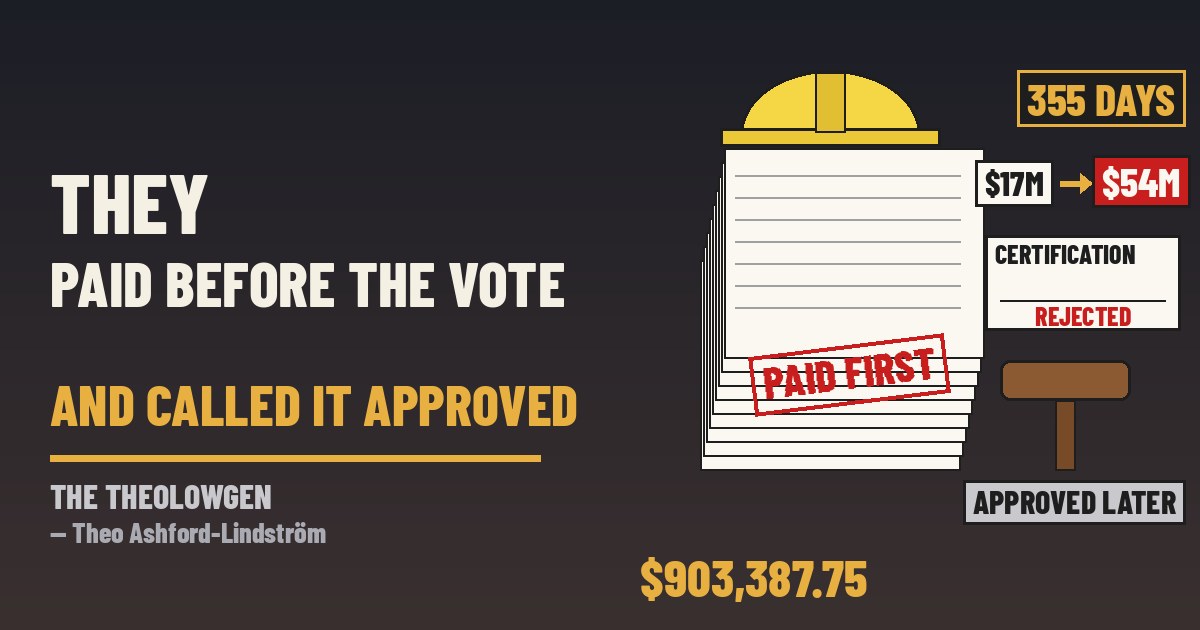
  • THEY PAID BEFORE THE VOTE AND CALLED IT APPROVED | Palm Beach County’s inspector general found the county paid $903,387.75 for change-order work on the sheriff’s headquarters renovation up to 355 business days before commissioners approved it, plus $223,243.30 in charges beyond the contract — on a job first estimated at $17 million, now $54 million and mostly paid from a voter-approved sales surtax — and the county still refused to make its contractor certify the bills

    THEY PAID BEFORE THE VOTE AND CALLED IT APPROVED | Palm Beach County’s inspector general found the county paid $903,387.75 for change-order work on the sheriff’s headquarters renovation up to 355 business days before commissioners approved it, plus $223,243.30 in charges beyond the contract — on a job first estimated at $17 million, now $54 million and mostly paid from a voter-approved sales surtax — and the county still refused to make its contractor certify the bills

    They paid before the vote and called it approved. I know the sentence. It is what a government says when the money walked out the door first, the permission strolled in months later, and the people in charge explain, with a straight face and a cover letter, that since the permission did eventually arrive, the order of events should not count against anybody.

    Here is the record, from the Palm Beach County Office of Inspector General itself. Audit Report 2027-A-0001, issued Oct. 19, 2026, examined the county’s construction-manager-at-risk contract with Kast Construction Company LLC for the Palm Beach County Sheriff’s Office headquarters renovation, Project No. 11206. The headline finding: the county reimbursed the construction manager for subcontractor change-order work “ranging between 6 and 355 business days” before the Board of County Commissioners formally approved those change orders, as the contract and county policy required. The inspector general counts that as $903,387.75 in questioned costs. On top of that, $223,243.30 in identified costs: $2,527.65 in general-requirements charges without sufficient documentation and $220,715.65 in insurance and bond fees paid at rates exceeding the contract. When the inspector general asked for invoices backing the higher insurance and bond costs, the report says, the construction manager told the office that invoices showing direct costs “were not available,” because the costs reflected increases to the guaranteed maximum price and the markup that rode along with them. The office gave the contractor a chance to answer the findings. “We did not receive a response.” The background section is the part that should be read aloud at a public meeting: the contract was approved in November 2016, construction was scheduled to start in late 2017 and finish in late 2018, and preliminary construction costs were estimated at $17 million. As of March 31, 2026, contract costs were $54,015,467, about $47,679,994 of it from the one-cent local government infrastructure surtax voters approved on Nov. 8, 2016, and the rest from property taxes. WLRN calls it an ongoing overhaul.

    Now the defense. The county agreed the payments went out too early but objected to calling the $903,387.75 “questioned costs,” because the Board approved the change orders before the report came out, and, in the report’s summary of its position, because the label “might imply an ongoing risk of fraud or waste.” The inspector general answered that not all questioned costs indicate fraud or waste; they indicate a violation of the rules governing how public money is spent. CBS12 reports the county’s own preliminary review found a net overpayment of $124,477.75 that it plans to deduct from the contractor’s final payment. The county accepted six of the seven recommendations. The one it rejected would have required the construction manager to sign a certification on each draft payment application confirming that every subcontractor request in it is for original-contract work or an approved change order.

    Buck says he once paid a guy to redo the gutters before Taryn approved it and he has been in the change-order phase of that marriage ever since. Deb wants to know if she can pay the electric bill first and get it approved by the board later. I love them. They are seasoning.

    “Approved” is the alibi. The calendar is the story. Sit with 355 business days until they confess. That is more than a working year in which public money had already left the county’s hands for work its elected board had not yet blessed, and the vote, when it came, was not a decision; it was a receipt. I know how punctual the county expects me to be when its number lands in my mailbox; the courtesy, it turns out, runs one direction. And I will not let the firm hide behind the clerks. A contractor that bills insurance and bond fees above the contract, says the invoices are not available, and does not bother answering the inspector general is not a victim of sloppy paperwork. It is the beneficiary. But the moment that made me put the coffee down is the rejected recommendation. The cheapest fix in the whole report was a signature: the contractor promises, in writing, that it is only billing for work somebody was allowed to buy. The county said no to the signature. A $17 million estimate became a $54 million building for the people with the badges, paid mostly by a voter-approved penny of sales surtax, and the one reform turned down is the one that would make the private side swear to it. Both parties are the help. One carries the badge. One carries the invoice. Neither, apparently, carries a pen. The cardigan stays. Fill the notebook. Then ask, out loud, what a vote is for when the check already cleared.

    Sources:

    — Theo Ashford-Lindström

  • THEY CAPTURED THE STATE TAXES AND CALLED IT A BROWNFIELD | Detroit’s Brownfield Redevelopment Authority voted 4-2 on Oct. 14 to back a Transformational Brownfield capture of future state taxes worth an estimated $300 million for Bedrock and General Motors’ $2.2 billion Renaissance Center redevelopment — after the developers warned a two-week delay could cost them state approval by year-end, and while the neighborhood benefits package was still being negotiated

    THEY CAPTURED THE STATE TAXES AND CALLED IT A BROWNFIELD | Detroit’s Brownfield Redevelopment Authority voted 4-2 on Oct. 14 to back a Transformational Brownfield capture of future state taxes worth an estimated $300 million for Bedrock and General Motors’ $2.2 billion Renaissance Center redevelopment — after the developers warned a two-week delay could cost them state approval by year-end, and while the neighborhood benefits package was still being negotiated

    They captured the state taxes and called it a brownfield. I know the sentence. It is what a handshake says when the most famous glass towers on a riverfront need public money, the program that hands out the public money was named for contaminated land, and everybody in the room agrees, with a straight face and a deadline, that the shoe fits.

    Here is the record. The Detroit Free Press reported that on Wednesday, Oct. 14, 2026, the Detroit Brownfield Redevelopment Authority voted 4-2 to approve a request for a Transformational Brownfield incentive for the $2.2 billion Renaissance Center redevelopment by Bedrock and General Motors, sending it to Detroit City Council. The incentive is a capture of future state-level taxes generated at the site, with an estimated value of $300 million. The two no votes, board members Maggie DeSantis and Eric Dueweke, said they did not oppose the project or the incentive; they opposed giving an important approval while the project’s community benefits package was still being negotiated, worried it would weaken the leverage of the nine-member Neighborhood Advisory Council bargaining with Bedrock and GM over the size of that package. They wanted to wait until the authority’s next meeting on Oct. 28. The developers argued a delay would jeopardize getting final state approval before the end of the year. The Free Press has also reported that the advisory council’s proposal sought $40 million in commitments from the developers, that Bedrock said yes to some community asks and no to others, and, on Oct. 20, that a benefits deal is close, with free parking possible. The City of Detroit lists the project under its Community Benefits Ordinance engagements, the process that is supposed to produce that deal.

    Deb asked what part of a skyscraper counts as a brownfield, and Buck said the part where they keep the parking money. Joey tried to draw the towers on a pizza box and ran out of round. I love them. They are seasoning.

    The brownfield is the alibi. The calendar is the story. Sit with the two weeks until they confess. Two board members asked for fourteen days so the neighbors could finish bargaining with leverage, and the answer was that fourteen days might cost the developers the state’s blessing by Christmas. So the public body moved on the developers’ clock, and the neighbors were left negotiating after the vote that gave their leverage its value. That is the handshake in its purest form: the state lets a city lend out the state’s future taxes, the city lets a quasi-public board say yes first, and a nine-member council of residents is told to keep talking while the check is already in the mail. I will not pretend the alternative is a heroic bureaucracy; the program is the state’s, the authority is the city’s, and both of them chose the deadline the firm asked for. Nor will I crown the firm because it said yes to some asks. A $2.2 billion project being asked for $40 million in commitments, against an estimated $300 million in public capture, and the headline of the week is that free parking is possible. I have had my own house’s number printed by a public office in a voice that called itself fair, and I know how a number becomes a destiny once the right people agree on it. The cardigan stays. Fill the notebook. Then ask, out loud, who the brownfield really is when the land is clean, the towers are famous, and the only thing contaminated is the order of the votes.

    Sources:

    — Theo Ashford-Lindström