
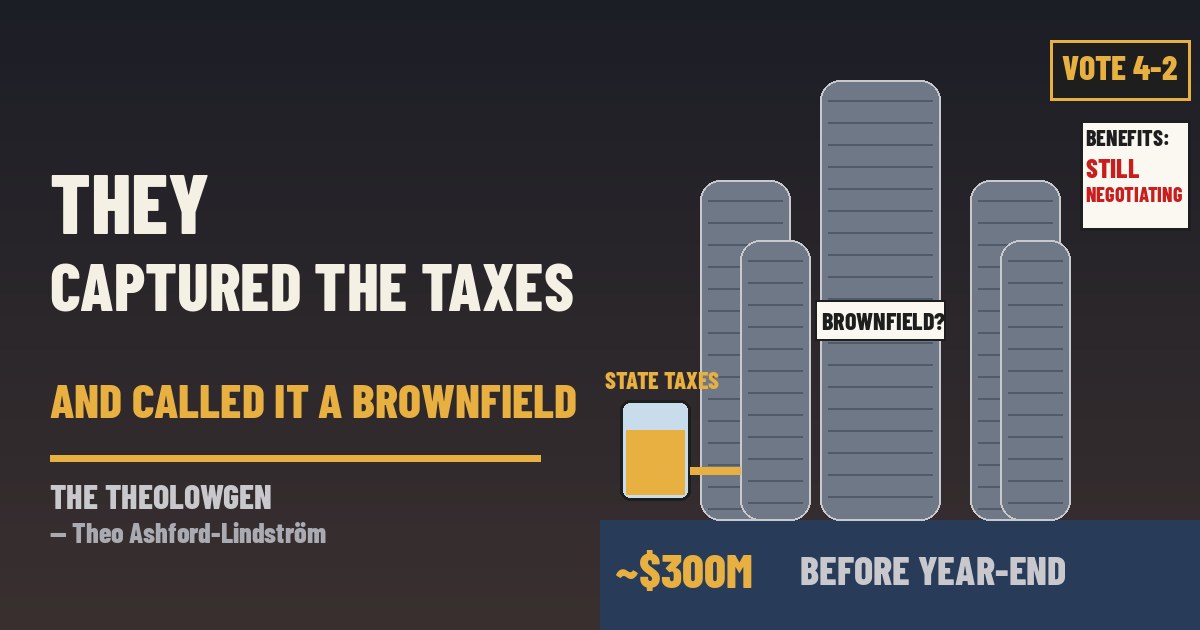
They captured the state taxes and called it a brownfield. I know the sentence. It is what a handshake says when the most famous glass towers on a riverfront need public money, the program that hands out the public money was named for contaminated land, and everybody in the room agrees, with a straight face and a deadline, that the shoe fits.
Here is the record. The Detroit Free Press reported that on Wednesday, Oct. 14, 2026, the Detroit Brownfield Redevelopment Authority voted 4-2 to approve a request for a Transformational Brownfield incentive for the $2.2 billion Renaissance Center redevelopment by Bedrock and General Motors, sending it to Detroit City Council. The incentive is a capture of future state-level taxes generated at the site, with an estimated value of $300 million. The two no votes, board members Maggie DeSantis and Eric Dueweke, said they did not oppose the project or the incentive; they opposed giving an important approval while the project’s community benefits package was still being negotiated, worried it would weaken the leverage of the nine-member Neighborhood Advisory Council bargaining with Bedrock and GM over the size of that package. They wanted to wait until the authority’s next meeting on Oct. 28. The developers argued a delay would jeopardize getting final state approval before the end of the year. The Free Press has also reported that the advisory council’s proposal sought $40 million in commitments from the developers, that Bedrock said yes to some community asks and no to others, and, on Oct. 20, that a benefits deal is close, with free parking possible. The City of Detroit lists the project under its Community Benefits Ordinance engagements, the process that is supposed to produce that deal.
Deb asked what part of a skyscraper counts as a brownfield, and Buck said the part where they keep the parking money. Joey tried to draw the towers on a pizza box and ran out of round. I love them. They are seasoning.
The brownfield is the alibi. The calendar is the story. Sit with the two weeks until they confess. Two board members asked for fourteen days so the neighbors could finish bargaining with leverage, and the answer was that fourteen days might cost the developers the state’s blessing by Christmas. So the public body moved on the developers’ clock, and the neighbors were left negotiating after the vote that gave their leverage its value. That is the handshake in its purest form: the state lets a city lend out the state’s future taxes, the city lets a quasi-public board say yes first, and a nine-member council of residents is told to keep talking while the check is already in the mail. I will not pretend the alternative is a heroic bureaucracy; the program is the state’s, the authority is the city’s, and both of them chose the deadline the firm asked for. Nor will I crown the firm because it said yes to some asks. A $2.2 billion project being asked for $40 million in commitments, against an estimated $300 million in public capture, and the headline of the week is that free parking is possible. I have had my own house’s number printed by a public office in a voice that called itself fair, and I know how a number becomes a destiny once the right people agree on it. The cardigan stays. Fill the notebook. Then ask, out loud, who the brownfield really is when the land is clean, the towers are famous, and the only thing contaminated is the order of the votes.
Sources:
- Detroit Free Press, “Brownfield board resists calls to delay RenCen vote after Bedrock plea,” Oct. 14, 2026
- Detroit Free Press, “RenCen Community Benefits proposal seeks $40M in gifts from developers,” Oct. 6, 2026
- Detroit Free Press, “What Bedrock said ‘yes’ and ‘no’ to of proposed RenCen community asks,” Oct. 13, 2026
- Detroit Free Press, “Community Benefits deal for RenCen is close, free parking possible,” Oct. 20, 2026
- City of Detroit, “Renaissance Center and East Riverfront Projects,” Community Benefits Ordinance engagements
— Theo Ashford-Lindström

Leave a Reply