They scanned your face and called it navigational data. I know the sentence. It is what a company says when it rolled a camera on six wheels up to your door, pointed it at you while you bent down for your groceries, and needs the thing it recorded to sound like a sidewalk instead of a person.
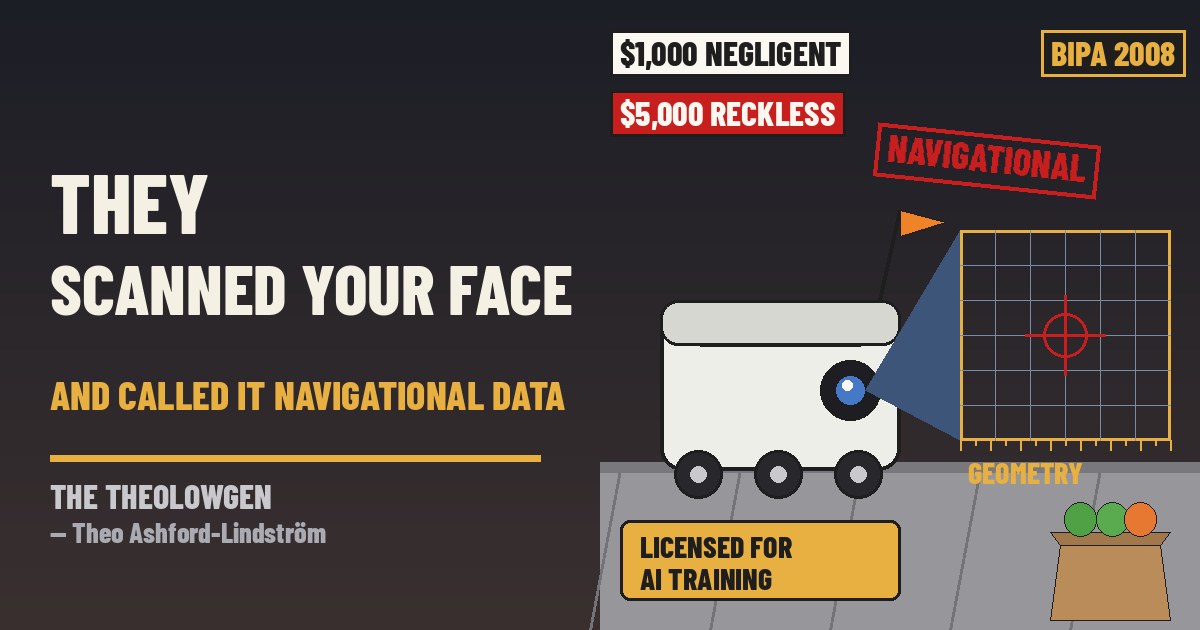
Here is the record, which for now is an allegation, and I will treat it like one. USA Today, Mashable and Straight Arrow News all reported on Oct. 21, 2026, on two proposed class-action lawsuits filed Oct. 9 in Cook County, Illinois, against Coco Robotics and Serve Robotics, the companies whose little coolers on wheels carry orders for DoorDash, Uber Eats and Grubhub. Mitchell Breidinger says a Coco robot delivered his DoorDash grocery order on Sept. 29, 2025; per his complaint, the robot’s cameras recorded his face, head and hands while its sensors measured the shapes and dimensions of those body parts, a remote operator watched the drop-off in real time, and Coco gave him no written notice and got no written consent. Barry Schain says he got three deliveries from Serve robots through Uber Eats, most recently Oct. 4, and makes the same claim. Both men say they never chose robot delivery; Mashable reports the suits hinge on customers being assigned to robots after they ordered. Breidinger’s complaint alleges Coco shared robot-collected data with OpenAI and other third parties; Schain’s alleges Serve licenses video and LiDAR data to third parties for AI training, and Mashable says the suits cite company disclosures that video and sensor data can be licensed that way. The law in question is Illinois’ Biometric Information Privacy Act, passed in 2008, which says a company that collects face or hand geometry must first tell you in writing why and for how long, and get your written consent. The suits seek $1,000 per negligent violation and $5,000 per intentional or reckless one.
Now the defense. Both companies deny it. Serve told USA Today, “Our robots use cameras and sensors to navigate the sidewalks of Chicago safely. Serve does not use that data to identify individuals and our systems are not designed to identify individuals or create biometric profiles,” and said it will defend itself. Coco’s head of government relations, Carl Hansen, called the case “frivolous”: “This lawsuit fundamentally misunderstands our technology, we have not collected biometric data in Chicago.” He said Coco has never used LiDAR in Chicago, that “the data we share is navigational data used to make sidewalks safer for all users” — real-time hazard information for BlindSquare, an app for people who are blind or have low vision — and that it does not share data from the beginning or end of delivery trips. Straight Arrow notes residents have complained about the robots since the city’s 2022 pilot, from blocked paths for people with disabilities to surveillance. None of it has been proven in court, and the plaintiffs’ lawyers had not answered USA Today when it asked for the complaints.
Buck says a robot came up the driveway in August and he waved at it, and now he wants to know if the wave is in a dataset. Taryn says the twins would try to ride it. I love them. They are seasoning.
“Navigational” is the alibi. The bag is the story. Sit with it until it confesses. A sidewalk robot does not need to know the shape of my hands to find my porch; it needs to know where the curb is. Every camera company swears it only looks at the curb, and the suits point to these companies’ own disclosures saying the video and sensor data can be licensed for AI training. I do not know yet whether that footage includes anybody’s face; that is what a court is for, and I will wait for it. But I know the shape of the business the suits describe. You order lettuce. The platform you ordered from assigns your lettuce to a machine you did not pick. The machine is owned by a company that is not the platform, and the footage is licensed to a third company that is neither, and the only party in the chain that never signed anything is the one with the face. That is not a delivery. That is a supply chain where you are the raw material. The anti-capitalist in me does not need a new statute to see it. He needs the old one read out loud. The cardigan stays. Fill the notebook. Then ask, out loud, what else rolls up the driveway with a camera, and who it reports to.
Sources:
- USA Today, Anthony Thompson, “Food delivery robots collected biometric data, lawsuits allege,” Oct. 21, 2026 (updated Oct. 22)
- Mashable, Chase Dibenedetto, “Delivery robots scan faces and collect customer biometric data, lawsuit alleges,” Oct. 21, 2026
- Straight Arrow News, Mikael Thalen, “Lawsuits claim robots deliver your food — and scan your face,” Oct. 21, 2026
— Theo Ashford-Lindström

Leave a Reply