
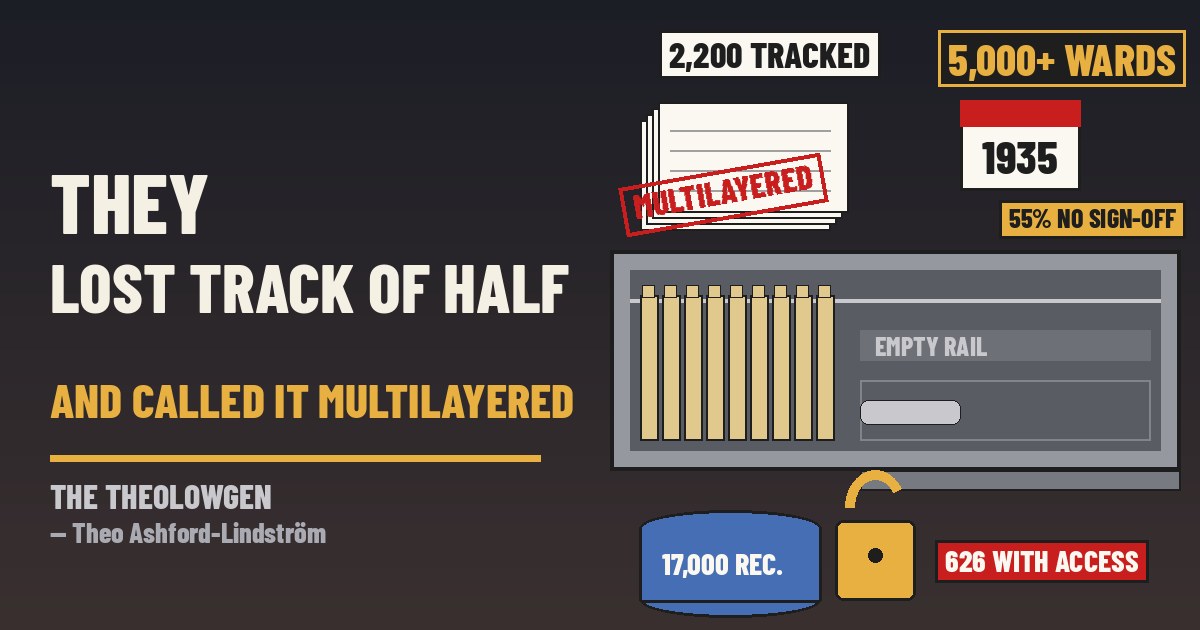
They lost track of half the wards and called it multilayered oversight. I know the sentence. It is what a government says when the law made one office the parent of last resort, the office never wrote down the names of most of its children, and the department above it explains, in a response long enough that the auditor had to print it on its own pages, that the parenting was being done by everybody else, which is the bureaucratic way of saying nobody in particular.
Here is the record, from the State of Michigan itself. The Office of the Auditor General released performance audit 491-2700-25 on the Michigan Children’s Institute this month — the report letter to the Department of Health and Human Services is dated Oct. 15, 2026 — and Michigan Public put it in front of the public on Oct. 19. MCI was created by Public Act 220 of 1935. Under that law its superintendent represents the State as legal guardian of each child a court commits to it after parental rights are terminated, until the child turns 19. As of August 2026 the institute was seven people, including the superintendent. The auditor’s conclusion on its guardianship work is two words: “Not sufficient.” MCI identified its wards only by tracking the consent requests caseworkers happened to send it — about 2,200 children during the audit period — while the state’s own child welfare system showed more than 5,000 active MCI wards. For over half of them, the auditor wrote, MCI “had not identified and/or carried out any monitoring activities,” and it did only limited monitoring of the ones it had found. State law tells the superintendent to order investigations of the homes where wards are placed and to procure regular reports during placement; MCI said it relied on caseworkers and typically read the reports only when an adoption request arrived. In a sample of 30 nonemergency procedures performed under anesthesia, MCI had no consent or notification on file for four, 13 percent, including surgery under general anesthesia. Its records on more than 17,000 past and present wards — names, birth dates, prospective and competing adoptive families, siblings — sat in an unencrypted Microsoft Access database on a shared drive where the auditor counted 626 non-MCI employees with permission to view and edit them, some not employed by the department at all. MCI said it was unaware the drive was open. Of 65 adoption consents made by county directors, 36 — 55 percent — had no written delegation from the superintendent, and 18 more came before the authorization did. Three of MCI’s six staff had no conflict-of-interest form on file after about nine years of handling adoption consents. In fiscal 2024 it missed the 90-day timeframe on 96 percent of competing-party adoption requests. And the auditor notes that most of the 1935 law has gone unchanged for 70 to 90 years; it still assigns powers to a Michigan Social Welfare Commission that was abolished in 1965.
Now the defense. The department disagreed with the main finding. It told the auditor it “maintains a comprehensive, multilayered system of oversight that fulfills all statutory guardianship requirements,” that those duties are carried out across program areas and contracted foster care agencies and “are not the sole responsibility of MCI,” and that daily case management of roughly 5,000 wards belongs to county offices and private agencies, with MCI consulted for statutory functions and notified of critical incidents. “MCI fulfills the statutory requirement to review investigative assessments,” it said. To Michigan Public it added that it “cares deeply for the children it serves.” The auditor answered that the report is about guardianship, not daily case management, and that the law created MCI precisely so the State could more effectively exercise the duty it owes these children. On the database and the adoption consents, the department agreed: it says it moved the database to a more restricted environment, will review access annually, tightened consent authorizations and hired a consultant to work the competing adoption requests. It has about 60 days to file a plan.
Taryn says she has to sign a form when the twins get a tooth looked at, and the dentist calls if she forgets. Deb kept every one of Buck’s permission slips in a shoebox from 1979 on, and Buck says he did not know he was being monitored. I love them. They are seasoning.
“Multilayered” is the alibi. The 2,200 is the story. Sit with it until it confesses. When the State takes a child away from her parents it does not become an idea; it becomes, by statute, one named guardian, and that guardian is supposed to know her name. A department that runs a statewide case system with every one of those children in it could not tell the auditor which children its guardian office was the parent of, and when an auditor counts the gap it does not say “we will find them” — it says the layers have it covered. Layers are how a government turns a duty into a diagram. Every layer can point to the layer underneath, and the child is at the bottom of the drawing, where nobody signs. I do not need the caseworkers to be villains; most of them are doing a job nobody pays enough for. And I am not going to tell you a contractor would love these kids better; the contractors are one of the layers. What I need is for the office that holds the guardianship to hold it. Both parties are the help. One writes the 1935 law and never reads it again. One writes the response so long the auditor gave it its own section. The kids get a shared drive with 626 strangers on it. The cardigan stays. Fill the notebook. Then ask, out loud, who in Lansing is the parent, and why the answer is a flowchart.
Sources:
- Michigan Office of the Auditor General, Performance Audit Report 491-2700-25, “Michigan Children’s Institute, Michigan Department of Health and Human Services,” October 2026 (report letter dated Oct. 15, 2026)
- Michigan Public / MPRN, Colin Jackson, “Thousands of foster kids under state guardianship not being monitored, audit finds,” Oct. 19, 2026
— Theo Ashford-Lindström

Leave a Reply