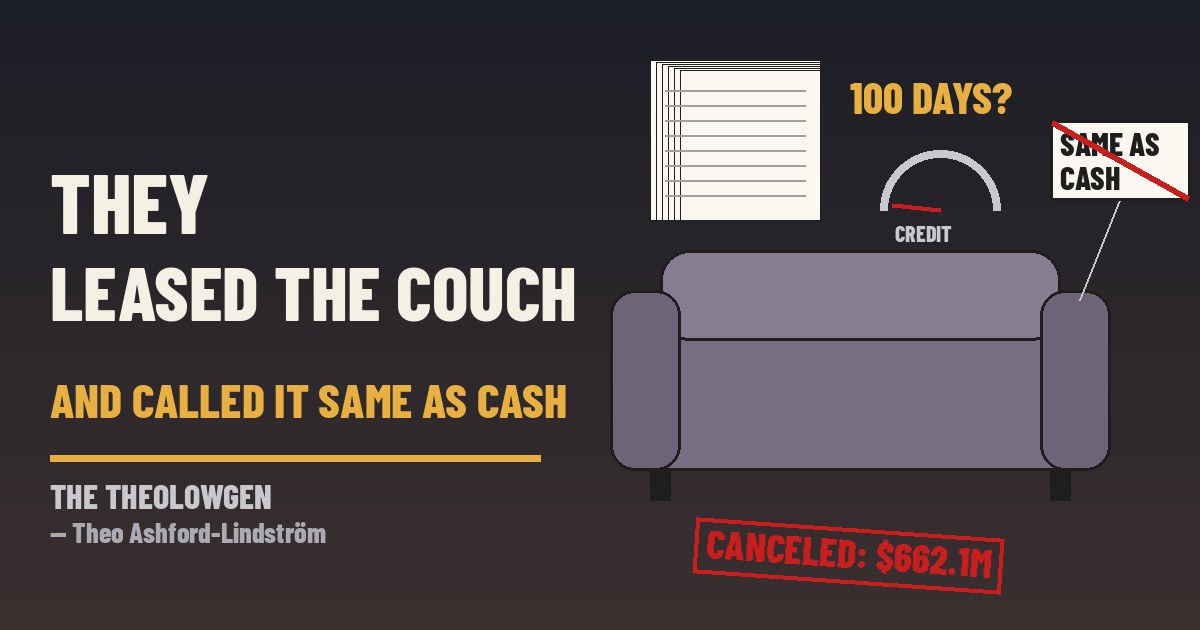
They leased you the couch and called it same as cash. I know the sentence. It is what a firm says when it stands at the checkout counter of somebody else’s store, buys the couch out from under you, keeps the title, and rents it back to you on terms you were not shown, with a slogan that sounds like a discount and a payment schedule that reads like a mortgage.
Here is the record. On Oct. 20, 2026, West Virginia Attorney General JB McCuskey announced his state had joined a coalition of 17 attorneys general in a nearly $664 million settlement with Snap Finance, led by Iowa and Nebraska. Total lease forgiveness for consumers in the settling states: $662,102,518. Snap also pays $2,750,000 to the states. How the product works, in the release’s words: Snap offers lease-to-own agreements “through merchant partners rather than through its own brick-and-mortar stores”; when a customer picks it, “Snap purchases the merchandise from the merchant, Snap takes the title or owns the merchandise, and then Snap leases it to the customer until the customer pays off the full cost of the lease.” What the states alleged: misleading disclosures; customers not allowed to view the full terms of their contracts; “extreme communication issues” when trying to return products; confusing payment terms, with some customers believing they had pay-back windows of 100 days or fewer who instead signed long-term contracts that ended up more expensive; customers told that on-time lease payments could raise their credit score, “but that was not the case”; and potentially bad debt-collection practices and a deceptive return-and-termination process. What Snap agreed to change: no more slogans like “cash payoff,” “same as cash” and “no additional fees required”; full terms shown before signing; repair or replace leased property when required; no threatening to seize a product “when it has no intent to do so”; no claiming the product helps credit scores; a clear right to terminate, practical returns, and payments paused while termination is processed; plus merchant training and annual compliance reports for three years. For West Virginia, lease payments of $4,442,388 on agreements from 2017 to 2022 are canceled automatically, and customers keep the merchandise. The release says Snap cooperated with the investigation.
Cricket read “same as cash” out loud at dinner and Buck said that’s what they told him about the boat. Rafal R. asked if they lease granpapi onesies. They do not. I love them. They are seasoning.
The slogan is the alibi. The title is the story. Sit with “Snap takes the title” until it confesses. The couch was never yours at the register; it became the firm’s at the register, and you became a tenant of your own living room, paying rent on furniture to a company you met for ninety seconds at somebody else’s checkout. That is the trick of the whole business: it is not credit, so it dodges the rules for credit, and it is not a store, so it dodges the shame of a store, and it lives in the gap at the counter where a tired person with a broken fridge is told the words “same as cash” and believes them because the alternative is no fridge. $662 million in canceled payments is a confession with a press release stapled to it. Do not let anyone call it generosity. It is the firm handing back money the states say it should never have been in a position to collect. And I will not crown the states for it either. They took $2.75 million off the top, and West Virginia’s slice goes into a fund for “consumer education,” as if the problem were that poor people were insufficiently educated about a slogan the firm was allowed to print for years. The cardigan stays. I paid full price for it, which is the only kind of honesty the market ever taught me. Fill the notebook. Then ask, out loud, how many couches it took before somebody read the lease.
Sources:
— Theo Ashford-Lindström

Leave a Reply