
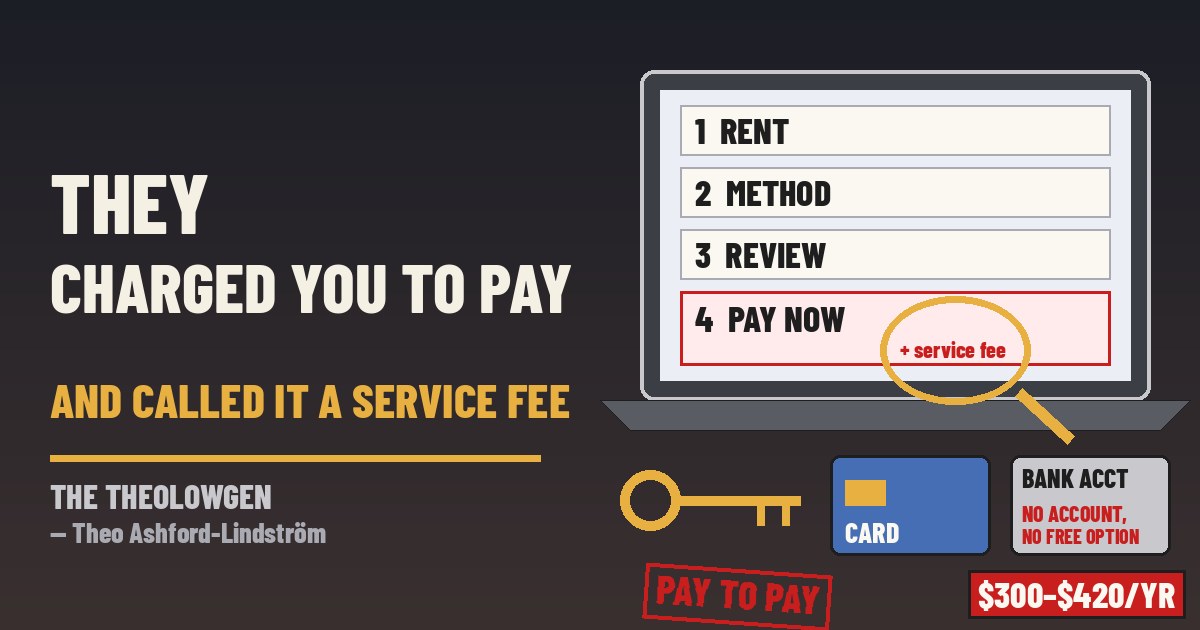
They charged you to pay the rent and called it a service fee. I know the sentence. It is what a platform says when the only thing it sells is the door you are required to walk through, and it sells it to the people least able to walk around it, and the receipt calls the toll a service because “toll” tests poorly with landlords.
Here is the record, which for now is an allegation, and I will treat it like one. On Monday, Oct. 19, 2026, Baltimore Mayor Brandon M. Scott and the City Council sued Yardi Systems LLC and RentCafe LLC, which jointly sell the RentCafe property-management platform, along with Pennrose Management Company LLC, which owns and manages hundreds of units for low-income renters in the city. The Banner reports the complaint was filed in Baltimore Circuit Court by the Washington law firm Relman Colfax. The mechanics, in the city’s own summary of the complaint: RentCafe “steers tenants toward fee-generating payment options by obscuring the fees associated with each payment method behind multiple clicks, embedding fee information across several web pages in fine print, and failing to disclose the fee associated with a selected payment method until the last step of the payment flow.” Tenants get no additional service for the fee. They pay it to pay rent, or they risk late fees or eviction. The Banner fills in the numbers. Pennrose runs nine low-income developments in Baltimore, housing many older adults, people with disabilities and others on low or fixed incomes; rents in the suit run from about $869 for a one-bedroom to $1,654 for four bedrooms. Around 2024, the suit says, Pennrose stopped taking rent in person and moved payments onto RentCafe. Tenants who pay by credit or debit card have faced annual service fees of $300 to $420. The automatic payment option is free — but, per the suit, it is not well advertised, and it is not available to tenants without bank accounts. The fees, the suit says, are not disclosed up front or in the leases.
Now the defense, such as it is so far. The Banner says representatives for the three companies did not immediately respond to a request for comment. So I will not put words in their mouths, and you should not either; a complaint is a story one side tells a judge. But I know the shape of the usual answer, because every convenience fee in America comes with the same one: the option is optional, the free path exists, nobody had to pay. Sit with who “nobody” is here. The free path, per the complaint, requires a bank account. The tenants in question are, by the landlord’s own business model, people who qualify for low-income housing. The city’s release notes that last year four of ten Baltimore renter households spent 35 percent or more of their income on rent and utilities, and for households making $35,000 or less, more than half spent 50 percent or more.
Taryn priced the fee against the twins’ diaper budget and got a month and a half. Buck says he pays his rent the old way, in an envelope, under protest, and has never once been charged for the envelope. I love them. They are seasoning.
“Service” is the alibi. The last step is the story. Sit with the last step until it confesses. A fee that appears only after you have picked your method, typed your card and committed your Tuesday is not a disclosure; it is a dare. And the dare lands on the people who left the bank long ago, or were never let in, because the bank charged them to be poor first. I am not here to canonize City Hall; a city that hired a private firm to file its suit is welcome to file it, but it does not get my rosary. The rent was always a transfer from the people who live in the building to the people who own it. What the platform figured out is that you can stand in the middle of that transfer and take a little off the top, and call the standing a product. That is not technology. It is a turnstile with a terms-of-service page. Read the complaint. Watch what the companies say when they do answer. The cardigan stays. Fill the notebook. Then ask, out loud, what exactly is being serviced.
Sources:
- City of Baltimore, Office of the Mayor, “Mayor Brandon M. Scott and City Take Action Against Property Platform Over Alleged Hidden Fees Targeting Renters,” Oct. 19, 2026
- The Banner, Hallie Miller, “Baltimore sues property manager, software vendors for charging ‘junk fees’,” Oct. 21, 2026
- CBS Baltimore, Renee Anderson, “Baltimore sues RentCafe and property manager over alleged hidden fees,” Oct. 21, 2026
— Theo Ashford-Lindström

Leave a Reply