
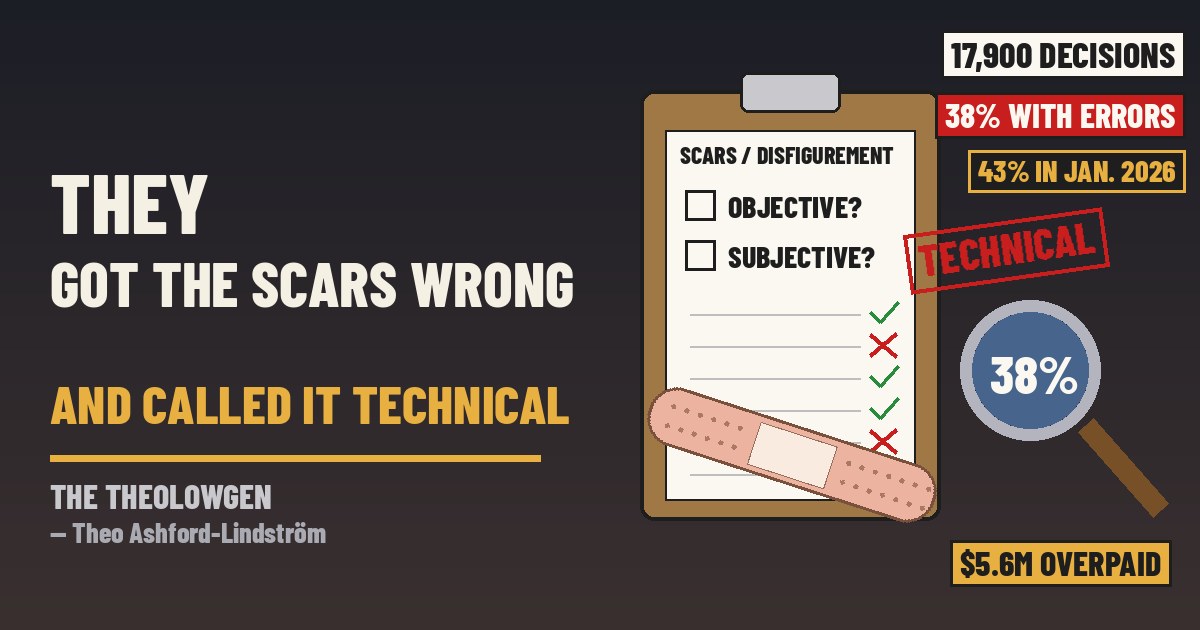
They got the scars wrong and called it technical. I know the sentence. It is what a bureau says when an inspector pulls its homework, finds red ink on more than a third of the pages, and the bureau’s reply is a lecture on sample sizes — as if the math were the defendant and not the decisions.
Here is the record, from the government’s own watchdog. The Department of Veterans Affairs Office of Inspector General issued Report 25-03303-266 on Oct. 21, 2026, and Military Times reported it on Oct. 22. The OIG examined disability decisions in which the Veterans Benefits Administration granted service connection for painful scars, or raised the rating on one, between June 1, 2024, and May 31, 2025 — scars, Military Times notes, from burns, surgeries, shrapnel and gunshot wounds, among other sources. More than a half-million veterans receive VA disability benefits for painful scarring caused or worsened by service. The OIG estimated that about 17,900 of those decisions, 38 percent, contained at least one error, and that at least about 920 of them produced roughly $5.6 million in overpayments “which will continue to accrue until VBA takes corrective action.” That is the conservative number; the report’s own note says the errors were estimated at about $12.5 million in improper payments, and the $5.6 million is the lower-bound scenario. On decisions that increased a rating, the estimated error rate was 58 percent. The biggest categories: about 7,400 decisions with no objective evidence that the scar was painful; about 5,500 that rated the same scars under multiple painful-scar codes, the practice the regulations call “pyramiding”; and about 1,300 where a scar already service-connected became painful and never got the separate evaluation the manual allows — the kind of error where the veteran is the one left short. The inspectors found the exam questionnaire for scars “does not clearly define objective versus subjective evidence,” and that the VA’s claims software flagged pyramiding for other kinds of claims but not for painful scars; a flag was added April 19, 2026, in response to the review. One example: a keloid scar on an ear rated 10 percent with no documented tenderness, an ongoing overpayment that had reached about $6,900 by March 2026 because nobody had fixed it. The OIG briefed the VBA in February 2026, then checked 30 more decisions from January 2026 and found a 43 percent error rate.
Now the defense. The principal deputy under secretary for benefits concurred with all three recommendations — revise the scar questionnaire, make sure employees know how to rate painful scars, and review and correct the decisions the OIG flagged — and Military Times reports the VA aims to finish by February 2027. But the VBA also filed what it called a technical comment. “The OIG examined 130 decisions, representing approximately 0.27 percent of the total review population of about 47,300 decisions,” it wrote. “Importantly, only seven of the 60 errors OIG found resulted in improper payments, which represents about 5.4 percent of the sample, and when viewed across the full review population, only about 0.015 percent of all decisions reviewed. The remaining 53 errors, more than 88 percent of the sample, were technical or procedural issues that did not result in improper payments.” The OIG answered that its estimates are population-based projections and that the size of a sample as a percentage of the population “has very little influence on statistical precision,” and it made no material changes. As of July 17, 2026, the report says, the VBA still had not responded to the OIG’s additional evidence on two errors it disputed — one of them a case where staff carried out an appeals-board decision that itself violated the scar regulation.
Buck has a scar on his shin from a riding mower in 1988 and has told the story so many times that Deb says it is service-connected to the lawn. Taryn says the twins now rate each other’s bandages out of ten. I love them. They are seasoning.
“Technical” is the alibi. The 38 is the story. Sit with it until it confesses. A veteran with a burn scar did not write the questionnaire. He did not build the software that catches pyramiding on every other kind of claim and waved this one through. He did not pick the diagnostic code. The bureau did all of that, for years, at scale, and when its own inspector counted the misses, the bureau’s first instinct was to shrink the denominator. An agency that overpays some veterans and shorts others is not generous and it is not stingy. It is guessing, with the government’s seal on the guess. And watch which way the correction runs. The fix for an overpayment the bureau made is a decision the bureau will make about somebody else’s money, and I will be curious whether the man with the scar or the form that confused his examiner ends up carrying it. I am not asking for the claims to be farmed out to some vendor with a dashboard; the vendor would bill by the decision and call the errors “learnings.” I am asking the office that rates the wound to read the wound. The cardigan stays. Fill the notebook. Then ask, out loud, how many technicalities it takes to add up to a veteran.
Sources:
- Department of Veterans Affairs Office of Inspector General, “Review of Accuracy of Claims Processors’ Disability Evaluation Decisions for Painful Scars,” Report 25-03303-266, Oct. 21, 2026
- VA OIG, full report PDF, Report 25-03303-266
- Military Times, Claire Barrett, “Errors in disability cases for ‘painful scars’ resulted in overpayment: VA watchdog,” Oct. 22, 2026
— Theo Ashford-Lindström

Leave a Reply