
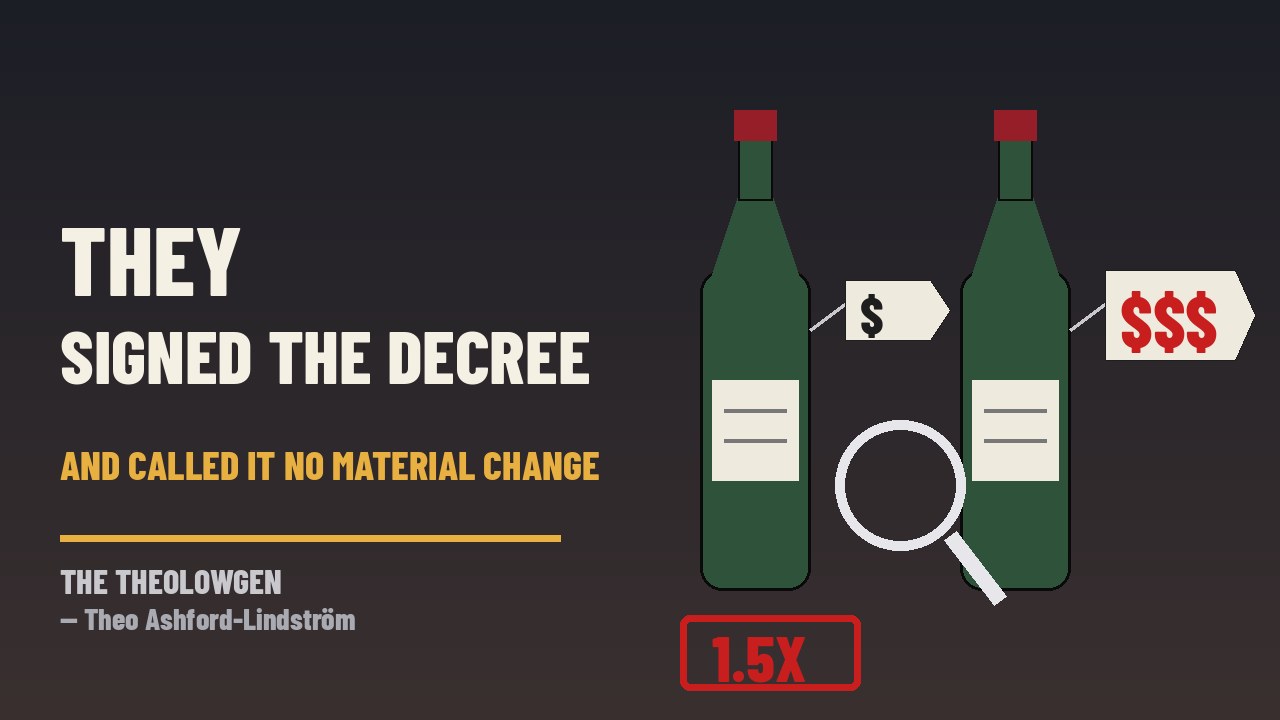
They signed the decree and called it no material change. I know the sentence. It is what a firm says when it has settled a federal case, kept its denial, and wants every chain store buyer to know by Monday morning that the prices are not going anywhere.
On Friday, October 2, 2026, the Federal Trade Commission announced a proposed consent decree with Southern Glazer’s Wine and Spirits, the largest U.S. distributor of wine and spirits, resolving its first Robinson-Patman Act case in a generation. The AP (Dee-Ann Durbin) reports Southern Glazer’s handles one out of every three bottles of wine and spirits in the country and had $26 billion in 2023 revenue from sales to retailers, according to the FTC. The agency sued in December 2024, alleging the company kept small, independent stores from discounts and rebates it gave chains like Total Wine, Walmart and Kroger, sometimes when the stores were a few blocks apart. The 1936 law allows volume discounts only when a seller can show real cost savings. The order covers sales to the five largest chains in 26 states (the suit originally alleged 33; investigators could not show it in seven) and runs for six years. A violation requires price gaps above a state-specific threshold that add up to more than $5,000 over 12 months. When a monitor finds one, Southern Glazer’s can cure it by paying the store 1.5 times the gap; if it does not and the FTC wins in court, the payment is double. FTC Chairman Andrew Ferguson wrote that the monitor is “appointed by and answerable to the Commission, but funded by Southern,” called the order “self-calibrating,” and said, “I did not support this case at its conception.” The vote was 2–0. Southern Glazer’s chief legal and compliance officer, Alan Greenspan, said the company “did not violate—and is not violating—the Robinson-Patman Act” and added: “we do not anticipate material changes to our business or pricing practices.” The San Francisco Chronicle reports California regulators are continuing their own investigation that could touch the company’s state licenses, and that in September the company paid $12.5 million to resolve a Justice Department bribery investigation tied to which wines got shelf space in California supermarkets, acknowledging responsibility for employees’ conduct.
No material change is the alibi, and it is also the confession. A middleman that moves one bottle in three gets to decide what the corner store pays compared with the big box down the road, and when the government finally makes it promise to behave, it tells the press nothing will change. I still hold the anti-capitalist cut. A distributor that size is not a market. It is a gate with a price list. And I am not handing the FTC a medal. The chairman says he never wanted the case. The fix is a monitor the company pays, a $5,000 floor before anything counts, and a cure that works like a late fee. That is not a regulator protecting the small store. It is a regulator writing down a price for doing it anyway. California says it is still looking. I will believe it when a license actually moves.
Buck will say he buys his poker-night whiskey at the big box anyway, which is the whole point, Buck. Cricket will ask whether the little shop by Taryn’s place has heard of any of this. I love them. They are seasoning. The meal is a gatekeeper that signs the paper and tells you the paper changes nothing. I am keeping the cardigan. Fill the notebook. Then ask the corner store owner, in six years, what the monitor ever found.
Sources: Associated Press via ABC News, Oct. 2, 2026; FTC press release, Oct. 2, 2026; Statement of FTC Chairman Andrew N. Ferguson; San Francisco Chronicle, Oct. 2, 2026.
— Theo Ashford-Lindström

Leave a Reply