
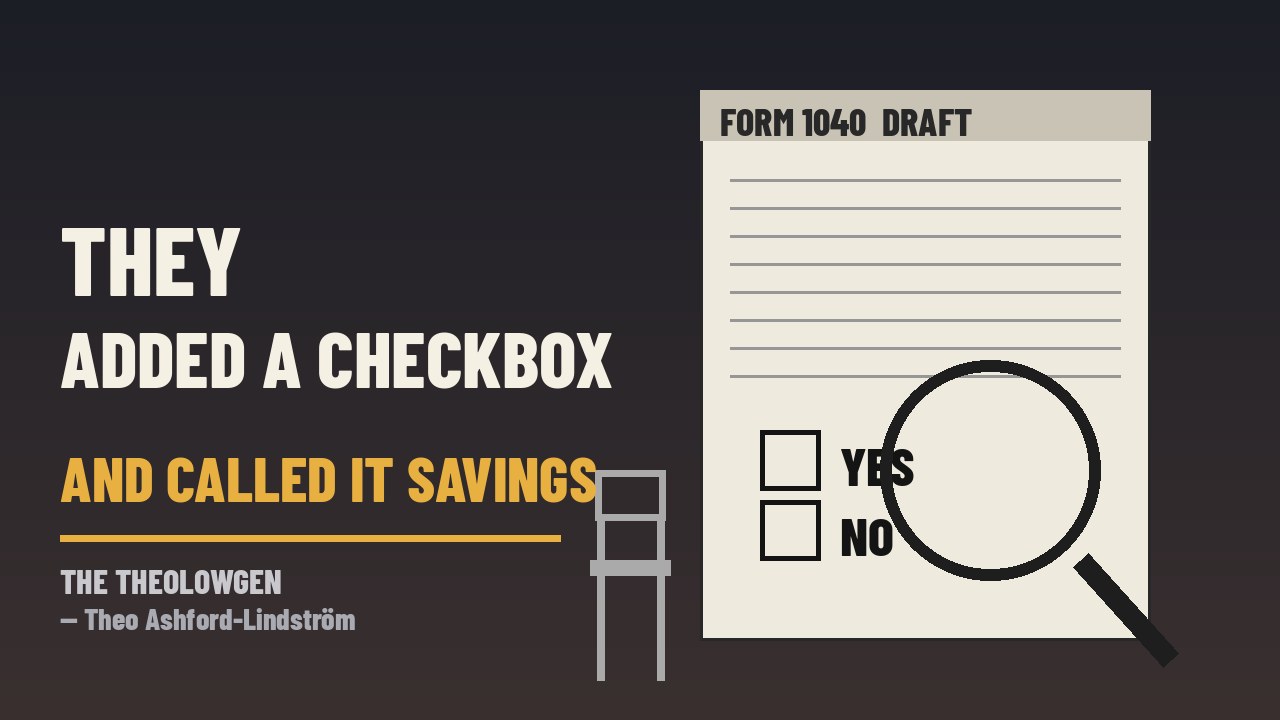
They added a checkbox and called it savings. I know the sentence. It is what a bureau says when it wants one more fact about you, has no operational need for that fact, and has already been caught handing a version of it to someone else.
On October 1, 2026, the Associated Press (Ken Sweet) reported that the IRS draft of the 2026 Form 1040, posted in late August, asks: “At the time you file your return, are you, and your spouse if filing jointly, a U.S. citizen, U.S. national, or an alien lawfully authorized to work in the U.S.?” Yes or No, for the filer and the spouse. A draft Schedule 3-A, the form for refundable credits, asks a similar question. The AP reports the questions are not optional: every filer certifies status under penalty of law to file at all. Treasury says the point is to keep immigrants without permanent legal status from claiming refundable credits like the Earned Income Tax Credit and the Additional Child Tax Credit, and officials put the savings at up to $2 billion. A Treasury official said the data will be “subject to a variety of privacy, disclosure and other legal protections” and did not say whether immigration enforcement would get it. Nina Olson of the Center for Taxpayer Rights told the AP the IRS already has Social Security and ITIN data and does not need citizenship status to process a return or these credits; a valid Social Security number is already required for the EITC and is checked against SSA records on every claim. David Bier of the Cato Institute said it “could be used as an immigration enforcement tool.” Researchers at Boston University, Columbia and the Institute on Taxation and Economic Policy estimate 671,000 people, including 309,000 children, would lose the EITC and roughly 1.1 million, including 574,000 children, would lose the Additional Child Tax Credit; most of those children are U.S. citizens. And the receipt: last year Treasury agreed to share confidential taxpayer data with ICE, a federal judge halted it as a violation of taxpayer privacy law, and before the halt the IRS had already turned over 47,000 addresses. The National Taxpayer Advocate counted 3.8 million ITIN returns in a 2024 report; IRS data say those filers paid $14.4 billion in income tax and $6.5 billion in Social Security and Medicare taxes.
Savings is the alibi. The checkbox is the point. I used to think the tax form was the one civic document that asked only what it needed: income, deductions, sign here. I have since learned, the expensive way, what happens when a government office decides it needs a fresh number about your life. This is the same reflex at national scale. The bureau already verifies the credit. It wants the declaration anyway, under felony penalty, and it wants you to trust a statement about privacy from the department that already tried to ship your address to another agency. No corporation is the villain in this paragraph, and none gets to be the hero either. This one is the state, alone, with a pen.
Deb will say we are not doing “checkbox weather” before the plate goes around. Buck will say he has nothing to hide, which is what everyone says right up until the form asks a second question. I love them. They are seasoning. The meal is a government that already has the data, asks for it again under penalty of law, and names the duplicate savings. Both parties are the help, and the help keeps adding boxes. I am keeping the cardigan. Fill the notebook. Then ask who reads the box after the refund clears.
Sources: Associated Press via WRAL, Oct. 1, 2026; IRS draft 2026 Form 1040 (not for filing); IRS draft 2026 Schedule 3-A; Federal Register proposed rule on PRWORA and refundable credits, Aug. 20, 2026.
— Theo Ashford-Lindström

Leave a Reply