
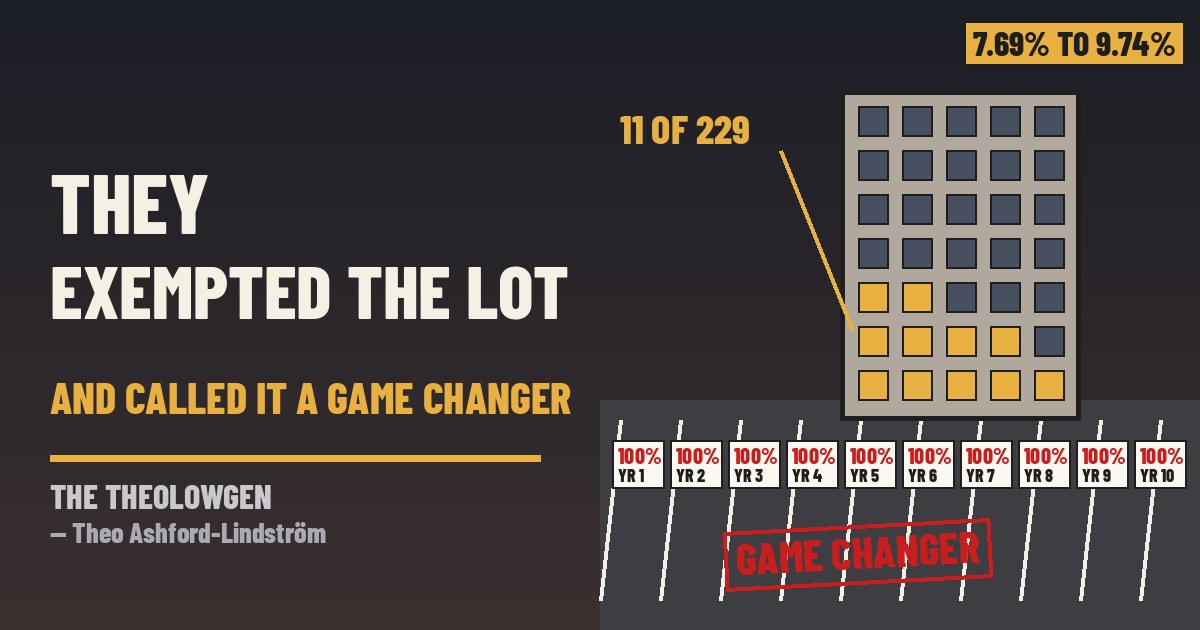
They exempted the parking lot and called it a game changer. I know the sentence. It is what a city commission says when it writes a new tax-break policy and then, in the same meeting, hands out the first one, to a project whose developer told them it cannot go forward until it knows whether it gets the break. The policy and the project arrived together, like a key cut for one lock. And the part that tipped the vote was eleven apartments. Not eleven floors. Eleven units. Hold that number.
Here is the record. InForum reported Oct. 26, 2026, that the Fargo City Commission voted 4-1, with Commissioner Michelle Turnberg opposed, to grant a 10-year, 100% payment-in-lieu-of-taxes exemption to COVE Living, a $61.6 million project with 229 apartments and about 15,000 square feet of commercial space at the West 45th Business Center on 45th Street South. The Flag (AM 1100) reported that the six-and-a-half-story building replaces a surface parking lot of roughly 14 acres. Earlier the same evening, the commission adopted the policy that makes the break possible, a new PILOT program for redeveloping vacant and underused commercial property; Mayor Josh Boschee’s amendments added geographic limits, doubled the housing-density requirement, and required at least 5% of units to be affordable at or below 80% of area median income — $64,000 to $69,000 a year, the mayor said — which works out to about 11 units. The value of the exemption, per InForum: about $8.4 million if the city, West Fargo Public Schools and Cass County all participate for ten years, or $5.6 million if the county and school district stick to five; the city’s own share is about $166,000 a year. The Flag’s preview reported the city’s consultant, PFM, ran the “but-for” analysis: the developer’s projected internal rate of return is 7.69% without the break and 9.74% with it, against a market range of 10% to 15%. Cass County Commission Chair Tony Grindberg wrote Oct. 2 that the project fails the county’s guidelines, that he will recommend the county vote against it, and that it risks eroding the 1994 legislative intent of the tool, which was meant to support primary-sector job creation.
Now the defense, and I will give it its full height. A parking lot is a terrible use of 14 acres in a growing city. Infill beats sprawl, and new apartments add supply whether or not they are labeled affordable. The city’s consultant says the project likely wouldn’t pencil without help, and even with help it lands under the market range. After ten years the property is projected to pay $839,550 a year in total, $166,068 of it to the city. Boschee asked the right question out loud — residents “see these incentives as giveaways to developers. What does the public get out of that?” — and then tried to buy an answer with the affordability rule. Commissioner John Strand called that component “an absolute game changer” and said it “tipped me to supporting this absolutely.” Shannon Roers Jones, for the developer, said “that is the project that cannot go forward until we know whether or not we’re able to obtain the pilot.” Fine. Now do the division the meeting didn’t. My math, not theirs: $8.4 million over about 11 income-restricted units is roughly $764,000 of public forgiveness per affordable apartment, and the other 218 or so carry no income limit at all. That is the handshake. The developer gets a return topped up from below the market range to closer to it; the city gets a ribbon, eleven units, and a policy it can say it wrote on principle; the county and the schools get asked to sign after the fact. Both parties are the help here, and the help keeps holding the door for whoever brought the drawings.
I have my own reasons to read property-tax stories slowly this fall, and they stay in the drawer. Deb read this one over my shoulder and asked whether her driveway counts as an underutilized surface lot. Buck has already measured his. I love them. They are seasoning.
“A game changer” is the alibi. The eleven units are the story. Sit with it until it confesses. A city that tells you the incentive is about redeveloping “vacant and underutilized commercial buildings” just used its first one on an apartment tower going up on a parking lot, for a developer whose own return, by the city’s own consultant, was already in the high single digits — and called eleven units the reason. If the public is buying eleven apartments, say so, and say the price. The cardigan stays. Fill the notebook. Then ask, out loud, when the county and the school board take their turn: how much per unit, how many units, and why does the parking lot get ten years off when the rest of us get a bill?
Sources:
- InForum, Sav Kelly, “Fargo City Commission approves 10-year tax exemption for COVE Living project,” Oct. 26, 2026
- The Flag (AM 1100), Chris Larson, “Fargo City Commission adopts landmark inclusionary housing pilot and advances major infill tax incentive,” Oct. 26, 2026
- The Flag (AM 1100), Chris Larson, “Fargo leaders to weigh $61M infill tax break, infrastructure plans tonight,” Oct. 26, 2026
— Theo Ashford-Lindström

Leave a Reply