
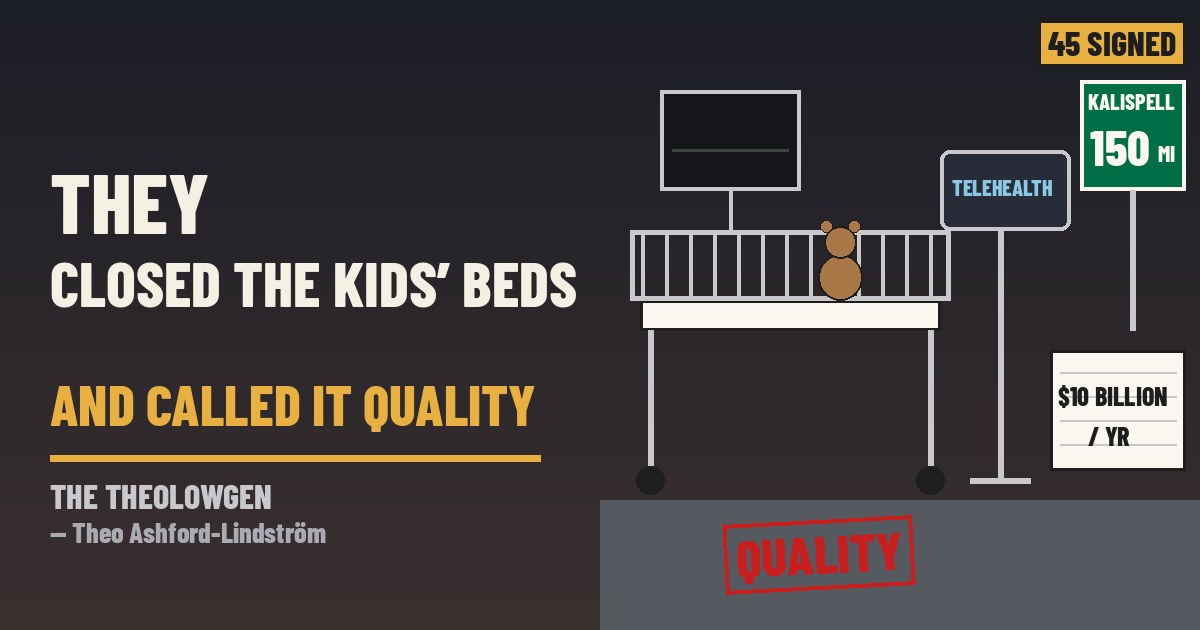
They closed the sickest kids’ beds and called it quality. I know the sentence. It is what a company says when it has done the math on how many children get critically ill in a year, decided the number is too small, and needs a better word than small. Not cost. Not margin. Quality. As if the safest bed for a seizing four-year-old were always the one a helicopter ride away. I am not going to pretend I know more about pediatric critical care than the doctors in this story. I am going to point out which word got picked, and who picked it.
Here is the record. KFF Health News reported Oct. 28, 2026, in a story by Katheryn Houghton that CBS News also carried, that Community Medical Center in Missoula, Montana — owned by Lifepoint Health, a for-profit system that the report says brings in more than $10 billion a year — ended its pediatric intensive care unit this month. The sickest children — a child on a ventilator, a child who needs continuous seizure monitoring — are now stabilized and sent elsewhere, with local doctors consulting pediatric critical care specialists at other hospitals. The nearest pediatric ICU is in Kalispell, about 150 miles north. CEO Greg Cook told KFF Health News that about two kids a month needed intensive care there, and that the last local pediatric intensivist retired eight years ago, leaving the hospital flying specialists in on rotation. “We made the decision to take care of the kids that we could absolutely take care of,” he said, and “It’s about quality more than it is about the dollars.” A Lifepoint spokesperson cited low volumes and staffing, and said, “Our decision was not driven by concerns about the quality of care currently being provided.” Back in June, NBC Montana reported that 45 of the hospital’s nurses and physicians had signed a letter urging it to reconsider the switch to a 24/7 telehealth model taking effect Oct. 1. This is not one hospital’s mood. KFF Health News cites an analysis finding the number of hospitals with pediatric inpatient units fell nearly 30% from 2008 to 2022, from 1,749 to 1,226, leaving three-quarters of U.S. hospitals with no pediatric inpatient services at all. St. Vincent Medical Center in Portland, Oregon, part of the nonprofit Providence system, closed its four-bed pediatric ICU last November. Dr. Elizabeth Mack of the American Academy of Pediatrics called the trend “a spreadsheet issue.”
Now the defense, and it deserves its full weight. Twenty-five critically ill children a year is a hard number on which to keep a unit sharp, and a pediatric intensivist nobody can recruit is not a pediatric intensivist. Dr. Raj Basu of Lurie Children’s Hospital in Chicago warns that hospitals taking on complicated pediatric cases without the doctors or experience could put kids at risk. The Missoula hospital keeps its newborn ICU, pediatric inpatient beds, emergency care and surgeons, and one of its pediatricians, Lauren Wilson, says, “This is still the place I would take my child if they were sick and I was worried.” Cook says asking Lifepoint to float the program wouldn’t have solved the main problem. Fine. Then notice what “quality” is doing in that sentence, and notice the other half of what he said: it’s about quality “more than” it is about the dollars. More than. Hospitals are often paid less to treat children than adults, about half the nation’s kids are covered by Medicaid or CHIP, and pediatric subspecialists earn less than doctors who treat grown-ups; KFF Health News lays that out plainly, and Mack calls it “a very pricey endeavor, and it’s not sustainable.” A company with more than $10 billion a year in revenue decided western Montana’s sickest children were a line it would not carry. And don’t look to Washington to rescue anybody — researchers in the same report warn that federal Medicaid cuts will widen these gaps. Dr. Kenneth Michelson of Lurie Children’s puts it in one sentence I would staple to every hospital board table in America: “this can’t be viewed as a typical good that we get from, like, a grocery store.” The grocery store at least tells you which aisle closed.
Taryn says she has driven the route to the nearest children’s hospital twice this month, both times with nothing wrong, just so she knows the turns in the dark. Deb has put a go-bag by the door with two of everything. Buck checked the tire pressure without being asked. I love them. They are seasoning.
“Quality” is the alibi. The 150 miles is the story. Sit with it until it confesses. A hospital system big enough to report revenue in the billions has decided that two kids a month in western Montana are a cost to be routed somewhere else, and has chosen a word for it that makes the routing sound like care. Maybe the transfers go well. I hope every one of them does. But 45 of its own people put their names on a letter and the answer came back anyway. The cardigan stays. Fill the notebook. Then ask, out loud, before the next board meeting: how far is the nearest bed for a child, who decided that was close enough, and what did the spreadsheet say about it?
Sources:
- KFF Health News, Katheryn Houghton, “Hospital Beds for the Nation’s Sickest Kids Are Disappearing,” Oct. 28, 2026
- CBS News (from KFF Health News), “Hospital beds for the nation’s sickest kids are disappearing,” Oct. 27, 2026
- NBC Montana, “Community Medical Center shifts pediatric ICU to telehealth model amid staff pushback,” June 12, 2026
— Theo Ashford-Lindström

Leave a Reply