
They got undersold by thirty-dollar fiber and called it irrational. I know the sentence. It is the sound a company makes when it spent years as the only fast wire on a lot of streets, and then somebody else ran a second wire and charged less. Not unfair. Not predatory. Irrational. As though the customer who left for a cheaper bill had lost her mind, instead of finally finding a door. I have paid a cable bill. I have spent forty minutes of my one life on hold listening to a jazz loop chosen by a committee. Rational is not the word I would have reached for either.
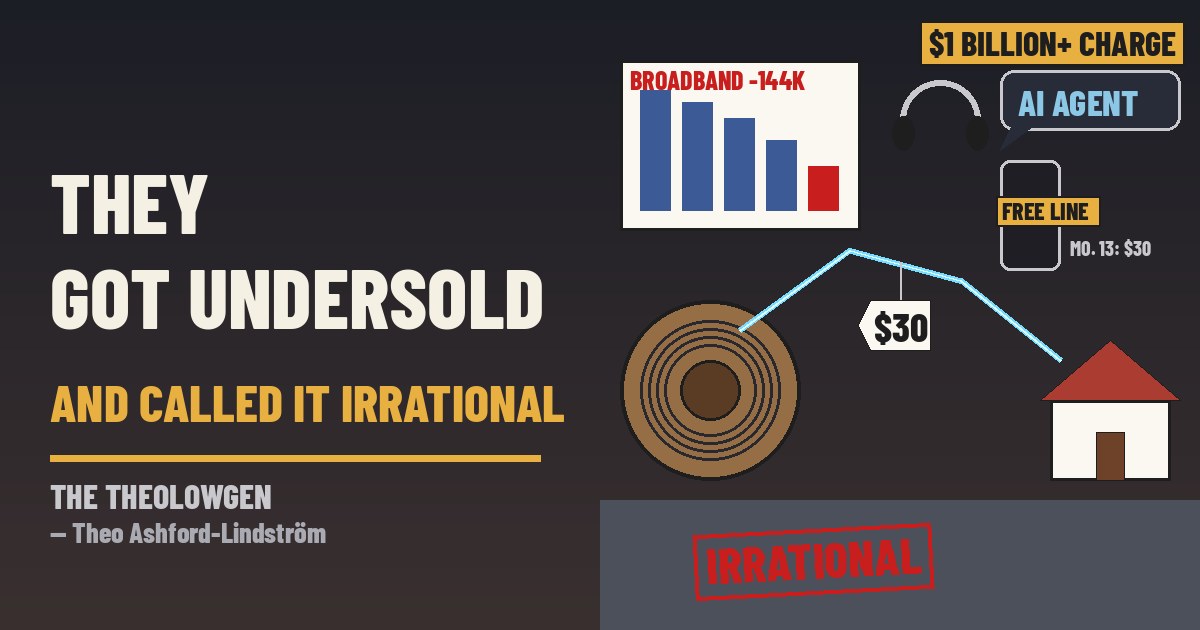
Here is the record. TheStreet reported Oct. 27, 2026, in a story carried by the Ledger-Enquirer, that Comcast is planning “a significant number of job cuts” to its Xfinity broadband, wireless and cable TV business, citing a Bloomberg report, after losing 144,000 U.S. broadband customers and 274,000 U.S. cable TV customers in the third quarter. Domestic broadband revenue fell 4.7% from a year earlier; cable TV revenue fell 8.7%. Ars Technica’s Jon Brodkin, covering the Oct. 22 earnings report, notes the broadband loss was up from 91,000 a year earlier and leaves Comcast with 28.3 million residential broadband customers. On the earnings call, co-CEO Mike Cavanagh described “pockets of irrational pricing and promotional activity,” and CFO Jason Armstrong spelled out what he meant: $30 to $40 monthly broadband offers “in specific markets in the third quarter,” against fiber that costs “$1,500+ per home” to build. “As we look at the return profile of that, to us, that is irrational competition.” In the same call, Armstrong defended Comcast’s own giveaway, a free wireless line for a year: “When we offer a free wireless line, it is against zero capital deployed.” Ars reports that line goes from free to $30 a month after a year, requires a Comcast internet bundle, and that Armstrong said 70% of those free lines convert into paying relationships. Comcast expects to book a charge of more than $1 billion in the fourth quarter for what Cavanagh calls “the most significant operating and cost transformation in our company’s history,” and Armstrong says AI agents built with partners Sierra and Cresta have already helped eliminate more than 30 million service interactions this year. Comcast’s quarterly net income rose, Ars reports, from $3.33 billion to $3.45 billion.
Now the defense, and there is a real one. Building fiber is expensive, and it is getting more expensive; a company is allowed to say it won’t build at a loss, and nobody is owed a gigabit. Comcast also did try the carrot first: TheStreet notes the 2025 refresh with lower everyday prices, one- and five-year price locks and unlimited data, and Armstrong says the company has “reduced historical pain points around promotional pricing expirations.” Fine. Then read who the word “irrational” is aimed at. It is not aimed at the competitor. It is aimed at the price. A $30 bill is irrational if you are the one who used to collect $80. Free is rational, apparently, when it is Comcast’s free and the meter starts in month thirteen. And the customers are not confused: TheStreet cites a Reviews.org survey from March finding 73% of Americans saw their internet bills spike this year, and 67% had switched or were considering switching over hidden or unexpected fees. Even the money men say the quiet part. TheStreet quotes analyst Peter Supino worrying that competition will “divert cost savings into lower broadband prices.” That is the fear. Not that you’ll pay too much — that you might pay less. So the plan is fewer people, more chatbots, a billion-dollar charge and a spinoff, and the company calls that agile. I am not going to tell you the fiber company is your friend. The fiber company is a promo with a contract attached, and its own price will rise the day the cable company finally stops being a threat. But the only rational act anywhere in this story is the 144,000 people who walked.
Taryn says she switched providers in August and the cancellation call took longer than her labor with the twins. Deb keeps the old cable box on the counter “in case they want it back,” which they have not asked. Buck says the free phone line is how they get you, and for once I can’t argue. I love them. They are seasoning.
“Irrational” is the alibi. The 144,000 is the story. Sit with it until it confesses. A company that grew up on being the only choice has discovered that a choice is irrational, a cheaper bill is a threat to its return profile, and the cure for losing customers is to stop paying the people who answer the phone. Maybe the AI agent is lovely. I hope it can find the cancellation button faster than I could. The cardigan stays. Fill the notebook. Then ask, out loud, the next time a nice synthetic voice offers you a retention deal: what is the price in month thirteen, who decided my old price was rational, and how many people did you lay off to keep it?
Sources:
- TheStreet via the Columbus Ledger-Enquirer, Patricia Battle and Celine Provini, “Comcast plans layoffs as customer losses mount,” Oct. 27, 2026
- Ars Technica, Jon Brodkin, “Comcast loses more customers, claims other ISPs’ cheap prices are ‘irrational,’” Oct. 22, 2026
— Theo Ashford-Lindström

Leave a Reply