
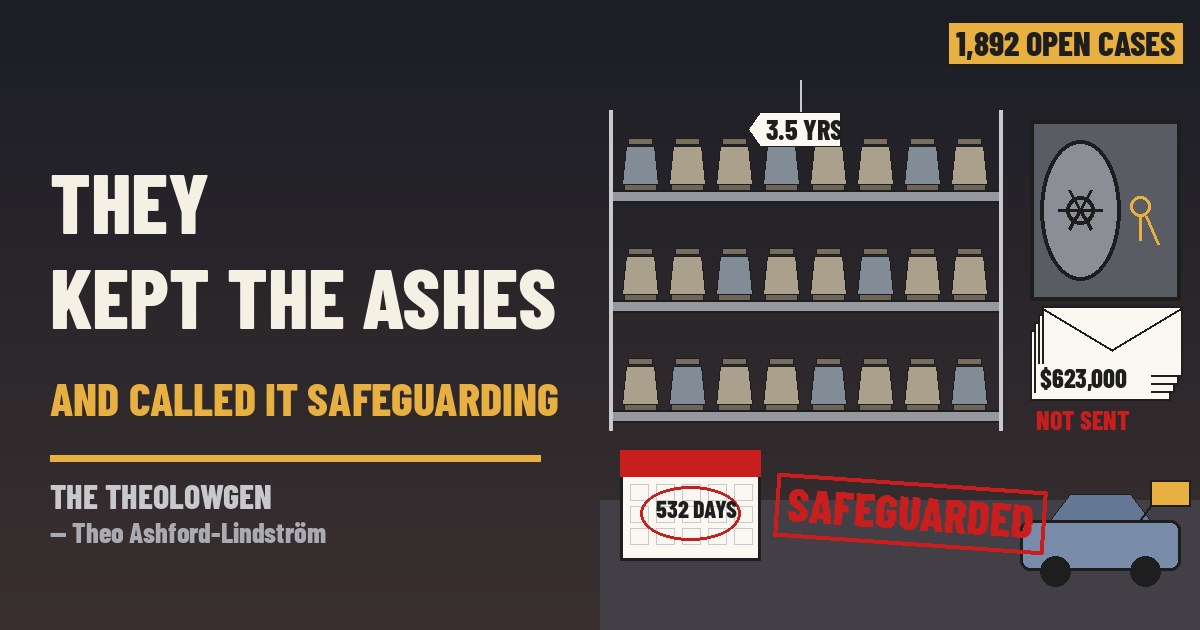
They kept the ashes for three and a half years and called it safeguarding. I know the sentence. It is what a government office says when the dead can’t complain and the living who might have aren’t on any list. There is a particular kind of public power that nobody notices because it only arrives after you are gone: no will, no next of kin, nobody willing, and the county shows up at your door with a clipboard and a key. It takes the car, the jewelry, the rifle, the laptop, the dog if there is a dog, and the box of somebody else’s ashes you kept on the shelf because you loved them. Then it promises to look after all of it. I own a cardigan I intend to be buried in. I would like to know who gets the cardigan.
Here is the record. The Clark County Audit Department, in a report dated October 2026 and titled “Improving Public Administration Processes to Protect and Safeguard Decedents’ Property,” examined the county’s Public Administrator’s Office — an elected, four-year office in Nevada that, the report says, “manages the estates of individuals who pass away without a qualified person willing or able to administer their estates.” It has a $2.5 million budget and a staff of 29, 16 of them full time. As of July 28, 2026, it had 1,892 open cases. The Nevada Independent’s Oona Milliken reports the office closed 1,808 cases during the two-year audit period at an average of 532 days each, that 59 percent of all cases have been open more than two years, 315 more than five years and 34 more than ten, and that it holds more than 147 vehicles in a lot that is almost full and more than 4,500 personal belongings, including firearms and jewelry. It is holding 289 checks, four of them for more than $10,000 and one for more than $42,000, some for years. The report counts 105 human cremains and six pet cremains as of June 4, 2026 — the ashes of other people found inside decedents’ homes — 63 percent of them taken in before 2024, some as early as 2014, held an average of 1,293 days, “or 3.5 years.” The county’s designated crypt space “is full.” The office collected $623,000 in service fees from March 2024 through July 7, 2026, and has not sent that revenue to the county since February 2024; the report says the public administrator “is the only individual who fully understands the remittance process,” and that the monthly remittances stopped shortly after the office spent extensive time tracing a $59,000 fee ledger discrepancy back to a 2002 transaction. Auditors sampled 30 of 4,025 items listed as being in the vault. One, a laptop taken into custody Jan. 1, 2020, and marked for donation in November 2021, could not be found. In one case, investigators returned to a house 70 days after the first visit and found the residence “compromised” and a vehicle missing. And, as the Independent quotes the audit, vault technicians “with physical inventory access, record-editing privileges, and sole auditing responsibility can easily steal items without detection.”
Now the defense, and it is the oldest one in the building. The office’s written management action plan says the backlog “has been impacted due to extremely limited staffing,” and that reaching the goal “is a slow process.” On the fees, it says that once the backlogged payments are submitted, “the routine monthly process that was in place for decades prior to 2023 will be reinstated,” by the end of November. A full vault audit will begin in January 2027. The Independent reports that public administrator Rita Page Reid, who declined the Independent’s request for comment and is not running for re-election, apologized at Wednesday’s audit committee meeting, cited the department’s troubled history and a lack of staff and resources, and agreed to let county staff begin supervising the office. The history is real and it is terrible: her predecessor, Robert Telles, murdered Las Vegas Review-Journal reporter Jeff German in 2022 after German investigated him. Fine. Understaffing is a reason. It is not a crypt. Staffing does not explain keeping no routine inventory of a room full of dead people’s guns, or letting the one person who knows how to send the county its money simply stop. Commissioner Michael Naft, who chairs the audit committee, said it plainly: “I think the hard part is you have no plan.” And then the people running to fix it. Republican Mike Murphy, the interim administrator after Telles, says the audit “provided a roadmap.” Democrat Stephanie Itkin-Goodman says, “The work begins on Day 1 with the county’s audit as our roadmap.” Both parties are the help. They have the same roadmap. Neither one of them is dead, which is the only qualification the clients have.
Deb has already labeled every casserole dish in her kitchen with the name of the grandchild who gets it, and now she wants to know who to call about the urn of Grandpa Lindström’s that has been on Buck’s bookshelf since 1997. Buck says Grandpa is fine where he is. I love them. They are seasoning.
“Safeguarding” is the alibi. The full crypt is the story. Sit with it until it confesses. The state took custody of things nobody could defend — a dead man’s car, a dead woman’s checks, the ashes of whoever those people loved — on the promise that public hands are the careful ones, and then it let the cases age like wine, the vault go uncounted and its own fees go unsent, and wrote “slow process” in the space where a deadline belongs. Nobody voted for that. Nobody could; the clients don’t vote. The cardigan stays. Fill the notebook. Then ask, out loud, at the next audit committee meeting: where is the laptop, when does the crypt get room, and who, by name, is counting the vault on Jan. 4, 2027, when the next administrator walks in?
Sources:
- The Nevada Independent, Oona Milliken, “Audit: Clark County Public Administrator’s Office marred by many ‘high risk’ issues,” Oct. 2026 (updated Oct. 28, 2026)
- Clark County Audit Department, Angela Darragh, Audit Director, “Improving Public Administration Processes to Protect and Safeguard Decedents’ Property,” October 2026
— Theo Ashford-Lindström

Leave a Reply