
They priced your town by the satellite and called it dynamic. I know the word. Dynamic is what a company calls a price when it wants you to hear weather instead of decision. Airlines taught us. Ride apps perfected it. Concert tickets made it a sport. And now the same idea has climbed into orbit and is looking down at a farmhouse in Missouri, deciding what that farmhouse can bear. I used to write admiring pieces about the frontier, at the You Know Who Post, in a cardigan that cost more than a year of rural broadband, about how the sky would liberate the places the cable companies skipped. It did. Then it sent the invoice.
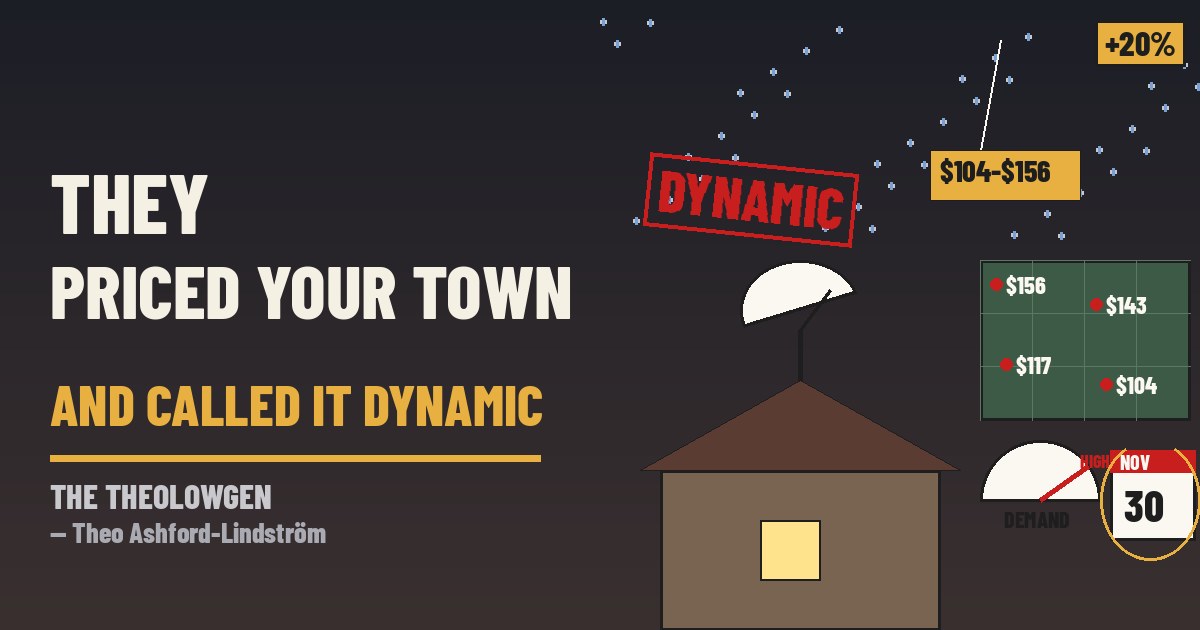
Here is the record. SatelliteInternet.com’s Andreas Rivera reported Oct. 29, 2026, that Starlink appears to be rolling out a dynamic pricing model in which monthly prices rise or fall by customer location, for current and new customers in affected areas, based on emails customers posted online. Reported increases run up to 20 percent, taking a $130 Residential Max plan to $156 a month; one customer got a 10 percent discount, to $117. “Starlink prices are dynamic, based on supply of capacity and demand from customers,” the email reads. “As our constellation grows and network capacity changes, service pricing may change from time to time.” Starlink says it will evaluate pricing roughly quarterly. Starlink had already raised prices for most U.S. customers in the first half of 2026, so for some this is the second increase in a year, and SpaceX, the site notes, recently became publicly traded. TeslaNorth, citing PCMag, reported Oct. 30 that in Missouri one Residential Max customer saw $130 become $156 and another saw a Residential 100 Mbps plan go from $50 to $60.50, both effective on or after Nov. 30. Starlink.com, it reported, currently lists Max at $156 in Rolla, Missouri, and $143 in Warsaw, Missouri, while Kansas City shows $117 and Marysville, Kansas, $104. The company now counts 13.6 million consumer subscribers worldwide. In high-demand places like Alaska and the Pacific Northwest, a one-time “demand surcharge” appears to still be in place.
Now the defense, and it is in the email. The constellation is still being built. The first V3 satellites, launched on Starship, are supposed to bring as much as ten times the downlink capacity; when capacity grows, prices can fall, and some towns already got cuts. Customers are month to month and can change or cancel at any time. Fine. Some of that is true, and I am not going to pretend a dish on a barn has a better option waiting at the end of the gravel road — that is the whole point. Read what the defense is defending. Not a cost. A position. “Supply of capacity and demand from customers” is a polite way of saying the price is whatever the neighborhood can’t walk away from, recalculated every quarter. In Kansas City you have choices, so the sky is cheaper. In Rolla you have fewer, so the sky is $156. The cancel-anytime line is the tell: it is only a freedom if there’s somewhere to go. The machine has not changed since the railroad. It finds the place with one way out and charges at the gate. It just does it from orbit now, with better stationery, and calls the gate a market signal.
Deb says her phone plan is fixed-price and she intends to die on it. Buck says the dish on the lake cabin went up twenty percent and the fish did not. I love them. They are seasoning.
“Dynamic” is the alibi. The town is the story. Sit with it until it confesses. A company with 13.6 million subscribers and new shareholders to please has decided that the same plan costs $104 in one Kansas town and $156 in one Missouri town, and that it will revisit the number four times a year, and has framed that as physics. Maybe the V3 satellites arrive and the needle swings down. I hope it does; the people who signed up because nothing else reached them deserve a price that stays put. But a price that moves with how badly you need it is not a market discovering anything. It is a meter on dependence. The cardigan stays. Fill the notebook. Then ask the next email, out loud, before Nov. 30: what is the capacity number in my cell, what would make my price fall, and why does the same sky cost more over the town with fewer ways out?
Sources:
- SatelliteInternet.com, Andreas Rivera, “Starlink Customers Hit With Price Changes Based on Location,” Oct. 29, 2026
- TeslaNorth, Sarah Lee-Jones, “Starlink Tests Dynamic Pricing, Pushing Some Bills to US$156,” Oct. 30, 2026
— Theo Ashford-Lindström

Leave a Reply