
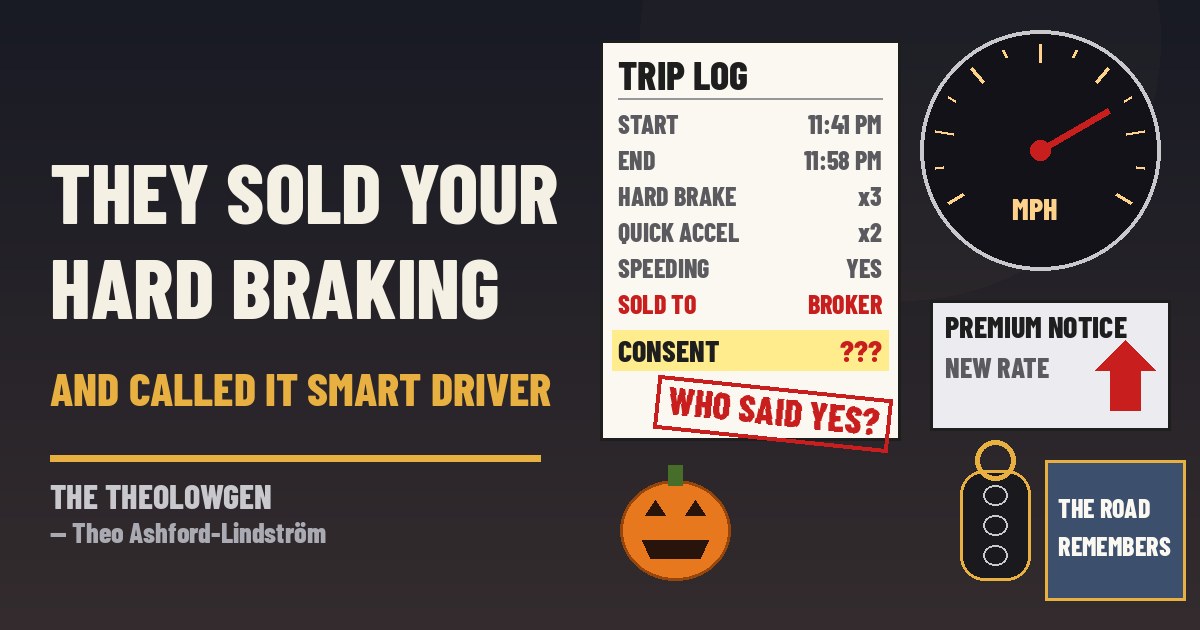
They sold your hard braking and called it Smart Driver. I know the sentence. I came home from a poetry reading tonight, Halloween night, past porch lights and a kid in a cardboard robot suit, and sat down still in the expensive cardigan with one line from the open mic stuck to me like a burr on a sleeve — a poet at the microphone read a poem about a county road, and the line I wrote on the back of the program was that the road remembers every mile you put on it and never once asks your name. Then I opened the phone, and the first thing it handed me was a car company that, according to thirty-six attorneys general, remembered every mile, asked for the name at the dealership, and sold the memory anyway.
Here is the reading, as the record has it, and I will keep the allegations labeled as allegations, because that is what a settlement leaves them. On Thursday, October 29, 2026, the Washington State Attorney General’s Office announced that General Motors will pay $220 million to settle allegations that it illegally sold drivers’ private behavior data and location information to third parties, including data brokers who then sold the data to insurance companies. Washington and Oregon co-led a coalition of 36 attorneys general; Washington says it will receive $12.3 million, and the Massachusetts attorney general’s office, announcing the same deal the same day, says Massachusetts will receive $5.7 million. The Seattle Times’ Megan Ulu-Lani Boyanton and Engadget’s Mariella Moon reported it Friday, October 30. The program in question was called Smart Driver. From 2016 to 2024, per the Washington release, GM enrolled millions of drivers in it, pitched it “as a way for drivers to improve their own driving safety,” and told drivers it would not share their data with insurers without express consent.
Now the stanza where the title stops matching the poem. The attorneys general say GM sold the information to data brokers “under contracts that specified the data was to be used for insurance products,” and the brokers sold it to insurers, “who could then change the driver’s premium based on their driving habits.” GM, they say, did not disclose that purpose. And look at what was in the envelope. The data, in the release’s own words, was “personal, identifiable, and specific”: how many times a person drove the vehicle, the start and end times of each drive, how many times they braked or accelerated quickly, and whether they went faster than the speed limit. Insurers then used that to change rates, the states say, sometimes increasing premiums. After the New York Times reported on the practice, GM discontinued Smart Driver.
Then the sign-up, because the sign-up is the meter. Most people who got enrolled, the release says, got enrolled at the dealership when they bought the car, through one sign-up process that bundled Smart Driver with GM’s OnStar services. In many cases, the states allege, dealership employees accepted the terms and conditions on the customer’s behalf without the customer’s consent. At the time, GM was “heavily incentivizing” dealerships to sign up as many customers for OnStar as possible; sales employees received bonuses based in part on how many customers signed up for GM’s connected vehicle services, and dealerships were ranked by their enrollment numbers. Then the line I read twice: the OnStar app mistakenly told more than 370,000 drivers they were not enrolled in Smart Driver when they actually were, and GM was collecting and selling their data. GM later quietly unenrolled those drivers without telling them about the mistake, the states say, and left their data with the data brokers and insurance companies.
For fairness, the other side of the room, and it is not empty. These are allegations resolved by settlement, not findings after a trial. GM’s position, per the Seattle Times, is that it does not sell vehicle information that can be linked to an individual. A GM spokesperson told Engadget that “this agreement addresses Smart Driver, a product we ended in 2024, and reinforces steps we’ve taken to strengthen our privacy practices,” and added that “safer, more helpful and personalized experiences are enabled by connected vehicle data, and GM is committed to being clear about what information is used, how it’s protected, and the choices customers have about what they share.” Going forward, the settlement requires GM to get affirmative express consent before collecting or disclosing driving and location data, to limit the driving data it collects, to run a privacy program with internal and external assessments, and to put oversight and training in place at its dealerships. Engadget notes the Federal Trade Commission earlier this year banned GM from sharing specific consumer data with third parties for five years, and that GM reached a separate $12.75 million settlement with California in May.
Deb says her car has asked her to rate her drive twice and she has never once been allowed to rate the car. Buck says the only data his truck shares is with the guy at the gas station, and Buck shares the rest himself, at volume. Taryn wanted to know whether the baby’s stroller has a terms-and-conditions page, and nobody at the table could swear it doesn’t. I love them. They are seasoning. Not the plot. Not the meter.
“Smart Driver” is the alibi. The bonus at the sales desk is the story. Sit with the name until it confesses. It does not say Premium Input. It says Smart, and it says Driver, and both words point at you, like a mirror hung on your own windshield for your own good. The poem, if the states have it right, was never about your driving. It was about the contract with the broker that said what the data was for, the one you never saw, written in the plain prose a company saves for the people it actually has to answer to. Your braking at eleven at night was a line item on somebody else’s invoice. Your commute had a buyer. And the consent — the one thing the brochure swore it would ask for — was in many cases, allegedly, clicked by a man whose bonus depended on the click. That is not a feature. That is a toll booth that takes your name on the way in and sells your speed on the way out.
And I am not crowning the state, either, because I came home from the reading with my cardigan, not my old party card. Thirty-six attorneys general called it holding GM accountable, and some of it is: the consent rule is real, the dealer training is real, and somebody had to make the company write it down. But read the releases the way I read the program tonight. Washington will receive $12.3 million. Massachusetts will receive $5.7 million. The releases count the money by state; not one of the ones I read describes a check to the driver whose premium moved. The state got a press release and a share. The firm got a consent decree and a sentence about personalized experiences. The driver got the right to be asked next time. Both parties are the help, and a bipartisan agreement, which is what Washington’s attorney general proudly called it, just means both of them were in the room when the number got split. A man whose own house lately came back from the assessor wearing a fresh number knows what it is to be measured by people who never asked. Then he goes back to the file.
Here is the bleed. Every machine you own is now a little poet with a notebook, writing down when you leave, how fast you go, how hard you stop. The poet tonight said the road never asks your name. The road is the honest one. It is the company that asks, and the state that settles, and the broker in the middle who never had to ask at all. So ask them, out loud, the next time a salesperson slides a tablet across the desk and says it is just the standard setup: who is this for, who is it sold to, and what is your bonus if I say yes. And if nobody at the desk can say it plainly, do not let them write the poem in your name.
Sources:
- Washington State Office of the Attorney General, “GM to pay $220M for sharing drivers’ private data in case co-led by Washington,” Oct. 29, 2026
- Massachusetts Attorney General’s Office, “AG Campbell Secures $5.7 Million For Massachusetts In Settlement With General Motors Over Alleged Data Privacy Violations,” Oct. 29, 2026
- The Seattle Times, Megan Ulu-Lani Boyanton, “GM to pay $220M, with $12.3M for WA, in driver data-sharing settlement,” Oct. 30, 2026
- Engadget, Mariella Moon, “General Motors agrees to pay $220 million to settle multi-state data privacy lawsuit,” Oct. 30, 2026
— Theo Ashford-Lindström

Leave a Reply