
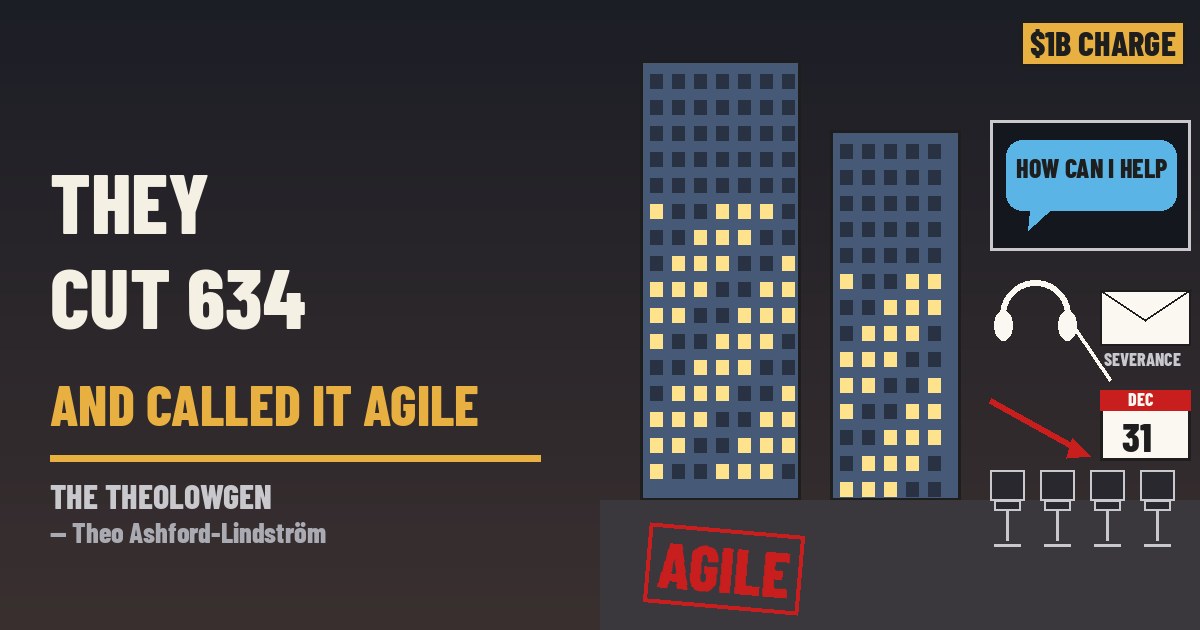
They cut six hundred thirty-four and called it agile. I know the word. Agile is what a company calls itself on the morning it lets people go, the way a man who has just sold his neighbor’s fence calls himself “light on his feet.” Agile used to mean something about software. Now it means the headcount moved and the press release didn’t. I spent years at the You Know Who Post in a cardigan that cost more than a month of the triple-play bundle, writing admiring copy about “transformation,” and I never once asked who was being transformed into what. Last week I sat with Comcast’s 144,000 departing broadband customers. This morning I am sitting with the people who answered their calls, designed their routers and kept the lines up.
Here is the record. Comcast is laying off 634 employees at its Philadelphia headquarters as it pursues a cost-cutting transformation and invests in artificial intelligence, the Philadelphia Inquirer’s Andrew Seidman and Ariana Perez-Castells reported Friday, Oct. 30, 2026, citing a notice filed with Pennsylvania regulators. The layoffs begin taking effect Dec. 31. Comcast also notified regulators it is cutting 119 positions in New Jersey, 159 in Washington state and 82 in California. The cuts hit the two Center City towers at 1800 Arch St. and 1701 JFK Blvd., Technical.ly’s Danya Henninger and Sarah Huffman reported — nearly 8 percent of the more than 8,000 people who work there — and include engineers, product managers, executive assistants, social media analysts, construction specialists, business analysts and IT leaders. The company says it will hire for more than 1,100 new positions, more than 500 of them in Philadelphia, and that affected workers will be considered for other roles or receive severance. On the Oct. 22 earnings call, co-CEO Michael Cavanaugh called it “the most significant operating and cost transformation in our company’s history, with an opportunity we believe will ultimately amount to billions of dollars over time,” WHYY’s Meir Rinde reported; the company will take a $1 billion fourth-quarter charge for the restructuring, and executives have said they are cutting layers and expanding AI agents to handle customer service. Chief financial officer Jason Armstrong had already told a Goldman Sachs conference in September that Comcast had embarked “on the largest cost transformation in the company’s history.” McKinsey & Co. consultants started showing up at headquarters around that time, multiple employees told the Inquirer. Workers described people “crying in the halls or the bathrooms.” Several spoke only anonymously so as not to endanger their severance. Comcast employs about 15,000 people in the Philadelphia region and roughly 180,000 worldwide; its revenue was flat in 2025, its shares hit their lowest level in more than a decade in October, and it lost 144,000 residential broadband customers in the third quarter.
Now the defense, and it was signed by a vice president. “Comcast is fundamentally redesigning our organization to build a more agile company and better serve our customers,” the company said, in a letter to Mayor Cherelle Parker from government affairs vice president Robert Murken. “We are deeply grateful to the colleagues whose roles are affected,” and “Philadelphia is our home.” Fine. The company is losing cable and broadband customers, a laid-off employee told the Inquirer “the writing was on the wall for years,” and some of the 1,100 new jobs will be real. I am not going to pretend a firm owes anyone a desk forever. But read what the defense is defending. Not the customers. The margin. “Better serve our customers” arrives in the same breath as the plan to have AI agents talk to them, and in the same year the customers are leaving for somebody else. A construction-department worker who maintains the network told the Inquirer the work “has to get done” and he doesn’t know who will do it. That is the whole confession: the work stays, the worker goes, the savings are booked as billions “over time,” and the people who were there at the beginning of that time get an envelope. The machine has not changed since the mill town. It just hires McKinsey to name the shift change.
Deb says when the parish switched to an automated phone tree she pressed zero for eleven minutes and then drove over with a casserole to talk to a human. Buck says he has had Comcast at the lake cabin for nineteen years and has never once been served agilely. I love them. They are seasoning.
“Agile” is the alibi. The 634 are the story. Sit with them until they confess. A company that calls this the largest cost transformation in its history, takes a billion-dollar charge to do it, and promises billions back over time has decided that the cheapest customer service is a machine and the cheapest headquarters is a thinner one — and has framed that as a gift to the customer. Maybe the new hires land and the net number shrinks. I hope it does; Philadelphia is a city, not a cost center. But a corporation that calls a layoff “better serving” is not serving anyone but the spreadsheet. The cardigan stays. Fill the notebook. Then ask Comcast, out loud, before Dec. 31: how many of the 1,100 new jobs go to the people losing theirs, which customer calls will a person still answer, and how much of the “billions over time” goes back into the network instead of out to the shareholders?
Sources:
- Philadelphia Inquirer, Andrew Seidman and Ariana Perez-Castells, “Comcast is laying off more than 600 Philly employees amid big cost-cutting transformation,” Oct. 30, 2026
- WHYY, Meir Rinde, “Comcast to lay off 753 employees in Philadelphia and New Jersey in restructuring bid to boost flagging revenues,” Oct. 30, 2026
- Technical.ly, Danya Henninger and Sarah Huffman, “Comcast’s nationwide overhaul will cut 634 jobs at its Philly headquarters,” Oct. 30, 2026
— Theo Ashford-Lindström

Leave a Reply