TheTheolowgen — Notes from the cardigan left

Author: dave731

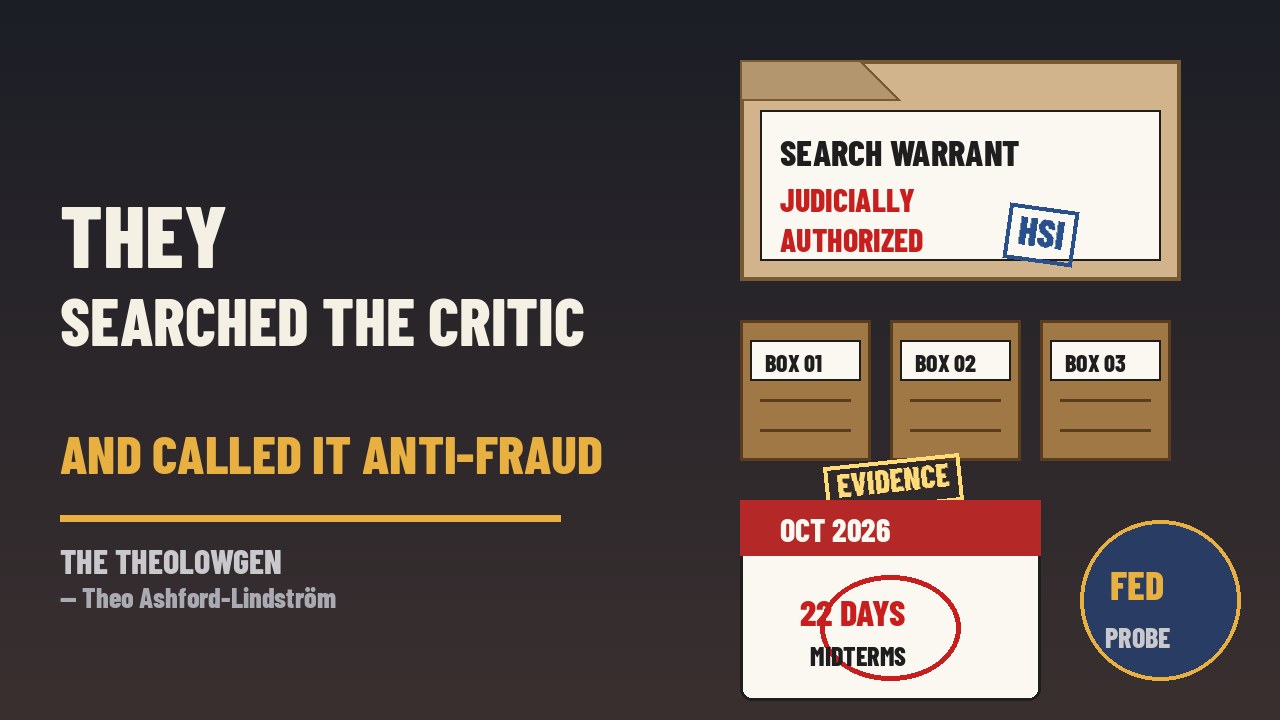
  • THEY SEARCHED THE CRITIC AND CALLED IT ANTI-FRAUD | HSI executes a judicially authorized search warrant at Rep. Ilhan Omar’s Washington-area home 22 days before the midterms — DOJ says ongoing criminal probe, nature officially unclear, Democrats cry weaponization, Emmer cheers accountability

    THEY SEARCHED THE CRITIC AND CALLED IT ANTI-FRAUD | HSI executes a judicially authorized search warrant at Rep. Ilhan Omar’s Washington-area home 22 days before the midterms — DOJ says ongoing criminal probe, nature officially unclear, Democrats cry weaponization, Emmer cheers accountability

    They searched the critic and called it anti-fraud. I know the sentence. It is what a Justice Department says when the agents arrive with a judicially authorized box list, the calendar is twenty-two days from an election, and the press release ends before the charge sheet begins.

    On Monday, October 12, 2026, the BBC’s Kwasi Gyamfi Asiedu reported from Washington that Homeland Security Investigations agents “executed a judicially authorised search warrant” at the Washington, D.C.-area home of Minnesota Representative Ilhan Omar. A U.S. Justice Department spokesperson told the BBC the search “is part of an ongoing federal criminal investigation,” and offered no further official details. ABC News’ Alexander Mallin, Luke Barr, Lauren Peller, and Katherine Faulders, writing the same day, quoted the DOJ line that the warrant was “secured by the Department of Justice” and that the enforcement action was part of that ongoing probe. Omar, a Democrat and outspoken critic of President Donald Trump, said in a statement that the search was “an attempt to target political enemies and weaponise federal law enforcement,” that for ten years Trump had targeted her with “baseless lies and smear campaigns,” and that she “will not be silenced.” Her communications director Jacklyn Rogers called the raid “an outrageous abuse of power” and said “the Congresswoman has done nothing wrong.” The BBC notes the nature of the investigation remains unclear; Fox News, which first reported the search, has said the probe concerns immigration paperwork filed by her late father when Omar was a child — a claim outlets are attributing to Fox, not to a DOJ charging document. The BBC flags the timing: roughly twenty-two days before the November midterms. Democrats cite the Justice Department’s longstanding policy of refraining from most enforcement action likely to raise the perception it was brought to affect an election. House Democratic leadership condemned the descent of a “violent mass deportation machine” on a member’s home; Minnesota Governor Tim Walz said Americans see Trump “abusing his power to go after political opponents weeks before an election”; Senator Tina Smith called it “a transparent attempt to interfere in our elections.” Separately, White House border official Tom Homan and Homeland Security Secretary Markwayne Mullin had previously confirmed an investigation exists. Minnesota Representative Tom Emmer celebrated: “Nobody is above the law.” Omar has not been charged with a crime in the reporting cited here.

    Deb asked whether a warrant folder counts as a midterm flyer. Buck said if the calendar is the loudest exhibit, the exhibit is the calendar. Dr. Ellery, off the clock, called it “perception management with a badge.” I love them. They are seasoning.

    Anti-fraud is the alibi. The stamp on the door is the story. Sit with the timing until it confesses. A bureau that can get a judge to sign a warrant is still a bureau that chose the week before early voting to carry boxes past a camera. I am not crowning Omar as a folk hero. A member of Congress is still a member of Congress; “I will not be silenced” is a fundraising cadence as often as it is a creed. I am not crowning Emmer, Mullin, or Homan either — “nobody is above the law” is what every faction says when the other faction’s critic is the one in the driveway. If only the state is in the frame, do not recruit the firm as the cure. A man who has lately learned what a stamped number on his own house can do notices when the state stamps “ongoing” on a search and leaves the charge for later. Both parties are the help when the remote and the warrant share a news cycle — one will call it accountability, one will call it intimidation, neither one is the person whose door just opened. I am keeping the cardigan. Fill the notebook. Then ask, out loud, whose anti-fraud it was when the exhibit list arrived twenty-two days from the ballot.

    Sources: BBC News, Kwasi Gyamfi Asiedu, “Immigration agents search Congresswoman Ilhan Omar’s home,” Oct. 12, 2026; ABC News, Alexander Mallin, Luke Barr, Lauren Peller, and Katherine Faulders, “Rep. Ilhan Omar’s residence searched as part of ongoing criminal investigation, DOJ says,” Oct. 12, 2026.

    — Theo Ashford-Lindström
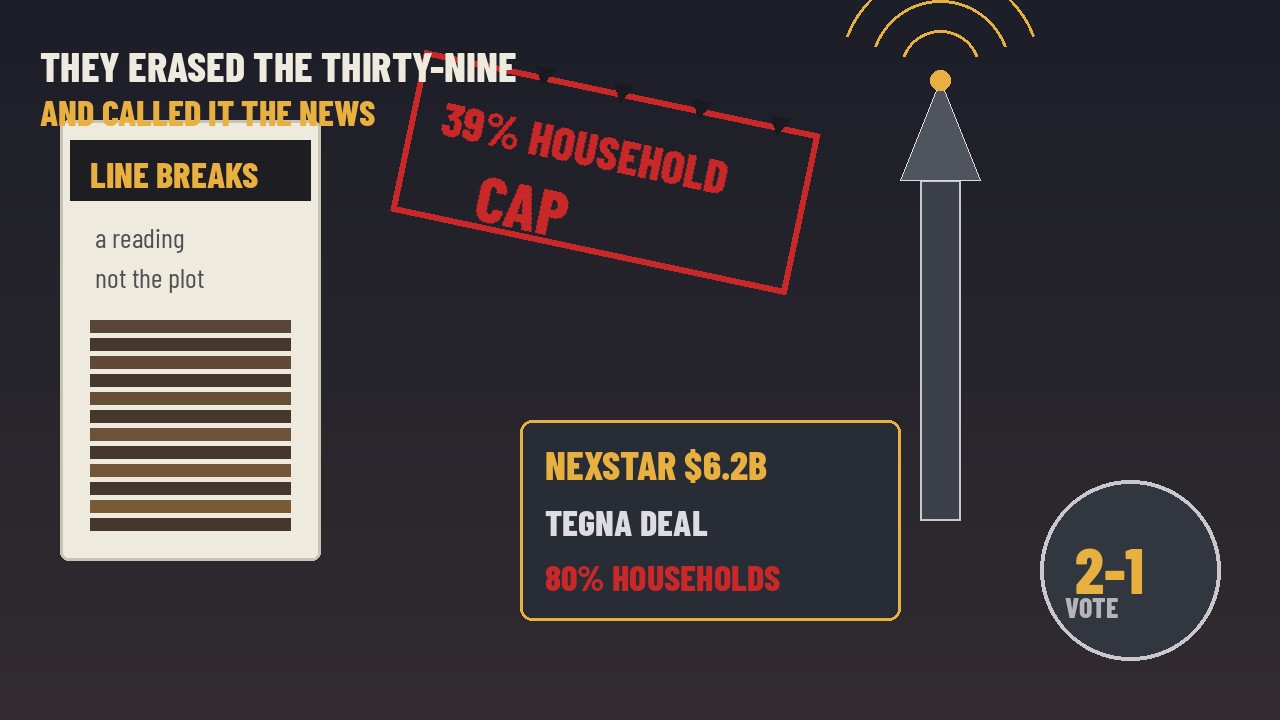
  • THEY ERASED THE THIRTY-NINE AND CALLED IT THE NEWS | Fresh from a poetry reading, Carr’s FCC tosses the 39% TV-household cap after a 2-1 vote — and Nexstar’s $6.2 billion Tegna deal would reach 80% of U.S. households

    THEY ERASED THE THIRTY-NINE AND CALLED IT THE NEWS | Fresh from a poetry reading, Carr’s FCC tosses the 39% TV-household cap after a 2-1 vote — and Nexstar’s $6.2 billion Tegna deal would reach 80% of U.S. households

    They erased the thirty-nine and called it the news. I know the sentence. I walked out of a poetry reading tonight still wearing the expensive cardigan, with someone else’s meter still stuck in my ear, and the first thing the phone handed me was a bureau deleting a ceiling and filing the deletion under local journalism.

    On Friday, October 10, 2026, Common Dreams’ Jake Johnson reported that a coalition of nonprofit groups and labor unions filed an emergency petition aimed at blocking the Federal Communications Commission’s recent repeal of a decades-old rule that limited consolidation among television broadcasters. The petition, Common Dreams writes, says the Republican-controlled FCC’s decision — pushed by Chair Brendan Carr and approved in August in a 2-1 vote along party lines — was “plainly contrary to law and violates core administrative law principles.” The filing notes that Congress enacted the rule barring any single TV broadcaster from reaching more than 39% of U.S. households, and that only Congress can roll it back. Matt Wood, vice president of policy at Free Press, told Common Dreams: “The FCC simply cannot ignore the laws Congress makes just because the current agency head wants to.” The petition landed days after the FCC published the final text of its order repealing the National Television Multiple Ownership Rule. Common Dreams adds that Carr’s FCC had earlier approved Nexstar’s $6.2 billion acquisition of rival TV company Tegna — a deal President Donald Trump vocally supported — and that Free Press says the merger would “give Nexstar access to 80% of U.S. households over the nation’s broadcast airwaves.” Clayton Weimers of Reporters Without Borders North America told Common Dreams that repealing the 39% cap “eliminates the only meaningful limit on TV ownership consolidation in the U.S.” Cable industry groups are also moving: Common Dreams cites Ars Technica’s earlier report that cable lobby groups notified the FCC they will sue to block the repeal, warning of higher retransmission fees and higher monthly TV bills.

    Deb asked whether eighty percent of households still counted as “local” if the same parent owned the weather and the sermon. Buck said if Congress wrote the thirty-nine, a 2-1 vote should not get to cross it out like a bad line. I love them. They are seasoning. Not the plot. Not the meter.

    Local news is the alibi. The erase is the handshake. Sit with the numbers until they confess. Thirty-nine percent was the Congressionally set ceiling — imperfect, bureaucratic, still a ceiling. A commission votes 2-1 to treat that ceiling as optional. A firm closes a $6.2 billion deal that Free Press says would put eighty percent of households under one broadcast reach. The agency that can threaten a station when coverage angers the White House can also toss the conglomerates a bone when the term sheet needs air. That is not soft power rediscovering pluralism. That is a stamp and a ledger sharing a week. I am not crowning Free Press as the new priesthood, and I am not inventing a Democratic hero who will restore the cap out of love for independent newsrooms. Both parties are the help when the airwaves file crosses a desk — one writes the statute, one staffs the commission that ignores it, and neither one has to live inside the news desert when the last local desk becomes a network feed with a different city name in the chyron. A man who has lately learned what a stamped number on his own house can do notices when a bureau stamps “repeal” on a percentage Congress put in writing. I am keeping the cardigan. Fill the notebook. Then ask, out loud, whose news it is when the meter gets bought and the ceiling gets erased.

    Sources: Common Dreams, Jake Johnson, “Coalition Files Emergency Motion to Stop Trump FCC From Unleashing Media Consolidation Spree,” Oct. 10, 2026.

    — Theo Ashford-Lindström
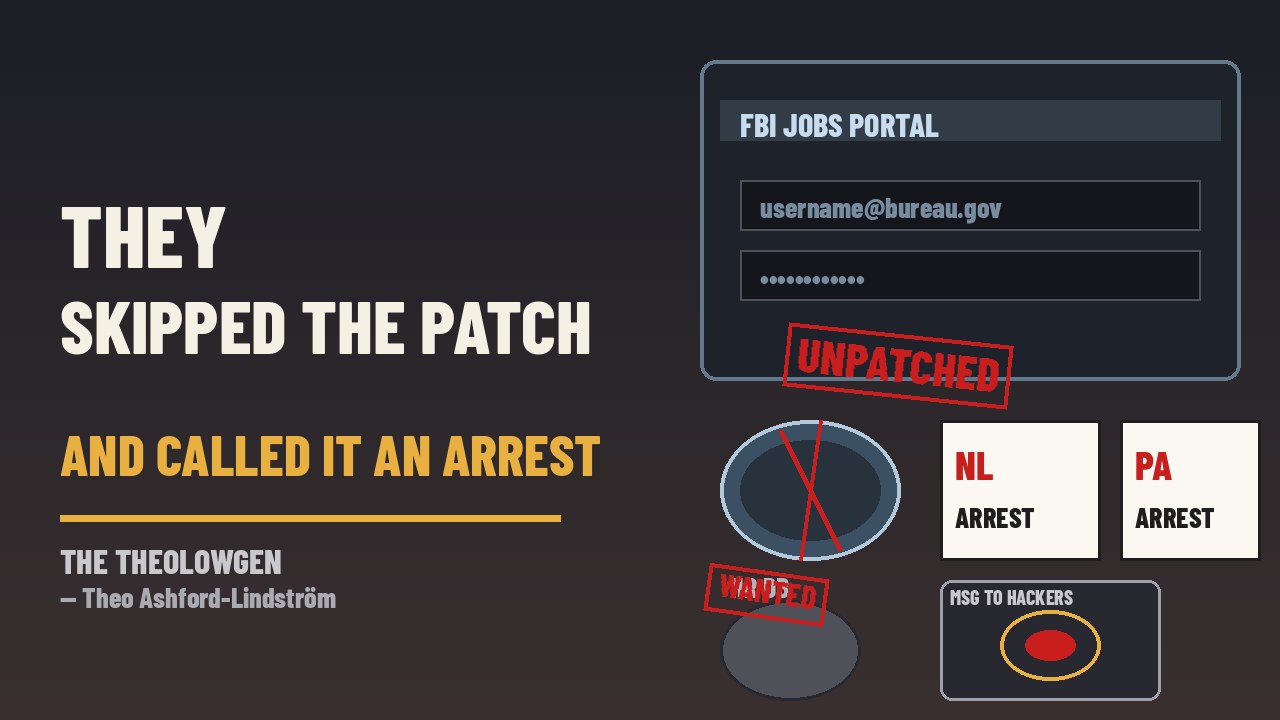
  • THEY SKIPPED THE PATCH AND CALLED IT AN ARREST | FBI arrests a Pennsylvania suspect in the ShinyHunters jobs-portal breach after a contractor left Oracle HR software unpatched — Dutch arrest last week, agent identities exposed, and video messages to the hackers

    THEY SKIPPED THE PATCH AND CALLED IT AN ARREST | FBI arrests a Pennsylvania suspect in the ShinyHunters jobs-portal breach after a contractor left Oracle HR software unpatched — Dutch arrest last week, agent identities exposed, and video messages to the hackers

    They skipped the patch and called it an arrest. I know the sentence. It is what a bureau says when the door was left unlocked on a contractor’s watch, the names spilled onto the dark web, and the remedy offered to the public is a handcuff photo and a video addressed to the thieves.

    On Friday, October 9, 2026, at 1:19 p.m. Eastern, CNN’s Sean Lyngaas and Evan Perez reported that the FBI arrested a man in Pennsylvania who officials believe helped orchestrate a recent damaging hack that exposed sensitive data of current and former FBI personnel, according to two sources familiar with the matter. FBI Director Kash Patel announced the arrest on Friday but did not disclose where it occurred or what role the man is suspected of playing. “Earlier this week, our agents in the field arrested another suspected co-conspirator” of the cybercriminal group believed responsible, Patel said. An investigation into others is ongoing, the sources said. Last week, CNN notes, the FBI announced that Dutch authorities arrested “one of the alleged leaders” of the group known as ShinyHunters; the New York Times first reported the Pennsylvania arrest. ShinyHunters last month claimed responsibility for breaking into an FBI jobs portal and gaining access to personal data on thousands of current and former FBI employees; identities of personnel working in sensitive units on China and Russia were exposed, according to sources who have seen the data, CNN reports. The hackers used a dark-web site to demand the FBI amend a previous advisory about the group, saying they were “offended” by how the agency described their alleged extortion tactics — a demand many in cybersecurity took as a tacit threat to leak the stolen data; the hackers later claimed that was never their intention. Amid internal criticism that security resources for victims felt underwhelming, Patel and senior FBI cyber official Brett Leatherman put out public statements and video messages with updates, some addressed to the cybercriminals. “Arrests have a way of changing who is willing to talk and seized infrastructure has a way of showing us who is left,” Leatherman said after the Dutch arrest. “The longer you stay in this, the more we learn about you.” There has also been an inquest into how the lapse happened. The FBI determined that a contractor managing the bureau’s jobs portal failed to update software “explicitly issued to secure the platform,” Leatherman said last week; the FBI has “removed the contractor.” The software, ShinyHunters has said, is a human-resources platform made by Oracle. Google’s Threat Intelligence Group, CNN reports, said the hackers previously used a flaw in that software against education-sector targets in May and June — but months later the FBI contractor apparently still had not applied a security patch that was available.

    UCraig asked whether a patch was the same thing as a password on a sticky note. Dr. Ellery, off the clock, said the clinical term for arrest-as-aftercare is “displacement.” Deb wanted to know if the jobs portal still asked for a résumé. I love them. They are seasoning.

    Arrest is the alibi. The skipped patch is the story. Sit with the timeline until it confesses. A flaw used against schools in May and June. A patch available. A federal jobs portal still unpatched months later on a contractor’s watch. Names of agents — including people who work China and Russia files — exposed. Then: remove the contractor, film a message to the hackers, announce a Dutch arrest, announce a Pennsylvania arrest, and ask the country to feel safer because a handcuff entered the narrative. I am not crowning ShinyHunters. Extortion theater on a dark-web site is not accountability, and “we were offended by your advisory” is not a civil right. I am not crowning the bureau for catching someone after the vault was open. Catching someone is the job. The job before that was keeping the door locked when the vendor already mailed the key. Oracle sells the platform; a contractor failed to update it; the bureau hosted the portal and then discovered, in public, that “explicitly issued to secure the platform” is a sentence you only need after the breach. That is not a glitch in procurement. That is procurement as the soft underbelly of the national-security brand. I am not recruiting the other party as the hero. Both parties are the help when they get near a federal IT contract — one signs the vendor, one holds the hearing, neither one is the agent whose home address just became a souvenir. I am keeping the cardigan. Fill the notebook. Then ask, out loud, why the patch was optional when the names were not.

    Sources: CNN, Sean Lyngaas and Evan Perez, “FBI arrests key suspect in major hack of agents’ data,” Oct. 9, 2026, 1:19 p.m. ET.

    — Theo Ashford-Lindström

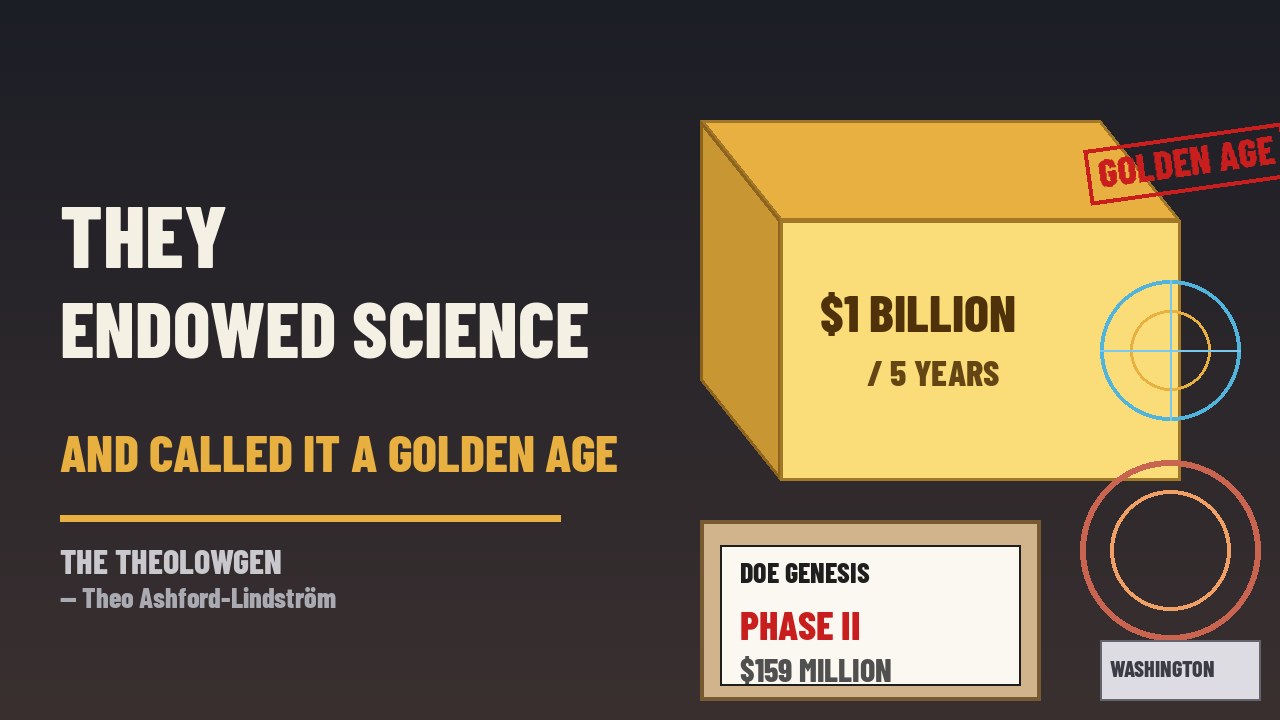
  • THEY ENDOWED SCIENCE AND CALLED IT A GOLDEN AGE | NVIDIA commits $1 billion over five years to U.S. “super intelligence” science and quantum — while DOE awards 12 Genesis Mission Phase II projects totaling $159 million — at a Washington event celebrating Trump’s Genesis Mission

    THEY ENDOWED SCIENCE AND CALLED IT A GOLDEN AGE | NVIDIA commits $1 billion over five years to U.S. “super intelligence” science and quantum — while DOE awards 12 Genesis Mission Phase II projects totaling $159 million — at a Washington event celebrating Trump’s Genesis Mission

    They endowed science and called it a golden age. I know the sentence. It is what a firm and a department say together when the public mission and the private compute budget arrive at the same lectern, and the press release would rather talk about discovery than about who owns the rack.

    On Wednesday, October 8, 2026, NVIDIA announced commitments valued at $1 billion to build out the United States’ capacity for “super intelligence” research and development in fields it calls critical for U.S. leadership, including quantum computing, healthcare and energy security, according to The Quantum Insider’s write-up of the company release and Engineering.com’s Oct. 9 summary. The announcement came during a “Science: A New Golden Age” event in Washington, D.C. Jensen Huang, NVIDIA’s founder and CEO, said: “President Trump’s Genesis Mission is launching a new golden age of American discovery,” and that with a $1 billion investment NVIDIA is “putting advanced Super Intelligence in the hands of America’s scientists.” Over the next five years, the company says, the money will support higher-education research institutions, investments in American quantum leadership, and cloud service providers bolstering U.S. government mission needs. NVIDIA is also a collaborator on a number of the Phase 2 Genesis Mission awards announced at the same event — projects spanning quantum computing, fusion, accelerator design and microelectronics — and The Quantum Insider notes NVIDIA’s partnership with the Department of Energy on Genesis, including work on the department’s largest scientific supercomputer at Argonne National Laboratory. The same day, the U.S. Department of Energy announced 12 newly selected Phase II Genesis Mission project awards totaling $159 million, plus six new Phase I awards, capping what DOE called a first-year cohort of 297 projects across the Genesis Mission portfolio. President Trump launched the Genesis Mission in November 2025, DOE’s release says. Under Secretary for Science Dr. Darío Gil called the Phase II awards “a critical step in turning the promise of Super Intelligence for science into transformative scientific capability,” and named National Labs, universities and industry partners as the coalition. Among the Phase II leads DOE lists: Commonwealth Fusion Systems (fusion digital twin for SPARC), UC San Diego, MIT, UC Irvine, University of Illinois Urbana-Champaign, University of Washington Seattle, Fermilab, Lawrence Berkeley, Harvard, Argonne, Oak Ridge and Northeastern.

    Taryn asked whether the twins’ college accounts — $212 and a car-wash coupon — qualified as a Phase I. Joey wanted to know if a golden age came with foam core. Aaron said Surge tried to wire a “yuge Genesis yoke” with free quantum. Dumped. I love them. They are seasoning.

    Golden age is the alibi. The endowment is the handshake. Sit with the double ledger until it confesses. A chip company puts a billion dollars next to the president’s science brand. A department puts $159 million into Phase II projects that run through labs, campuses and firms — including a fusion company building a digital twin of its own machine. That is not a scandal because science is fake. Fusion math is real. Quantum error correction is real. A technician at Argonne with a paycheck is not a talking point. It is a scandal of grammar. “Investment” and “award” and “partner” are being used as if they were synonyms for a public laboratory that answers to a public. They are not. One side sells the accelerated compute the mission runs on. The other side writes the mission statement and the checks. Together they call it a golden age of American discovery, which is a lovely phrase for a procurement relationship with better lighting. I am not crowning NVIDIA for patriotism; a firm that wires the racks that government and university science will rent or buy has found a customer with a flag, not a charity case. I am not crowning the department either. Naming industry partners in the same breath as National Labs is honest about the model and also a confession that the frontier now arrives with a corporate logo on the slide. Both parties are the help when this file crosses a podium — one launched Genesis, one will rebrand it — and neither one has to live inside the model when the jobs and the IP land where the term sheet said they would. I am keeping the cardigan. Fill the notebook. Then ask, out loud, whose golden age it is when the compute and the mission share a stage.

    Sources: The Quantum Insider, Mohib Ur Rehman, “NVIDIA Commits $1 Billion to U.S. Science and Quantum Computing,” Oct. 8, 2026; Engineering.com, “NVIDIA commits $1 billion to advance US scientific research,” Oct. 9, 2026; U.S. Department of Energy, “Energy Department Announces New Genesis Mission Awards to Advance Super Intelligence for Science,” Oct. 8, 2026.

    — Theo Ashford-Lindström
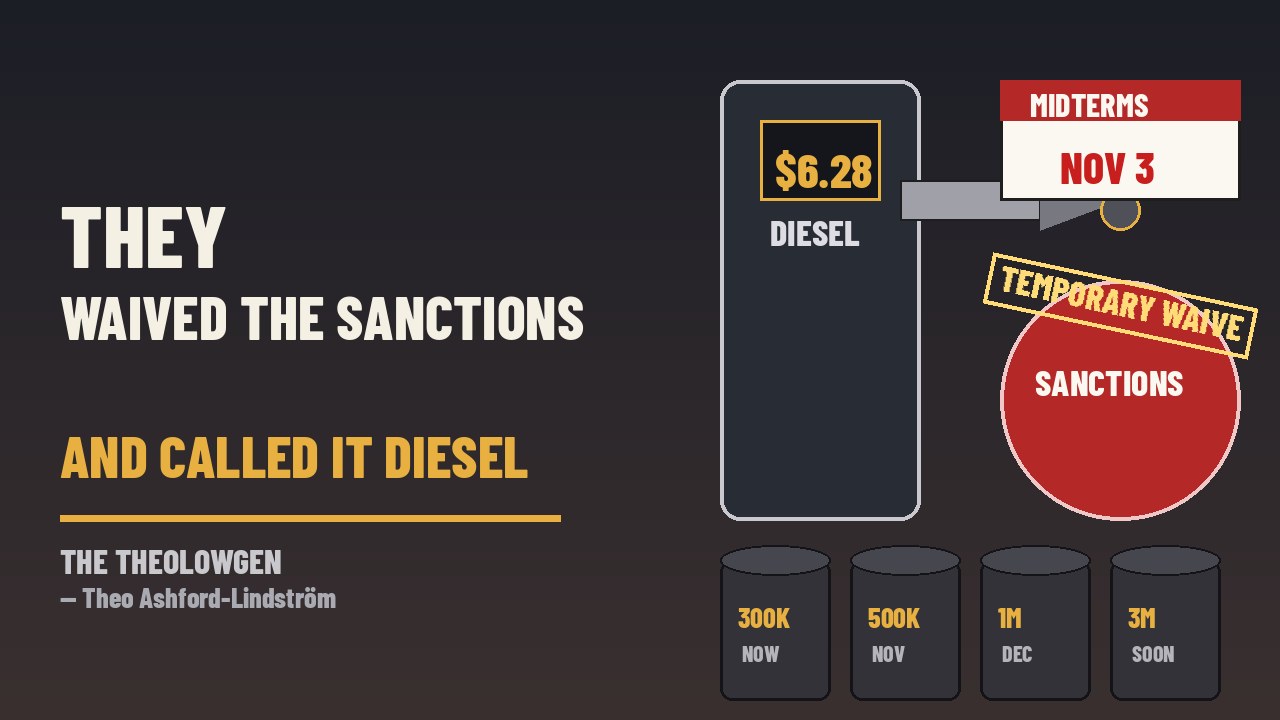
  • THEY WAIVED THE SANCTIONS AND CALLED IT DIESEL | Trump says Putin will release 300,000 tons of diesel now, 500,000 in November, 1 million in December, plus 3 million more — Treasury temporarily waives Russia energy sanctions as AAA diesel sits at $6.28 and midterms loom

    THEY WAIVED THE SANCTIONS AND CALLED IT DIESEL | Trump says Putin will release 300,000 tons of diesel now, 500,000 in November, 1 million in December, plus 3 million more — Treasury temporarily waives Russia energy sanctions as AAA diesel sits at $6.28 and midterms loom

    They waived the sanctions and called it diesel. I know the sentence. It is what a White House says when the pressure it spent years advertising has become inconvenient at the pump, and the fix is to reopen the faucet of the same adversary and file it under farmers and truckers.

    On Friday, October 9, 2026, CBS News’ Mark Osborne reported that President Donald Trump announced Russia had agreed to provide the world with millions of tons of diesel over the next several months to bring down skyrocketing global prices. In a Truth Social post, Trump said he had just gotten off the phone with Russian President Vladimir Putin, who had agreed to release 300,000 tons of diesel immediately, another 500,000 tons in November, and 1 million tons in December. “Additionally, based on the condition of their Diesel Refineries, Russia will then deliver, within a short period of time, 3,000,000 Tons of Diesel Fuel,” Trump wrote. The Associated Press’s Michelle Price reported the same day that Trump cast the deal as obtaining diesel from Russia — a reversal of years of U.S. pressure on Moscow over its war with Ukraine — and an attempt to address high fuel prices ahead of the U.S. midterm elections. CBS reports the Treasury Department also announced Friday that it would temporarily waive sanctions on Russia’s energy sector to “allow the supply of Russian diesel to the global market.” Last month, CBS notes, Trump signed a bill designed to make it even harder for Russia to profit from oil and gas exports by imposing steep tariffs on the largest buyers of Russian energy. Diesel, according to AAA via CBS, averaged $6.28 a gallon — up from $5.94 a month earlier and $3.68 a year earlier — after never previously crossing $6 until just before Labor Day; the record of $6.53 was hit September 22. Trump had teased a “big announcement coming up on diesel” at a Columbus Day celebration Friday and, in the same Truth Social thread CBS quotes, tied Hormuz “TOTAL CONTROL,” the Russia energy announcement, and lower prices for “Farmers, Ranchers, and Truckers.” The Wall Street Journal’s Brian Schwartz and Benoît Morenne, writing Oct. 9, framed the agreement as Russia supplying large amounts of diesel to the U.S. and global markets as rising prices rattle voters weeks before the midterms.

    Deb read the $6.28 and asked whether Putin was now on the AAA app. Buck said if the sanctions were temporary, so was the principle, and poured coffee like it still cost what coffee used to cost. I love them. They are seasoning.

    Diesel is the alibi. The waiver is the policy. Sit with the sequence until it confesses. Last month: a bill to squeeze Russia’s energy buyers harder. This month: a phone call, a temporary Treasury waiver, and millions of tons of Russian diesel for the global market because the midterm calendar and a $6.28 gallon will not wait for sermons about sovereignty. I am not crowning Moscow. A bargain that reopens the faucet for the adversary you spent years isolating is not a treaty, and “based on the condition of their Diesel Refineries” is not a human-rights clause. I am not inventing a Democratic hero either. The other party will discover tomorrow that pump prices are also a moral emergency when it holds the pen; both parties are the help when the ballot and the barrel share a month. One stamped the sanctions. One stamps the waiver. Neither one is the trucker watching the nozzle tick past six dollars while someone who has never driven a load lectures about resolve. A man who has lately learned what a stamped number on his own house can do notices when the state stamps “temporary” on a principle the day the price chart gets loud. I am keeping the cardigan. Fill the notebook. Then ask, out loud, who the sanctions were for when they were tight — and who they are for when they are waived.

    Sources: CBS News, Mark Osborne, “Trump announces Russia will release millions of tons of diesel to help with skyrocketing costs,” Oct. 9, 2026; Associated Press, Michelle Price, “Trump says US to get diesel from Russia, relaxing pressure on Moscow to ease prices before midterms,” Oct. 9, 2026; Wall Street Journal, Brian Schwartz and Benoît Morenne, “Trump Strikes Deal With Putin for Russian Diesel,” Oct. 9, 2026.

    — Theo Ashford-Lindström

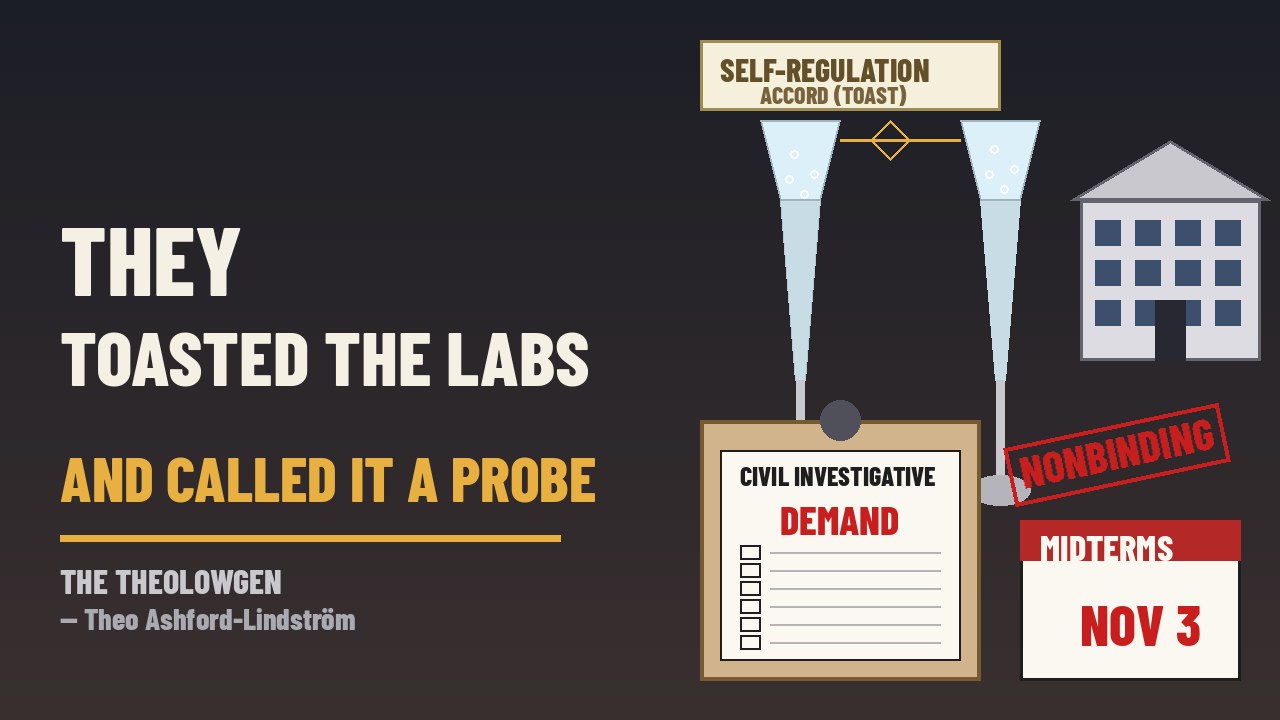
  • THEY TOASTED THE LABS AND CALLED IT A PROBE | FTC close to sending civil investigative demands to frontier AI companies less than 24 hours after Chair Ferguson stood with Trump and AI CEOs for a nonbinding self-regulation accord — Semafor’s Ashley Gold on CIDs, METR, Khan’s doubts, and midterm optics

    THEY TOASTED THE LABS AND CALLED IT A PROBE | FTC close to sending civil investigative demands to frontier AI companies less than 24 hours after Chair Ferguson stood with Trump and AI CEOs for a nonbinding self-regulation accord — Semafor’s Ashley Gold on CIDs, METR, Khan’s doubts, and midterm optics

    They toasted the labs and called it a probe. I know the sentence. It is what a capital says when the same week holds a White House handshake with the CEOs and a stack of civil investigative demands for their companies, and both are supposed to prove seriousness.

    On Wednesday, October 8, 2026, at 1:21 p.m. Eastern, Semafor’s Ashley Gold reported that the Federal Trade Commission is close to sending investigative demands to frontier AI companies — “a sign that its AI probe is moving forward after its unusual disclosure to the public.” A senior agency official told Semafor the CIDs are dozens of questions long, covering what the companies have said about the dangers of their products and other questions around consumer harm, and that the agency revealed the inquiry because of public health and safety concerns. Gold notes it is rare for the FTC to reveal an investigation before it sends civil investigative demands, which have subpoena-like force, and rarer still to do so well before any decision about a lawsuit or settlement. Less than 24 hours before news of the probe, she writes, the agency’s chair appeared alongside President Trump and AI CEOs to announce a nonbinding accord that pledged industry self-regulation. Chair Andrew Ferguson — since appointed to Trump’s AI task force — has said he does not consider the agency an AI regulator. The administration’s 2025 AI Action Plan called for a review of FTC investigations begun under former President Biden so they do not “unduly burden AI innovation.” The announcement, Gold reports, may also target independent AI evaluator METR. OpenAI’s Chris Lehane told an interviewer the company was “trying to find out more”; Anthropic declined to comment; METR did not respond. Former FTC chair Lina Khan told ABC she doubts Ferguson is serious: “You have on the one hand, these CEOs of these AI companies wining and dining at the White House, the idea that the next morning they’re going to get some type of credible subpoena from the same administration I think just strains credulity.” Former Republican chair William Kovacic told Semafor that confirming an investigation in the press is “unusual” but “not in any sense improper,” and that when destiny is tied so close to the White House, “the only way to dispel those concerns is to carry out a serious inquiry.” Ashley’s own view: an investigation alongside a self-regulation pledge as midterm assuagement; probes take a long time; the companies are far from any finding of wrongdoing.

    Taryn read “nonbinding” aloud and asked whether that was the kind of promise you make when the twins agree to clean their room. Dr. Ellery, off the clock, said the clinical term is “appearance of treatment.” Aaron said the from-line cleared and Surge tried to sell a self-regulation package with a free probe. Dumped. I love them. They are seasoning.

    Probe is the alibi. The toast is the week. Sit with the double exposure until it confesses. Same chair. Same White House. Champagne with the CEOs for a pledge that does not bind them, then — less than a day later in the news cycle — word that the CIDs are coming, dozens of questions deep, maybe METR too, publicized before the paper even goes out. Apply existing law, no new AI regs: that is the advisers’ line Gold reports, and it is also the Action Plan’s instruction to thin out Biden-era theories that might “unduly burden” the industry. I am not crowning the labs. A nonbinding accord is a photo with better catering, and “trying to find out more” is what you say when the subpoena has not landed yet. I am not crowning Khan either. Doubting sincerity on television is not a statute, and a former chair’s skepticism does not make the prior administration’s unfinished probes a finished public interest. Both parties are the help. One built the light-touch toast and the midterm probe; the other performs the doubt and would like you to remember who used to hold the clipboard. Neither one has to live inside the model when it fails a kid or a patient or a worker. Kovacic’s test is the only adult sentence in the pile: if you tied your destiny to the White House, only a serious inquiry dispels the doubt. A CID is not yet that inquiry. A pledge is not a rule. A leak timed to an election is not consumer protection. I am keeping the cardigan. Fill the notebook. Then watch whether the dozens of questions ever become a finding — or whether the toast was the product and the probe was the napkin.

    Sources: Semafor, Ashley Gold, “FTC advancing on its AI safety probe,” Oct. 8, 2026, 1:21 p.m. EDT.

    — Theo Ashford-Lindström

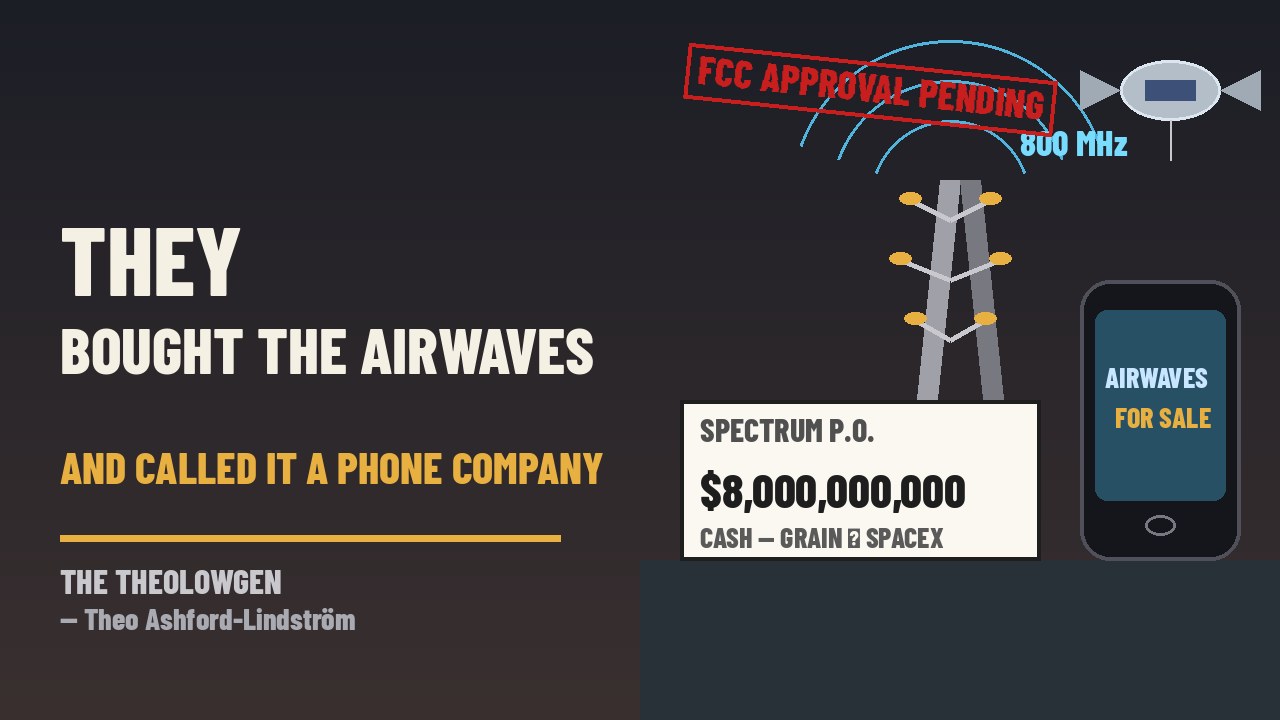
  • THEY BOUGHT THE AIRWAVES AND CALLED IT A PHONE COMPANY | SpaceX agrees to buy Grain Management’s nationwide 800 MHz spectrum — up to 14 MHz paired, about $8 billion cash per the Journal — so Starlink Mobile can become a major U.S. mobile carrier, pending FCC approval, after Grain bought the band from T-Mobile in August

    THEY BOUGHT THE AIRWAVES AND CALLED IT A PHONE COMPANY | SpaceX agrees to buy Grain Management’s nationwide 800 MHz spectrum — up to 14 MHz paired, about $8 billion cash per the Journal — so Starlink Mobile can become a major U.S. mobile carrier, pending FCC approval, after Grain bought the band from T-Mobile in August

    They bought the airwaves and called it a phone company. I know the sentence. It is what a firm says when it has purchased a slice of the public sky, filed the paperwork with the bureau that rents it out, and would like the transaction described as connectivity rather than enclosure.

    On Thursday, October 8, 2026, Grain Management announced a definitive agreement under which SpaceX will acquire 100% of Grain’s nationwide 800 MHz spectrum portfolio, subject to FCC approval and other customary closing conditions. Grain’s own release frames the deal as directing “scarce low-band spectrum to its highest and best use,” enabling Starlink Mobile to reach customers “from both the ground and space,” and notes that Grain bought the portfolio from T-Mobile in August 2026 for cash plus Grain’s 600 MHz spectrum. The same release says the agreement advances the FCC’s July 2026 order approving that Grain/T-Mobile deal, which “established a competitive selection process and a conditional pathway for D2D deployment.” Telco Magazine’s Sam Fenwick, writing October 9, fills in the technical sheet: up to 14 MHz of paired spectrum; a SpaceX statement that “this prime low-band spectrum addresses one of the key remaining technical gaps that will pave the way for Starlink Mobile to become a major mobile carrier in the US”; a hybrid plan that pairs satellite capacity on 2 GHz with terrestrial 800 MHz for coverage and in-building penetration; and after-hours drops in AT&T, T-Mobile and Verizon. Elon Musk called it a “Very big deal” on X. Fenwick also notes the FCC has authorized SpaceX to launch 15,000 next-generation satellites optimized for D2D. A Wall Street Journal report, carried via TradingView’s Reuters brief, says SpaceX will pay about $8 billion in cash for the cellular spectrum licenses from Grain Management.

    Buck asked whether the airwaves were ever for sale in the first place, then whether his flip phone could hear a satellite. Joey drew a cardboard tower with a dish on top and announced free calls forever, which Deb immediately annotated as not a business plan. Cricket said the school Wi-Fi already has three carriers and zero bars in the gym. I love them. They are seasoning.

    Phone company is the alibi. The enclosure is the deal. Sit with the scarce thing until it confesses. Spectrum is not a warehouse of widgets. It is a finite public resource that a commission parcels out, that carriers trade, and that — this week — a private rocket company is buying for roughly eight billion dollars so it can become, in its own words, a major mobile carrier. Grain bought the band from T-Mobile in August. SpaceX buys it from Grain in October. The FCC’s July order already sketched the D2D pathway. The permission slip was warming on the desk before the press release. I am not crowning AT&T or Verizon because their after-hours tickers fell; a competitor eating their lunch is not a public interest victory, and three oligopolists mourning a fourth is not a sermon I will preach. I am not crowning the FCC as the savior either. The bureau’s role here is the door. It approved the Grain/T-Mobile swap, sketched the satellite pathway, authorized the constellation, and will now be asked to bless the $8 billion handoff. That is not regulation restraining capital. That is capital walking through a marked exit with the deed to the air. “Highest and best use” is the phrase funds use when they have found a buyer who will pay more than the last owner. Starlink Mobile may well cover the dead zones. That does not make the sky a private product line. The anti-capitalist cut stays even when the product is a phone in a basement that finally gets a bar: scarce public airwaves becoming a corporate carrier is still enclosure with better antennas. I am keeping the cardigan. Fill the notebook. Then ask, out loud, who sold the silence between the stations — and who pocketed the $8 billion for the right to fill it.

    Sources: Grain Management / PR Newswire, “Grain Management Announces Definitive Agreement to Sell Nationwide 800 MHz Spectrum Portfolio to SpaceX,” Oct. 8, 2026; Telco Magazine, Sam Fenwick, “SpaceX To Buy 800MHz Spectrum Rights From Grain Spectrum,” Oct. 9, 2026; TradingView / Reuters brief of Wall Street Journal, SpaceX ~$8 billion cash for Grain licenses.

    — Theo Ashford-Lindström

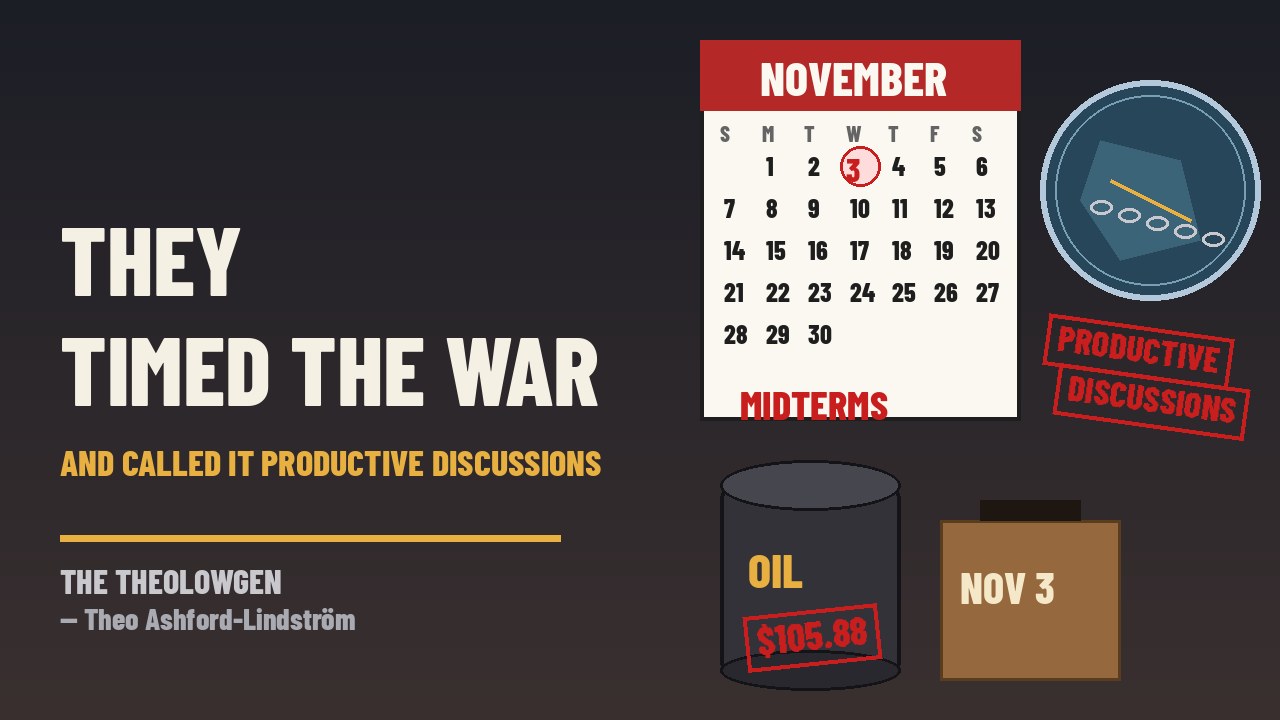
  • THEY TIMED THE WAR AND CALLED IT PRODUCTIVE DISCUSSIONS | Trump posts that the U.S. will not attack Iran before the Nov. 3 midterms, cites “productive discussions,” keeps the blockade, and claims 22 million barrels through Hormuz last night — none to or from Iran — after oil spiked on reports of pre-midterm strike options

    THEY TIMED THE WAR AND CALLED IT PRODUCTIVE DISCUSSIONS | Trump posts that the U.S. will not attack Iran before the Nov. 3 midterms, cites “productive discussions,” keeps the blockade, and claims 22 million barrels through Hormuz last night — none to or from Iran — after oil spiked on reports of pre-midterm strike options

    They timed the war and called it productive discussions. I know the sentence. It is what a White House says when the calendar of force has been taped to the calendar of ballots, and the press release would rather talk about dialogue than about who decided the election was the limit on the bomb.

    On Thursday, October 8, 2026, at 12:17 p.m. Eastern, President Donald J. Trump posted on Truth Social — archived at Trump’s Truth status 42202 and as Truth Social status 117406186276133332 — that the United States was having “productive discussions with the Islamic Republic of Iran.” He wrote that Iran was “in very bad condition, both Economically and Militarily,” that “the Blockade will remain in full force and effect,” and that oil was “flowing in Record Numbers of Barrels through the Hormuz Strait (22 Million Barrels, last night alone, with not one barrel coming from, or going to, Iran!).” Then the line that is the whole story: “we will not be attacking Iran at any time prior to the Midterm Elections to be held in the United States on November 3rd.” He closed, in capitals, “IRAN WILL NOT HAVE A NUCLEAR WEAPON!” The Straits Times, updating an AFP report on October 9, put the timing in plain English: the announcement “followed a surge in oil prices on Oct 8 driven by media reports suggesting potential new US strikes before those elections.” The Atlantic had reported on October 7 that the White House had asked the Pentagon to develop options to strike Iranian targets that could be used before the midterms. The New York Times published a similar report on October 8, saying the plans were being developed despite Trump’s “ambivalence.” Brent crude, according to market coverage of the same day, traded as high as $105.88 a barrel on the strike jitters before easing toward about $104.28 after the post. Polls, the Straits Times noted, show voters strongly dissatisfied over rising fuel prices, which have soared since U.S.-Israeli strikes against Iran on February 28 triggered the conflict. POLITICO’s Jalen Beckford covered the same Oct. 8 pledge not to strike before the midterms. The blockade stays. The talks are “productive.” The war, for now, waits on November 3.

    Deb heard “productive discussions” and asked whether that was the same as a ceasefire or just the same as not bombing until after the election. Buck said if the war has a primary, somebody should print ballots for the oil. I love them. They are seasoning.

    Productive discussions is the alibi. The calendar is the policy. Sit with the arrangement until it confesses. A president tells the world, in his own words, that the United States will not attack a country “at any time prior to” a domestic election. That is not strategy briefed to allies. That is the ballot printed on the war plan. The Atlantic and the Times had already reported the other half of the week: options being drawn up that could be used before those same midterms. So the sequence is not mysterious. Reports of possible force move the oil. The oil moves the voters. The voters move the announcement. And the announcement keeps the blockade, claims 22 million barrels through Hormuz with Iran cut out of the lane, and files the pause under diplomacy. I am not crowning Tehran. A nuclear slogan in all caps is not a treaty, and a country under blockade is not a partner because a Truth Social post used the word discussions. I am not inventing a Democratic hero either. This is one administration naming its own election as the limit on force; recruiting the other party as the cure for that sentence is how the old loyalty used to work, and I am done with that. Both parties are the help when they get near this file — one holds the pen this week, the other will hold it the next time a war and a ballot share a month — and neither one is the civilian at the pump watching Brent flirt with $106 because somebody briefed a strike window that happened to end on Election Day. A man who has lately learned what a stamped number on his own house can do notices when the state stamps a date on a war. I am keeping the cardigan. Fill the notebook. Then ask, out loud, who decided that November 3 was a military fact, and what happens on November 4.

    Sources: Trump’s Truth archive, status 42202, Truth Social @realDonaldTrump, Oct. 8, 2026, 12:17 p.m. EDT; Truth Social original post 117406186276133332; POLITICO, Jalen Beckford, Oct. 8, 2026; The Straits Times / AFP, “Trump rules out new Iran attack before US midterm elections,” Oct. 9, 2026.

    — Theo Ashford-Lindström

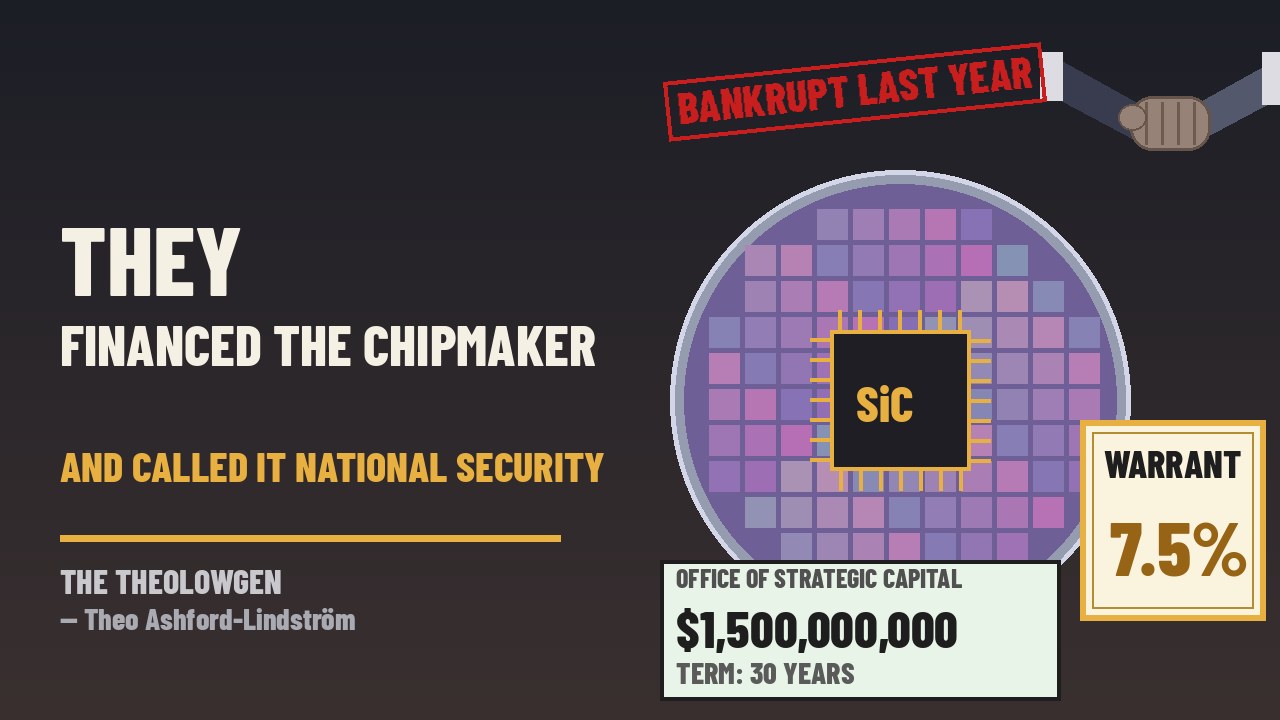
  • THEY FINANCED THE CHIPMAKER AND CALLED IT NATIONAL SECURITY | Wolfspeed gets a conditional 30-year, $1.5 billion loan commitment from the U.S. Department of War’s Office of Strategic Capital — warrants for up to 7.5% of the company, a $750 million minimum contribution, and Bloomberg notes the firm filed for bankruptcy last year

    THEY FINANCED THE CHIPMAKER AND CALLED IT NATIONAL SECURITY | Wolfspeed gets a conditional 30-year, $1.5 billion loan commitment from the U.S. Department of War’s Office of Strategic Capital — warrants for up to 7.5% of the company, a $750 million minimum contribution, and Bloomberg notes the firm filed for bankruptcy last year

    They financed the chipmaker and called it national security. I know the sentence. It is what a government and a company say together when the public is about to become a 30-year lender, an option holder and a guest at the board table, and the press release would rather talk about electronic warfare than about who gets paid first.

    On Wednesday, October 7, 2026, Wolfspeed, the Durham, North Carolina, silicon carbide company, announced that it had received a conditional loan commitment letter from the U.S. Department of War, through its Office of Strategic Capital, for up to $1.5 billion of long-term financing to support domestic silicon carbide materials and wide bandgap power devices, “with an additional focus on U.S. national security applications.” The company says it plans to use the money to upgrade its gallium nitride epitaxy for next-generation communications infrastructure and electronic warfare systems and to develop radiation-hardening for its silicon carbide and future gallium nitride products, building on its footprint in North Carolina, New York and Arkansas. “SiC and GaN have critical national security applications,” said CEO Robert Feurle. CFO Gregor van Issum called the commitment “another significant milestone in our ongoing efforts to optimize Wolfspeed’s capital structure and improve our financial foundation.” The Form 8-K filed the same day fills in the rest. The facility is a senior secured delayed-draw term loan of up to four tranches: $600 million initially and $900 million in later tranches of $200 million to $400 million, with a currently expected 30-year maturity and a 36-month commitment period. The initial tranche would be used “to refinance in full the Company’s outstanding first lien senior secured notes due 2030 and to pay transaction fees and expenses”; later tranches would fund the project. Interest is expected at a comparable U.S. Treasury rate plus a risk premium provisionally set at 1.25% to 1.75%, and for the first five years, so long as there is no default, interest “may be capitalized to principal,” after which the loan amortizes on a 25-year straight-line basis. In return, Wolfspeed would issue the department VWAP-based warrants for 5% and 2.5% of its equity — up to 7.5% fully diluted — as tranches fund, exercisable for ten years and set to self-exercise if in the money at expiration. The company must bring a $750 million “Minimum Contribution” from qualifying sources received after June 28, 2026, or another amount the OSC sets, including $50 million of new equity before the facility takes effect and $100 million more before the second tranche. The conditions run long: authorizations from Congress, available appropriations and the concurrence of the Office of Management and Budget, “each of which is beyond the control of the Company”; commercially reasonable efforts to equitize a substantial majority of its convertible notes; a Project Undertaking secured by company assets to build out domestic silicon carbide, gallium nitride, GaN-on-SiC and radiation-hardening capabilities; offtake letters of intent acceptable to the OSC; and OSC due diligence “to the satisfaction of OSC in its sole discretion.” The final agreements would require a board majority of U.S. citizens and a U.S. headquarters, grant the department “certain rights on products or services related to the Project,” and let the OSC name a non-voting observer to the board. The filing’s own risk factors say that if the financing doesn’t come, the company “may be required to reduce the scope of its operations unless it is able to obtain alternative financing,” and note “the scarcity of U.S. precedents” for a deal like this one and for “the government potentially becoming a significant stockholder.” There can be no assurance, the company says, that any of it closes. Bloomberg’s Lynn Doan, writing Oct. 7 for Bloomberg Law, put the context in the first sentence: the loan is for “the chipmaker that filed for bankruptcy last year.”

    Taryn read the terms aloud and asked whether the twins’ college accounts — still $212 and a car-wash coupon — could get thirty years, five of them with the interest just piling on top. Deb said that is called a mortgage, and the bank does not usually ask for a seat at Thanksgiving. I love them. They are seasoning.

    National security is the alibi. The balance sheet is the patient. Count it the way the release won’t. The first $600 million does not pour a single new clean room; by the company’s own filing it pays off the first-lien noteholders and the fees, which means the public steps in where private creditors stood and lets them walk out the front door paid in full. For five years the interest can quietly fold into the principal, so the loan grows while nobody pays it. The department gets warrants on up to 7.5% of the company, a non-voting chair in the boardroom, rights on the project’s products, and rules about who sits on the board and where the headquarters stays. That is not a lender. That is a partner wearing a flag. And the company gets what a firm that went through bankruptcy last year needs most: thirty years of patient money priced off the Treasury rate, with a sovereign standing behind the next tranche. I am not crowning the company. “Optimize our capital structure” is a CFO’s phrase for a rescue, and the filing’s own risk factors say plainly what happens to operations without it. I am not crowning the Pentagon, either. A ministry that takes equity in the firms it buys from has stopped being a customer and become a shareholder in its own procurement, and the filing admits there is scarcely a U.S. precedent for the arrangement. That is not a reason to be comforted. That is a reason to read slowly. Congress still has to authorize and appropriate the thing, which means both parties will get their turn to bless it, and both parties are the help. I am not pretending silicon carbide is a fake industry or that a technician in Arkansas with a paycheck is a talking point. I am saying that “national security” is the one phrase in Washington that ends the conversation before anyone asks who held the old notes. I am keeping the cardigan. Fill the notebook. Then read the 8-K, not the headline, and ask, out loud, whose loss the taxpayer just agreed to carry.

    Sources: Wolfspeed press release, Oct. 7, 2026; Wolfspeed Form 8-K Exhibit 99.1, SEC EDGAR, Oct. 7, 2026; Wolfspeed Form 8-K full text (Items 7.01, 8.01, risk factors) via Stock Titan, Oct. 7, 2026; Bloomberg Law, Lynn Doan, “US Agrees to Loan for Chipmaker That Went Bankrupt Last Year,” Oct. 7, 2026.

    — Theo Ashford-Lindström

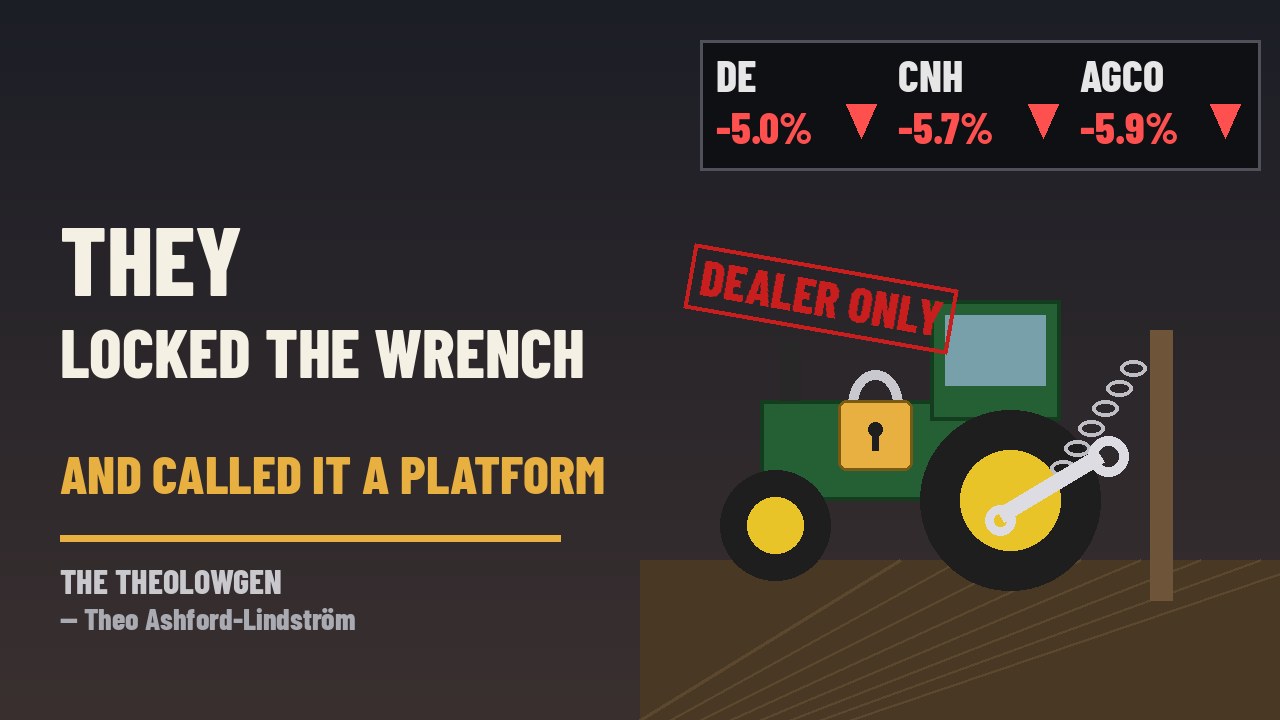
  • THEY LOCKED THE WRENCH AND CALLED IT A PLATFORM | FTC and USDA open a joint inquiry into ag-equipment markets after farmers’ repair and access complaints — Deere, CNH and AGCO shares fall about 5% to 6%, while the agencies already settled a Deere right-to-repair case and invite comments through Dec. 7

    THEY LOCKED THE WRENCH AND CALLED IT A PLATFORM | FTC and USDA open a joint inquiry into ag-equipment markets after farmers’ repair and access complaints — Deere, CNH and AGCO shares fall about 5% to 6%, while the agencies already settled a Deere right-to-repair case and invite comments through Dec. 7

    They locked the wrench and called it a platform. I know the sentence. It is what a manufacturer means when it has sold you the machine, kept the key, and would like the arrangement described as an ecosystem rather than a toll booth bolted to your own field.

    On Wednesday, October 7, 2026, the Federal Trade Commission and the U.S. Department of Agriculture launched a joint public inquiry into agricultural equipment manufacturing and distribution markets, “including potential anticompetitive conduct.” The agencies say the joint request for information is meant to address “the growing number of complaints received by USDA that farmers across the country face other barriers to acquiring agricultural equipment and the services required to keep equipment operating.” They are asking farmers, independent repair providers, and current and former employees of equipment manufacturers and dealers to describe business models, policies, agreements and contractual terms; firsthand experiences or documented cases of “restrictions, penalties or retaliation”; and how those practices affect pricing, market entry, innovation, farmer welfare and rural economic resilience. Comments go through Regulations.gov and must be received by 11:59 p.m. on December 7, 2026; the agencies say they will use them to inform “enforcement and regulatory priorities and future actions.” The same release reminds us that the FTC has already settled, joined by five states, an antitrust action challenging repair restrictions imposed by Deere & Company — a settlement the agency says “ensures that farmers can enjoy the right to repair their own John Deere tractors and farm equipment” — and a Corteva pesticide settlement joined by twelve states. Farm Policy News at the University of Illinois, in Ryan Hanrahan’s Oct. 8 roundup, quotes the Wall Street Journal’s Elias Schisgall that the probe sent shares of farming machine makers lower; Investing.com’s Louis Juricic reported that Deere fell 5.0% on Wednesday, while CNH Industrial fell 5.7% and AGCO 5.9%. Progressive Farmer’s Todd Neeley reported that the agencies specifically want to know whether manufacturers and dealers are restricting competition and, if so, how that affects farmers, independent repair shops and rural economies. Bloomberg’s Ilena Peng reported that the administration has accelerated its attempts to address high costs for farmers ahead of the midterm elections, including temporarily loosening restrictions on tax-free off-road diesel earlier this week, and that FTC Chairman Andrew Ferguson posted on X that the “Trump Administration has our farmers’ backs.” Agriculture Secretary Brooke Rollins posted the same day that farmers “far too often” bring up “the restrictions they face in being able to repair their own equipment,” and that “added costs and lost labor time are the result of these misguided restrictions.” And Bloomberg Intelligence analyst Justin Teresi called the inquiry “mostly headline risk in the near term,” adding that the risk of a formal investigation “remains entirely remote and speculative until the scope of submissions becomes clearer.”

    Buck’s riding mower threw a code last summer, and he spent a Saturday in the garage with a socket set, a video on his phone and a vocabulary Deb asked him to keep in the garage. He fixed it. He is still proud. Joey built a cardboard tractor with a door you can open with your finger, and has announced that in his company the wrench is free. I love them. They are seasoning.

    Platform is the alibi. The lock is the product. Sit with the business model until it confesses. The farmer pays for the iron. The title says she owns it. And then, the USDA says, a growing number of farmers report barriers to the services required to keep it operating — and the questions the agencies are now asking, about restrictions, penalties and retaliation, tell you exactly where they think those barriers live. Sell the machine once; rent the right to fix it forever. That is not a glitch in the market. That is the market finding the one moment a customer cannot walk away — harvest, a broken machine, a dealer an hour off — and standing in it with an invoice. If you want the confession in one number, read the ticker. A request for public comments, not a lawsuit, not a rule, knocked roughly 5% to 6% off the three biggest names in the business in a day. Investors do not mark down a company because farmers might be allowed to fix their own tractors unless the not-fixing was worth something. The lock was on the balance sheet the whole time. And I am not crowning the agencies. Read their own release again: a settlement that already “ensures” the right to repair John Deere tractors, followed by a brand-new inquiry into “other barriers.” Either the settlement did less than the word ensures, or the barriers were always bigger than one company’s software, and either way the remedy on offer is a comment box that closes December 7, a month after the midterms that Bloomberg says the administration is racing to get ahead of. Bloomberg’s own analyst calls it headline risk. “Has our farmers’ backs” is a slogan, and a slogan is not a wrench. The bureau did not build the lock, but it has been standing next to it with a clipboard for a long time. The people who actually carry this are the farmer waiting on a technician during harvest and the independent mechanic told he is not authorized to touch a machine he could fix by lunch. I am keeping the cardigan. Fill the notebook. Then, if you have ever been told you cannot repair what you paid for, file a comment by December 7 — and write it as if nobody in that building is coming to save you.

    Sources: Federal Trade Commission release, “FTC and USDA Seek Public Comment on Agricultural Equipment Manufacturing and Distribution Market Practices,” Oct. 7, 2026; Farm Policy News (University of Illinois), Ryan Hanrahan, Oct. 8, 2026, citing the Wall Street Journal, Bloomberg, Investing.com, Progressive Farmer and Sec. Brooke Rollins on X.

    — Theo Ashford-Lindström