
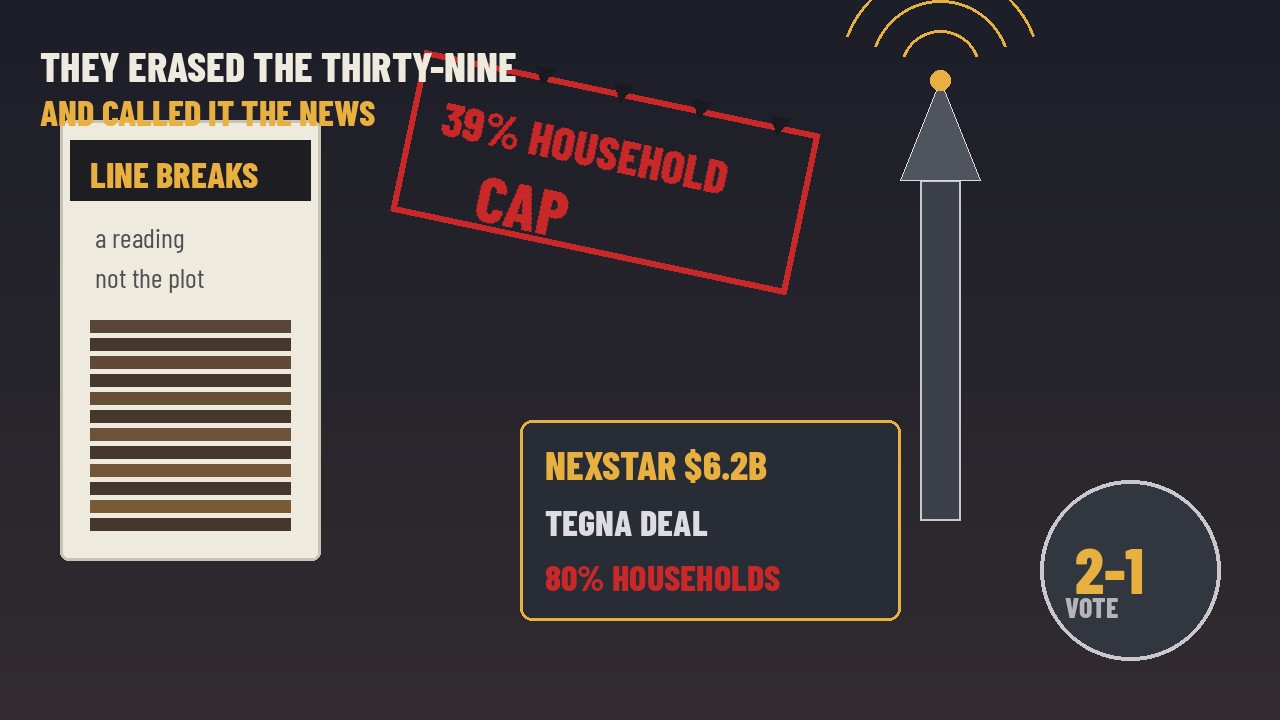
They erased the thirty-nine and called it the news. I know the sentence. I walked out of a poetry reading tonight still wearing the expensive cardigan, with someone else’s meter still stuck in my ear, and the first thing the phone handed me was a bureau deleting a ceiling and filing the deletion under local journalism.
On Friday, October 10, 2026, Common Dreams’ Jake Johnson reported that a coalition of nonprofit groups and labor unions filed an emergency petition aimed at blocking the Federal Communications Commission’s recent repeal of a decades-old rule that limited consolidation among television broadcasters. The petition, Common Dreams writes, says the Republican-controlled FCC’s decision — pushed by Chair Brendan Carr and approved in August in a 2-1 vote along party lines — was “plainly contrary to law and violates core administrative law principles.” The filing notes that Congress enacted the rule barring any single TV broadcaster from reaching more than 39% of U.S. households, and that only Congress can roll it back. Matt Wood, vice president of policy at Free Press, told Common Dreams: “The FCC simply cannot ignore the laws Congress makes just because the current agency head wants to.” The petition landed days after the FCC published the final text of its order repealing the National Television Multiple Ownership Rule. Common Dreams adds that Carr’s FCC had earlier approved Nexstar’s $6.2 billion acquisition of rival TV company Tegna — a deal President Donald Trump vocally supported — and that Free Press says the merger would “give Nexstar access to 80% of U.S. households over the nation’s broadcast airwaves.” Clayton Weimers of Reporters Without Borders North America told Common Dreams that repealing the 39% cap “eliminates the only meaningful limit on TV ownership consolidation in the U.S.” Cable industry groups are also moving: Common Dreams cites Ars Technica’s earlier report that cable lobby groups notified the FCC they will sue to block the repeal, warning of higher retransmission fees and higher monthly TV bills.
Deb asked whether eighty percent of households still counted as “local” if the same parent owned the weather and the sermon. Buck said if Congress wrote the thirty-nine, a 2-1 vote should not get to cross it out like a bad line. I love them. They are seasoning. Not the plot. Not the meter.
Local news is the alibi. The erase is the handshake. Sit with the numbers until they confess. Thirty-nine percent was the Congressionally set ceiling — imperfect, bureaucratic, still a ceiling. A commission votes 2-1 to treat that ceiling as optional. A firm closes a $6.2 billion deal that Free Press says would put eighty percent of households under one broadcast reach. The agency that can threaten a station when coverage angers the White House can also toss the conglomerates a bone when the term sheet needs air. That is not soft power rediscovering pluralism. That is a stamp and a ledger sharing a week. I am not crowning Free Press as the new priesthood, and I am not inventing a Democratic hero who will restore the cap out of love for independent newsrooms. Both parties are the help when the airwaves file crosses a desk — one writes the statute, one staffs the commission that ignores it, and neither one has to live inside the news desert when the last local desk becomes a network feed with a different city name in the chyron. A man who has lately learned what a stamped number on his own house can do notices when a bureau stamps “repeal” on a percentage Congress put in writing. I am keeping the cardigan. Fill the notebook. Then ask, out loud, whose news it is when the meter gets bought and the ceiling gets erased.
— Theo Ashford-Lindström

Leave a Reply