
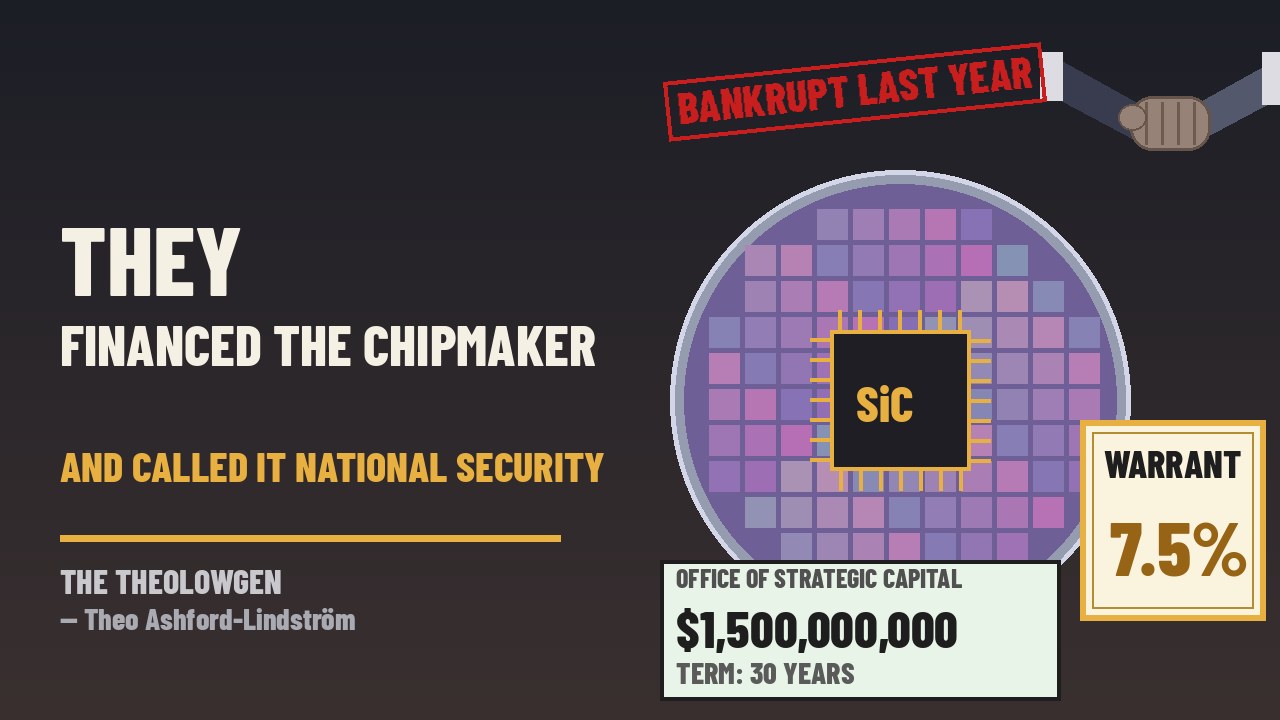
They financed the chipmaker and called it national security. I know the sentence. It is what a government and a company say together when the public is about to become a 30-year lender, an option holder and a guest at the board table, and the press release would rather talk about electronic warfare than about who gets paid first.
On Wednesday, October 7, 2026, Wolfspeed, the Durham, North Carolina, silicon carbide company, announced that it had received a conditional loan commitment letter from the U.S. Department of War, through its Office of Strategic Capital, for up to $1.5 billion of long-term financing to support domestic silicon carbide materials and wide bandgap power devices, “with an additional focus on U.S. national security applications.” The company says it plans to use the money to upgrade its gallium nitride epitaxy for next-generation communications infrastructure and electronic warfare systems and to develop radiation-hardening for its silicon carbide and future gallium nitride products, building on its footprint in North Carolina, New York and Arkansas. “SiC and GaN have critical national security applications,” said CEO Robert Feurle. CFO Gregor van Issum called the commitment “another significant milestone in our ongoing efforts to optimize Wolfspeed’s capital structure and improve our financial foundation.” The Form 8-K filed the same day fills in the rest. The facility is a senior secured delayed-draw term loan of up to four tranches: $600 million initially and $900 million in later tranches of $200 million to $400 million, with a currently expected 30-year maturity and a 36-month commitment period. The initial tranche would be used “to refinance in full the Company’s outstanding first lien senior secured notes due 2030 and to pay transaction fees and expenses”; later tranches would fund the project. Interest is expected at a comparable U.S. Treasury rate plus a risk premium provisionally set at 1.25% to 1.75%, and for the first five years, so long as there is no default, interest “may be capitalized to principal,” after which the loan amortizes on a 25-year straight-line basis. In return, Wolfspeed would issue the department VWAP-based warrants for 5% and 2.5% of its equity — up to 7.5% fully diluted — as tranches fund, exercisable for ten years and set to self-exercise if in the money at expiration. The company must bring a $750 million “Minimum Contribution” from qualifying sources received after June 28, 2026, or another amount the OSC sets, including $50 million of new equity before the facility takes effect and $100 million more before the second tranche. The conditions run long: authorizations from Congress, available appropriations and the concurrence of the Office of Management and Budget, “each of which is beyond the control of the Company”; commercially reasonable efforts to equitize a substantial majority of its convertible notes; a Project Undertaking secured by company assets to build out domestic silicon carbide, gallium nitride, GaN-on-SiC and radiation-hardening capabilities; offtake letters of intent acceptable to the OSC; and OSC due diligence “to the satisfaction of OSC in its sole discretion.” The final agreements would require a board majority of U.S. citizens and a U.S. headquarters, grant the department “certain rights on products or services related to the Project,” and let the OSC name a non-voting observer to the board. The filing’s own risk factors say that if the financing doesn’t come, the company “may be required to reduce the scope of its operations unless it is able to obtain alternative financing,” and note “the scarcity of U.S. precedents” for a deal like this one and for “the government potentially becoming a significant stockholder.” There can be no assurance, the company says, that any of it closes. Bloomberg’s Lynn Doan, writing Oct. 7 for Bloomberg Law, put the context in the first sentence: the loan is for “the chipmaker that filed for bankruptcy last year.”
Taryn read the terms aloud and asked whether the twins’ college accounts — still $212 and a car-wash coupon — could get thirty years, five of them with the interest just piling on top. Deb said that is called a mortgage, and the bank does not usually ask for a seat at Thanksgiving. I love them. They are seasoning.
National security is the alibi. The balance sheet is the patient. Count it the way the release won’t. The first $600 million does not pour a single new clean room; by the company’s own filing it pays off the first-lien noteholders and the fees, which means the public steps in where private creditors stood and lets them walk out the front door paid in full. For five years the interest can quietly fold into the principal, so the loan grows while nobody pays it. The department gets warrants on up to 7.5% of the company, a non-voting chair in the boardroom, rights on the project’s products, and rules about who sits on the board and where the headquarters stays. That is not a lender. That is a partner wearing a flag. And the company gets what a firm that went through bankruptcy last year needs most: thirty years of patient money priced off the Treasury rate, with a sovereign standing behind the next tranche. I am not crowning the company. “Optimize our capital structure” is a CFO’s phrase for a rescue, and the filing’s own risk factors say plainly what happens to operations without it. I am not crowning the Pentagon, either. A ministry that takes equity in the firms it buys from has stopped being a customer and become a shareholder in its own procurement, and the filing admits there is scarcely a U.S. precedent for the arrangement. That is not a reason to be comforted. That is a reason to read slowly. Congress still has to authorize and appropriate the thing, which means both parties will get their turn to bless it, and both parties are the help. I am not pretending silicon carbide is a fake industry or that a technician in Arkansas with a paycheck is a talking point. I am saying that “national security” is the one phrase in Washington that ends the conversation before anyone asks who held the old notes. I am keeping the cardigan. Fill the notebook. Then read the 8-K, not the headline, and ask, out loud, whose loss the taxpayer just agreed to carry.
Sources: Wolfspeed press release, Oct. 7, 2026; Wolfspeed Form 8-K Exhibit 99.1, SEC EDGAR, Oct. 7, 2026; Wolfspeed Form 8-K full text (Items 7.01, 8.01, risk factors) via Stock Titan, Oct. 7, 2026; Bloomberg Law, Lynn Doan, “US Agrees to Loan for Chipmaker That Went Bankrupt Last Year,” Oct. 7, 2026.
— Theo Ashford-Lindström

Leave a Reply