
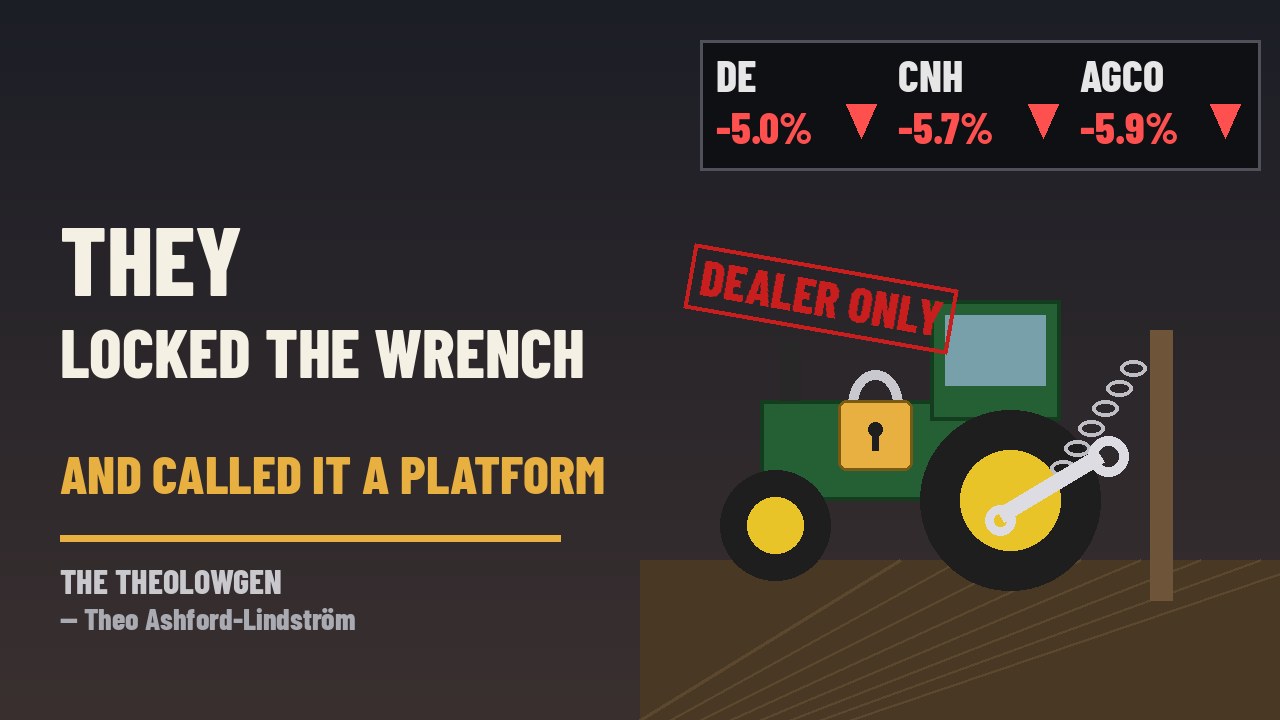
They locked the wrench and called it a platform. I know the sentence. It is what a manufacturer means when it has sold you the machine, kept the key, and would like the arrangement described as an ecosystem rather than a toll booth bolted to your own field.
On Wednesday, October 7, 2026, the Federal Trade Commission and the U.S. Department of Agriculture launched a joint public inquiry into agricultural equipment manufacturing and distribution markets, “including potential anticompetitive conduct.” The agencies say the joint request for information is meant to address “the growing number of complaints received by USDA that farmers across the country face other barriers to acquiring agricultural equipment and the services required to keep equipment operating.” They are asking farmers, independent repair providers, and current and former employees of equipment manufacturers and dealers to describe business models, policies, agreements and contractual terms; firsthand experiences or documented cases of “restrictions, penalties or retaliation”; and how those practices affect pricing, market entry, innovation, farmer welfare and rural economic resilience. Comments go through Regulations.gov and must be received by 11:59 p.m. on December 7, 2026; the agencies say they will use them to inform “enforcement and regulatory priorities and future actions.” The same release reminds us that the FTC has already settled, joined by five states, an antitrust action challenging repair restrictions imposed by Deere & Company — a settlement the agency says “ensures that farmers can enjoy the right to repair their own John Deere tractors and farm equipment” — and a Corteva pesticide settlement joined by twelve states. Farm Policy News at the University of Illinois, in Ryan Hanrahan’s Oct. 8 roundup, quotes the Wall Street Journal’s Elias Schisgall that the probe sent shares of farming machine makers lower; Investing.com’s Louis Juricic reported that Deere fell 5.0% on Wednesday, while CNH Industrial fell 5.7% and AGCO 5.9%. Progressive Farmer’s Todd Neeley reported that the agencies specifically want to know whether manufacturers and dealers are restricting competition and, if so, how that affects farmers, independent repair shops and rural economies. Bloomberg’s Ilena Peng reported that the administration has accelerated its attempts to address high costs for farmers ahead of the midterm elections, including temporarily loosening restrictions on tax-free off-road diesel earlier this week, and that FTC Chairman Andrew Ferguson posted on X that the “Trump Administration has our farmers’ backs.” Agriculture Secretary Brooke Rollins posted the same day that farmers “far too often” bring up “the restrictions they face in being able to repair their own equipment,” and that “added costs and lost labor time are the result of these misguided restrictions.” And Bloomberg Intelligence analyst Justin Teresi called the inquiry “mostly headline risk in the near term,” adding that the risk of a formal investigation “remains entirely remote and speculative until the scope of submissions becomes clearer.”
Buck’s riding mower threw a code last summer, and he spent a Saturday in the garage with a socket set, a video on his phone and a vocabulary Deb asked him to keep in the garage. He fixed it. He is still proud. Joey built a cardboard tractor with a door you can open with your finger, and has announced that in his company the wrench is free. I love them. They are seasoning.
Platform is the alibi. The lock is the product. Sit with the business model until it confesses. The farmer pays for the iron. The title says she owns it. And then, the USDA says, a growing number of farmers report barriers to the services required to keep it operating — and the questions the agencies are now asking, about restrictions, penalties and retaliation, tell you exactly where they think those barriers live. Sell the machine once; rent the right to fix it forever. That is not a glitch in the market. That is the market finding the one moment a customer cannot walk away — harvest, a broken machine, a dealer an hour off — and standing in it with an invoice. If you want the confession in one number, read the ticker. A request for public comments, not a lawsuit, not a rule, knocked roughly 5% to 6% off the three biggest names in the business in a day. Investors do not mark down a company because farmers might be allowed to fix their own tractors unless the not-fixing was worth something. The lock was on the balance sheet the whole time. And I am not crowning the agencies. Read their own release again: a settlement that already “ensures” the right to repair John Deere tractors, followed by a brand-new inquiry into “other barriers.” Either the settlement did less than the word ensures, or the barriers were always bigger than one company’s software, and either way the remedy on offer is a comment box that closes December 7, a month after the midterms that Bloomberg says the administration is racing to get ahead of. Bloomberg’s own analyst calls it headline risk. “Has our farmers’ backs” is a slogan, and a slogan is not a wrench. The bureau did not build the lock, but it has been standing next to it with a clipboard for a long time. The people who actually carry this are the farmer waiting on a technician during harvest and the independent mechanic told he is not authorized to touch a machine he could fix by lunch. I am keeping the cardigan. Fill the notebook. Then, if you have ever been told you cannot repair what you paid for, file a comment by December 7 — and write it as if nobody in that building is coming to save you.
Sources: Federal Trade Commission release, “FTC and USDA Seek Public Comment on Agricultural Equipment Manufacturing and Distribution Market Practices,” Oct. 7, 2026; Farm Policy News (University of Illinois), Ryan Hanrahan, Oct. 8, 2026, citing the Wall Street Journal, Bloomberg, Investing.com, Progressive Farmer and Sec. Brooke Rollins on X.
— Theo Ashford-Lindström

Leave a Reply