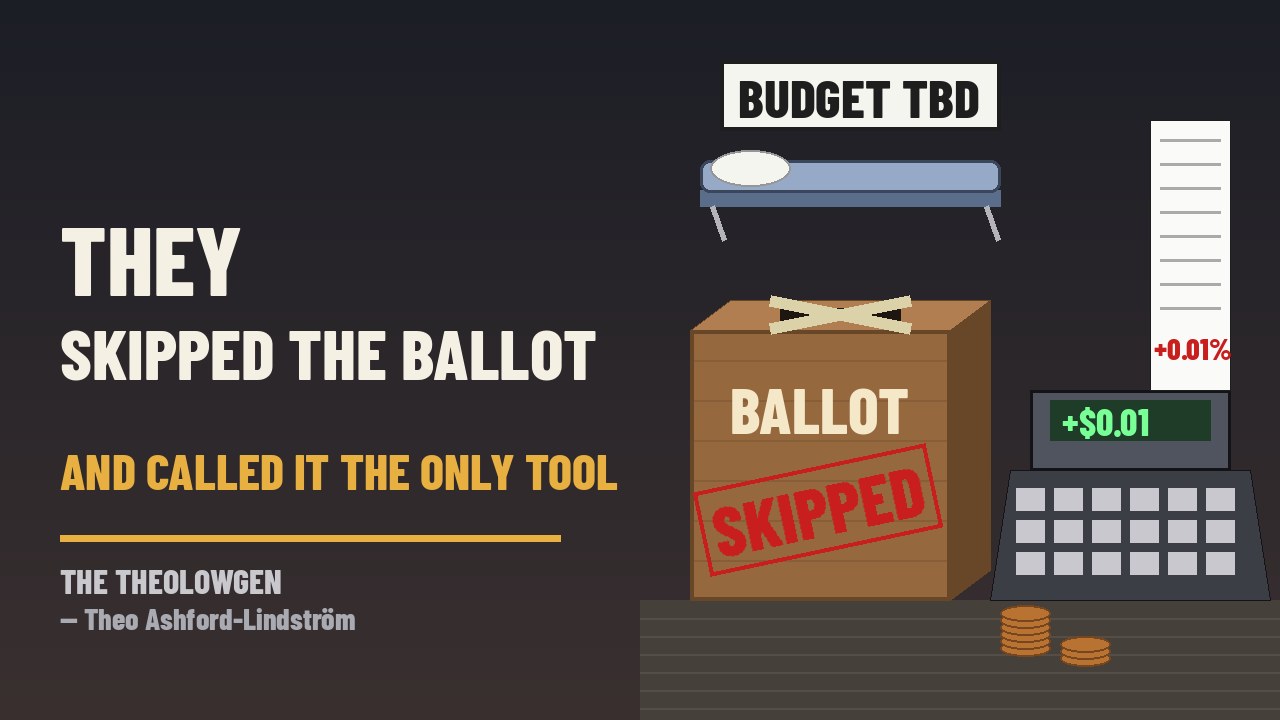
They skipped the ballot and called it the only tool. I know the sentence. It is what a council says when it has found a way to raise a tax without asking the people who pay it, and would like the missing vote filed under urgency rather than convenience.
On Tuesday, October 6, 2026, The Seattle Times’ David Gutman reported that the Metropolitan King County Council approved a 0.01% sales tax increase intended to expand emergency shelter options for homeless children and families. The increase is one penny on a $100 retail purchase, or about $4 a year for the median taxpayer, and it would raise a maximum of about $10 million a year for the county for the next three years. When it takes effect Jan. 1, it brings the sales tax in Seattle to 10.56%, among the highest in the nation. There was no vote of the people, and there did not need to be, because the state Legislature, earlier this year, gave local governments authority to pass this small tax for childcare, shelter, youth services, after-school programs and similar services. The Legislature, Gutman writes, “didn’t get much more specific than that,” and the legislation the council passed says only that the new revenue will be used for the purposes the Legislature stipulated. Councilmember Jorge Barón said he intends the money to go toward shelter and rental assistance, but that its ultimate destination would be determined during a later budget process. Council staff, in their summary, wrote that the legislation “provides the Executive broad authority to determine how proceeds resulting from the sales and use tax would be allocated.” County Executive Girmay Zahilay was already anticipating passage when, last month, he announced plans for new affordable housing, tiny home and shelter projects. Barón noted that there are significantly more homeless children in King County than there are shelter beds available for families. “I recognize that this tax may be an imperfect tool, but it’s the only tool that we have now to open these beds,” he said. “I do believe it is important to act urgently when you have children and families unsheltered in a community like ours.” The vote was 6-3, with Councilmembers Reagan Dunn, Sarah Perry and Pete von Reichbauer opposed. Dunn noted that the council has more often been getting permission from the Legislature to raise taxes rather than asking for a vote of the people, including for a roads measure this summer and for Harborview Medical Center two years ago. “Families across King County are being squeezed by the high costs of housing, groceries, and fuel,” Dunn said in a prepared statement. “At the same time, the county has had to take repeated steps to address waste and fraud in its own spending. The difficult truth is that raising taxes will not make life more affordable.” The Legislature also gave cities the option to impose the same tax; if a city in King County does, that amount is subtracted from the county’s revenue so shoppers are not charged twice.
Deb read the story off my laptop, went to the junk drawer, and came back with last week’s grocery receipt to work out the damage to the penny. Then she asked to see the ballot she didn’t get. Buck says a penny is a penny until somebody stacks ten million of them, and then it is a budget process. I love them. They are seasoning.
The only tool is the alibi. The skipped ballot is the policy. Sit with the arrangement until it confesses, because the arrangement is the story. The Legislature hands the county a key. The county uses the key without knocking. The council passes a tax whose stated purpose is the Legislature’s list, “and similar services” included. And the actual spending goes to the Executive’s “broad authority” and a budget process to come. Three layers of government, and the one participant none of them needed was the person at the register. I believe the children are real. I believe the shelter beds are short. I do not believe a cause that urgent and that sympathetic required a mechanism built so nobody would ever have to persuade a voter of it. When a bureau wants your money for a thing you would plainly support, it can ask. When it skips the asking, it is telling you something — about how sure it is, or about how much else fits inside the word “similar.” A man who has lately learned to read his own county’s fine print notices these things. And I am not crowning the three no votes. Dunn’s complaint is fair as far as it goes — the permission-slip habit is real, the roads measure, the hospital — but a prepared statement about waste and fraud is not a ballot either, and voting no on a council is not the same as handing the question to the people. Both parties are the help. One side writes the enabling law and spends the penny; the other issues the statement and keeps the habit in the record for the next time it holds the pen. A penny is small. That is the trick. They always start with the tax too small to march about and the precedent too big to notice. Seattle did not reach 10.56% in one vote; it got there one imperfect tool at a time. I am keeping the cardigan. Fill the notebook. Then watch the budget process line by line and ask, out loud, who decided where your penny went, since it was not you.
— Theo Ashford-Lindström

Leave a Reply