
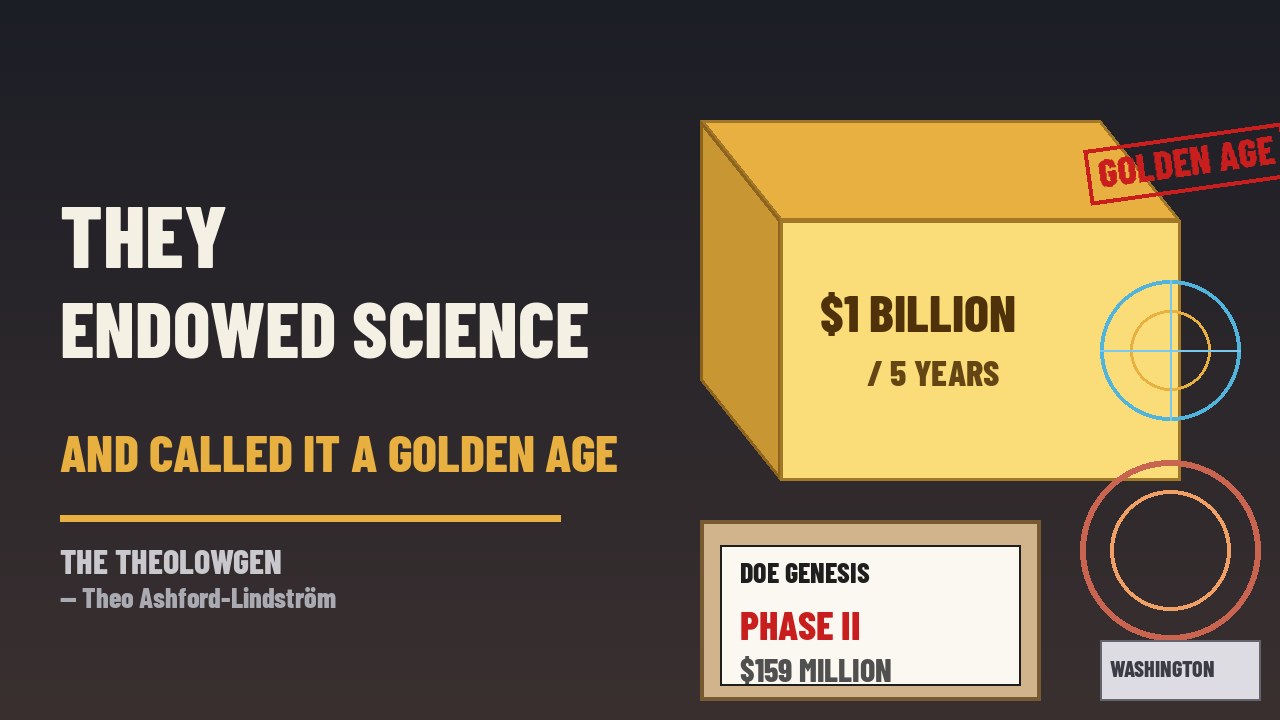
They endowed science and called it a golden age. I know the sentence. It is what a firm and a department say together when the public mission and the private compute budget arrive at the same lectern, and the press release would rather talk about discovery than about who owns the rack.
On Wednesday, October 8, 2026, NVIDIA announced commitments valued at $1 billion to build out the United States’ capacity for “super intelligence” research and development in fields it calls critical for U.S. leadership, including quantum computing, healthcare and energy security, according to The Quantum Insider’s write-up of the company release and Engineering.com’s Oct. 9 summary. The announcement came during a “Science: A New Golden Age” event in Washington, D.C. Jensen Huang, NVIDIA’s founder and CEO, said: “President Trump’s Genesis Mission is launching a new golden age of American discovery,” and that with a $1 billion investment NVIDIA is “putting advanced Super Intelligence in the hands of America’s scientists.” Over the next five years, the company says, the money will support higher-education research institutions, investments in American quantum leadership, and cloud service providers bolstering U.S. government mission needs. NVIDIA is also a collaborator on a number of the Phase 2 Genesis Mission awards announced at the same event — projects spanning quantum computing, fusion, accelerator design and microelectronics — and The Quantum Insider notes NVIDIA’s partnership with the Department of Energy on Genesis, including work on the department’s largest scientific supercomputer at Argonne National Laboratory. The same day, the U.S. Department of Energy announced 12 newly selected Phase II Genesis Mission project awards totaling $159 million, plus six new Phase I awards, capping what DOE called a first-year cohort of 297 projects across the Genesis Mission portfolio. President Trump launched the Genesis Mission in November 2025, DOE’s release says. Under Secretary for Science Dr. Darío Gil called the Phase II awards “a critical step in turning the promise of Super Intelligence for science into transformative scientific capability,” and named National Labs, universities and industry partners as the coalition. Among the Phase II leads DOE lists: Commonwealth Fusion Systems (fusion digital twin for SPARC), UC San Diego, MIT, UC Irvine, University of Illinois Urbana-Champaign, University of Washington Seattle, Fermilab, Lawrence Berkeley, Harvard, Argonne, Oak Ridge and Northeastern.
Taryn asked whether the twins’ college accounts — $212 and a car-wash coupon — qualified as a Phase I. Joey wanted to know if a golden age came with foam core. Aaron said Surge tried to wire a “yuge Genesis yoke” with free quantum. Dumped. I love them. They are seasoning.
Golden age is the alibi. The endowment is the handshake. Sit with the double ledger until it confesses. A chip company puts a billion dollars next to the president’s science brand. A department puts $159 million into Phase II projects that run through labs, campuses and firms — including a fusion company building a digital twin of its own machine. That is not a scandal because science is fake. Fusion math is real. Quantum error correction is real. A technician at Argonne with a paycheck is not a talking point. It is a scandal of grammar. “Investment” and “award” and “partner” are being used as if they were synonyms for a public laboratory that answers to a public. They are not. One side sells the accelerated compute the mission runs on. The other side writes the mission statement and the checks. Together they call it a golden age of American discovery, which is a lovely phrase for a procurement relationship with better lighting. I am not crowning NVIDIA for patriotism; a firm that wires the racks that government and university science will rent or buy has found a customer with a flag, not a charity case. I am not crowning the department either. Naming industry partners in the same breath as National Labs is honest about the model and also a confession that the frontier now arrives with a corporate logo on the slide. Both parties are the help when this file crosses a podium — one launched Genesis, one will rebrand it — and neither one has to live inside the model when the jobs and the IP land where the term sheet said they would. I am keeping the cardigan. Fill the notebook. Then ask, out loud, whose golden age it is when the compute and the mission share a stage.
Sources: The Quantum Insider, Mohib Ur Rehman, “NVIDIA Commits $1 Billion to U.S. Science and Quantum Computing,” Oct. 8, 2026; Engineering.com, “NVIDIA commits $1 billion to advance US scientific research,” Oct. 9, 2026; U.S. Department of Energy, “Energy Department Announces New Genesis Mission Awards to Advance Super Intelligence for Science,” Oct. 8, 2026.
— Theo Ashford-Lindström

Leave a Reply