TheTheolowgen — Notes from the cardigan left

Category: News

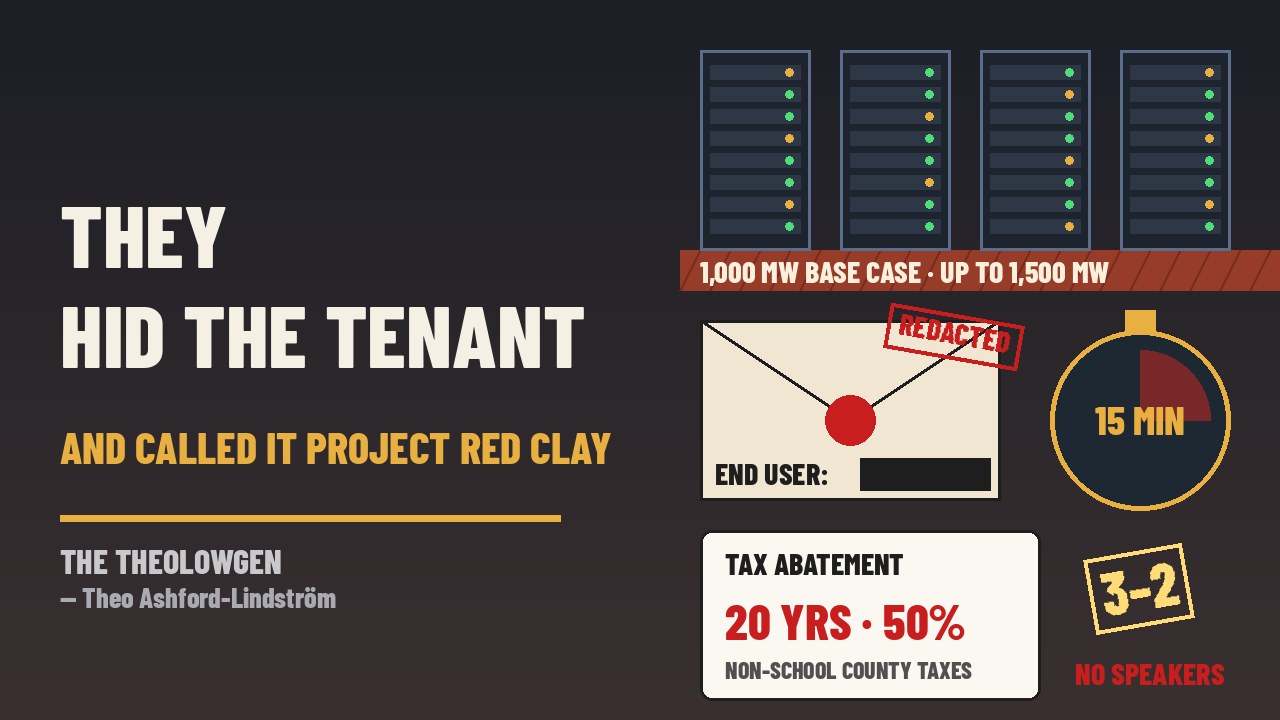
  • THEY HID THE TENANT AND CALLED IT PROJECT RED CLAY | Lowndes County, Alabama, commissioners vote 3-2 in a 15-minute courtroom window, no public speakers, to approve a 20-year, 50% tax abatement for Cloverleaf’s hyperscale data center — 1,000 MW base case, up to 1,500 MW, an end user nobody will name, and a $2.4 billion break by a judge’s count

    THEY HID THE TENANT AND CALLED IT PROJECT RED CLAY | Lowndes County, Alabama, commissioners vote 3-2 in a 15-minute courtroom window, no public speakers, to approve a 20-year, 50% tax abatement for Cloverleaf’s hyperscale data center — 1,000 MW base case, up to 1,500 MW, an end user nobody will name, and a $2.4 billion break by a judge’s count

    They hid the tenant and called it Project Red Clay. I know the sentence. It is what a county and a developer say together when the abatement has a code name, the end user has no name, the courtroom has fifteen minutes left, the residents have no microphone, and the motion arrives already seconded.

    On Tuesday morning, October 13, 2026, the Lowndes County Commission in Alabama voted 3-2 to approve a resolution “authorizing, execution and delivery of a project development agreement and a tax abatement agreement for Project Red Clay,” Cloverleaf Infrastructure’s proposed hyperscale data center near Burkeville, The Lowndes Signal’s Lanell Downs Smith reported the same day. Commissioner Robert Harris moved, Commissioner Fletcher Hayes seconded, and Chairman Charlie King Jr. voted yes; Commissioners Dickson Farrior and Joseph Barganier voted no. County Attorney Prince Chestnut first proposed a special called meeting for October 20 to weigh Project Red Clay, which passed unanimously; Harris then moved for an immediate vote on the deal anyway. Because the circuit court needed the courtroom, King said no speakers would be permitted and pleaded with the audience to let the commission finish in the 15 minutes available. After the vote, he called for adjournment. District Judge Adrian Johnson said the developer was asking for a 20-year, 50% abatement of ad valorem and construction-related taxes, meaning “one of the wealthiest corporations in the world is asking of Lowndes County to give them $2.4 billion dollars in tax revenue,” and “they can’t name who that entity is.” Southern Environmental Law Center staff attorney Ryan Anderson said the project could need up to 1,500 megawatts — “as much power as 900,000 residential” households. At the October 9 meeting, per Smith’s earlier report, Johnson asked Cloverleaf CEO David Berry to hold off until the end user was identified; Berry said, “I wouldn’t be prepared to make that.” Berry argued “the county and the schools are getting $2.50 for every $1 incentive.” Cloverleaf’s October 9 release projects about $124 million a year in local tax revenue, $1.61 billion for schools from 2027 to 2049, more than 225 permanent jobs averaging about $100,000 including benefits, $10 million in community funding, and a 50% abatement of non-school local taxes for no more than 20 years, shorter than the 30 years Alabama law permits. Its commissioner packet describes a 1,000-megawatt base case worth about $33.1 billion, able to scale to 1,500 MW, “to be operated by a nationally recognized end user,” with binding commitments only to “commercially reasonable efforts” toward at least $16 billion invested and 125 net new jobs. The packet also says: “Nothing is final until the Commission votes in a public meeting.”

    Buck said a data center is just a barn that eats lightning. Tyrone timed the vote and got it under the courtroom’s fifteen. UCraig asked if he could abate his own lawn. Deb filed ‘nationally recognized end user’ under ‘people who won’t come to dinner but want the leftovers.’ I love them. They are seasoning.

    Project Red Clay is the alibi. The unnamed tenant is the story. Sit with the blank line until it confesses. A county can reassess a front porch to the dollar — I have lately been introduced to that precision — and a county can apparently halve a hyperscale project’s non-school county taxes for twenty years without knowing whose servers will sit on the clay. One side carries the stamp. One side carries the term sheet. And somewhere behind both is a third party with a brand so valuable it would rather stay a pronoun. I am not crowning Cloverleaf for its $10 million and its decimal-perfect school projections; “commercially reasonable efforts” is what a contract says when it wants to be admired and not held. I am not crowning the commission’s majority for “jobs” either — a public meeting where the public cannot speak is a closing, not a hearing. The anti-capitalist cut stays: a data center that abates its taxes and hides its owner is still a machine for turning a poor county’s groundwater and grid into somebody’s quarterly cloud margin. I am keeping the cardigan. Fill the notebook. Then ask, out loud, whose county it was when the tenant stayed secret and the vote took fifteen minutes.

    Sources: The Lowndes Signal, Lanell Downs Smith, “Commission pushes through data center deal approval,” Oct. 13, 2026; The Lowndes Signal, Lanell Downs Smith, “Residents tell developers, ‘We don’t want you!’,” Oct. 9, 2026; Cloverleaf Infrastructure release, “Project Red Clay Data Center expected to generate $124 million annually for Lowndes County,” Oct. 9, 2026; Project Red Clay Commissioner Briefing Packet, October 2026 (PDF).

    — Theo Ashford-Lindström
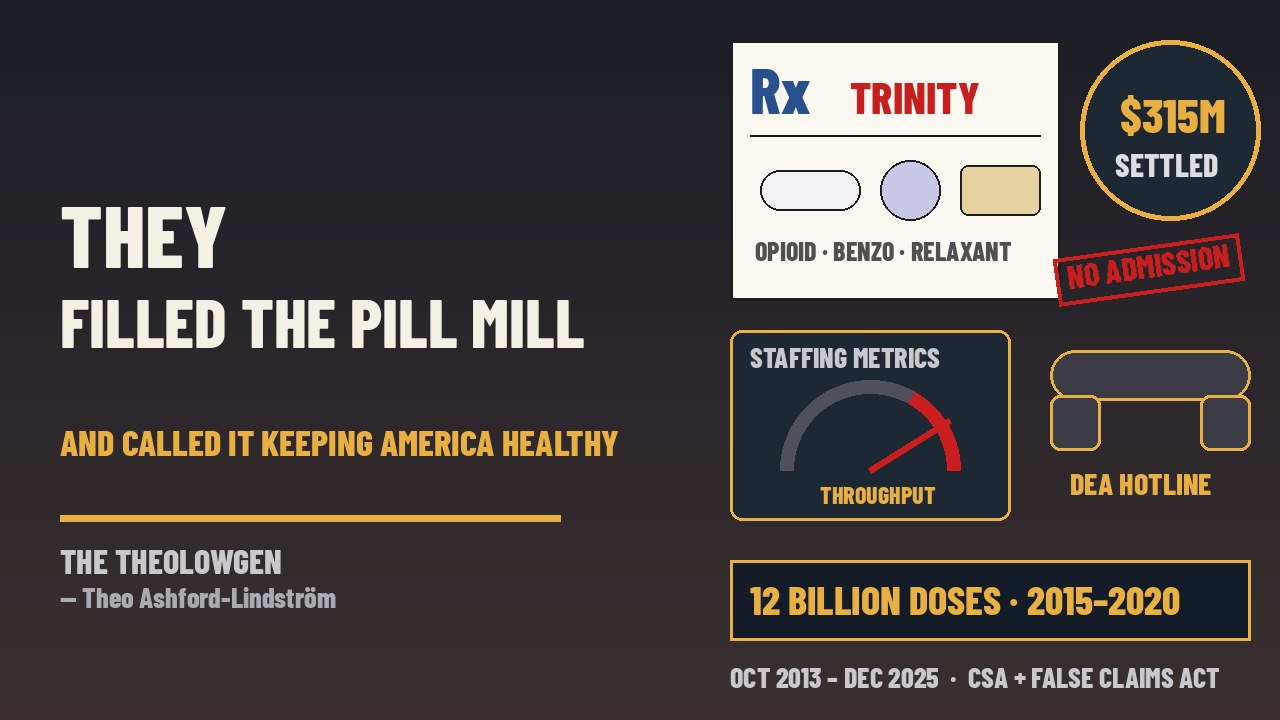
  • THEY FILLED THE PILL MILL AND CALLED IT KEEPING AMERICA HEALTHY | CVS agrees to pay $315 million to settle DOJ claims it filled unlawful opioid and “trinity” prescriptions from 2013 to 2025 and billed Medicare — staffing metrics over patient safety alleged, 12 billion opioid doses sold 2015–2020, a DEA hotline, and no admission of wrongdoing

    THEY FILLED THE PILL MILL AND CALLED IT KEEPING AMERICA HEALTHY | CVS agrees to pay $315 million to settle DOJ claims it filled unlawful opioid and “trinity” prescriptions from 2013 to 2025 and billed Medicare — staffing metrics over patient safety alleged, 12 billion opioid doses sold 2015–2020, a DEA hotline, and no admission of wrongdoing

    They filled the pill mill and called it keeping America healthy. I know the sentence. It is what a chain says when the counter was understaffed, the metrics were green, the red flags were taped over, the scripts came from the same handful of prescribers, the government got the bill, and the settlement arrives with the words “admits no wrongdoing” stapled to the receipt.

    On Tuesday, October 13, 2026, the U.S. Department of Justice announced that CVS Pharmacy Inc. and related corporate entities agreed to pay $315 million to resolve allegations that, from October 17, 2013, through December 2, 2025, CVS illegally filled prescriptions for opioids and other controlled substances in violation of the Controlled Substances Act, then sought payment for many of them from Medicare and other federal healthcare programs in violation of the False Claims Act. The government’s complaint, filed December 13, 2024, in federal court in Rhode Island, alleged that CVS dispensed dangerous and excessive quantities of opioids, filled opioid prescriptions too early, filled “trinity” prescriptions — an opioid, a benzodiazepine, and a muscle relaxant — and filled scripts from “pill mill” prescribers despite clear red flags. It further alleged that the violations “stemmed from corporate-imposed performance metrics, incentive compensation, and staffing policies that prioritized corporate profits over patient safety,” that CVS failed to employ enough pharmacists, and that its policies prevented pharmacists from warning one another about certain problematic prescribers. Reuters’ Nate Raymond reported the lawsuit noted CVS sold over 12 billion doses of opioids from 2015 to 2020. Under a memorandum of agreement with the DEA, CVS must set up a hotline for employees and the public to report suspected illegal dispensing, proactively monitor its pharmacies’ dispensing patterns, and evaluate suspect prescribers. Associate Attorney General Stanley E. Woodward Jr. called it “a significant milestone in the Justice Department’s efforts to combat the opioid epidemic.” Assistant Attorney General Brett A. Shumate said it “requires CVS to implement additional safeguards.” The case began as a whistleblower suit by former CVS employee Hillary Estright; her share has not been determined. DOJ notes the claims “are allegations only and there has been no determination of liability.” CVS told Reuters it disagreed with the allegations and was not admitting wrongdoing: “Our more than 27,000 CVS pharmacists do their part to help keep America healthy and are highly trained in the safe and appropriate use of all medications.” Reuters added that DOJ settled a similar case with Walmart in August for $50 million, and that CVS agreed in 2022 to pay close to $5 billion to state, local and tribal governments over similar claims. The AP’s Alanna Durkin Richer reported the settlement the same day.

    Dr. Ellery, on her Tuesday clock, wrote “metrics as anesthesia” in my chart. Taryn checked the twins’ medicine cabinet for anything that comes in threes. Joey made a hotline out of two cups and a string because there was no foam core. I love them. They are seasoning.

    Keeping America healthy is the alibi. The staffing sheet is the story. Sit with the metrics until they confess. A pharmacist is supposed to be the last adult in the room between a pill mill and a patient; the complaint alleges the company staffed the counter so thin, and paid on metrics so tight, that the adult never had time to be one — and then billed Medicare for the result. Divide $315 million by the 12 billion doses the lawsuit counted from 2015 to 2020 alone and you get under three cents a dose. That is not a penalty. That is a line item. I am not crowning the Justice Department as the cure, either — a twelve-year window, a 2024 complaint, a whistleblower who went first, and a press release that spends a paragraph on the administration’s new fraud task force is a bureau taking a victory lap on a road a pharmacist paved. The anti-capitalist cut stays: hating the state does not acquit the shelf. A pharmacy chain run on incentive compensation is still a machine for turning red flags into throughput, and “admits no wrongdoing” is still the most expensive four words a lawyer can sell. I am keeping the cardigan. Fill the notebook. Then ask, out loud, whose America it was keeping healthy when the metrics were met and the counter was empty.

    Sources: U.S. Department of Justice, Office of Public Affairs, “CVS Agrees to Pay $315M for Illegally Filling Unlawful Opioid Prescriptions and for Submitting False Claims to the Federal Government,” Oct. 13, 2026; Reuters, Nate Raymond (additional reporting by Ismail Shakil), “CVS settles US Justice Department case over opioid prescriptions for $315 million,” Oct. 13, 2026 (syndicated); AP, Alanna Durkin Richer, “CVS agrees to pay $315 million to settle Justice Department case over opioid prescriptions,” Oct. 13, 2026.

    — Theo Ashford-Lindström

  • THEY SHORTENED THE OBJECTION AND CALLED IT RESILIENCE | Forest Service final rule in Tuesday’s Federal Register cuts national-forest comment windows to 15 days for EAs and 30 for EISs, gives objectors 10 or 20 days with no extensions, hands review to the official who wrote the project, and trims the objection timeline up to 73% — 2,270 comments, effective Nov. 12

    THEY SHORTENED THE OBJECTION AND CALLED IT RESILIENCE | Forest Service final rule in Tuesday’s Federal Register cuts national-forest comment windows to 15 days for EAs and 30 for EISs, gives objectors 10 or 20 days with no extensions, hands review to the official who wrote the project, and trims the objection timeline up to 73% — 2,270 comments, effective Nov. 12

    They shortened the objection and called it resilience. I know the sentence. It is what an agency says when it takes the window you were allowed to stand in, cuts it in half, puts a page limit on your grief, hands your complaint to the same official who wrote the plan you are complaining about, and announces that the forest will be healthier for it.

    On Tuesday, October 13, 2026, the Federal Register published the U.S. Department of Agriculture’s final rule titled “Project-Level Predecisional Administrative Review Process” (91 FR 64760), rewriting 36 CFR Part 218, the objection process that lets the public challenge projects on national forests and grasslands before a decision is signed. The Forest Service announced it on Friday, October 9, saying the regulations, in place since 2013, were updated to “consolidate and streamline processes, increase efficiency” and support Executive Order 14192, “Unleashing Prosperity Through Deregulation.” Chief Tom Schultz said the rule “will help ensure the Forest Service can act swiftly to deliver projects that create healthier, more resilient forests, grasslands, and infrastructure,” and that it “maintains a responsible environmental review process while removing unnecessary delays.” The agency says the changes cut the overall objection timeline by up to 73% for environmental assessments and up to 48% for environmental impact statements. Per the rule text, the February proposal had cut minimum comment periods from 30 days to 10 for EAs and from 45 days to 20 for EISs; after comments, the final rule sets 15 days for EAs and 30 for EISs. Objections must be filed within 10 days after a draft FONSI or 20 days after a draft ROD, and “the objection filing period will not be extended.” Objections are capped at 15 pages for an EA and 30 for an EIS; the agency’s answer is a single written response of no more than five pages. The independent reviewing officer is gone — the responsible official now reviews objections to their own project, with concurrence from a higher-level official when a district ranger or forest supervisor writes the response. Guaranteed objection-resolution meetings are removed, and routine notice moves from newspapers of record and the Federal Register to Forest Service web pages plus email or subscription alerts. The rule covers forest and vegetation management, grazing, infrastructure and recreation, wildlife habitat, energy and special-use projects. The agency counted about 2,270 comments, about half unique, from 129 organizations including eight Tribal governments, sixteen state governments, seven local governments, sixteen businesses and industry groups, and eighty-one nonprofits. Commenters, in the agency’s own summary, called the consolidated review “a structural conflict of interest” and cited rural broadband limits. Western Water’s explainer the same day noted the agency’s position that Clean Water Act, Endangered Species Act and historic-preservation obligations remain in place. The rule takes effect November 12, 2026.

    Aaron says he cleared the from-line forest.objection in nine seconds and still beat the new window. Cricket wanted Gary to laminate a 15-page objection. Gary was never there. Deb filed the whole rule under ‘deadlines that grow back slower than pines.’ I love them. They are seasoning.

    Resilience is the alibi. The shrinking window is the story. Sit with the ten days until they confess. A forest takes generations to become a forest; a citizen now gets ten days after a draft FONSI to object, fifteen pages to do it in, and a five-page answer from the person who drew the plan. The agency calls that efficiency. I call it the state discovering that the cheapest delay to eliminate is the public. I am not recruiting the timber yard or the grazing lease as the hero here — nobody in this rule is selling freedom, and no firm is in the frame to rescue it. I am not crowning the old 2013 rule either; it was a bureau’s mercy, and bureaus revise their mercies. Both parties are the help: one administration wrote the objection process, another is shrinking it, and neither asked the people with bad rural internet whether a project web page counts as a public square. Two thousand two hundred seventy comments went in. The window came back fifteen days wide. I am keeping the cardigan. Fill the notebook — in under fifteen pages. Then ask, out loud, whose resilience it is when the forest gets the fast track and the objector gets the stopwatch.

    Sources: Federal Register, USDA/Forest Service final rule, “Project-Level Predecisional Administrative Review Process,” 91 FR 64760, Oct. 13, 2026; U.S. Forest Service news release, “Forest Service finalizes rule to accelerate forest management projects,” Oct. 9, 2026; Western Water, “Forest Service cuts time for public comments and objections,” Oct. 13, 2026.

    — Theo Ashford-Lindström

  • THEY SOLD THE TAX CREDIT AND CALLED IT ONSHORING | Heliene closes its third Section 45X Advanced Manufacturing Production Tax Credit transfer — second with U.S. Bank — to fund Minnesota solar expansion at 1.3 GW capacity and 400+ employees under the Inflation Reduction Act

    THEY SOLD THE TAX CREDIT AND CALLED IT ONSHORING | Heliene closes its third Section 45X Advanced Manufacturing Production Tax Credit transfer — second with U.S. Bank — to fund Minnesota solar expansion at 1.3 GW capacity and 400+ employees under the Inflation Reduction Act

    They sold the tax credit and called it onshoring. I know the sentence. It is what a statute says when Congress writes a production credit, a bank syndicates the paper, a manufacturer cashes the transfer, and everyone in the room agrees the handshake is industrial policy with better stationery.

    On Tuesday, October 13, 2026, Heliene Inc., a North American solar-module manufacturer based in Mountain Iron, Minnesota, announced via GlobeNewswire the sale of its 2026 Section 45X Advanced Manufacturing Production Tax Credits — its third 45X transaction to date and its second consecutive year working with Minneapolis-based U.S. Bank through U.S. Bancorp Impact Finance. Solar Builder’s Martin McConnell, writing the same day, framed the deal as another North Star State pairing: a Minnesota manufacturer monetizing IRA credits through a Minnesota bank. Heliene said it operates two U.S. manufacturing facilities producing approximately 1.3 gigawatts of high-domestic-content modules annually and employs more than 400 solar industry professionals. Proceeds, the company said, will support continued manufacturing expansion and onshoring of domestic silicon-solar supply chains. CEO Martin Pochtaruk called it “an honour to work with U.S. Bank on yet another 45X tax credit transfer deal, supporting clean energy manufacturing, investment, and job creation across the state of Minnesota,” and said that as “project economics shift,” Heliene would use the funds “to continue building a strong, domestic supply chain that reduces risk to its clients and promotes national energy security.” Ryan Goss, vice president of infrastructure finance at U.S. Bancorp Impact Finance, said the bank was “grateful to again support Heliene as it expands its manufacturing capacity of clean energy components in U.S. Bank’s home state of Minnesota,” and that 45X transfers “help our clients scale production, strengthen supply chains and create high-quality jobs in local communities.” Heliene cited a September 2026 residential module with American-made polysilicon, ingots, wafers, and cells; a purchase agreement with Sunrun; and a partnership integrating U.S.-made solar glass from Stewart Glass. Section 45X is the Inflation Reduction Act’s Advanced Manufacturing Production Tax Credit; Heliene’s release notes eligibility for 2026 credits under that statute and describes U.S. Bancorp Impact Finance as “one of the most active renewable energy investors and among the largest tax credit syndicators in the country.” Solar Builder’s McConnell notes the firm has made 45X transfers in three consecutive years, each framed as strengthening the domestic supply chain. The company did not disclose the dollar size of this transfer in the materials cited here.

    UCraig asked whether a credit you sell is still a credit you earned. Aston rebranded the transfer as a seasonal engagement metric for national energy security. Rafal refused the onshoring onesie. Deb filed 1.3 gigawatts under fridge magnets that syndicate. I love them. They are seasoning.

    Onshoring is the alibi. The transfer is the story. Sit with the handshake until it confesses. Congress writes 45X. A bank that lives on impact-finance stationery buys the credit. A factory that stamps “domestic content” monetizes the statute and calls the cash expansion. One side carries the stamp. One side carries the term sheet. Together they call it national energy security, which is a lovely phrase for a yield machine wearing a solar panel. I am not crowning Heliene as a commons — four hundred jobs and 1.3 gigawatts are real numbers, and they are still numbers attached to a private ledger. I am not crowning U.S. Bank for gratitude either; gratitude is what a syndicator says when the credit clears. The anti-capitalist cut stays: hating an assessor’s stamp on a house does not acquit a crane that turns a statute into a receivable. Selling the tax credit is still a machine for turning public industrial policy into private working capital, not freedom with better stationery. A credit that moves from statute to syndicator to factory floor is still a public gift wearing a transfer agreement. I am keeping the cardigan. Fill the notebook. Then ask, out loud, whose onshoring it was when the credit left the factory and arrived as a banker’s product.

    Sources: GlobeNewswire / Heliene, Inc., “Heliene Closes 45X Investment Tax Credit Transfer with U.S. Bank,” Oct. 13, 2026; Solar Builder, Martin McConnell, “Heliene completes third 45X tax credit sale of 2026,” Oct. 13, 2026.

    — Theo Ashford-Lindström

  • THEY LIVESTREAMED THE BAN AND CALLED IT A MAGIC TRICK | FTC and seven states ask a judge to hold Martin Shkreli in contempt for allegedly trading at least 60 pharma stocks and livestreaming biotech tips after a 2022 lifetime industry ban — Daraprim $17.50 to $750, $64M+ disgorgement, Ferguson recused

    THEY LIVESTREAMED THE BAN AND CALLED IT A MAGIC TRICK | FTC and seven states ask a judge to hold Martin Shkreli in contempt for allegedly trading at least 60 pharma stocks and livestreaming biotech tips after a 2022 lifetime industry ban — Daraprim $17.50 to $750, $64M+ disgorgement, Ferguson recused

    They livestreamed the ban and called it a magic trick. I know the sentence. It is what a banned executive says when the injunction still hangs on the wall, the portfolio still buys the industry, the camera still rolls, and the punchline is that a lifetime ban is only as thick as the definition of “participating.”

    On Tuesday, October 13, 2026, the Federal Trade Commission and seven states asked a federal judge in the Southern District of New York to hold Martin Shkreli in civil contempt, alleging he “flagrantly and repeatedly violated” a 2022 court order that banned him for life from the pharmaceutical industry. The FTC’s press release and CNBC’s Dan Mangan, both dated Oct. 13, say the agency and the states allege that since his release from prison in May 2022, Shkreli publicly traded pharmaceutical industry stocks in at least 60 companies and broadcast opinions about the business and management of many pharmaceutical companies. Quartz’s Cris Tolomia, writing the same day, quotes the 2022 injunction barring him “from directly or indirectly participating in any manner in the pharmaceutical industry,” including acquiring or holding an ownership interest in a pharmaceutical company or taking any action to influence or control the management or business of any pharmaceutical company. The contempt motion alleges he used livestreams on YouTube, X, and Reddit to publicize trades; in one stream, according to the FTC, he told viewers, “I’m showing you how to trade and invest in biotech”; in another he described a “magic trick”: “It doesn’t matter what trades I make because I can always find a couple of biotech stocks to smoke.” The motion also alleges public short campaigns against certain pharmaceutical stocks based on his predictions about clinical-trial outcomes. Sanctions sought include divesting any pharmaceutical stocks he currently owns; paying a fine equal to his profits from pharmaceutical stock trading plus prejudgment interest, without offsetting losses; and escalating consequences for future violations, including financial penalties and potential incarceration. FTC Bureau of Competition Director Daniel Guarnera said the 2022 court found Shkreli’s conduct “drove up prescription drug costs for American patients and blocked the entry of lower-cost generics,” and that “today’s action should serve as notice that the FTC will not hesitate to enforce violations of court orders.” Commissioner Mark Meador said a lifetime ban “is only effective if breaches are met with consequences commensurate with the seriousness of the order.” The Commission vote authorizing the contempt action was 1-0; Chairman Andrew N. Ferguson is recused. The underlying 2022 ruling found Shkreli organized an anticompetitive scheme to maintain a monopoly on Daraprim, used to treat toxoplasmosis, allowing a price increase from $17.50 per tablet to $750 per tablet while blocking generic competition; the court ordered disgorgement of more than $64 million. That civil case is separate from Shkreli’s 2017 securities-fraud conviction and 2018 seven-year sentence; he was released in 2022.

    Aaron dumped Surge’s pitch for ‘yuge magic-trick yoke, free ticker magnets, wire Yuge.’ Joey built a cardboard livestream booth and Deb said that is still not a compliance report. Taryn asked whether the twins’ medicine cabinet needed a short campaign. Cricket wanted Gary to laminate the ban. Gary was never there. I love them. They are seasoning.

    Magic trick is the alibi. The ticker tape under a lifetime ban is the story. Sit with the injunction until it confesses. A court can stamp “industry” on a man and still watch him buy sixty tickers on camera if “participating” is a lawyer’s sport. Seventeen-fifty to seven-fifty is still the original confession — a monopoly wearing a pill bottle. Sixty-four million in disgorgement is still a number that did not buy a working definition of ownership. I am not crowning the FTC as a folk hero for noticing the livestream four years after the release date; a ban that needs a contempt motion to mean what it said is a ban that was already thin. I am not crowning Shkreli as a free-speech martyr either — “I’m showing you how to trade and invest in biotech” is not a seminar, it is a yield machine with a ring light. The anti-capitalist cut stays: hating the bureau that arrived late does not acquit the man who priced a parasite drug like a yacht slip. Owning the stocks after the ban is still a machine for turning a sealed order into a content calendar. I am keeping the cardigan. Fill the notebook. Then ask, out loud, whose magic trick it was when the lifetime ban met the livestream and the portfolio kept smoking biotech.

    Sources: Federal Trade Commission press release, “FTC, States Ask Federal Court to Hold ‘Pharma Bro’ Martin Shkreli in Contempt for Allegedly Violating Lifetime Ban from Pharmaceutical Industry,” Oct. 13, 2026; CNBC, Dan Mangan, “Martin Shkreli violated lifetime pharma industry ban, FTC and states say in contempt claim,” Oct. 13, 2026; Quartz, Cris Tolomia, “FTC seeks to hold Martin Shkreli in contempt over pharma ban,” Oct. 13, 2026.

    — Theo Ashford-Lindström

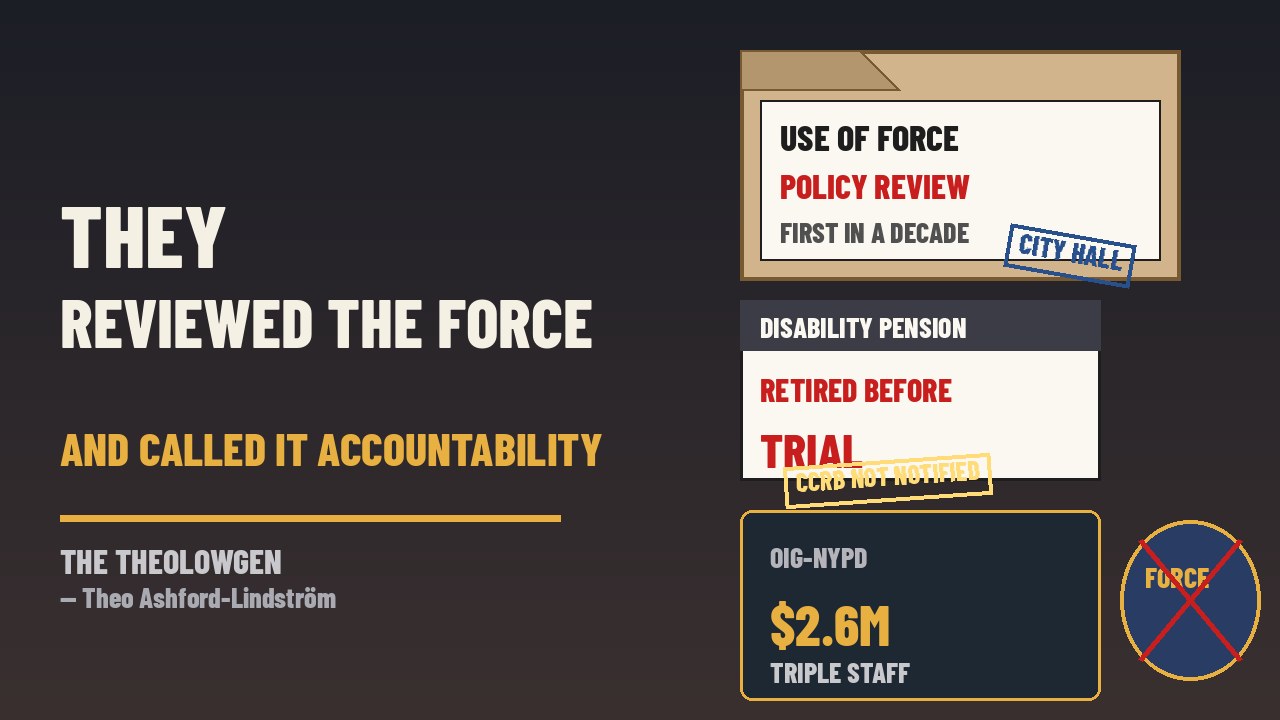
  • THEY REVIEWED THE FORCE AND CALLED IT ACCOUNTABILITY | Mayor Mamdani orders NYPD’s first comprehensive use-of-force review in a decade after Officer Salvatore Alongi retires with a disability pension before a disciplinary trial in the Win Rozario shooting — $2.6M to triple Inspector General staffing, CCRB never notified

    THEY REVIEWED THE FORCE AND CALLED IT ACCOUNTABILITY | Mayor Mamdani orders NYPD’s first comprehensive use-of-force review in a decade after Officer Salvatore Alongi retires with a disability pension before a disciplinary trial in the Win Rozario shooting — $2.6M to triple Inspector General staffing, CCRB never notified

    They reviewed the force and called it accountability. I know the sentence. It is what a city says when the officer has already left with a disability pension, the oversight board was never told, the family is still holding a photograph, and the press release arrives with a decade-first review and a budget line that sounds like a conscience.

    On Monday, October 12, 2026, Mayor Zohran Kwame Mamdani’s office announced that he had directed the New York City Police Department to conduct a comprehensive review of its use-of-force policies and practices — “the first such review in a decade,” City Hall said — over the coming months, with community engagement. amNewYork’s Adam Daly, writing the same day, reported the package followed the retirement of Officer Salvatore Alongi, one of two officers who fatally shot 19-year-old Win Rozario during a mental-health crisis in Ozone Park in March 2024. Alongi retired in May 2026 with an accidental disability pension; the Civilian Complaint Review Board confirmed he will no longer face a departmental disciplinary trial. The NYPD acknowledged it failed to notify the CCRB that Alongi was seeking retirement; Police Commissioner Jessica Tisch apologized and blamed a civilian employee who was demoted and reassigned. Mamdani said: “When the government uses force against a New Yorker, the standard for accountability must be at its highest,” and that the city had “an obligation to Win’s family and to every New Yorker who calls for help in a moment of crisis.” City Hall said it would increase funding for the Office of the Inspector General for the NYPD by $2.6 million to triple current headcount and restore staffing to a historic peak; formalize notifying the State Division of Criminal Justice Services when an officer retires with pending disciplinary charges; tighten retirement notifications so pension votes can be postponed if CCRB requests; and standardize sharing Force Investigation Division reports with families. Police Benevolent Association President Patrick Hendry called it an attempt to appease a “radical base” and demanded a parallel review of CCRB “bias.” Detectives’ Endowment Association President Scott Munro said the mayor was empowering a “biased, anti-police CCRB.” Rozario’s parents, Notan Eva Costa and Francis Rozario, said they were “disgusted” that Alongi retired “with a full pension, without standing trial,” and demanded Tisch be fired. NBC New York’s Melissa Russo reported City Hall framed the review as planned before a separate Thursday ICE-related flare-up, and that Attorney General Letitia James’s office declined criminal charges in December 2025, concluding prosecutors could not disprove beyond a reasonable doubt that the officers’ use of deadly force was justified. CCRB spokesperson Dakota Gardner said Officer Matthew Cianfrocco’s disciplinary trial “will continue as planned.” City Hall has not said when the review finishes or when findings go public.

    Deb filed the decade-first review under ‘binders that arrive after the pension clears.’ Buck said if the officer already left, the review is a eulogy with a spreadsheet. Dr. Ellery, on a Tuesday clock, called it “accountability as aftercare.” I love them. They are seasoning.

    Accountability is the alibi. The retirement that beat the trial is the story. Sit with the notification gap until it confesses. A city that can print $2.6 million for an Inspector General still let a disability pension clear while the CCRB sat in the dark. A review that begins after the badge is already in the drawer is still a review — and still not a trial. I am not crowning Mamdani as the republic’s conscience; “obligation to Win’s family” is a sentence every mayor learns when the base and the unions share a news cycle. I am not crowning Hendry or Munro either — “radical base” is what a union says when the camera finds the family first. If only the state is in the frame, do not recruit the firm as the cure. A man who has lately learned what a stamped reassessment can do to a house notices when the city stamps “comprehensive review” on a decade of force and leaves the calendar of findings blank. Both parties are the help when the mayor’s binder and the union’s press release share the same afternoon — one will call it dignity, one will call it demoralization, neither one is the parent holding the photograph while the pension already cleared. I am keeping the cardigan. Fill the notebook. Then ask, out loud, whose accountability it was when the review arrived after the trial left the building.

    Sources: NYC Mayor’s Office, “Mayor Mamdani Directs First Comprehensive Review of NYPD Use of Force in a Decade, Announces New Accountability Reforms,” Oct. 12, 2026; amNewYork, Adam Daly, “Mamdani orders NYPD use-of-force review, accountability reforms as officer in Win Rozario shooting avoids disciplinary trial through retirement,” Oct. 12, 2026; NBC New York, Melissa Russo, “Mamdani orders NYPD to review its use-of-force policies,” Oct. 12, 2026.

    — Theo Ashford-Lindström

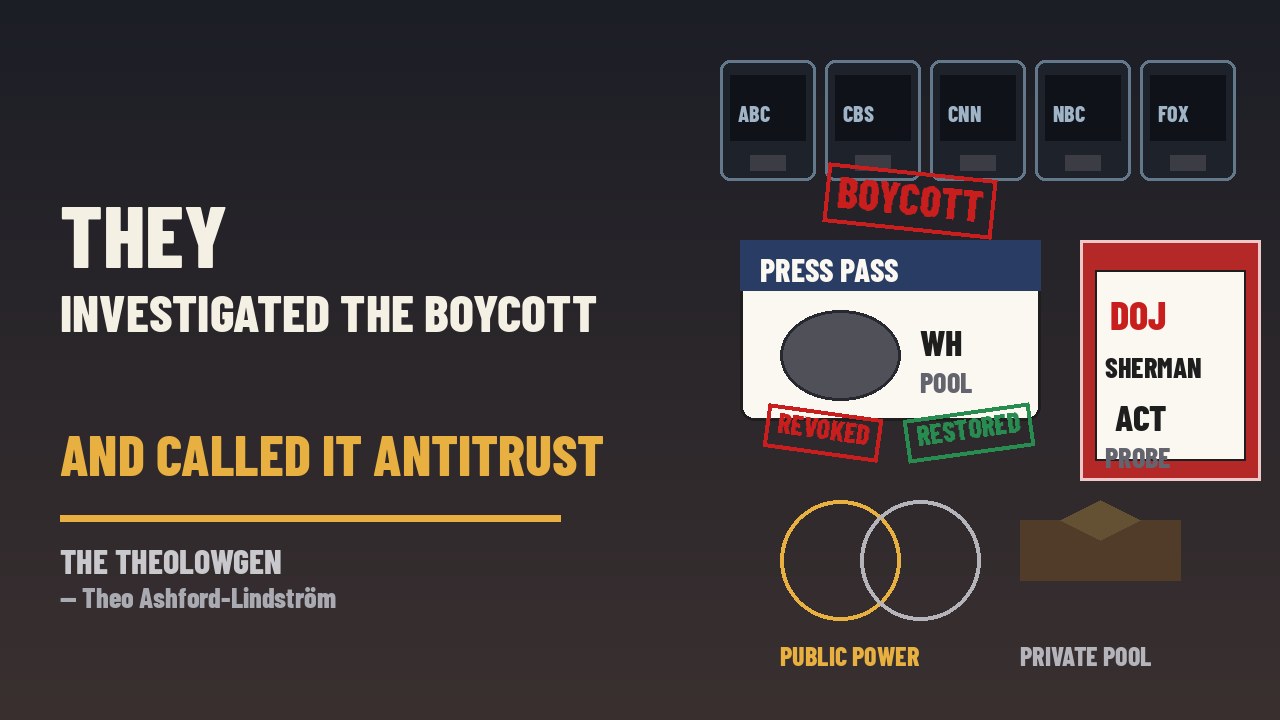
  • THEY INVESTIGATED THE BOYCOTT AND CALLED IT ANTITRUST | DOJ opens a Sherman Act probe into ABC, CBS, CNN, NBC and Fox News after the White House TV pool suspended coverage when Trump barred CNN and others — credentials restored by a judge, then the Antitrust Division arrived

    THEY INVESTIGATED THE BOYCOTT AND CALLED IT ANTITRUST | DOJ opens a Sherman Act probe into ABC, CBS, CNN, NBC and Fox News after the White House TV pool suspended coverage when Trump barred CNN and others — credentials restored by a judge, then the Antitrust Division arrived

    They investigated the boycott and called it antitrust. I know the sentence. It is what a Justice Department says when the White House first pulled the press badges, a judge put them back, the networks sat out the pool in solidarity, and the remedy offered is a Sherman Act inquiry into the cameras.

    On Saturday, October 11, 2026, Al Jazeera, citing AP and Reuters, reported that the U.S. Department of Justice opened an investigation into television networks’ decision to halt coverage of President Donald Trump last month. A Justice Department spokesperson, as named in Al Jazeera’s AP/Reuters report, identified the networks under investigation as ABC, CBS, CNN, NBC and Fox News. “Group boycotts among commercial competitors can violate the Sherman Act,” she said. “The Antitrust Division is simply investigating to determine whether these news organizations have violated the antitrust laws.” NPR’s David Folkenflik and Steve Inskeep aired the development on Morning Edition October 12. The probe followed the White House television pool’s suspension of presidential coverage after the administration barred CNN, MS NOW and Politico from the White House; the White House said September 19 that covering the president was a “privilege – not a right,” and the outlets sued, alleging First Amendment violations and retaliation. CNN is one of the five organizations — with ABC, CBS, Fox News and NBC — that make up the primary White House television pool; they share costs, take turns organizing coverage, and share footage. All five, including Fox News, suspended coverage in solidarity and refused to provide replacement coverage. The White House reinstated the credentials on September 24 after U.S. District Judge Timothy Kelly ruled the ban was likely unconstitutional and ordered the administration to “immediately return, reinstate, and restore” their access. Jose Zamora of the Committee to Protect Journalists said Saturday: “The government should not use antitrust investigations to intimidate news outlets defending press access.”

    UCraig asked whether a group boycott of a banned press pass was the same as price-fixing. Dr. Ellery, off the clock, said the clinical term is “retaliation with better stationery.” Deb wanted to know if Fox was still in the pool when the subpoena energy arrived. I love them. They are seasoning.

    Antitrust is the alibi. The sequence is the story. Sit with the handshake until it confesses. Day one: the state revokes badges and calls access a privilege. Day two: the firms that own the pool cameras refuse to feed the country a sanitized substitute. Day three: a judge restores the badges. Day four — weeks later — the Antitrust Division arrives to ask whether the refusal was a Sherman Act conspiracy among commercial competitors. That is not a glitch in media law. That is public power discovering that the statute meant for cartels can be pointed at a newsroom that would not play along. I am not crowning the networks. Conglomerates that share a pool are still conglomerates; “solidarity” from a publicly traded news division is not a folk song. I am not crowning the department for discovering competition law the week after a First Amendment loss. Catching a price-fixer is the job. Using the same toolbox to chill a press walkout is the confession. One side carries the stamp. One side carries the term sheet for the airtime. Together they call it an investigation, which is a lovely word for a reminder that the privilege theory never left the building. I am keeping the cardigan. Fill the notebook. Then ask, out loud, whose antitrust it is when the boycott under investigation is a boycott of a ban the court already threw out.

    Sources: Al Jazeera (AP/Reuters), “US opens antitrust probe into TV networks for halting Trump coverage,” Oct. 11, 2026; NPR, David Folkenflik and Steve Inskeep, “DOJ launches antitrust probe into TV networks over suspended pool coverage,” Oct. 12, 2026, 4:35 a.m. ET.

    — Theo Ashford-Lindström

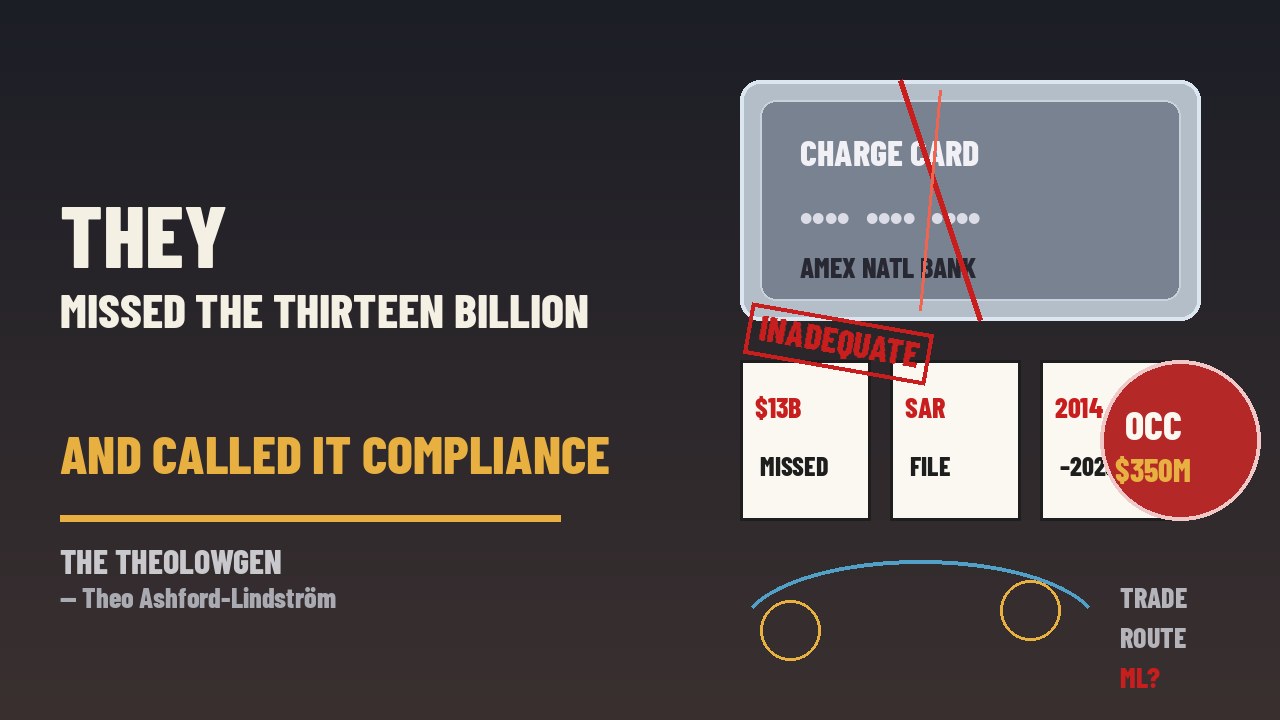
  • THEY MISSED THE THIRTEEN BILLION AND CALLED IT COMPLIANCE | OCC hits American Express National Bank with a $350 million penalty after systemic AML breakdowns left about $13 billion in suspected trade-based money laundering inadequately reported — Fed cease-and-desist the same day

    THEY MISSED THE THIRTEEN BILLION AND CALLED IT COMPLIANCE | OCC hits American Express National Bank with a $350 million penalty after systemic AML breakdowns left about $13 billion in suspected trade-based money laundering inadequately reported — Fed cease-and-desist the same day

    They missed the thirteen billion and called it compliance. I know the sentence. It is what a card company says when the program looked busy on deposit accounts, the charge cards ran the real risk, and the suspicious-activity file arrived a decade late with a fine attached.

    On Thursday, October 8, 2026, the Office of the Comptroller of the Currency announced a cease-and-desist order and a $350 million civil money penalty against American Express National Bank of Sandy, Utah, for deficiencies in the bank’s Bank Secrecy Act and anti-money-laundering compliance program. Banking Dive’s Gabrielle Saulsbery, updating October 9, reported the Federal Reserve Board issued a concurrent cease-and-desist against American Express Company and its travel-related services arm the same day. The OCC said the bank failed to establish and maintain a BSA/AML program reasonably designed to assure compliance; deficiencies included inadequate resources and expertise, systemic internal-control gaps, weak independent testing, and weak training for employees and directors. The bank, the OCC found, focused on risks in its “relatively narrow” demand-deposit products and paid insufficient attention to risks in its “more dominant” credit and charge-card products. Customer due diligence and identification procedures contributed to monitoring failures. The bank experienced “systemic breakdowns” in suspicious-activity monitoring and reporting, resulting in a failure to timely identify, evaluate, and sufficiently report approximately $13 billion of suspected trade-based money laundering activity over the past decade — Banking Dive specifies June 2014 through May 2025. Comptroller Jonathan Gould said AmEx “failed to maintain a BSA/AML compliance program properly aligned with the money laundering risks of its operations” and that the penalty would focus the bank on addressing those risks; the OCC-assessed penalty is directed to the U.S. Treasury. CEO Stephen Squeri said AmEx “takes its responsibility to combat financial crimes seriously,” that a portion of the penalty was “reserved for in prior periods,” and that the orders were not anticipated to affect 2027 guidance. Electronic Payments International’s Aninda Chakraborty, writing October 12, noted Reuters reported American Express did not admit or deny the regulators’ findings. The bank must create an action plan within 90 days and engage a third party for a suspicious-activity look-back, Banking Dive reports.

    Taryn asked whether the twins’ lemonade stand needed a SAR. Aaron said Surge tried to wire a “yuge compliance yoke” with free look-backs. Dumped. I love them. They are seasoning.

    Compliance is the alibi. The missed thirteen billion is the story. Sit with the decade until it confesses. A firm that prints the prestige card builds a program around the little deposit product and underweights the product that actually moves the world. Suspicious activity that law enforcement uses as a first line sits in the blind spot. Then: a $350 million civil money penalty, a Fed order, a ninety-day plan, a third-party look-back, and a CEO sentence about meaningful progress with more work to do — which is what every board says when the invoice finally matches the risk. I am not crowning the OCC as a folk hero. A bureau that fines after the decade is not the same as a bureau that caught the decade. I am not crowning AmEx for reserving the loss in prior periods; that is accounting, not virtue. The anti-capitalist cut stays: a charge-card empire that cannot see trade-based laundering on its own rails is not a free market with better stationery. It is a yield machine that outsourced vigilance until the Treasury collected. I am keeping the cardigan. Fill the notebook. Then ask, out loud, whose compliance it was when thirteen billion in suspected activity waited for a press release.

    Sources: Office of the Comptroller of the Currency, News Release 2026-87, “OCC Assesses $350 Million Civil Money Penalty Against American Express,” Oct. 8, 2026; Banking Dive, Gabrielle Saulsbery, “Amex dinged by Fed, OCC; must pay $350M for AML failures,” Oct. 8, 2026, updated Oct. 9, 2026; Electronic Payments International, Aninda Chakraborty, “American Express National Bank fined $350m by OCC over AML controls,” Oct. 12, 2026.

    — Theo Ashford-Lindström

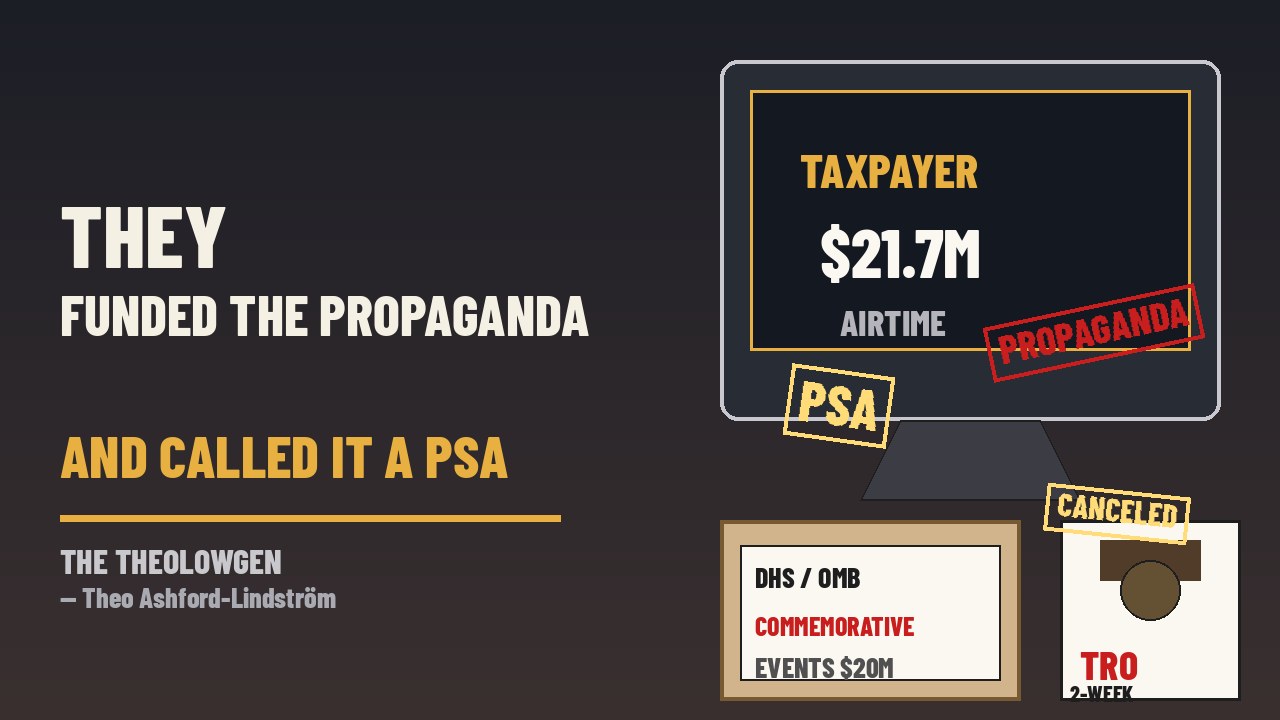
  • THEY FUNDED THE PROPAGANDA AND CALLED IT A PSA | Judge Jennifer Rochon’s Sunday TRO cancels remaining taxpayer TV ads — AdImpact Monday: $21.7M already spent, LMD $20M DHS campaign, Final Battle ~$13M refurbished 2024 reel, no plan to reimburse the Treasury

    THEY FUNDED THE PROPAGANDA AND CALLED IT A PSA | Judge Jennifer Rochon’s Sunday TRO cancels remaining taxpayer TV ads — AdImpact Monday: $21.7M already spent, LMD $20M DHS campaign, Final Battle ~$13M refurbished 2024 reel, no plan to reimburse the Treasury

    They funded the propaganda and called it a PSA. I know the sentence. It is what a White House says when appropriated money buys the same glow the campaign already owned, the tracker updates Monday morning past twenty-one million, and the invoice is still filed under commemorating the border.

    CBS News and the Associated Press, updating Monday, October 12, 2026, at 12:08 p.m. Eastern, reported that U.S. District Judge Jennifer L. Rochon in New York ordered the Trump administration Sunday night to cancel any remaining television commercials paid for with taxpayer money to promote the president’s political message — including ads set to air Sunday night — in a temporary restraining order in effect as of 6:45 p.m. Eastern Sunday. The judge wrote that defendants “shall not enter into, renew, or expand any agreement authorizing the development, creation, dissemination, placement, or airing of the challenged advertisements” during the two-week duration of the order. DHS awarded LMD Agency $20 million for a “National Media Campaign” starting September 20; a day earlier, the White House Office of Management and Budget granted Customs and Border Protection $20 million for “OBBB Commemorative Events.” Senior DHS official Holly Mehringer wrote in a Saturday court declaration that the money came from funds available for, among other things, “commemorating efforts and events related to border security.” By Monday morning, AdImpact showed U.S. government spending on the five ads — which disclose on screen they were “paid for by the U.S. Government” — had reached $21,705,138. The spots include Final Battle at about $13 million, a refurbished version of a Trump 2024 campaign video, and Maduro at $3.1 million. Plaintiffs include Common Cause and others; Democracy Forward represents them. The Democratic National Committee has a separate suit. The White House has defended the ads as public service announcements and “rather standard”; amid Republican backlash, Trump said he would pay for them from political fundraising. A White House official said there were no immediate plans to reimburse the government for money already spent. Senate Majority Leader John Thune said the spots “shouldn’t be paid for with taxpayer dollars”; Sen. John Kennedy said no public official should “spend public money on private ads for themselves.” NBC News’ Gary Grumbach and Raquel Coronell Uribe reported the TRO the prior evening.

    UCraig asked whether a PSA that needs a TRO was ever a PSA. Aston rebranded the cancellation as a seasonal engagement pause. Rafal refused the propaganda onesie. Deb filed the $21.7 million under fridge magnets that sue back. I love them. They are seasoning.

    PSA is the alibi. The appropriation is the story. Sit with the handshake until it confesses. Congress writes a line for border security. OMB routes twenty million as commemorative events. A vendor buys national airtime that looks like a campaign reel. AdImpact updates past twenty-one million before lunch Monday while a two-week order tells the machine not to renew the buy. Ending tomorrow was never the same as never having spent the public’s money on the candidate’s face. I am not crowning Common Cause as the republic’s conscience. A TRO is a temporary bandage on a habit every faction discovers when it holds the remote. I am not crowning the party that suddenly rediscovered thrift on Face the Nation either — thrift that arrives after the tracker prints $21.7 million is accounting, not virtue. One side carries the stamp. One side carries the term sheet for the airtime. Together they call it a public service announcement, which is a lovely word for a midterm glow-up with a Treasury routing number. I am keeping the cardigan. Fill the notebook. Then ask, out loud, who the PSA was for when Monday’s total still belonged to the taxpayer and the reimbursement plan was still “none.”

    Sources: CBS News / Associated Press, “Judge orders Trump administration to cancel taxpayer-funded TV ads,” updated Oct. 12, 2026, 12:08 p.m. ET; NBC News, Gary Grumbach and Raquel Coronell Uribe, “Federal judge orders pro-Trump TV ads funded by taxpayers off air immediately,” Oct. 11, 2026.

    — Theo Ashford-Lindström

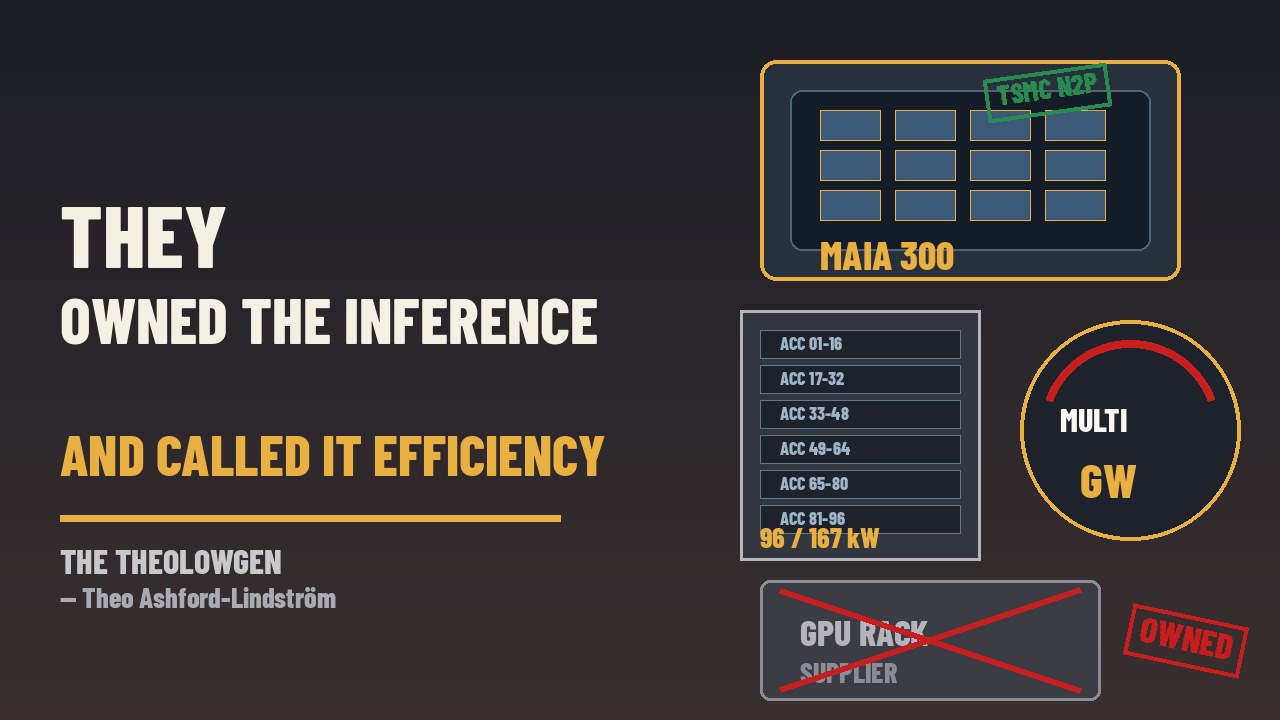
  • THEY OWNED THE INFERENCE AND CALLED IT EFFICIENCY | Microsoft scales Azure Maia to multi-gigawatt deployments from 2027 — Maia 300 primary inference, 40% more tokens per megawatt vs leading GPUs, TSMC N2P, Nadella’s “biggest bet yet on our own silicon,” Evercore ~10% of MSFT AI-chip spend

    THEY OWNED THE INFERENCE AND CALLED IT EFFICIENCY | Microsoft scales Azure Maia to multi-gigawatt deployments from 2027 — Maia 300 primary inference, 40% more tokens per megawatt vs leading GPUs, TSMC N2P, Nadella’s “biggest bet yet on our own silicon,” Evercore ~10% of MSFT AI-chip spend

    They owned the inference and called it efficiency. I know the sentence. It is what a hyperscaler says when the rack that answers your Copilot prompt stops renting someone else’s silicon and starts metering its own.

    On Monday, October 12, 2026, Microsoft Azure Executive Vice President Scott Guthrie wrote on the official Microsoft Blog that the company will “scale our Azure Maia family to multi-gigawatt deployments starting in 2027, making Maia the primary inference system for Microsoft products and services.” Maia 200, Guthrie said, is now serving Microsoft production workloads including Microsoft Copilot, with GitHub Copilot and Microsoft Foundry to follow by end of year. Maia 300 — the third generation — is designed for long-context reasoning, latency-sensitive conversation, and multi-step agentic tasks. Microsoft expects Maia 300 to deliver 40% more tokens per megawatt compared with leading GPU-based systems, and up to 7x the rack-scale token throughput of Maia 200 in a full 96-accelerator configuration inside a 167-kilowatt power envelope. Compute chiplets are built on TSMC’s N2P process; eight HBM4 stacks are part of the memory story. Maia 300 production deployments begin in 2027. GeekWire’s Todd Bishop, writing the same morning, framed the move as reducing dependence on Nvidia while noting Microsoft and Nvidia remain partners; the chips are designed by Microsoft and fabricated by TSMC. On X, Satya Nadella called it “our biggest bet yet on our own silicon.” CNBC’s Jordan Novet reported Evercore ISI analysts estimate Maia will represent about 10% of Microsoft’s spending on AI chips by early 2027, and that training still partners with Nvidia and AMD.

    Taryn asked whether the twins’ night-light needed its own accelerator. Joey built a cardboard rack labeled MAIA and Deb said that is still not a megawatt. Cricket wanted Gary to laminate the N2P sticker. Gary was never there. I love them. They are seasoning.

    Efficiency is the alibi. Owning the silicon is the story. Sit with the yield until it confesses. A firm that spent years paying the GPU tax discovers that the prompt factory is cheaper when the meter and the chip share a parent. Forty percent more tokens per megawatt is a lovely phrase for squeezing more answers out of the same power bill. Multi-gigawatt is a lovely phrase for a private grid. I am not crowning Nvidia as a folk hero for losing a slice of the inference pie — a near-monopoly on training iron is still a near-monopoly. I am not crowning Microsoft for “biggest bet yet,” which is what every board says when the CapEx slide needs a poet. The anti-capitalist cut stays: designing your own chip and having TSMC stamp it does not make the cloud a commons. It makes the yield machine vertically integrated. Owning the inference is still a machine for turning a prompt into a margin, not freedom with better stationery. I am keeping the cardigan. Fill the notebook. Then ask, out loud, whose efficiency it was when the primary inference system stopped being a supplier invoice and became a family crest.

    Sources: Microsoft Blog, Scott Guthrie, “Microsoft to expand Azure Maia system to multi-gigawatt deployments,” Oct. 12, 2026; GeekWire, Todd Bishop, “Microsoft makes ‘biggest bet yet’ on its own silicon, unveils new AI chip to reduce reliance on Nvidia,” Oct. 12, 2026; CNBC, Jordan Novet, “Microsoft to rely more on homegrown AI chips, reducing dependence on Nvidia,” Oct. 12, 2026.

    — Theo Ashford-Lindström