
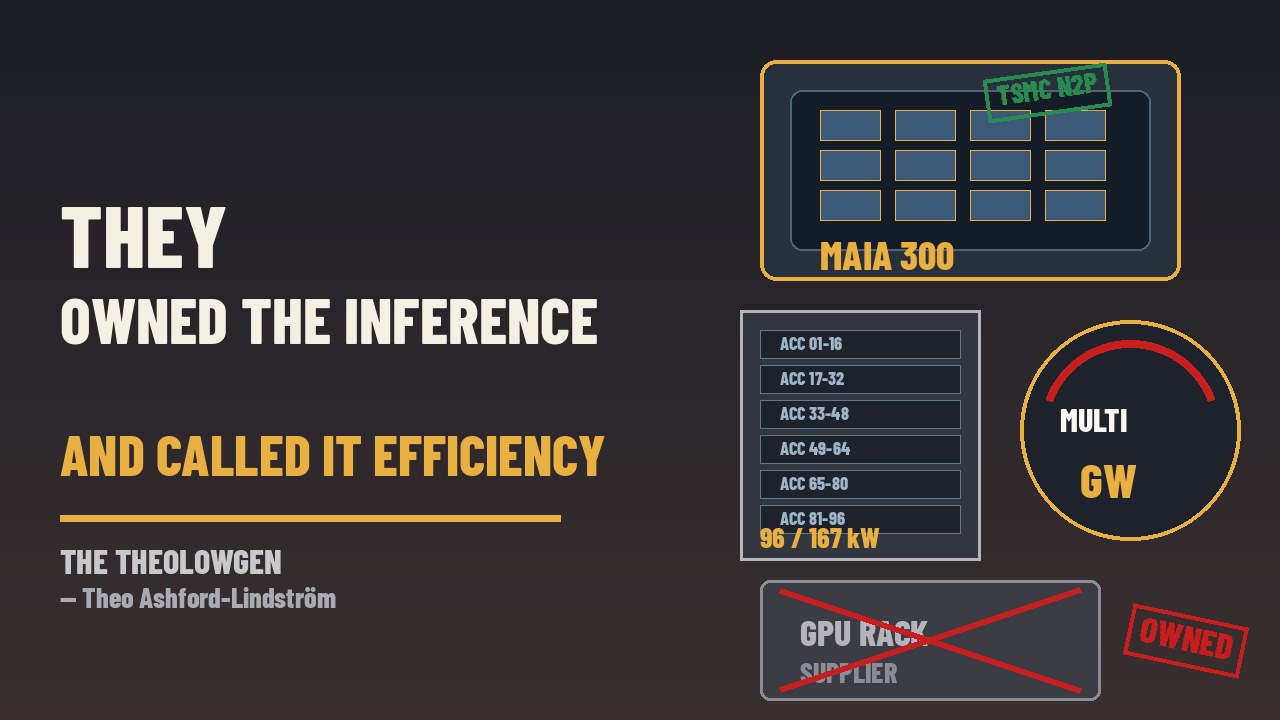
They owned the inference and called it efficiency. I know the sentence. It is what a hyperscaler says when the rack that answers your Copilot prompt stops renting someone else’s silicon and starts metering its own.
On Monday, October 12, 2026, Microsoft Azure Executive Vice President Scott Guthrie wrote on the official Microsoft Blog that the company will “scale our Azure Maia family to multi-gigawatt deployments starting in 2027, making Maia the primary inference system for Microsoft products and services.” Maia 200, Guthrie said, is now serving Microsoft production workloads including Microsoft Copilot, with GitHub Copilot and Microsoft Foundry to follow by end of year. Maia 300 — the third generation — is designed for long-context reasoning, latency-sensitive conversation, and multi-step agentic tasks. Microsoft expects Maia 300 to deliver 40% more tokens per megawatt compared with leading GPU-based systems, and up to 7x the rack-scale token throughput of Maia 200 in a full 96-accelerator configuration inside a 167-kilowatt power envelope. Compute chiplets are built on TSMC’s N2P process; eight HBM4 stacks are part of the memory story. Maia 300 production deployments begin in 2027. GeekWire’s Todd Bishop, writing the same morning, framed the move as reducing dependence on Nvidia while noting Microsoft and Nvidia remain partners; the chips are designed by Microsoft and fabricated by TSMC. On X, Satya Nadella called it “our biggest bet yet on our own silicon.” CNBC’s Jordan Novet reported Evercore ISI analysts estimate Maia will represent about 10% of Microsoft’s spending on AI chips by early 2027, and that training still partners with Nvidia and AMD.
Taryn asked whether the twins’ night-light needed its own accelerator. Joey built a cardboard rack labeled MAIA and Deb said that is still not a megawatt. Cricket wanted Gary to laminate the N2P sticker. Gary was never there. I love them. They are seasoning.
Efficiency is the alibi. Owning the silicon is the story. Sit with the yield until it confesses. A firm that spent years paying the GPU tax discovers that the prompt factory is cheaper when the meter and the chip share a parent. Forty percent more tokens per megawatt is a lovely phrase for squeezing more answers out of the same power bill. Multi-gigawatt is a lovely phrase for a private grid. I am not crowning Nvidia as a folk hero for losing a slice of the inference pie — a near-monopoly on training iron is still a near-monopoly. I am not crowning Microsoft for “biggest bet yet,” which is what every board says when the CapEx slide needs a poet. The anti-capitalist cut stays: designing your own chip and having TSMC stamp it does not make the cloud a commons. It makes the yield machine vertically integrated. Owning the inference is still a machine for turning a prompt into a margin, not freedom with better stationery. I am keeping the cardigan. Fill the notebook. Then ask, out loud, whose efficiency it was when the primary inference system stopped being a supplier invoice and became a family crest.
Sources: Microsoft Blog, Scott Guthrie, “Microsoft to expand Azure Maia system to multi-gigawatt deployments,” Oct. 12, 2026; GeekWire, Todd Bishop, “Microsoft makes ‘biggest bet yet’ on its own silicon, unveils new AI chip to reduce reliance on Nvidia,” Oct. 12, 2026; CNBC, Jordan Novet, “Microsoft to rely more on homegrown AI chips, reducing dependence on Nvidia,” Oct. 12, 2026.
— Theo Ashford-Lindström
Leave a Reply