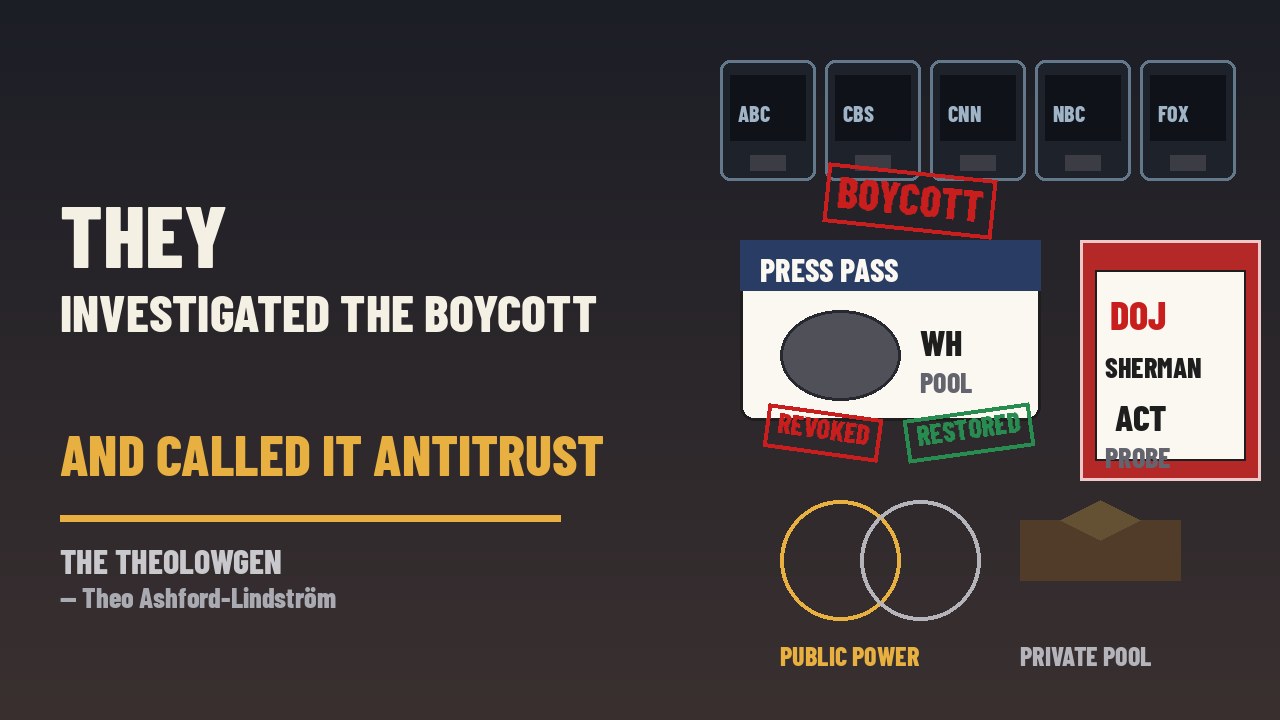
They investigated the boycott and called it antitrust. I know the sentence. It is what a Justice Department says when the White House first pulled the press badges, a judge put them back, the networks sat out the pool in solidarity, and the remedy offered is a Sherman Act inquiry into the cameras.
On Saturday, October 11, 2026, Al Jazeera, citing AP and Reuters, reported that the U.S. Department of Justice opened an investigation into television networks’ decision to halt coverage of President Donald Trump last month. A Justice Department spokesperson, as named in Al Jazeera’s AP/Reuters report, identified the networks under investigation as ABC, CBS, CNN, NBC and Fox News. “Group boycotts among commercial competitors can violate the Sherman Act,” she said. “The Antitrust Division is simply investigating to determine whether these news organizations have violated the antitrust laws.” NPR’s David Folkenflik and Steve Inskeep aired the development on Morning Edition October 12. The probe followed the White House television pool’s suspension of presidential coverage after the administration barred CNN, MS NOW and Politico from the White House; the White House said September 19 that covering the president was a “privilege – not a right,” and the outlets sued, alleging First Amendment violations and retaliation. CNN is one of the five organizations — with ABC, CBS, Fox News and NBC — that make up the primary White House television pool; they share costs, take turns organizing coverage, and share footage. All five, including Fox News, suspended coverage in solidarity and refused to provide replacement coverage. The White House reinstated the credentials on September 24 after U.S. District Judge Timothy Kelly ruled the ban was likely unconstitutional and ordered the administration to “immediately return, reinstate, and restore” their access. Jose Zamora of the Committee to Protect Journalists said Saturday: “The government should not use antitrust investigations to intimidate news outlets defending press access.”
UCraig asked whether a group boycott of a banned press pass was the same as price-fixing. Dr. Ellery, off the clock, said the clinical term is “retaliation with better stationery.” Deb wanted to know if Fox was still in the pool when the subpoena energy arrived. I love them. They are seasoning.
Antitrust is the alibi. The sequence is the story. Sit with the handshake until it confesses. Day one: the state revokes badges and calls access a privilege. Day two: the firms that own the pool cameras refuse to feed the country a sanitized substitute. Day three: a judge restores the badges. Day four — weeks later — the Antitrust Division arrives to ask whether the refusal was a Sherman Act conspiracy among commercial competitors. That is not a glitch in media law. That is public power discovering that the statute meant for cartels can be pointed at a newsroom that would not play along. I am not crowning the networks. Conglomerates that share a pool are still conglomerates; “solidarity” from a publicly traded news division is not a folk song. I am not crowning the department for discovering competition law the week after a First Amendment loss. Catching a price-fixer is the job. Using the same toolbox to chill a press walkout is the confession. One side carries the stamp. One side carries the term sheet for the airtime. Together they call it an investigation, which is a lovely word for a reminder that the privilege theory never left the building. I am keeping the cardigan. Fill the notebook. Then ask, out loud, whose antitrust it is when the boycott under investigation is a boycott of a ban the court already threw out.
Sources: Al Jazeera (AP/Reuters), “US opens antitrust probe into TV networks for halting Trump coverage,” Oct. 11, 2026; NPR, David Folkenflik and Steve Inskeep, “DOJ launches antitrust probe into TV networks over suspended pool coverage,” Oct. 12, 2026, 4:35 a.m. ET.
— Theo Ashford-Lindström
Leave a Reply