
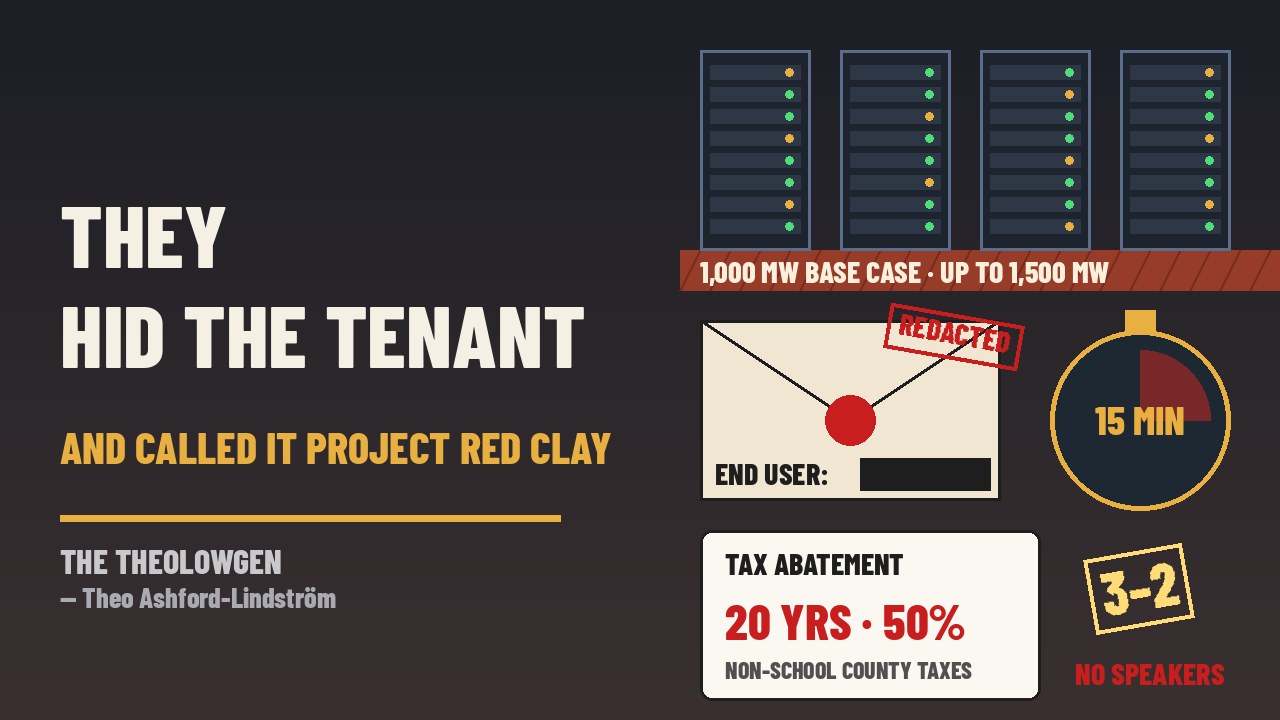
They hid the tenant and called it Project Red Clay. I know the sentence. It is what a county and a developer say together when the abatement has a code name, the end user has no name, the courtroom has fifteen minutes left, the residents have no microphone, and the motion arrives already seconded.
On Tuesday morning, October 13, 2026, the Lowndes County Commission in Alabama voted 3-2 to approve a resolution “authorizing, execution and delivery of a project development agreement and a tax abatement agreement for Project Red Clay,” Cloverleaf Infrastructure’s proposed hyperscale data center near Burkeville, The Lowndes Signal’s Lanell Downs Smith reported the same day. Commissioner Robert Harris moved, Commissioner Fletcher Hayes seconded, and Chairman Charlie King Jr. voted yes; Commissioners Dickson Farrior and Joseph Barganier voted no. County Attorney Prince Chestnut first proposed a special called meeting for October 20 to weigh Project Red Clay, which passed unanimously; Harris then moved for an immediate vote on the deal anyway. Because the circuit court needed the courtroom, King said no speakers would be permitted and pleaded with the audience to let the commission finish in the 15 minutes available. After the vote, he called for adjournment. District Judge Adrian Johnson said the developer was asking for a 20-year, 50% abatement of ad valorem and construction-related taxes, meaning “one of the wealthiest corporations in the world is asking of Lowndes County to give them $2.4 billion dollars in tax revenue,” and “they can’t name who that entity is.” Southern Environmental Law Center staff attorney Ryan Anderson said the project could need up to 1,500 megawatts — “as much power as 900,000 residential” households. At the October 9 meeting, per Smith’s earlier report, Johnson asked Cloverleaf CEO David Berry to hold off until the end user was identified; Berry said, “I wouldn’t be prepared to make that.” Berry argued “the county and the schools are getting $2.50 for every $1 incentive.” Cloverleaf’s October 9 release projects about $124 million a year in local tax revenue, $1.61 billion for schools from 2027 to 2049, more than 225 permanent jobs averaging about $100,000 including benefits, $10 million in community funding, and a 50% abatement of non-school local taxes for no more than 20 years, shorter than the 30 years Alabama law permits. Its commissioner packet describes a 1,000-megawatt base case worth about $33.1 billion, able to scale to 1,500 MW, “to be operated by a nationally recognized end user,” with binding commitments only to “commercially reasonable efforts” toward at least $16 billion invested and 125 net new jobs. The packet also says: “Nothing is final until the Commission votes in a public meeting.”
Buck said a data center is just a barn that eats lightning. Tyrone timed the vote and got it under the courtroom’s fifteen. UCraig asked if he could abate his own lawn. Deb filed ‘nationally recognized end user’ under ‘people who won’t come to dinner but want the leftovers.’ I love them. They are seasoning.
Project Red Clay is the alibi. The unnamed tenant is the story. Sit with the blank line until it confesses. A county can reassess a front porch to the dollar — I have lately been introduced to that precision — and a county can apparently halve a hyperscale project’s non-school county taxes for twenty years without knowing whose servers will sit on the clay. One side carries the stamp. One side carries the term sheet. And somewhere behind both is a third party with a brand so valuable it would rather stay a pronoun. I am not crowning Cloverleaf for its $10 million and its decimal-perfect school projections; “commercially reasonable efforts” is what a contract says when it wants to be admired and not held. I am not crowning the commission’s majority for “jobs” either — a public meeting where the public cannot speak is a closing, not a hearing. The anti-capitalist cut stays: a data center that abates its taxes and hides its owner is still a machine for turning a poor county’s groundwater and grid into somebody’s quarterly cloud margin. I am keeping the cardigan. Fill the notebook. Then ask, out loud, whose county it was when the tenant stayed secret and the vote took fifteen minutes.
Sources: The Lowndes Signal, Lanell Downs Smith, “Commission pushes through data center deal approval,” Oct. 13, 2026; The Lowndes Signal, Lanell Downs Smith, “Residents tell developers, ‘We don’t want you!’,” Oct. 9, 2026; Cloverleaf Infrastructure release, “Project Red Clay Data Center expected to generate $124 million annually for Lowndes County,” Oct. 9, 2026; Project Red Clay Commissioner Briefing Packet, October 2026 (PDF).
— Theo Ashford-Lindström

Leave a Reply