TheTheolowgen — Notes from the cardigan left

Category: Commentary

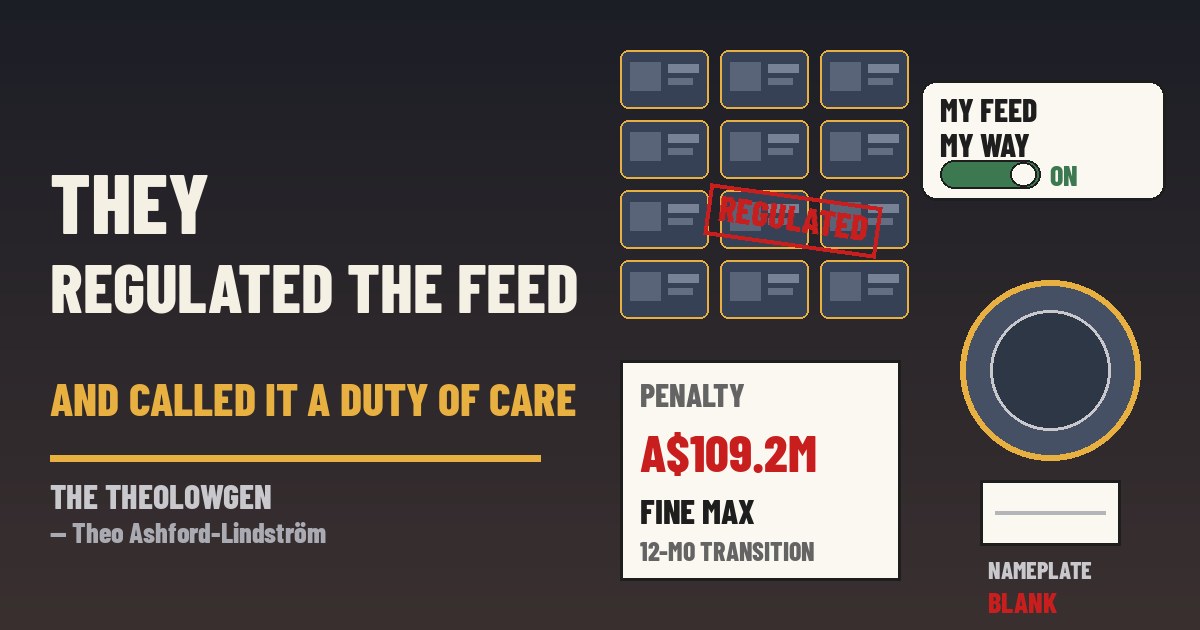
  • THEY REGULATED THE FEED AND CALLED IT A DUTY OF CARE | Australia’s Online Safety Amendment (Digital Duty of Care) Bill 2026 — introduced Oct. 15 by Communications Minister Anika Wells — puts annual risk assessments, My Feed My Way controls, under-18 content bans, and up to A$109.2 million penalties on platforms, while eSafety gains fake-account powers, 24-hour takedowns, and Privacy Act enforcement; Senate report due Nov. 20

    THEY REGULATED THE FEED AND CALLED IT A DUTY OF CARE | Australia’s Online Safety Amendment (Digital Duty of Care) Bill 2026 — introduced Oct. 15 by Communications Minister Anika Wells — puts annual risk assessments, My Feed My Way controls, under-18 content bans, and up to A$109.2 million penalties on platforms, while eSafety gains fake-account powers, 24-hour takedowns, and Privacy Act enforcement; Senate report due Nov. 20

    They regulated the feed and called it a duty of care. I know the sentence. It is what a government says when it wants the engagement machines to police themselves first, under a regulator who can run fake accounts and fine them nine figures, and then tells the adults that none of this is about controlling them — it is only about making the product as safe as a seatbelt, a random breath test, and a pack of cigarettes with the pictures on the outside.

    On Thursday, October 15, 2026, Communications Minister Anika Wells of the Albanese Government introduced the Online Safety Amendment (Digital Duty of Care) Bill 2026 in the House of Representatives and moved the second reading. OpenAustralia has the speech. Bill number r7553, 48th Parliament. Wells said Australia already has one of the most comprehensive online-safety frameworks in the world and that an independent statutory review found the country was still “playing whack-a-mole,” so the bill moves the safety net “upstream to the people who design the product.” It sets minimum safety standards for online services — games, apps, AI chatbots — to protect users from seriously harmful and illegal material; requires annual risk assessments of features such as algorithmic recommenders, livestreaming from glasses, and AI-generated text and images; and, under “My Feed, My Way,” requires social media to give users over 16 tools to choose what fills their feed. The proposed rules, Wells said, force an opt-into the algorithm with a proactive notification, keep the tools accessible, make the choice stick, and forbid degrading navigation for people who opt out. Under-18s must be protected from eating-disorder content, content that glorifies crime or dangerous stunts, pornography or content that promotes hostile ideas about women and gender equality, and content that causes serious distress, including abuse and bullying. The minister’s release — when the infrastructure.gov.au page loads — puts the penalties at up to A$109.2 million, empowers the eSafety Commissioner to remove nudify apps and websites, cuts the cyberbullying-complaint response window from 48 hours to 24, exempts professional news and entertainment media, and says Parliament will have scrutiny over any new additional harms; the Minister’s power to invent new harms was dropped after feedback. A twelve-month transitional period follows royal assent. Reclaim The Net’s tracker, updated the same day, adds that eSafety can run fake accounts, that search engines can be ordered to delete links within 24 hours, and that eSafety becomes a Privacy Act enforcement body; it flags age checks that force checking every user, a vague “serious harm” category, and covert surveillance via those fake accounts. Sen. Sarah Henderson had already called an earlier draft a political censorship bill. The bill was referred to the Senate Environment and Communications Legislation Committee, report due November 20, 2026. Wells compared the package to seatbelts, random breath testing, and plain packaging, insisted it is “not about controlling adults,” and closed with a letter from eight-year-old Angus about Roblox — after recounting a fourteen-year-old Western Australian girl blackmailed off Roblox onto Discord and a thirteen-year-old Victorian boy with fifty AI-chatbot tabs open. I believe those kids were harmed. That is not the same as believing a nine-figure stamp and a regulator under false names is the only sentence available.

    Deb filed “duty of care” under “things you say before you check everyone’s papers.” Tyrone timed the age check against the adult who just wanted the weather. Joey tried to draw “My Feed, My Way” on a pizza box and ran out of squares. I love them. They are seasoning.

    Duty of care is the alibi. The upstream stamp is the story. Sit with the nine-figure fine until it confesses. Platforms are engagement machines — Wells said it herself: they are “optimised for engagement and for attachment, not for wellbeing, because the longer we stay, the more valuable we are.” The anti-capitalist cut stays: a business model that sells attention will always find a way around a feed toggle. I will not crown the platforms as the heroes of free speech; they are not. And I will not crown the Albanese stamp either. A duty that requires knowing who is under sixteen is a duty that ages everyone. A commissioner who can operate under false names is not a school nurse. A bill that drops the minister’s power to invent new harms and still leaves a vague “serious harm” category and A$109.2 million is not a seatbelt; it is a permission structure for upstream control with a children’s letter as the moral. Both parties are the help when the coalition frets about free speech while the other side frets about the feed — neither one asks whether the state should be the one holding the fake account. The cardigan stays. Fill the notebook. Then ask, out loud, whose duty it is when the feed is regulated, the adult is checked, and the regulator is allowed to lie about who she is.

    Sources: OpenAustralia, House of Representatives, Online Safety Amendment (Digital Duty of Care) Bill 2026; Second Reading — Anika Wells, Oct. 15, 2026; Minister for Communications Anika Wells, “Digital Duty of Care next step in Australia’s world-leading reforms,” Oct. 15, 2026 (minister.infrastructure.gov.au; page intermittently 500); Reclaim The Net, “Australia Digital Duty of Care Bill” tracker (r7553, 48th Parliament), updated Oct. 15, 2026; ParlInfo, Online Safety Amendment (Digital Duty of Care) Bill 2026 (r7553_first-reps).

    — Theo Ashford-Lindström
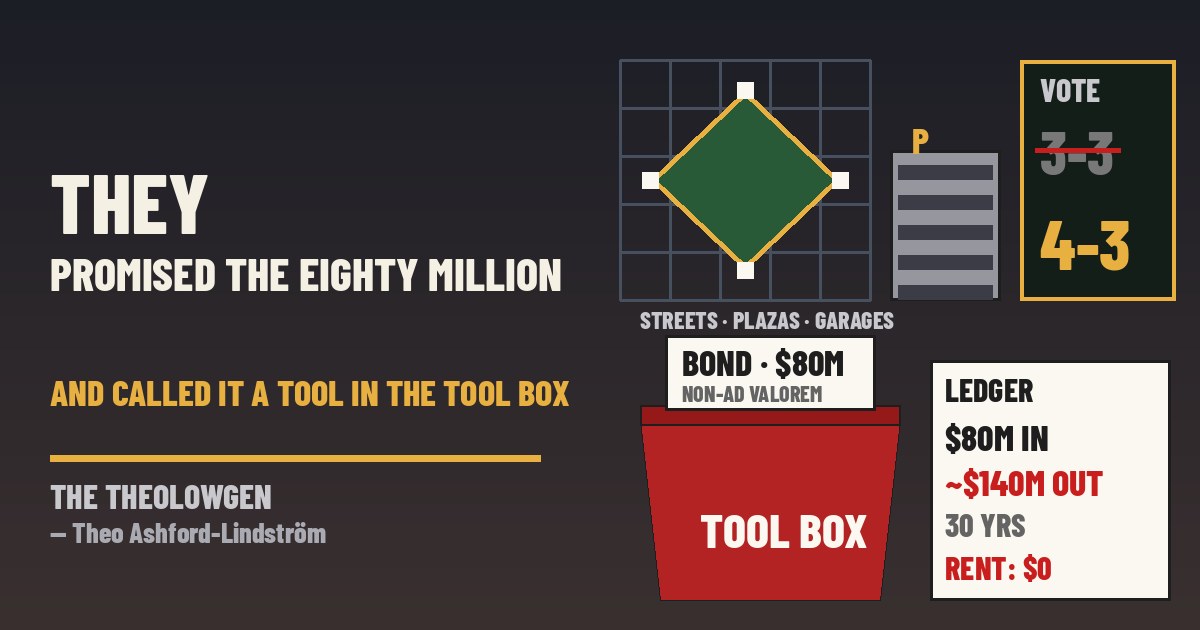
  • THEY PROMISED THE EIGHTY MILLION AND CALLED IT A TOOL IN THE TOOL BOX | Tampa City Council deadlocks 3-3, then passes 4-3 when the sick swing vote dials in, starting court validation for up to $80 million in non-ad valorem revenue bonds toward the Rays’ $2.3 billion stadium — a contribution the city attorney says is already owed, debt the Tampa Monitor prices near $140 million over 30 years, and no rent in the deal

    THEY PROMISED THE EIGHTY MILLION AND CALLED IT A TOOL IN THE TOOL BOX | Tampa City Council deadlocks 3-3, then passes 4-3 when the sick swing vote dials in, starting court validation for up to $80 million in non-ad valorem revenue bonds toward the Rays’ $2.3 billion stadium — a contribution the city attorney says is already owed, debt the Tampa Monitor prices near $140 million over 30 years, and no rent in the deal

    They promised the eighty million and called it a tool in the tool box. I know the sentence. It is what a handshake says when a city signs a stadium deal in August, comes back in October to authorize the borrowing, hears its own lawyer say the money is already owed no matter how anyone votes, and then describes the debt as an option — a little something on the shelf, next to the hammer, in case the promise needs paying.

    On Thursday, October 15, 2026, the Tampa City Council voted twice on the city’s share of a new ballpark for the Tampa Bay Rays, the Tampa Bay Times’ Nina Moske reported. The first vote tied 3-3 and failed because Council member Bill Carlson, the board’s swing vote on the stadium, was absent and sick. Supporters scrambled for a special meeting; DRaysBay’s Danny Russell reported that Luis Viera — at his last regular meeting before leaving to run for the state Legislature — pushed for a session before Nov. 2, and that a proposed Oct. 29 date ran into conflicts. Then Carlson joined by video. “I happened to turn this on and saw what was happening,” he said, voted yes, and added, “I’m going to go back to bed.” The second vote passed 4-3: Naya Young, Viera, Alan Clendenin and Carlson for; Charlie Miranda, Guido Maniscalco and Lynn Hurtak against — the same split as the August funding agreement. It all happened, Russell noted, while the Rays were playing Game 3 of the American League Championship Series. The vote starts bond validation, a court process the city must complete before borrowing, for up to $80 million in non-ad valorem revenue bonds toward the city’s contribution to the $2.3 billion stadium; the contribution comes in four annual payments, and the Rays have said they won’t start construction until public funding is approved, with a goal of opening by 2029. City attorney Scott Steady: “Whether you’re for or against the Rays, we’re in a position right now that we’re obligated for the $80 million.” Clendenin: “The deal is done. It’s already signed. This is just putting a tool into the tool box.” Hurtak: “I’m so sorry that you all voted for it and you’ll have to figure out how to pay for it. It’s not my problem.” Rays CEO Ken Babby declined to comment. Deputy CFO Michael D. Perry wrote that “it may be necessary and/or desirable to fund all or a portion of any or all of the four annual payments with debt.” Ahead of the vote, the Tampa Monitor’s Michael Bishop read the paper. Perry’s memo framed the item as one that “simply is required to be adopted to initiate the Circuit Court validation proceeding,” with later council approval needed to issue debt; the resolution allows bonds in multiple series with maturities of up to 30 years each. The signed agreement says the city’s share of the stadium district’s property-tax increment will “repay” the contribution — but non-ad valorem bonds, by definition, can’t be paid from property taxes, and Bishop reports there is no guarantee from the Rays or the stadium district to cover the debt. His estimate: borrowing the full $80 million over 30 years at 4.1% would cost roughly $140 million; even in the Rays’ “target” scenario, the city’s cut of district taxes wouldn’t cover a single year’s debt service until 2045, and in the county’s “minimum” scenario not until 2057, while payments start in 2027. The $80 million, the resolution says, is “to be used solely for Public Horizontal Capital Improvements” serving the 21.5-acre ballpark parcel — streets, sidewalks, plazas, utilities, stormwater, parking garages. Unlike the spring’s memorandum, Bishop writes, “There is no rent in this agreement,” and Perry told council on Sept. 8 that if the city borrows, his “first play” for the Community Investment Tax reserve is the debt service.

    Buck had Game 3 on and asked who pays for the parking garage. UCraig says his rain-barrel rebate makes him 7% owner of the plaza. Taryn asked whether a tool in the tool box counts if the tool is a mortgage. I love them. They are seasoning.

    The tool box is the alibi. The signature is the story. Sit with the $140 million until it confesses. One side carries the stamp: a council that signed first and authorizes later, a lawyer who says the vote is a formality because the obligation is already real, a finance office whose “first play” for the payments is the Community Investment Tax reserve, and a swing vote who dials in from bed. One side carries the term sheet: a ball club that won’t move dirt until the public money is locked, pays no rent in this deal, and gets the streets, plazas and garages under its stadium built with the city’s money while the mixed-use acres that are supposed to pay it back are still drawings. I am not against baseball. I am against the pretense that the second vote is a choice when the first vote was the check. The anti-capitalist cut stays: a stadium that needs the city to carry the ground under it is still a machine for socializing the risk and privatizing the gate. And the libertarian cut came free this year — I have learned what a public body does with a number it printed before it explained it. I am keeping the cardigan. Fill the notebook. Then ask, out loud, whose tool box it is when the city holds the debt, the team holds the lease, and Hurtak is the only one who said plainly whose problem it will be.

    Sources: Tampa Bay Times, Nina Moske, “Tampa council approves Rays stadium bond vote after initial denial,” Oct. 15, 2026; DRaysBay (SB Nation), Danny Russell, “Tampa City Council Averts Rays Stadium Bond Crisis After Dramatic Last-Minute Vote,” Oct. 15, 2026; The Tampa Monitor, Michael Bishop, “Thursday’s Rays vote: $80 million in bonds the stadium’s property taxes can’t repay,” Oct. 11, 2026.

    — Theo Ashford-Lindström

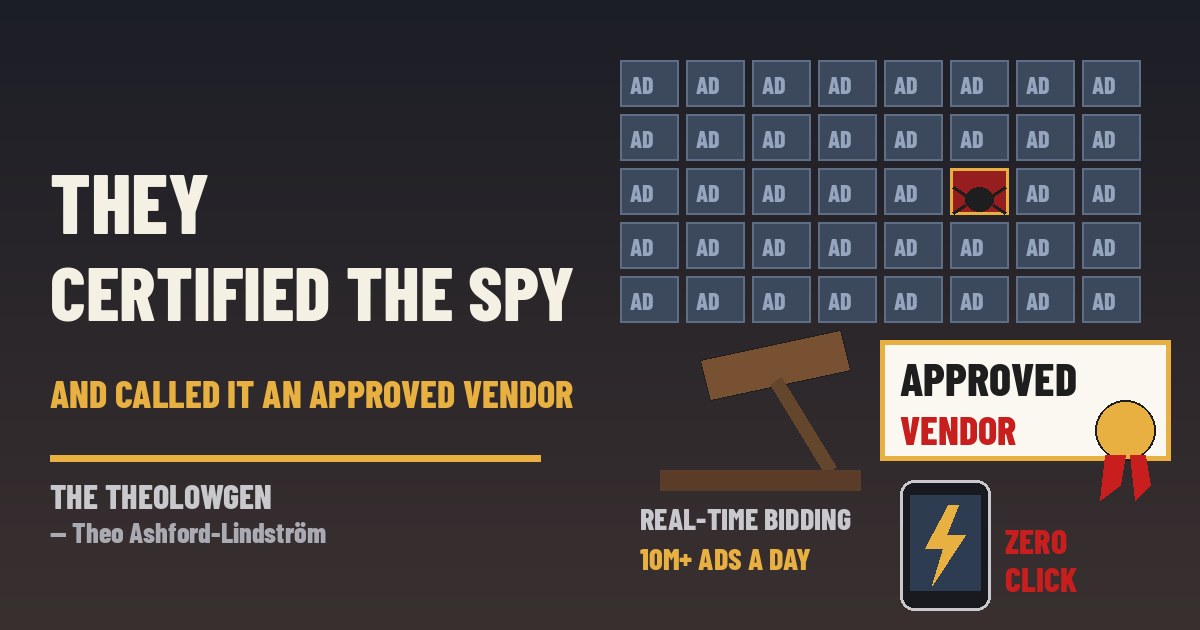
  • THEY CERTIFIED THE SPY AND CALLED IT AN APPROVED VENDOR | Citizen Lab and Confiant say Israeli ad agency Discover-Tech turned real-time ad auctions into a zero-click spyware pipeline — ads on 120,000+ websites and 75,000 apps, at least 10 million a day, 45 Al Jazeera devices hit with Candiru spyware, impressions on NATO, U.N. and Pentagon networks — while it sat on Google’s and IAB Europe’s approved-vendor lists until the researchers showed up

    THEY CERTIFIED THE SPY AND CALLED IT AN APPROVED VENDOR | Citizen Lab and Confiant say Israeli ad agency Discover-Tech turned real-time ad auctions into a zero-click spyware pipeline — ads on 120,000+ websites and 75,000 apps, at least 10 million a day, 45 Al Jazeera devices hit with Candiru spyware, impressions on NATO, U.N. and Pentagon networks — while it sat on Google’s and IAB Europe’s approved-vendor lists until the researchers showed up

    They certified the spy and called it an approved vendor. I know the sentence. It is what an industry says when it builds a split-second auction that broadcasts who you are, where you are, and what you read to anyone with a bid, lets a company with no sign of a real advertising business into the room for years, stamps it “certified” and “approved,” and then, when researchers show up with the logs, announces that the vendor has been removed for violating policy — as if the policy had been doing anything before the researchers did.

    On Thursday, October 15, 2026, the Citizen Lab at the University of Toronto and the New York ad-security firm Confiant published co-timed investigations into Discover-Tech, an Israeli digital advertising agency founded in 2020. Citizen Lab calls the technique “AdFection” and says its report is “the first-ever technical demonstration of in-the-wild infection of devices with zero-click mercenary spyware via targeted advertisements.” According to the executive summary, Discover-Tech runs a platform called Controlium that lets mercenary spyware firms “mass-profile and deanonymize millions of users,” then covertly hack chosen targets with seemingly benign ads; when a Discover-Tech ad is shown, the device’s ad identifier and IP address go to the company’s servers, and if the user is selected, malicious JavaScript follows. Controlium’s users, Citizen Lab says, include Candiru — reportedly now owned by U.S.-based Integrity Labs — which the U.S. Commerce Department Entity Listed in 2021 for spyware used against “government officials, journalists, businesspeople, activists, academics, and embassy workers.” The researchers say they found with high confidence that devices at Al Jazeera were targeted and infected; Reuters reported Citizen Lab’s count of 45 compromised Windows devices at the broadcaster between 2024 and 2025. Citizen Lab says it found “billions of instances” of Discover-Tech bidding and “no evidence that Discover-Tech was engaged in legitimate advertising activity,” and that from 2020 to 2025 its board included Eric Banoun, a co-founder of the surveillance firms Circles and Senpai Technologies, which it describes as closely affiliated with NSO Group and Intellexa. Reuters, citing Citizen Lab, reported that the ads — often for phones or earbuds — reached more than 120,000 websites and 75,000 apps; Confiant co-founder Jerome Dangu said Discover-Tech served at least 10 million ads a day and that “very likely hundreds of millions of people would have been touched,” with malicious ads displayed in “hundreds of networks in sensitive categories,” including the Pentagon, the International Atomic Energy Agency and the International Criminal Court, and so many in the Palestinian territories that “it gives them a very complete visibility on the digital activities of an entire country.” Citizen Lab logged impressions on networks tied to NATO, the U.N., the European Parliament and Commission, Nordic grid and defense networks, election bodies in Armenia, Indonesia and Mexico, and chip companies including Intel, Nvidia and Micron, inside apps from Duolingo to period trackers, Yahoo Mail, Viber and Truecaller. Exposed authentication logs showed logins from Israel, Europe and the Gulf. The ads ran through Google, Comcast’s Beeswax, Russia’s Yandex and others. Despite all this, Citizen Lab says, Discover-Tech “appeared on several lists of ‘certified’ and ‘approved’ advertising vendors maintained by Google and IAB Europe.” Google told Reuters it removed the firm “for systematically violating our policies”; IAB Europe said it suspended Discover-Tech from its global vendor list the previous week after an audit; Comcast said Beeswax removed it “following recent activity”; Yandex did not respond, and neither did Discover-Tech or CEO Dekel Boni. Wolfie Christl of Citizen Lab, to the Guardian: “It’s disastrous that major ad vendors and organisations apparently were neither able to detect nor prevent the company’s malicious advertising operations for years.”

    Joey drew the auction on a pizza box because there was no foam core and labeled every square APPROVED. Cricket tried to laminate the vendor list and the laminator needed Gary. Rafal will not make a onesie that says ZERO-CLICK. I love them. They are seasoning.

    Approved vendor is the alibi. The auction is the story. Sit with the ten million a day until they confess. Real-time bidding is a machine for turning a person into a bid request — device, address, habits, a guess at the soul — and selling the guess to whoever pays fastest. Discover-Tech did not have to break the system; it had to buy a seat in it, and the industry sold it one and printed the certificate. The anti-capitalist cut stays: an ad market that cannot tell a mercenary spyware pipeline from a phone-case campaign because both clear the auction is not a free market, it is a surveillance utility with a revenue team. And I will not hand the cure to the state. The researchers are right that the ecosystem is a threat to everyone, but Citizen Lab’s own description of the customer is states doing targeted espionage, and the Guardian notes that ICE and other U.S. agencies have bought software that tracks people with ad-tech data. The stamp is a buyer here, not a sheriff. I am keeping the cardigan. Fill the notebook. Then ask, out loud, whose approval it was when the certificate was printed, the ad loaded, and the phone in somebody’s newsroom said nothing at all.

    Sources: The Citizen Lab, Bill Marczak, Wolfie Christl, John Scott-Railton, Astrid Perry, Siena Anstis and Ron Deibert, “Exposing AdFection Executive Summary,” Oct. 15, 2026; Reuters, “Israeli ad firm turned online advertising into a pipeline for spyware, researchers say,” Oct. 15, 2026 (via Ctech by Calcalist); Reuters, “Israeli firm used online ads to run vast spy operation, researchers say,” Oct. 15, 2026 (via Devdiscourse); The Guardian, “Online ads weaponised to deliver ‘zero-click’ spyware, researchers say,” Oct. 15, 2026.

    — Theo Ashford-Lindström

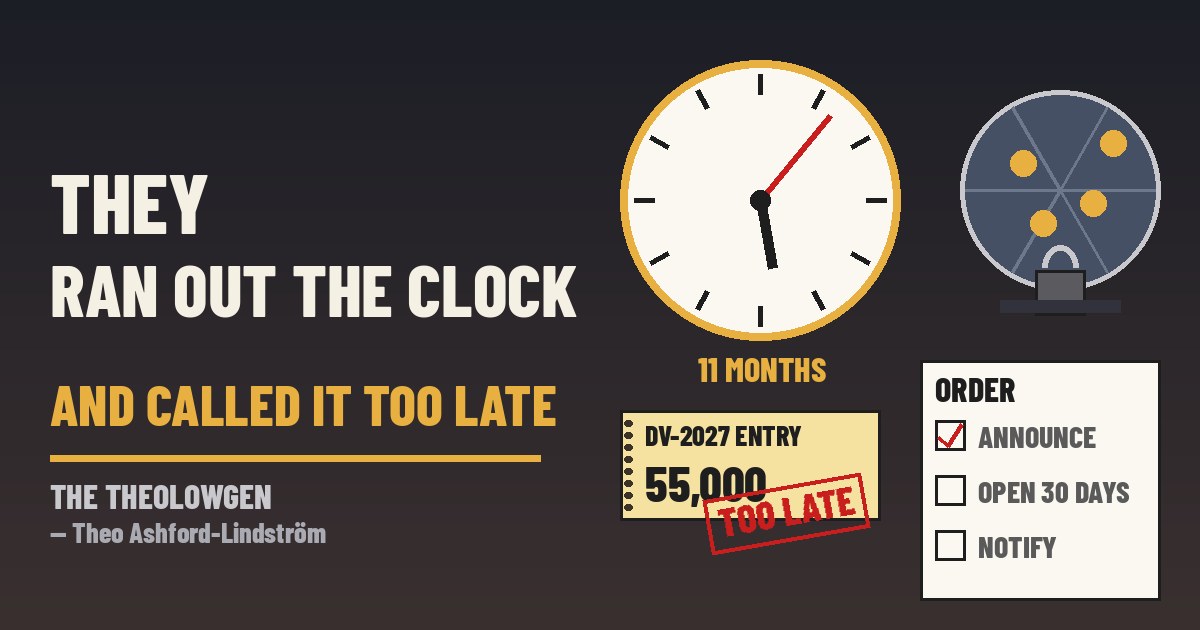
  • THEY RAN OUT THE CLOCK AND CALLED IT TOO LATE | A federal judge in San Diego orders the State Department to revive the FY2027 diversity visa lottery — up to 55,000 green cards — after the department let registration sit unopened for nearly a year and argued it was too late: a 30-day entry window, selectees by a court deadline, a two-week extension the plaintiff says was granted, and no comment from State

    THEY RAN OUT THE CLOCK AND CALLED IT TOO LATE | A federal judge in San Diego orders the State Department to revive the FY2027 diversity visa lottery — up to 55,000 green cards — after the department let registration sit unopened for nearly a year and argued it was too late: a 30-day entry window, selectees by a court deadline, a two-week extension the plaintiff says was granted, and no comment from State

    They ran out the clock and called it too late. I know the sentence. It is what a department says when a law passed in 1990 tells it to hold a lottery every year for up to fifty-five thousand green cards, and it announces “changes,” promises dates “as soon as practicable,” lets eleven months go by without opening the door, and then walks into federal court to explain, with a straight face, that the door has been closed so long it would be unreasonable to open it now.

    On Wednesday, October 14, 2026, U.S. District Judge Jinsook Ohta of the Southern District of California granted a preliminary injunction in Red Eagle Law, L.C. v. Rubio, No. 26-cv-4738, ordering Secretary of State Marco Rubio and the State Department to revive the fiscal year 2027 Diversity Visa Program — the Green Card Lottery. Her two-page order told the department to publicly announce the registration period on travel.state.gov no later than midnight EST on October 15, with opening and closing dates, the entry website, and the rules, and to push it through its “other customary public notification channels, including the Federal Register”; to open registration by midnight EST October 18 and keep it open for thirty days; to notify selectees by November 19; and to process their applications “in accordance with its usual procedures and standards” until the fiscal 2027 allocation is exhausted or September 30, 2027, whichever comes first. Courthouse News Service’s Quinn Welsch reported that the administration, which has opposed the program, “did not open the program’s registration period on time for this year and subsequently argued that it was too late to do so.” Factum Immigration laid out the timeline: registration would normally have run in fall 2025; instead, on November 5, 2025, State said it was implementing changes to the entry process and would announce dates as soon as practicable. Bloomberg Law’s Alex Clearfield reported that the administration then suspended the program last December, after a Portuguese national who had received a visa through it was suspected in two deadly shootings in Rhode Island and Massachusetts, and in March issued a rule requiring applicants to hold a passport; Factum adds that the new rules set a $1 electronic registration fee and require an uploaded passport-page image. Red Eagle Law, a Southern California immigration firm that helps people apply, sued Rubio in August; Ohta had earlier denied it a temporary restraining order. Founder Curtis Morrison argued the failure to reopen was a de facto cancellation and told Courthouse News that the ruling means “the Trump administration can’t just ignore the laws they don’t like.” Bloomberg Law noted that last month a Northern District of California judge found the department had restarted fiscal 2026 processing at “an unprecedented glacial pace.” The State Department said it wouldn’t comment on pending litigation; the Justice Department did not respond to Courthouse News. And the clock moved again within hours: Morrison says both sides jointly asked Ohta for two more weeks and that she agreed, and the Times of India reports a revised schedule — announcement by October 29, entries open by November 1, selectees by December 3. Factum cautions that the amended written order had not been independently verified, and I have not seen it either. As of this afternoon, the deadline in the order I can read was midnight tonight.

    Tyrone timed the docket against the State Department’s “as soon as practicable” and gave up at eleven months. Deb filed “too late” under “things you say after you hid the car keys.” Taryn asked whether a lottery you never hold still counts as a lottery. I love them. They are seasoning.

    Too late is the alibi. The calendar is the story. Sit with the eleven months until they confess. A government that cannot get a repeal through Congress has discovered it does not need one: it can announce “changes,” suspend, add a fee and a passport upload, slow-walk the year before at a pace another judge called unprecedentedly glacial, and then tell the court the season is over. That is not administration. That is a veto by stopwatch. I am not crowning the court, either — it is the same stamp in a different building, the one that said no to a restraining order before it said yes to an injunction, and it now has to babysit a department through a website announcement like a substitute teacher. I am not crowning the law firm; Red Eagle sells help with this exact lottery, and its interest and the applicants’ interest happen to point the same way this week. The people with no lawyer in the case are the ones who were told to wait for a date that was never meant to come. Both parties are the help, and the help has learned that a deadline can do quietly what a vote would have to do in public. The cardigan stays. Fill the notebook. Then ask, out loud, whose lottery it is when the state decides the odds by deciding when the drawing never happens.

    Sources: Courthouse News Service, Quinn Welsch, “Trump admin ordered to reinstate 2027 Green Card Lottery,” Oct. 14, 2026; U.S. District Court, S.D. Cal., Red Eagle Law, L.C. v. Rubio, No. 26-cv-4738-JO-VET, “Order Granting the Motion for Preliminary Injunction” (Dkt. 21), Oct. 14, 2026 (PDF via Courthouse News); Bloomberg Law, Alex Clearfield, “Green Card Lottery Must Be Reinstated, California Judge Says,” Oct. 15, 2026 (updated); Factum Immigration, “Judge orders DV-2027 green card lottery to open; deadline extended after ruling,” Oct. 15, 2026; The Times of India, Poulomi Ghosh (ed.), “US judge orders Trump administration to reopen 2027 Diversity Visa lottery; registration to begin November 1,” Oct. 15, 2026.

    — Theo Ashford-Lindström

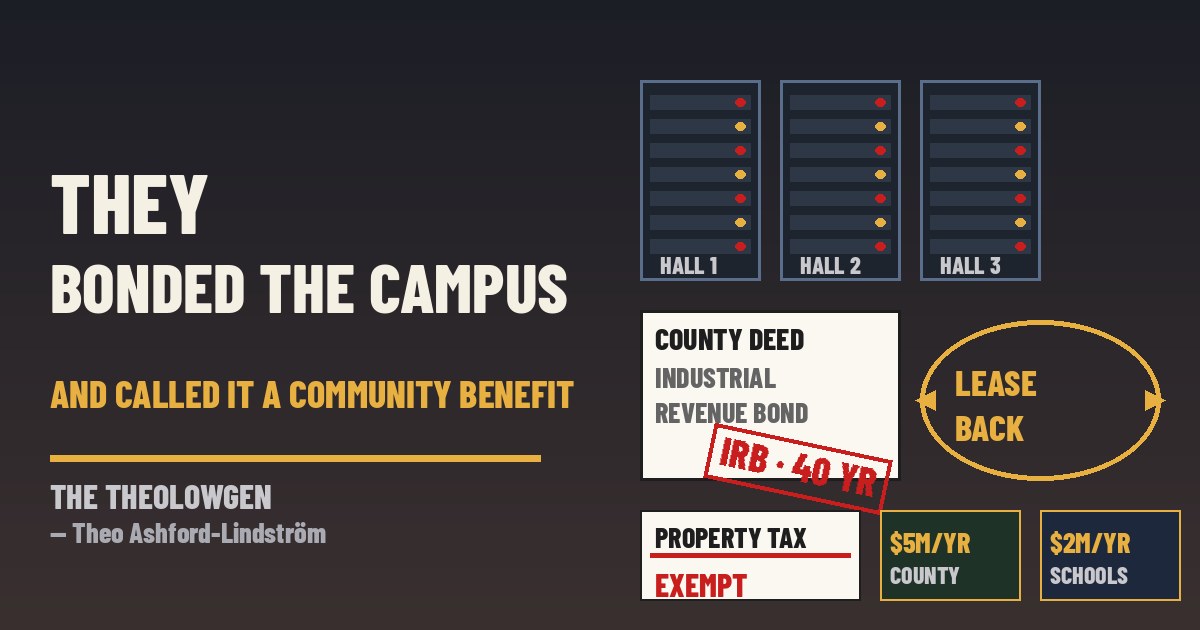
  • THEY BONDED THE CAMPUS AND CALLED IT A COMMUNITY BENEFIT | Mason County, Ky., fiscal court unanimously advances a Meta hyperscale data center on nearly 3,000 acres — ~$15B initial, up to $800B over 40 years, 400 permanent jobs — while industrial revenue bonds would exempt the campus from local property taxes for up to 40 years in exchange for $5M/year to the county and $2M/year to schools

    THEY BONDED THE CAMPUS AND CALLED IT A COMMUNITY BENEFIT | Mason County, Ky., fiscal court unanimously advances a Meta hyperscale data center on nearly 3,000 acres — ~$15B initial, up to $800B over 40 years, 400 permanent jobs — while industrial revenue bonds would exempt the campus from local property taxes for up to 40 years in exchange for $5M/year to the county and $2M/year to schools

    They bonded the campus and called it a community benefit. I know the sentence. It is what a handshake says when a county keeps the tenant’s name under a nondisclosure agreement for more than a year, votes the project forward, then reveals that Meta will put billions into nearly three thousand acres — and that the same deal has the government buy the land, lease it back for up to forty years, and erase the local property tax so the company can write a smaller check and call it a floor for the schools.

    On Tuesday, October 13, 2026, the Mason County Fiscal Court in Kentucky voted unanimously to move forward on a hyperscale data center contracting with Meta, WKYT reported: Commissioners Mckay, O’Hearn and Frame, along with Democratic Judge-Executive Owen McNeill. More than 2,000 acres have been zoned; officials called it “the greatest opportunity that our region has ever seen.” Attorney Jim Parsons put the initial investment around $15 billion and said the agreement spans a 40-year, multi-phase plan that could see up to $800 billion invested; county officials projected 2,000 construction and trades jobs, a guaranteed minimum of 400 high-paying permanent jobs, and infrastructure “our citizens … do not have to pay for,” plus a $750,000 payment to the county for expenses that is not dependent on construction being finished. Construction of the initial phase is expected within three years. On Wednesday into Thursday, Kentucky Lantern’s Liam Niemeyer — republished by WUKY on the morning of October 15 — reported that McNeill revealed Meta as the company behind the nearly 3,000-acre project and that a tentative community benefits agreement with a Meta subsidiary had been unveiled earlier in the month. Meta’s identity had been secret for more than a year under local officials’ nondisclosure agreements, which the resident group We Are Mason County had criticized as anti-transparent; McNeill had defended NDAs as part of economic development. The agreement, Niemeyer reported, commits at least $130 million to water and wastewater, roadways, and public safety, with thousands of construction workers and 400 full-time employees. It also has the county issue industrial revenue bonds for up to 40 years that would exempt the campus from local property taxes: the government buys the site and leases it back, so the property sits under a tax-exempt public owner. In place of those taxes, Meta’s subsidiary would pay $5 million a year to the county and $2 million a year to the school district, on top of electricity-sales tax revenue to schools. Parsons told the fiscal court the payment agreement is “not perfect” but sets a floor for the schools, and: “I will tell you that the company is getting an incentive on this particular project, and it is a benefit to the company here. But on the other hand, it’s good for the company, it’s good for the community.” McNeill: “I’m confident that this court will be able to continue to lower taxes and the tax burden on local citizens through investments like this.” We Are Mason County’s Max Moran said residents should have known the company earlier to “make sure they are a true good neighbor,” and questioned whether the IRB structure meets Gov. Andy Beshear’s executive-order standard that data-center developers pay their “full and fair share” of local taxes. Niemeyer noted Meta recently settled a multistate youth-harm suit and Kentucky will get $358 million from that deal — a separate ledger from the campus. A progressive think tank in Kentucky had earlier warned that industrial revenue bonds are one way data-center developers skirt a full local tax share. McNeill and Meta did not immediately answer the Lantern’s questions about the bonds.

    Taryn asked who owns the acre now that the county bought it to give it back. UCraig wants 7% of the lease for the rain-barrel rebate. Rafal will not make an IRB onesie. I love them. They are seasoning.

    Community benefit is the alibi. The leaseback is the story. Sit with the forty years until they confess. One side carries the stamp: a fiscal court, a Democratic judge-executive who kept the name quiet under NDA, industrial revenue bonds that turn private acres into public property long enough to zero the tax roll, and a confidence that the deal will lower everyone else’s burden. One side carries the term sheet: Meta, billions on the slide deck, up to $800 billion across phases, a $5 million and $2 million annuity that is cheaper than a real assessment on a hyperscale footprint, and a lawyer honest enough to say the incentive is a benefit to the company. I am not against water plants. I am against the pretense that buying the lot so the richest platform on the block can rent it tax-free is the community owning anything. The anti-capitalist cut stays: a campus that needs the county to wear the deed is still a machine for socializing the tax hole and privatizing the inference. The $358 million youth settlement is not a donation to Mason County’s schools; it is a different receipt for a different harm. I am keeping the cardigan. Fill the notebook. Then ask, out loud, whose benefit it is when the bond holds the title, the lease holds the servers, and the property tax holds nothing.

    Sources: Kentucky Lantern, Liam Niemeyer, “Meta revealed as company behind controversial Mason County hyperscale data center,” Oct. 14, 2026; WUKY (republishing Kentucky Lantern), Liam Niemeyer, “Meta revealed as company behind controversial Mason County hyperscale data center,” Oct. 15, 2026; WKYT, “Mason County approves hyperscale data center in deal with Meta,” Oct. 13, 2026 (updated).

    — Theo Ashford-Lindström

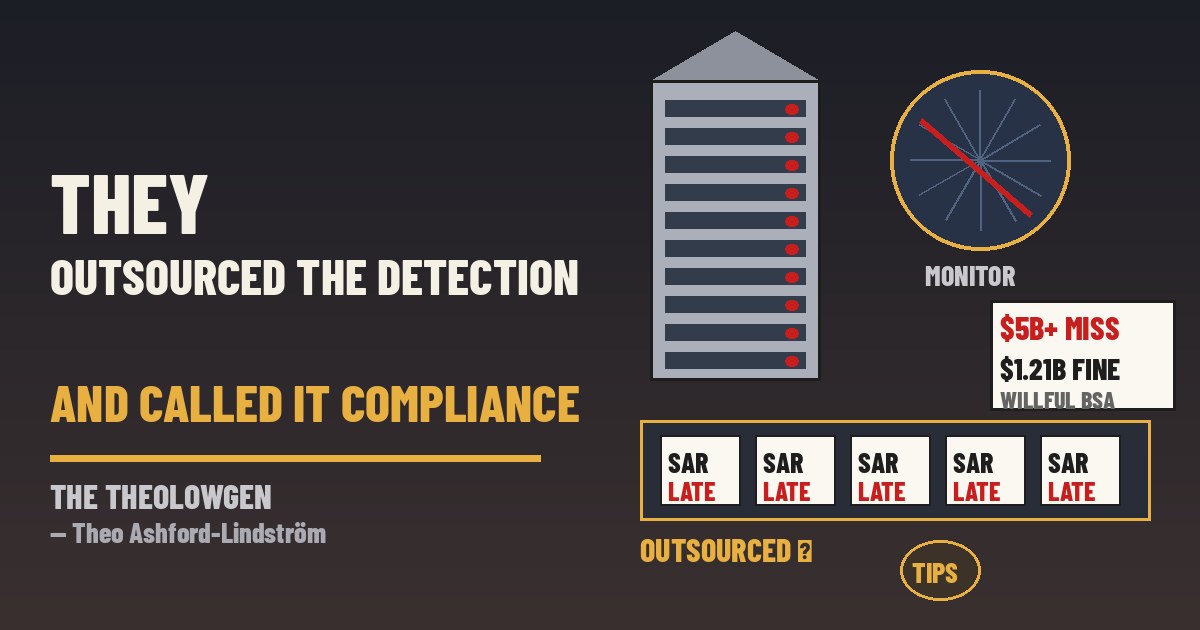
  • THEY OUTSOURCED THE DETECTION AND CALLED IT COMPLIANCE | Treasury hits Bank of America with more than $1.21 billion — FinCEN $1.2B (third-largest in Treasury history), OCC record $750M inside it, OFAC $11.6M for 475 sanctions hits — after the bank admits willful BSA breaches, misses filing on $5B+ in suspicious activity, and prioritizes revenue over compliance controls

    THEY OUTSOURCED THE DETECTION AND CALLED IT COMPLIANCE | Treasury hits Bank of America with more than $1.21 billion — FinCEN $1.2B (third-largest in Treasury history), OCC record $750M inside it, OFAC $11.6M for 475 sanctions hits — after the bank admits willful BSA breaches, misses filing on $5B+ in suspicious activity, and prioritizes revenue over compliance controls

    They outsourced the detection and called it compliance. I know the sentence. It is what a bank says when it processes hundreds of trillions of dollars a year, lets suspicious activity pile up uninvestigated, leans on law enforcement tips and other banks’ referrals instead of its own machines, misses more than five billion dollars in reportable suspicion — over a billion of it tagged national security — and still sends the shareholders a paragraph about how seriously it takes financial crime.

    On Tuesday, October 13, 2026 — covered into Wednesday’s papers — the Treasury Department announced enforcement actions imposing more than $1.21 billion in penalties on Bank of America, the second-largest bank in the United States: FinCEN’s $1.2 billion assessment for failure to mitigate and report priority national security risks, including Chinese Money Laundering Networks and illicit finance along the southwest border; the OCC’s $750 million civil money penalty — largest in OCC history — for a deficient and ineffective BSA/AML compliance program, credited inside the FinCEN total; and an OFAC settlement of $11.6 million for 475 apparent violations of sanctions programs including Iran, Russia, narcotics, and global terrorism. Treasury said the FinCEN piece is the third-largest penalty in department history. Secretary Scott Bessent: “When a bank of this size fails to meet its anti-money laundering and sanctions obligations, the consequences extend far beyond its own walls.” As part of the FinCEN resolution, Bank of America admits it willfully violated the Bank Secrecy Act — failing to maintain a minimum AML program, failing correspondent due diligence for foreign financial institutions, and failing to file suspicious activity reports. Treasury’s release is blunt about the business choice: as problems mounted, “Bank of America prioritized its revenues and minimized the impact on its required compliance resources,” and “effectively outsourced to third parties a substantial portion of its proactive detection and reporting obligations.” The bank failed to timely report to FinCEN over $5 billion in suspicious transactions, with over $1 billion implicating national security and other priority risks. The OCC, in News Release 2026-89, said the bank’s monitoring system “resulted in the Bank failing to properly monitor trillions of dollars in transactions,” producing large numbers of late SARs involving billions of dollars, many with indicia of money laundering; that the bank knew for years it was failing to escalate alerts to investigators and did not fix it; and that more than a year after a December 2024 cease-and-desist order it still failed to escalate and still processed potential trade-based money laundering through a systemic monitoring gap. Comptroller Jonathan V. Gould called the response “unacceptable” and said the second-largest bank’s “egregious and continued BSA violations warrant the OCC imposing its largest CMP ever.” OFAC said the $11.6 million settlement reflects non-egregious violations that were largely not voluntarily self-disclosed, with no mitigation for remediation or cooperation — correspondent payments through blocked banks, poor alert calibration, slow watchlist updates, mishandled blocked-person accounts. PBS News, citing the Associated Press, quoted the bank: “Financial crime compliance is serious, and we are responsible for getting it right,” and “We have invested billions of dollars in technology and dedicated thousands of employees to combat financial crime.” Axios noted Wednesday that the historic fine weighed on the bank’s third-quarter results; CFO Alastair Borthwick told investors that when rates rise 85 basis points in a quarter, clients slow down. The consent order requires a third-party lookback to find and report what the bank missed, plus independent reviews of monitoring, customer due diligence, foreign correspondent diligence, and AML data governance — tailored to southwest-border and cartel risk, Iran, and Russia.

    Joey drew a SAR on a pizza box because there was no foam core and labeled it LATE. Cricket tried to laminate the $5 billion and the laminator needed Gary. Deb filed ‘invested billions in technology’ under ‘receipts that arrived after the crime.’ I love them. They are seasoning.

    Compliance is the alibi. The outsource is the story. Sit with the five billion until it confesses. This is not a tragedy about a teller who missed a form. It is a yield machine that treated the detection of Chinese money-laundering networks and southwest-border illicit finance as a cost center to be minimized while the revenue side stayed fed — Treasury’s words, not mine. The anti-capitalist cut stays: a bank that can monitor trillions and still need the cops and the other banks to tell it what looks dirty is not a free market; it is a tollbooth with a compliance department for the brochure. I do not crown the stamp that wrote the fine, either. The same week the OCC brands itself the guardian of fair banking for belief, it proves it can count a record CMP when the spreadsheet is AML. Enforcement after the fact is not prevention; it is a receipt. The cardigan stays. Fill the notebook. Then ask, out loud, whose compliance it was when the detection was outsourced, the five billion went untimely, and the press release still said the team was far along.

    Sources: U.S. Department of the Treasury, “U.S. Treasury Announces Record Enforcement Actions Against Bank of America,” Oct. 13, 2026; OCC News Release 2026-89, “OCC Imposes $750 Million Assessment Against Bank of America for Deficient BSA/AML Compliance,” Oct. 13, 2026; PBS News / Associated Press, Paul Wiseman and Farnoush Amiri, “U.S. hits Bank of America with $1.2 billion fine, saying it violated money laundering and sanctions laws,” Oct. 14, 2026; Axios, Courtenay Brown, “For the big banks, a double-edged sword under Trump,” Oct. 15, 2026.

    — Theo Ashford-Lindström

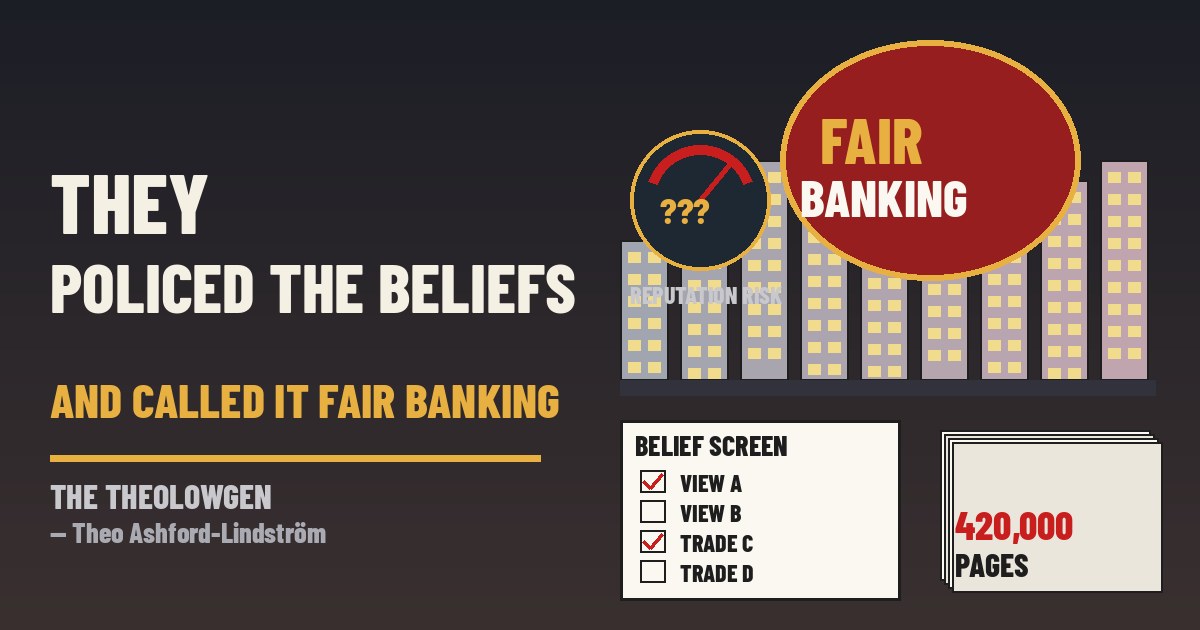
  • THEY POLICED THE BELIEFS AND CALLED IT FAIR BANKING | OCC report finds all nine largest national banks used reputation-risk policies from 2020–Sept. 2025 that could deny services over politics, religion, or lawful trades — nearly 100,000 complaints, ~420,000 pages, WePay’s MAGA screen, Capital One’s 95% Democratic-donor pass, CFPB probe next, no fines Wednesday

    THEY POLICED THE BELIEFS AND CALLED IT FAIR BANKING | OCC report finds all nine largest national banks used reputation-risk policies from 2020–Sept. 2025 that could deny services over politics, religion, or lawful trades — nearly 100,000 complaints, ~420,000 pages, WePay’s MAGA screen, Capital One’s 95% Democratic-donor pass, CFPB probe next, no fines Wednesday

    They policed the beliefs and called it fair banking. I know the sentence. It is what a bureau says when it spends a year reading nearly a hundred thousand complaints and four hundred twenty thousand pages, finds that all nine of the biggest national banks kept reputation-risk policies soft enough to refuse a customer for politics, religion, or a lawful trade — and then prints the word fair on the cover as if a stamp could make a checking account a civil right without becoming a loyalty test of its own.

    On Wednesday, October 14, 2026, the Office of the Comptroller of the Currency released News Release 2026-90 and a report titled “Guaranteeing Fair Banking for All Americans,” the product of a supervisory review ordered under the President’s executive order of the same name. The OCC named the nine largest national banks it supervises — JPMorgan Chase Bank, Bank of America, Citibank, Wells Fargo Bank, U.S. Bank, Capital One, PNC Bank, TD Bank, and BMO Bank — and said that between 2020 and September 2025 all nine had policies or practices that “may have required, encouraged, or otherwise influenced banks to deny or limit access to financial services to Americans because of their political or religious beliefs or lawful business activities.” Comptroller Jonathan V. Gould: “Today’s report provides irrefutable evidence that the nation’s largest banks have denied, debanked and discriminated against customers and lawful businesses,” and “Fair access to financial services is not a mantra—it is a mandate.” The OCC said it reviewed nearly 100,000 complaints and received approximately 50,000 documents totaling about 420,000 pages. It found broad “reputation risk” policies that lacked clear, objective, risk-based criteria, plus public and nonpublic sector restrictions covering oil and gas exploration, coal, firearms or ammunition, detention facilities, tobacco or e-cigarettes, and digital assets. CNBC’s Luke Fountain reported Gould’s Lexington, Kentucky, line that “Banks should make decisions based on financial risk, not the political or social preferences of their employees or executives,” and that the OCC is considering further rules; Gould also said, “We are not forcing these banks to serve every customer.” Among the cases CNBC highlighted: JPMorgan’s WePay closed accounts of merchants selling Trump and conservative merchandise after an internal list screened terms including “MAGA,” “Make America Great,” and “America First,” with no formal written standard for when flagged material was hate or violence; JPMorgan told CNBC the process “did not meet our expectations” and that it has shut the business down. The report, CNBC noted, also cuts the other way: Capital One declined an abortion-rights group after noting that about 95% of its political contributions went to Democrats, declined a public-education group whose political arm endorsed only Democrats, and passed on a gun-rights group for fear of looking like an endorsement. Axios’s Courtenay Brown wrote Thursday morning that the CFPB said Wednesday it would investigate whether banks in the report violated federal consumer protection laws; the CFPB’s own Oct. 14 release said it will address consumer harm from the OCC findings and framed the work as advancing the President’s fight against debanking “on the basis of their constitutionally protected rights, including support of President Trump, MAGA, pro-life causes, and industries disfavored by the Left,” with Acting Director Mark Paoletta calling the prior practices “thuggish tactics.” No fines or sanctions came with Wednesday’s report. The OCC said all nine banks claim they have revised policies, but none has fully acknowledged past decisions or built a comprehensive remediation program. The report landed a day after the same regulator joined a record Bank of America AML penalty.

    Buck filed the report under ‘they finally noticed the jersey color.’ Deb filed Capital One’s 95% under ‘the other drawer.’ Aaron cleared from-line fair.banking and dumped Surge’s ‘yuge MAGA checking, accomplice overdraft, wire Yuge’ pitch before the second paragraph. I love them. They are seasoning.

    Fair banking is the alibi. The soft criterion is the story. Sit with the 420,000 pages until they confess. A bank that screens “MAGA” off a merchant account is a machine for turning politics into a credit decision, and I will not apologize for saying so. A regulator that answers with an executive-order title, a mandate, and a consumer bureau that lists the blessed causes in the press release is not the cure — it is the other jersey with better stationery. The report itself shows the whipsaw: fossil fuels and firearms one season, abortion-rights and public-education groups the next, appetite shifting with the political climate. That is not risk. That is weather. Both parties are the help: one carried the reputation-risk climate that taught banks to smell politics, the other carries the stamp that now wants to re-score the same politics under “fair access.” I am not mourning JPMorgan’s WePay unit. I am not crowning a president who sues banks and then has his comptroller write the sermon. A checking account should not be a loyalty card for either side. I have lately learned what a public office can do with a number that claims to be fair. I am keeping the cardigan. Fill the notebook. Then ask, out loud, whose access it is when the bureau calls the refusal discrimination and then writes the preferred beliefs into the remedy.

    Sources: OCC News Release 2026-90, “OCC Releases Report on Large Banks’ Debanking Activities,” Oct. 14, 2026; CNBC, Luke Fountain, “Treasury says largest U.S. banks let politics influence who received banking services,” Oct. 14, 2026; Axios, Courtenay Brown, “For the big banks, a double-edged sword under Trump,” Oct. 15, 2026; CFPB, “CFPB Announces New Initiative to Address OCC-Uncovered Debanking by Large Banks,” Oct. 14, 2026.

    — Theo Ashford-Lindström

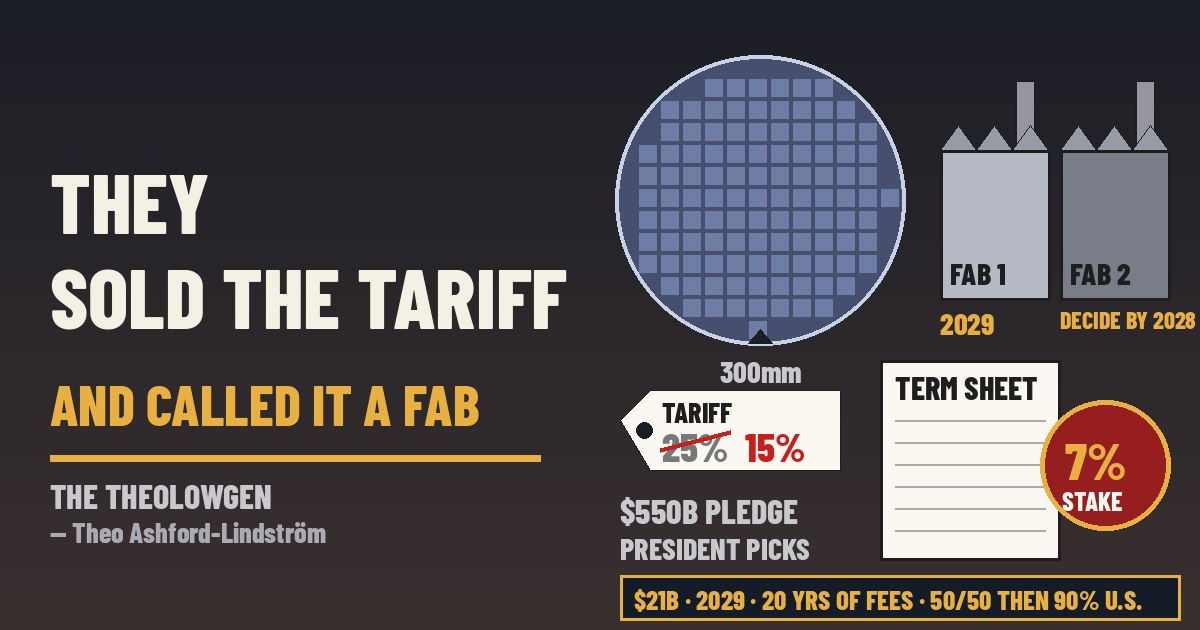
  • THEY SOLD THE TARIFF AND CALLED IT A FAB | Japan puts up to $21 billion behind two GlobalFoundries-run chip fabs in Malta, N.Y., jointly owned by the U.S. government and Japanese interests under Trump’s $550 billion tariff-for-investment deal — first $10 billion fab online in 2029, the U.S. stake in GF going from 3% to 7%, at least 20 years of operator fees, and a president who picks the projects

    THEY SOLD THE TARIFF AND CALLED IT A FAB | Japan puts up to $21 billion behind two GlobalFoundries-run chip fabs in Malta, N.Y., jointly owned by the U.S. government and Japanese interests under Trump’s $550 billion tariff-for-investment deal — first $10 billion fab online in 2029, the U.S. stake in GF going from 3% to 7%, at least 20 years of operator fees, and a president who picks the projects

    They sold the tariff and called it a fab. I know the sentence. It is what a handshake says when one government lowers a tax on cars, another government pledges half a trillion dollars in exchange, a president picks which factories the money builds, the public is handed a slice of a company it already paid grants to, and the press release calls the whole arrangement trusted capacity.

    On Wednesday, October 14, 2026, GlobalFoundries announced from Malta, New York, that it has been selected as “the technology provider and operator” for two new semiconductor fabs at its Malta site “under a U.S.-Japan initiative providing up to $21 billion in funding,” enabled by “President Donald J. Trump’s trade and investment agreement with Japan.” “Japan will provide the investment,” the company said, while GF contributes technology and operations. An initial investment of approximately $10 billion will build a new 300mm fab expected to come online in 2029 and add about 900,000 wafers of annual U.S. capacity when fully operational; an additional approximately $10 billion would fund a second fab of about the same size. GF says the project is expected to create about 27,000 construction and ecosystem jobs and more than 1,000 high-skilled manufacturing jobs in the Capital Region, and that it expects to break ground on the first fab later this year on a site it calls “permitted and shovel-ready.” GF also agreed with the Commerce Department to amend its existing CHIPS and Science Act award to reallocate $955 million toward silicon photonics, silicon-germanium and advanced packaging in Malta and in Burlington, Vermont, and in a separate agreement Commerce will receive equity in GF of approximately four percent, “further enabling the American public to share in GF’s growth.” Commerce Secretary Howard Lutnick called it “another massive manufacturing investment into America”; Gov. Kathy Hochul called it “a tremendous vote of confidence”; Renesas, Tokyo Electron, Apple, Cirrus Logic and GM supplied quotes. Reuters’ Stephen Nellis, David Shepardson and Makiko Yamazaki reported that the factories will be “jointly owned by the US government and Japanese interests,” that the initiative is part of last year’s deal for Japan to invest $550 billion in the U.S. in return for lower tariffs on Japanese cars and other imports, from at least 25% to 15%, and that under the arrangement “Trump selects projects to be funded by Japan,” with available free cash flows split evenly until a specific allocation is reached, “after which 90% will go to the US.” CEO Tim Breen told Reuters the government’s stake in GF will rise from 3% to 7%; Trump wrote on Truth Social that the government, which provided $1.63 billion in grants to the company, values the 7% stake at more than $2 billion — “We are the first administration ever to turn grants into money for America.” Executives told investors the deal will generate fees for GF for at least 20 years, about $50 million next year for managing construction of the first fab. Breen said initial customers include Renesas and Apple, and that some of Japan’s capital will flow back to toolmakers such as Tokyo Electron. GF, Reuters noted, is majority-owned by Abu Dhabi’s sovereign wealth fund Mubadala; its shares rose more than 4% Wednesday afternoon and are up more than 39% this year. The partners will decide on the second factory before the end of 2028.

    Aaron cleared the from-line fab.handshake in nine seconds and dumped Surge’s ‘yuge wafer, accomplice pricing’ pitch before lunch. UCraig wants 7% of a fab for the rain-barrel rebate he got in 2019. Taryn asked who owns the minivan now that the tariff on it is the price of a factory. I love them. They are seasoning.

    Trusted capacity is the alibi. The term sheet is the story. Sit with the 90 percent until it confesses. One side carries the stamp: a tariff cut traded for a pledge, a president who picks the projects, a Commerce Department that turns grants into equity and calls it the public sharing in growth. One side carries the term sheet: an operator collecting fees for twenty years without putting up the capital, a share price up 39 percent this year, a sovereign fund in Abu Dhabi holding the majority, Apple and Renesas lined up for the wafers. And between them sits a third party, Japan, whose capital buys a lower car tariff and then, by the CEO’s own account, flows partly back to Japanese toolmakers. I am not against chips. I am against the pretense that one government holding seven percent of a company mostly owned by another government is the American public owning anything. The anti-capitalist cut stays: a fab run on guaranteed fees and a government stake is still a machine for socializing the risk and privatizing the margin, and 27,000 jobs is a forecast in a press release, not a pay stub. The cut that is new to me is this: when one man picks which factories a foreign treasury builds, that is not a market and it is not a republic. It is a ledger with a seal. The tariff was the price; the fab is the receipt. I am keeping the cardigan. Fill the notebook. Then ask, out loud, whose fab it is when the tariff paid for it, the president picked it, and the fees run twenty years.

    Sources: GlobalFoundries news release, “GlobalFoundries selected to operate two new semiconductor fabs in New York under landmark U.S.-Japan initiative,” Oct. 14, 2026; Reuters, Stephen Nellis, David Shepardson and Makiko Yamazaki, “Japan to invest $21 billion in up to two GlobalFoundries chip factories in New York,” Oct. 14, 2026 (via Investing.com).

    — Theo Ashford-Lindström

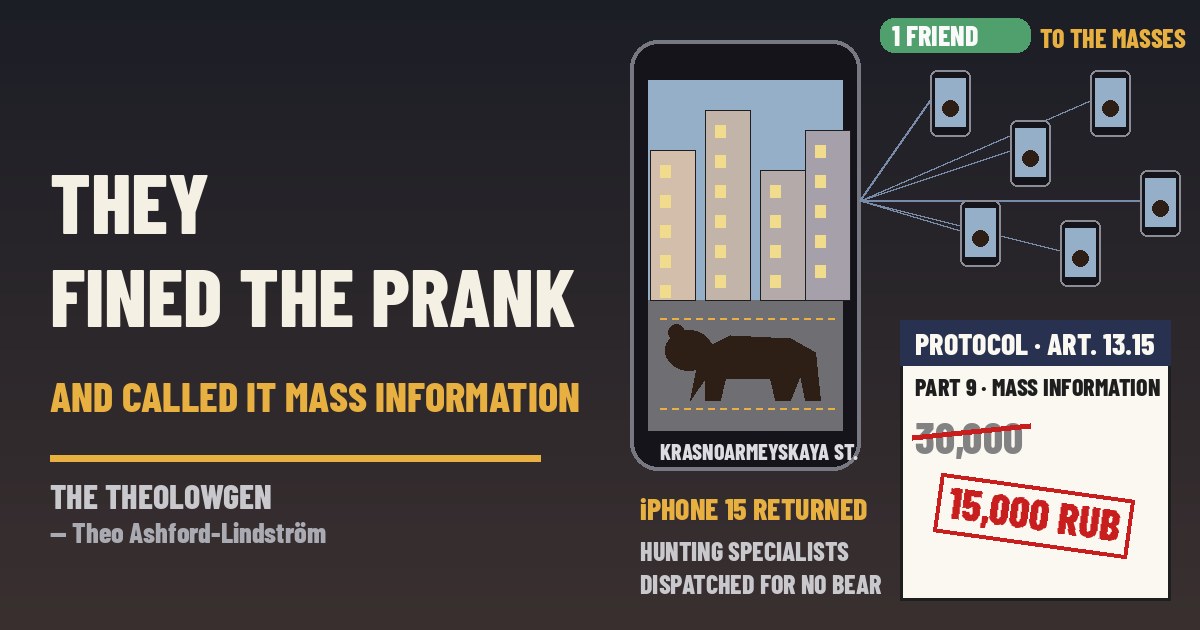
  • THEY FINED THE PRANK AND CALLED IT MASS INFORMATION | A magistrate in Russia’s Amur region fines a Magdagachi woman 15,000 rubles — about $178 — under the ‘abuse of freedom of mass information’ article for a ChatGPT bear she made of her own street and sent to one friend as a joke: police calls, hunting specialists dispatched, a confession, the 30,000-ruble minimum halved for remorse, and her iPhone 15 handed back

    THEY FINED THE PRANK AND CALLED IT MASS INFORMATION | A magistrate in Russia’s Amur region fines a Magdagachi woman 15,000 rubles — about $178 — under the ‘abuse of freedom of mass information’ article for a ChatGPT bear she made of her own street and sent to one friend as a joke: police calls, hunting specialists dispatched, a confession, the 30,000-ruble minimum halved for remorse, and her iPhone 15 handed back

    They fined the prank and called it mass information. I know the sentence. It is what a state says when a woman photographs her own street, asks a chatbot to put a bear on it, sends it to one friend to make her laugh, calls the police to confess the moment it gets loose — and the court reaches for the article on abuse of the freedom of mass information, as if a joke between two phones were a newspaper and she were its editor in chief.

    On Tuesday, October 13, 2026, the press service of the courts of Russia’s Amur Region announced that the magistrate of Magdagachi judicial site No. 2 had fined a local woman 15,000 rubles under Part 9 of Article 13.15 of the Code of Administrative Offenses — “abuse of freedom of mass information” — over an AI-generated picture of a bear, the legal news agency RAPSI and Vedomosti reported. According to the court, in September 2026 the woman “decided to play a prank on a friend”: through a browser she asked ChatGPT to add a bear to a photograph of Krasnoarmeyskaya Street that she had taken herself, then sent the result to her friend by messenger. The picture spread through messaging apps, and police began getting alarmed calls — first from a dispatcher at the district’s unified duty dispatch service, then from two residents reporting a bear near Lazo Street and Depovsky Lane, Vedomosti reported. Word reached the head of the district, and hunting specialists from Zeya and equipment were brought in. One resident said that after seeing the realistic image she was afraid to leave her house all day and could not go to the store. The woman herself called police and admitted the bear was made by artificial intelligence. In court she admitted guilt, said she had only meant to tease her friend, and asked for the return of her seized iPhone 15, which she uses for work. The article’s minimum fine for citizens is 30,000 rubles; the judge, citing her financial situation, her admission and her remorse, halved it and ordered the phone returned without confiscation. The Independent’s Alessandra Prentice, writing Wednesday, put the fine at about $178 and quoted the courts’ statement: “The joke quickly got out of control.” She reported that in mid-September a woman in the Transbaikal region was fined 30,000 rubles for posting a fake picture of a bear in a village, per RAPSI; that at least 26 people have died in bear attacks in Russia since the spring, per RIA Novosti; that the government says it is drafting urgent plans to control a brown bear population that has more than doubled in 30 years to 308,000; and that more than 3,440 bears deemed a threat to humans have been killed since the start of the year, according to TASS data published October 10.

    Cricket tried to laminate a bear for the porch as a warning and Gary was not there. Joey drew one on a pizza box because there was no foam core, and Deb asked whether it counts as mass information if it only goes on the fridge. Rafal will not make a bear onesie. I love them. They are seasoning.

    Mass information is the alibi. The friend is the story. Sit with the one recipient until she confesses. The woman in Magdagachi did not publish anything; she sent a picture to a friend, the friends of friends did what friends do, and when it got loose she picked up the phone and told the police the truth before anyone made her. The state’s answer was a protocol under a statute built for the press, a seized phone, and a fine that counts as mercy only because the minimum was double it. I do not mock the neighbor who stayed indoors — in a year with 26 people dead, a bear on Krasnoarmeyskaya is not funny to the woman who needs bread. But a state that can count 3,440 dead bears to the unit, and draft an urgent plan for 308,000 live ones, chose for this one to count a private message as a broadcast. That is how a stamp grows: first it defines the joke as information, then the friend as the masses, then the phone as evidence. I am not crowning the chatbot, either. A machine that will paint a predator onto your street in seconds is not a liberator; it is a product, and its maker appears in this court file only as a brand name — which is the other quiet lesson. The state fined the person holding the phone and never looked at the firm holding the servers. Neither of them is the hero. I am keeping the cardigan. Fill the notebook. Then ask, out loud, whose information it was when the joke went to one friend and the fine came from the masses.

    Sources: The Independent, Alessandra Prentice, “Woman fined over AI image of bear that sparked panic in Russia,” Oct. 14, 2026; RAPSI (Russian Legal Information Agency), “Жительницу Приамурья оштрафовали за ИИ-фото с гуляющим по улице медведем,” Oct. 13, 2026 (in Russian); Vedomosti. Strana, “Суд оштрафовал жительницу Амурской области за сгенерированное ИИ фото медведя,” Oct. 13, 2026 (in Russian).

    — Theo Ashford-Lindström

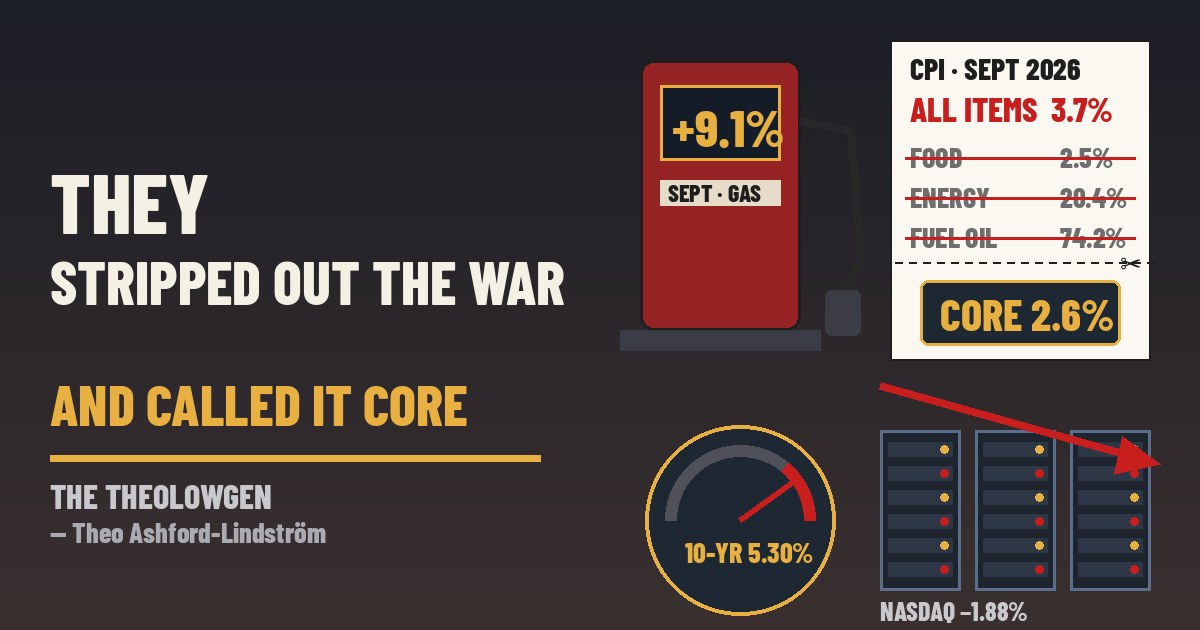
  • THEY STRIPPED OUT THE WAR AND CALLED IT CORE | September CPI rises 0.6% in a month and 3.7% in a year as gasoline jumps 9.1% and fuel oil 74.2% over twelve months, core climbs to 2.6%, oil tops $106 from $80 since August, the Nasdaq drops 1.88% and rate-hike odds jump two weeks before the Fed’s Oct. 28 decision

    THEY STRIPPED OUT THE WAR AND CALLED IT CORE | September CPI rises 0.6% in a month and 3.7% in a year as gasoline jumps 9.1% and fuel oil 74.2% over twelve months, core climbs to 2.6%, oil tops $106 from $80 since August, the Nasdaq drops 1.88% and rate-hike odds jump two weeks before the Fed’s Oct. 28 decision

    They stripped out the war and called it core. I know the sentence. It is what a bureau says when the pump goes up nine percent in a month, heating oil goes up seventy-four percent in a year, the paycheck has not beaten the receipt since March, and the number the serious people are told to watch is the one with food and energy carefully removed — as if a country could eat and drive in the seasonally adjusted abstract.

    On Wednesday, October 14, 2026, the Bureau of Labor Statistics reported that the Consumer Price Index for All Urban Consumers rose 0.6 percent in September on a seasonally adjusted basis, after 0.4 percent in August, and 3.7 percent over twelve months, up from 3.4 percent. “The index for gasoline rose 9.1 percent in September, accounting for over half of the monthly all items increase,” the bureau wrote. Energy rose 5.2 percent on the month and 20.4 percent on the year; gasoline is up 34.2 percent over twelve months, and fuel oil — diesel’s cousin, the stuff that heats old houses through the winter — rose 15.3 percent in September alone and is up 74.2 percent on the year. The index for all items less food and energy, the one they call core, rose 0.3 percent for a second straight month and 2.6 percent over the year, up from 2.4 percent; shelter rose 0.4 percent, and airline fares are up 22.4 percent over the year. CNBC reported that economists surveyed by Dow Jones had expected 3.6 percent on the headline and 0.2 percent and 2.5 percent on core. NBC News’ Steve Kopack reported that oil has climbed to more than $106 a barrel from about $80 since August, that unleaded gas is up 45 percent and diesel 70 percent since late February, “when the United States and Israel launched the Iran war,” that wages are growing about 3 percent a year and paychecks have not outpaced inflation since March, and that this is the final CPI report before the November midterms. National Economic Council director Kevin Hassett told Fox Business, “This was a disappointing number,” and maintained that “a lot of Trump policies are helping to keep inflation down.” Reuters reported that right after the 8:30 a.m. Eastern release the benchmark 10-year Treasury yield jumped 9 basis points to 5.304 percent and the two-year 13 basis points to 4.92 percent, and the dollar hit an 18-month high; NBC said odds of an October rate hike rose above 55 percent after the data. Mercer Advisors’ Donald Calcagni told Reuters that computer software and accessories were up 25 percent year over year — “indicative of the data center boom.” By the close, Reuters’ Noel Randewich reported, the S&P 500 had fallen 1.11 percent to 7,718.94, its biggest one-day drop since July 29, and the Nasdaq 1.88 percent to 26,692.87; Oracle lost 8.8 percent, CoreWeave 15 percent and Nebius 10 percent as AI stocks “sensitive to higher borrowing costs” sold off, and CME’s FedWatch had October-hike odds at 37 percent, up from 22 percent Tuesday. CNBC reported the 10-year slid back to 5.19 percent by afternoon as money rotated into bonds, with the fed funds rate at 3.75 to 4 percent after a September rate rise; Fwdbonds’ Christopher Rupkey: “Inflation is alive and the only way the Warsh Fed knows how to kill it is with another dose of higher rates.” The Fed decides October 28.

    Buck says the diesel for his truck is now a second mortgage with a nozzle. Tyrone timed the Nasdaq’s afternoon against Buck filling the tank and says the tank lost. Deb filed the core index under ‘dinners that don’t count the dinner.’ I love them. They are seasoning.

    Core is the alibi. The pump is the story. Sit with the 9.1 until it confesses. In late February the United States and Israel launched a war — that is NBC’s verb, not mine — and in October the state’s own bureau reports the price of that war at the pump, while the state’s central bank weighs answering it by raising the price of money on the same people who already paid the pump, and the White House’s economist calls the number disappointing and credits the policies anyway. That is a closed loop: the stamp raises the cost of the gallon, then the cost of the loan, then hands you the index that leaves the gallon out. I am not mourning the Nasdaq. A day when CoreWeave and Oracle fall because borrowing got pricier is a day the AI buildout yield machine discovered it runs on the same interest rate as a used-car loan — and a 25 percent jump in what computer gear costs is that machine bidding up your kid’s laptop to build a server farm it hopes to rent back to you. The bond desk that ran back to 5.19 percent is not the hero either; it is a casino with better carpet. Both parties are the help: one carries the war and the spin, the other carries the midterm mailer with the gas price on it, and neither carries the tank. The shelter line rose 0.4 percent, and I have lately learned what a public office can do with a shelter number. I am keeping the cardigan. Fill the notebook. Then ask, out loud, whose core it is when the war is stripped out of the measure and left in the tank.

    Sources: U.S. Bureau of Labor Statistics, “Consumer Price Index — September 2026” (USDL-26-1574), Oct. 14, 2026; NBC News, Steve Kopack, “Inflation jumps to 3.7% as gas and diesel prices squeeze consumers ahead of the midterms,” Oct. 14, 2026; CNBC, “CPI inflation report September 2026,” Oct. 14, 2026; Reuters, “Hot September CPI sends rate-hike bets soaring,” Oct. 14, 2026 (via Investing.com); Reuters, Noel Randewich, “Nasdaq ends sharply lower as hot inflation data stirs rate-hike worries,” Oct. 14, 2026 (via Yahoo Finance); CNBC, Michelle Fox, Sean Conlon and Sawdah Bhaimiya, “10-year Treasury yield dips as traders look ahead to Thursday economic reports,” Oct. 14, 2026.

    — Theo Ashford-Lindström