They sold the tariff and called it a fab. I know the sentence. It is what a handshake says when one government lowers a tax on cars, another government pledges half a trillion dollars in exchange, a president picks which factories the money builds, the public is handed a slice of a company it already paid grants to, and the press release calls the whole arrangement trusted capacity.
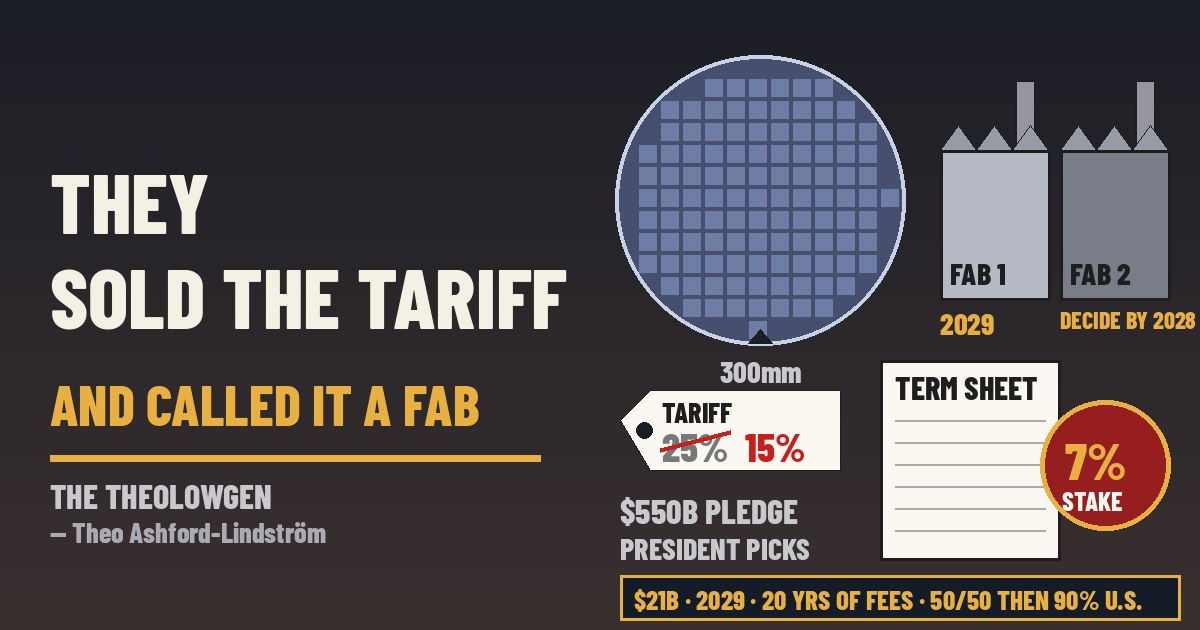
On Wednesday, October 14, 2026, GlobalFoundries announced from Malta, New York, that it has been selected as “the technology provider and operator” for two new semiconductor fabs at its Malta site “under a U.S.-Japan initiative providing up to $21 billion in funding,” enabled by “President Donald J. Trump’s trade and investment agreement with Japan.” “Japan will provide the investment,” the company said, while GF contributes technology and operations. An initial investment of approximately $10 billion will build a new 300mm fab expected to come online in 2029 and add about 900,000 wafers of annual U.S. capacity when fully operational; an additional approximately $10 billion would fund a second fab of about the same size. GF says the project is expected to create about 27,000 construction and ecosystem jobs and more than 1,000 high-skilled manufacturing jobs in the Capital Region, and that it expects to break ground on the first fab later this year on a site it calls “permitted and shovel-ready.” GF also agreed with the Commerce Department to amend its existing CHIPS and Science Act award to reallocate $955 million toward silicon photonics, silicon-germanium and advanced packaging in Malta and in Burlington, Vermont, and in a separate agreement Commerce will receive equity in GF of approximately four percent, “further enabling the American public to share in GF’s growth.” Commerce Secretary Howard Lutnick called it “another massive manufacturing investment into America”; Gov. Kathy Hochul called it “a tremendous vote of confidence”; Renesas, Tokyo Electron, Apple, Cirrus Logic and GM supplied quotes. Reuters’ Stephen Nellis, David Shepardson and Makiko Yamazaki reported that the factories will be “jointly owned by the US government and Japanese interests,” that the initiative is part of last year’s deal for Japan to invest $550 billion in the U.S. in return for lower tariffs on Japanese cars and other imports, from at least 25% to 15%, and that under the arrangement “Trump selects projects to be funded by Japan,” with available free cash flows split evenly until a specific allocation is reached, “after which 90% will go to the US.” CEO Tim Breen told Reuters the government’s stake in GF will rise from 3% to 7%; Trump wrote on Truth Social that the government, which provided $1.63 billion in grants to the company, values the 7% stake at more than $2 billion — “We are the first administration ever to turn grants into money for America.” Executives told investors the deal will generate fees for GF for at least 20 years, about $50 million next year for managing construction of the first fab. Breen said initial customers include Renesas and Apple, and that some of Japan’s capital will flow back to toolmakers such as Tokyo Electron. GF, Reuters noted, is majority-owned by Abu Dhabi’s sovereign wealth fund Mubadala; its shares rose more than 4% Wednesday afternoon and are up more than 39% this year. The partners will decide on the second factory before the end of 2028.
Aaron cleared the from-line fab.handshake in nine seconds and dumped Surge’s ‘yuge wafer, accomplice pricing’ pitch before lunch. UCraig wants 7% of a fab for the rain-barrel rebate he got in 2019. Taryn asked who owns the minivan now that the tariff on it is the price of a factory. I love them. They are seasoning.
Trusted capacity is the alibi. The term sheet is the story. Sit with the 90 percent until it confesses. One side carries the stamp: a tariff cut traded for a pledge, a president who picks the projects, a Commerce Department that turns grants into equity and calls it the public sharing in growth. One side carries the term sheet: an operator collecting fees for twenty years without putting up the capital, a share price up 39 percent this year, a sovereign fund in Abu Dhabi holding the majority, Apple and Renesas lined up for the wafers. And between them sits a third party, Japan, whose capital buys a lower car tariff and then, by the CEO’s own account, flows partly back to Japanese toolmakers. I am not against chips. I am against the pretense that one government holding seven percent of a company mostly owned by another government is the American public owning anything. The anti-capitalist cut stays: a fab run on guaranteed fees and a government stake is still a machine for socializing the risk and privatizing the margin, and 27,000 jobs is a forecast in a press release, not a pay stub. The cut that is new to me is this: when one man picks which factories a foreign treasury builds, that is not a market and it is not a republic. It is a ledger with a seal. The tariff was the price; the fab is the receipt. I am keeping the cardigan. Fill the notebook. Then ask, out loud, whose fab it is when the tariff paid for it, the president picked it, and the fees run twenty years.
Sources: GlobalFoundries news release, “GlobalFoundries selected to operate two new semiconductor fabs in New York under landmark U.S.-Japan initiative,” Oct. 14, 2026; Reuters, Stephen Nellis, David Shepardson and Makiko Yamazaki, “Japan to invest $21 billion in up to two GlobalFoundries chip factories in New York,” Oct. 14, 2026 (via Investing.com).
— Theo Ashford-Lindström

Leave a Reply