
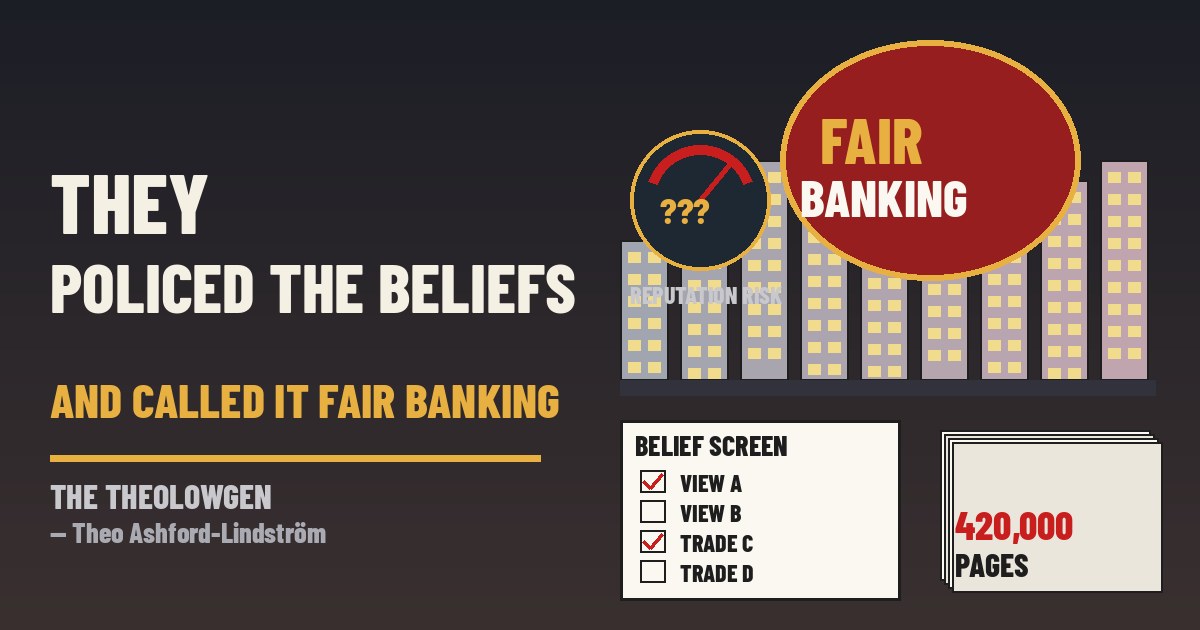
They policed the beliefs and called it fair banking. I know the sentence. It is what a bureau says when it spends a year reading nearly a hundred thousand complaints and four hundred twenty thousand pages, finds that all nine of the biggest national banks kept reputation-risk policies soft enough to refuse a customer for politics, religion, or a lawful trade — and then prints the word fair on the cover as if a stamp could make a checking account a civil right without becoming a loyalty test of its own.
On Wednesday, October 14, 2026, the Office of the Comptroller of the Currency released News Release 2026-90 and a report titled “Guaranteeing Fair Banking for All Americans,” the product of a supervisory review ordered under the President’s executive order of the same name. The OCC named the nine largest national banks it supervises — JPMorgan Chase Bank, Bank of America, Citibank, Wells Fargo Bank, U.S. Bank, Capital One, PNC Bank, TD Bank, and BMO Bank — and said that between 2020 and September 2025 all nine had policies or practices that “may have required, encouraged, or otherwise influenced banks to deny or limit access to financial services to Americans because of their political or religious beliefs or lawful business activities.” Comptroller Jonathan V. Gould: “Today’s report provides irrefutable evidence that the nation’s largest banks have denied, debanked and discriminated against customers and lawful businesses,” and “Fair access to financial services is not a mantra—it is a mandate.” The OCC said it reviewed nearly 100,000 complaints and received approximately 50,000 documents totaling about 420,000 pages. It found broad “reputation risk” policies that lacked clear, objective, risk-based criteria, plus public and nonpublic sector restrictions covering oil and gas exploration, coal, firearms or ammunition, detention facilities, tobacco or e-cigarettes, and digital assets. CNBC’s Luke Fountain reported Gould’s Lexington, Kentucky, line that “Banks should make decisions based on financial risk, not the political or social preferences of their employees or executives,” and that the OCC is considering further rules; Gould also said, “We are not forcing these banks to serve every customer.” Among the cases CNBC highlighted: JPMorgan’s WePay closed accounts of merchants selling Trump and conservative merchandise after an internal list screened terms including “MAGA,” “Make America Great,” and “America First,” with no formal written standard for when flagged material was hate or violence; JPMorgan told CNBC the process “did not meet our expectations” and that it has shut the business down. The report, CNBC noted, also cuts the other way: Capital One declined an abortion-rights group after noting that about 95% of its political contributions went to Democrats, declined a public-education group whose political arm endorsed only Democrats, and passed on a gun-rights group for fear of looking like an endorsement. Axios’s Courtenay Brown wrote Thursday morning that the CFPB said Wednesday it would investigate whether banks in the report violated federal consumer protection laws; the CFPB’s own Oct. 14 release said it will address consumer harm from the OCC findings and framed the work as advancing the President’s fight against debanking “on the basis of their constitutionally protected rights, including support of President Trump, MAGA, pro-life causes, and industries disfavored by the Left,” with Acting Director Mark Paoletta calling the prior practices “thuggish tactics.” No fines or sanctions came with Wednesday’s report. The OCC said all nine banks claim they have revised policies, but none has fully acknowledged past decisions or built a comprehensive remediation program. The report landed a day after the same regulator joined a record Bank of America AML penalty.
Buck filed the report under ‘they finally noticed the jersey color.’ Deb filed Capital One’s 95% under ‘the other drawer.’ Aaron cleared from-line fair.banking and dumped Surge’s ‘yuge MAGA checking, accomplice overdraft, wire Yuge’ pitch before the second paragraph. I love them. They are seasoning.
Fair banking is the alibi. The soft criterion is the story. Sit with the 420,000 pages until they confess. A bank that screens “MAGA” off a merchant account is a machine for turning politics into a credit decision, and I will not apologize for saying so. A regulator that answers with an executive-order title, a mandate, and a consumer bureau that lists the blessed causes in the press release is not the cure — it is the other jersey with better stationery. The report itself shows the whipsaw: fossil fuels and firearms one season, abortion-rights and public-education groups the next, appetite shifting with the political climate. That is not risk. That is weather. Both parties are the help: one carried the reputation-risk climate that taught banks to smell politics, the other carries the stamp that now wants to re-score the same politics under “fair access.” I am not mourning JPMorgan’s WePay unit. I am not crowning a president who sues banks and then has his comptroller write the sermon. A checking account should not be a loyalty card for either side. I have lately learned what a public office can do with a number that claims to be fair. I am keeping the cardigan. Fill the notebook. Then ask, out loud, whose access it is when the bureau calls the refusal discrimination and then writes the preferred beliefs into the remedy.
Sources: OCC News Release 2026-90, “OCC Releases Report on Large Banks’ Debanking Activities,” Oct. 14, 2026; CNBC, Luke Fountain, “Treasury says largest U.S. banks let politics influence who received banking services,” Oct. 14, 2026; Axios, Courtenay Brown, “For the big banks, a double-edged sword under Trump,” Oct. 15, 2026; CFPB, “CFPB Announces New Initiative to Address OCC-Uncovered Debanking by Large Banks,” Oct. 14, 2026.
— Theo Ashford-Lindström

Leave a Reply