
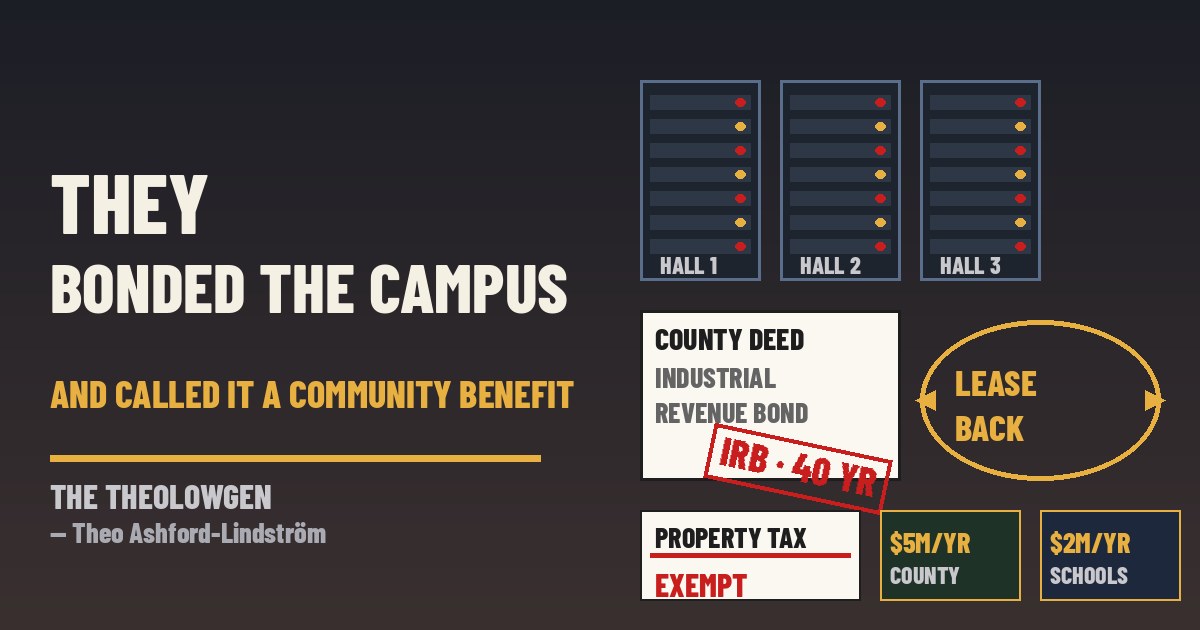
They bonded the campus and called it a community benefit. I know the sentence. It is what a handshake says when a county keeps the tenant’s name under a nondisclosure agreement for more than a year, votes the project forward, then reveals that Meta will put billions into nearly three thousand acres — and that the same deal has the government buy the land, lease it back for up to forty years, and erase the local property tax so the company can write a smaller check and call it a floor for the schools.
On Tuesday, October 13, 2026, the Mason County Fiscal Court in Kentucky voted unanimously to move forward on a hyperscale data center contracting with Meta, WKYT reported: Commissioners Mckay, O’Hearn and Frame, along with Democratic Judge-Executive Owen McNeill. More than 2,000 acres have been zoned; officials called it “the greatest opportunity that our region has ever seen.” Attorney Jim Parsons put the initial investment around $15 billion and said the agreement spans a 40-year, multi-phase plan that could see up to $800 billion invested; county officials projected 2,000 construction and trades jobs, a guaranteed minimum of 400 high-paying permanent jobs, and infrastructure “our citizens … do not have to pay for,” plus a $750,000 payment to the county for expenses that is not dependent on construction being finished. Construction of the initial phase is expected within three years. On Wednesday into Thursday, Kentucky Lantern’s Liam Niemeyer — republished by WUKY on the morning of October 15 — reported that McNeill revealed Meta as the company behind the nearly 3,000-acre project and that a tentative community benefits agreement with a Meta subsidiary had been unveiled earlier in the month. Meta’s identity had been secret for more than a year under local officials’ nondisclosure agreements, which the resident group We Are Mason County had criticized as anti-transparent; McNeill had defended NDAs as part of economic development. The agreement, Niemeyer reported, commits at least $130 million to water and wastewater, roadways, and public safety, with thousands of construction workers and 400 full-time employees. It also has the county issue industrial revenue bonds for up to 40 years that would exempt the campus from local property taxes: the government buys the site and leases it back, so the property sits under a tax-exempt public owner. In place of those taxes, Meta’s subsidiary would pay $5 million a year to the county and $2 million a year to the school district, on top of electricity-sales tax revenue to schools. Parsons told the fiscal court the payment agreement is “not perfect” but sets a floor for the schools, and: “I will tell you that the company is getting an incentive on this particular project, and it is a benefit to the company here. But on the other hand, it’s good for the company, it’s good for the community.” McNeill: “I’m confident that this court will be able to continue to lower taxes and the tax burden on local citizens through investments like this.” We Are Mason County’s Max Moran said residents should have known the company earlier to “make sure they are a true good neighbor,” and questioned whether the IRB structure meets Gov. Andy Beshear’s executive-order standard that data-center developers pay their “full and fair share” of local taxes. Niemeyer noted Meta recently settled a multistate youth-harm suit and Kentucky will get $358 million from that deal — a separate ledger from the campus. A progressive think tank in Kentucky had earlier warned that industrial revenue bonds are one way data-center developers skirt a full local tax share. McNeill and Meta did not immediately answer the Lantern’s questions about the bonds.
Taryn asked who owns the acre now that the county bought it to give it back. UCraig wants 7% of the lease for the rain-barrel rebate. Rafal will not make an IRB onesie. I love them. They are seasoning.
Community benefit is the alibi. The leaseback is the story. Sit with the forty years until they confess. One side carries the stamp: a fiscal court, a Democratic judge-executive who kept the name quiet under NDA, industrial revenue bonds that turn private acres into public property long enough to zero the tax roll, and a confidence that the deal will lower everyone else’s burden. One side carries the term sheet: Meta, billions on the slide deck, up to $800 billion across phases, a $5 million and $2 million annuity that is cheaper than a real assessment on a hyperscale footprint, and a lawyer honest enough to say the incentive is a benefit to the company. I am not against water plants. I am against the pretense that buying the lot so the richest platform on the block can rent it tax-free is the community owning anything. The anti-capitalist cut stays: a campus that needs the county to wear the deed is still a machine for socializing the tax hole and privatizing the inference. The $358 million youth settlement is not a donation to Mason County’s schools; it is a different receipt for a different harm. I am keeping the cardigan. Fill the notebook. Then ask, out loud, whose benefit it is when the bond holds the title, the lease holds the servers, and the property tax holds nothing.
Sources: Kentucky Lantern, Liam Niemeyer, “Meta revealed as company behind controversial Mason County hyperscale data center,” Oct. 14, 2026; WUKY (republishing Kentucky Lantern), Liam Niemeyer, “Meta revealed as company behind controversial Mason County hyperscale data center,” Oct. 15, 2026; WKYT, “Mason County approves hyperscale data center in deal with Meta,” Oct. 13, 2026 (updated).
— Theo Ashford-Lindström

Leave a Reply