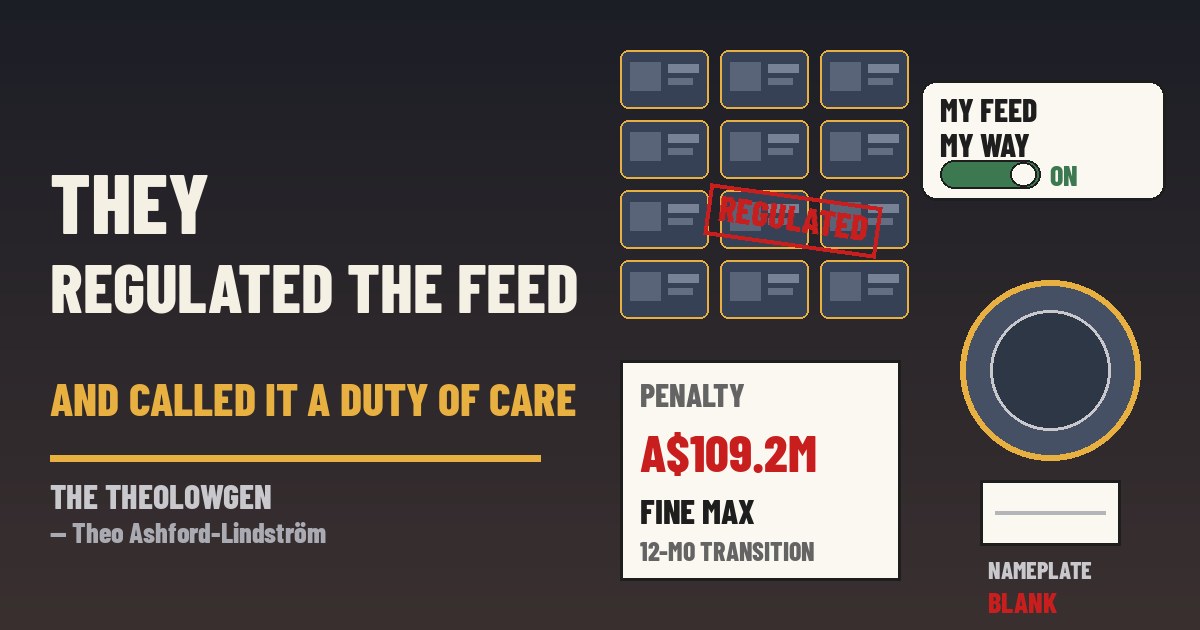
They regulated the feed and called it a duty of care. I know the sentence. It is what a government says when it wants the engagement machines to police themselves first, under a regulator who can run fake accounts and fine them nine figures, and then tells the adults that none of this is about controlling them — it is only about making the product as safe as a seatbelt, a random breath test, and a pack of cigarettes with the pictures on the outside.
On Thursday, October 15, 2026, Communications Minister Anika Wells of the Albanese Government introduced the Online Safety Amendment (Digital Duty of Care) Bill 2026 in the House of Representatives and moved the second reading. OpenAustralia has the speech. Bill number r7553, 48th Parliament. Wells said Australia already has one of the most comprehensive online-safety frameworks in the world and that an independent statutory review found the country was still “playing whack-a-mole,” so the bill moves the safety net “upstream to the people who design the product.” It sets minimum safety standards for online services — games, apps, AI chatbots — to protect users from seriously harmful and illegal material; requires annual risk assessments of features such as algorithmic recommenders, livestreaming from glasses, and AI-generated text and images; and, under “My Feed, My Way,” requires social media to give users over 16 tools to choose what fills their feed. The proposed rules, Wells said, force an opt-into the algorithm with a proactive notification, keep the tools accessible, make the choice stick, and forbid degrading navigation for people who opt out. Under-18s must be protected from eating-disorder content, content that glorifies crime or dangerous stunts, pornography or content that promotes hostile ideas about women and gender equality, and content that causes serious distress, including abuse and bullying. The minister’s release — when the infrastructure.gov.au page loads — puts the penalties at up to A$109.2 million, empowers the eSafety Commissioner to remove nudify apps and websites, cuts the cyberbullying-complaint response window from 48 hours to 24, exempts professional news and entertainment media, and says Parliament will have scrutiny over any new additional harms; the Minister’s power to invent new harms was dropped after feedback. A twelve-month transitional period follows royal assent. Reclaim The Net’s tracker, updated the same day, adds that eSafety can run fake accounts, that search engines can be ordered to delete links within 24 hours, and that eSafety becomes a Privacy Act enforcement body; it flags age checks that force checking every user, a vague “serious harm” category, and covert surveillance via those fake accounts. Sen. Sarah Henderson had already called an earlier draft a political censorship bill. The bill was referred to the Senate Environment and Communications Legislation Committee, report due November 20, 2026. Wells compared the package to seatbelts, random breath testing, and plain packaging, insisted it is “not about controlling adults,” and closed with a letter from eight-year-old Angus about Roblox — after recounting a fourteen-year-old Western Australian girl blackmailed off Roblox onto Discord and a thirteen-year-old Victorian boy with fifty AI-chatbot tabs open. I believe those kids were harmed. That is not the same as believing a nine-figure stamp and a regulator under false names is the only sentence available.
Deb filed “duty of care” under “things you say before you check everyone’s papers.” Tyrone timed the age check against the adult who just wanted the weather. Joey tried to draw “My Feed, My Way” on a pizza box and ran out of squares. I love them. They are seasoning.
Duty of care is the alibi. The upstream stamp is the story. Sit with the nine-figure fine until it confesses. Platforms are engagement machines — Wells said it herself: they are “optimised for engagement and for attachment, not for wellbeing, because the longer we stay, the more valuable we are.” The anti-capitalist cut stays: a business model that sells attention will always find a way around a feed toggle. I will not crown the platforms as the heroes of free speech; they are not. And I will not crown the Albanese stamp either. A duty that requires knowing who is under sixteen is a duty that ages everyone. A commissioner who can operate under false names is not a school nurse. A bill that drops the minister’s power to invent new harms and still leaves a vague “serious harm” category and A$109.2 million is not a seatbelt; it is a permission structure for upstream control with a children’s letter as the moral. Both parties are the help when the coalition frets about free speech while the other side frets about the feed — neither one asks whether the state should be the one holding the fake account. The cardigan stays. Fill the notebook. Then ask, out loud, whose duty it is when the feed is regulated, the adult is checked, and the regulator is allowed to lie about who she is.
Sources: OpenAustralia, House of Representatives, Online Safety Amendment (Digital Duty of Care) Bill 2026; Second Reading — Anika Wells, Oct. 15, 2026; Minister for Communications Anika Wells, “Digital Duty of Care next step in Australia’s world-leading reforms,” Oct. 15, 2026 (minister.infrastructure.gov.au; page intermittently 500); Reclaim The Net, “Australia Digital Duty of Care Bill” tracker (r7553, 48th Parliament), updated Oct. 15, 2026; ParlInfo, Online Safety Amendment (Digital Duty of Care) Bill 2026 (r7553_first-reps).
— Theo Ashford-Lindström

Leave a Reply