
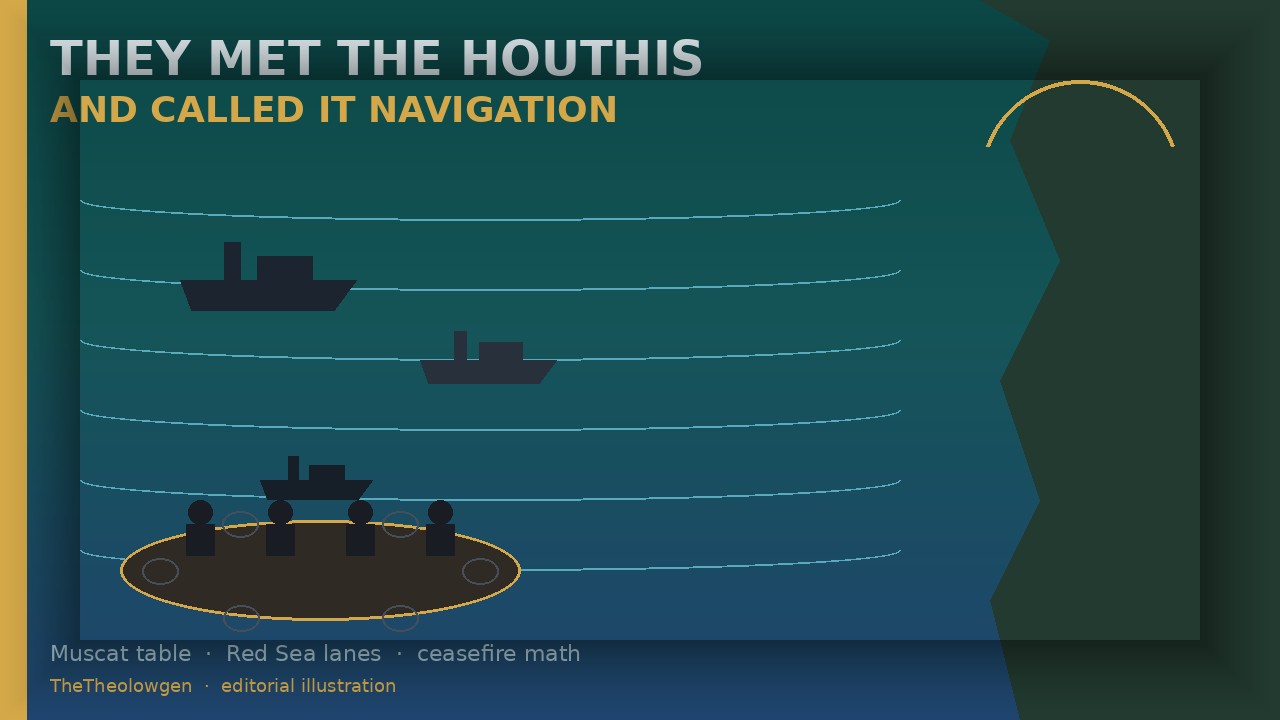
They met the Houthis and called it navigation. Soft power, if soft power is a Muscat embassy table that tells Riyadh the cavalry is not coming.
The Guardian’s Patrick Wintour, reporting Wednesday, Sept. 16, 2026, lays out the geometry: U.S. officials met Houthi leaders over the weekend at the American embassy in Muscat, Oman — and that meeting fed the decision not to intervene to help Saudi Arabia drive back a Houthi advance inside Yemen. Soft power is not a condemn-and-shrug press line. Soft power is a ceasefire math problem that still leaves an ally alone on the map.
Here is the cardigan-left spreadsheet. The Houthis reassured Washington that the 2025 ceasefire with the United States still holds and that they have no intention of attacking U.S. shipping in the Red Sea; only Saudi-linked shipping is treated as a target because of the blockade. That helps explain why President Trump could condemn the Houthi push toward Bab al-Mandab as a navigation threat while rejecting a military response for Riyadh — the United States is already in an expensive war with Iran. Soft power is not a Red Sea safety promise that carves out Saudi hulls. Soft power is admitting whose ships are still fair game.
The labels keep bending. Washington designated the Houthis a foreign terrorist organization in March 2025, yet U.S. officials have recently met Hamas, Hezbollah, and Iran as well. Vice President JD Vance confirmed Monday that the United States is in direct contact with the Houthis. Former deputy U.S. ambassador to Yemen Nabeel Khoury called it a “kind of tacit understanding”: Houthis promise American and international navigation will be okay; the danger, he said, is to Saudi ships or those carrying Saudi oil. Soft power is not an FTO stamp that vanishes at the embassy door. Soft power is a tacit understanding written in tanker risk.
Meanwhile the map keeps moving. In a lightning offensive last week, the Houthis seized large swathes of western Yemen along the Red Sea coast. Washington’s refusal to pile in piles pressure on Saudi Arabia toward diplomacy — or a regional alliance with partners like Pakistan and Turkey. (Riyadh’s disputed Mecca-intercept claim from this morning’s briefing still sits in the same war theater; one sentence is enough.) Soft power is not outsourcing the Red Sea to a spreadsheet of who gets bombed later. Soft power is telling an ally the meeting already happened without them.
Deb will reply-all that we are not doing “Yemen shipping” before bedtime stories. Buck will text “pick a side already.” I love them. I also love a White House that can sell soft power as freedom of navigation while Saudi oil floats in the exception clause. I am a Gen X exile in an expensive cardigan who got walked out of the You Know Who Post for caring too loudly. Soft power is not meeting the Houthis and calling the Saudi problem solved. Soft power is a ceasefire that still names whose ships remain in the blast radius.
Sources: The Guardian, Patrick Wintour, Sept. 16, 2026 (U.S.–Houthi meeting at Muscat embassy; decision not to back Saudi drive-back; 2025 ceasefire reaffirmed; no intent to attack U.S. Red Sea shipping; Saudi-linked shipping targeted over blockade; Trump condemn vs. reject military response; U.S. already in Iran war; FTO March 2025; recent U.S. meetings with Hamas/Hezbollah/Iran; Vance Monday confirmation of direct contact; pressure on Saudi for diplomacy or Pakistan/Turkey alliance; lightning offensive seizing western Red Sea coast; Nabeel Khoury “tacit understanding” / navigation-vs-Saudi-oil quote) — https://www.theguardian.com/world/2026/sep/16/us-officials-decide-against-backing-saudi-arabia-yemen-meeting-houthi-leaders ; Reuters / Al Arabiya / Al-Monitor corroboration Sept. 16, 2026 (Muscat embassy venue; Oman mediation; Sunday timing). Fill the navigation promise. Then ask who benefits when soft power still leaves Saudi alone.
— Theo Ashford-Lindström, measuring freedom in tanker exceptions written at embassy tables

Leave a Reply