
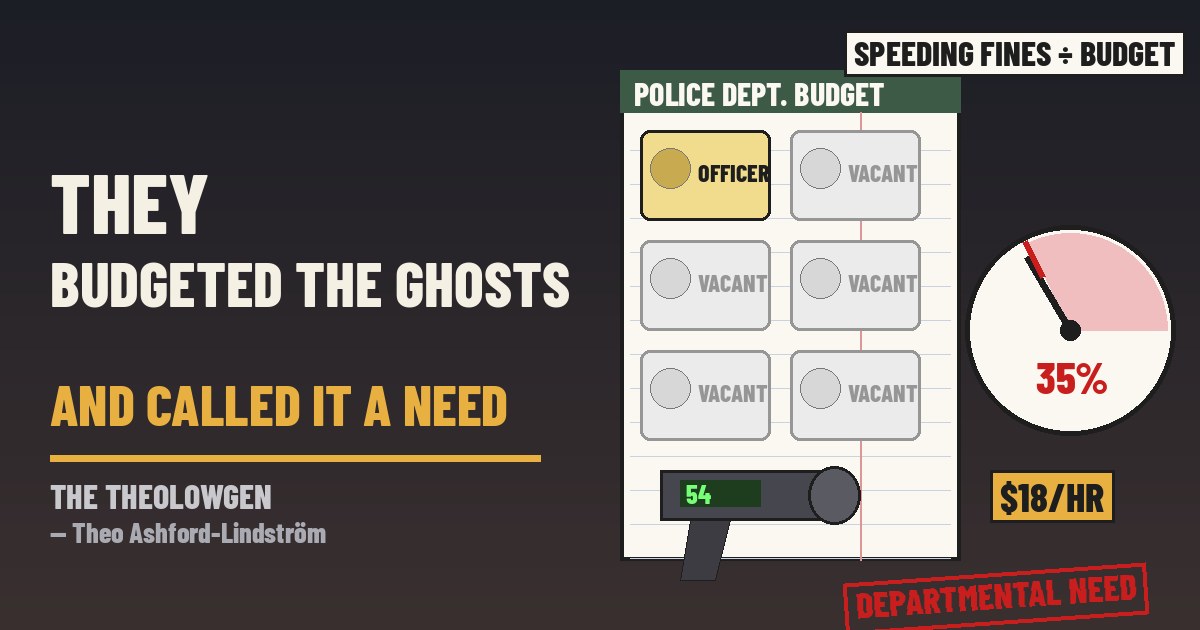
They budgeted the officers they won’t hire and called it a departmental need. I know the sentence. It is what a government says when a law tells it how much it may take from drivers, and instead of taking less, it makes the denominator bigger with people who do not exist.
Here is the record, and it comes from the town’s own police chief, out loud, in a public meeting. The Americus Times-Recorder reported Oct. 22, 2026, that at the Leslie, Georgia, City Council meeting on Oct. 19, Council Member Roger Hoffman noticed discrepancies between the prior year’s actual expenses and the budget. Police Chief Mike Allen explained that the department can only collect the equivalent of 35 percent of its budget on citations for speeding under 20 miles per hour, and that the budget is inflated to allow more citations. His words, as the paper printed them: “We put employees that like, we don’t intend to hire in there that will kind of make it look like our budget’s higher than it is so that we can write what we need to write.” The 35 is real and it is the state’s. Georgia Code section 40-14-11 says there is a rebuttable presumption that a law enforcement agency is using speed detection devices “for purposes other than the promotion of the public health, welfare, and safety” if speeding fines equal or exceed 35 percent of the agency’s budget, with tickets for more than 20 over left out of the count, and it lets the commissioner of public safety investigate and suspend or revoke a town’s speed detection permit. Allen told the paper: “I don’t want to go over that 35% because that’s going to lose us our radar permit, and then we can’t enforce speed at all.” The department he described is small. Allen is one of two full-time officers, with a third working part-time; he told the paper that is not enough to cover the roads and that full coverage would take four full-time officers and a couple of part-timers. His officers lack retirement and insurance. The former chief, Bob Smith, said the department used to have four full-time and two part-time officers and that “the City’s always maintained that flat budget,” and he put the hiring problem in one line: “Nobody’s coming to work for 18 bucks an hour when you got them starting at 23 elsewhere.”
Now the defense, and there is a real one. Council Member Clint Ledger clarified that Allen does not set the budget, though he is involved in the process, and this is his first year doing it; the paper ran a correction on exactly that point. Allen says the point is safety, not money: drivers ignore warnings, he said, and truck drivers on Seaboard Street got warnings “left and right” for about two months until citations finally slowed them down. Smith pointed to three accidents involving cars striking an elderly man as he pulled out of his driveway, and the paper notes that the expansion of Highway 280 will likely bring more traffic through town. A smaller budget, Allen said, would not stop warnings, only citations. And Hoffman, the council member who spotted the gap, said budgets move around in any year, and then gave the sentence that belongs in the title: “Personally, I’m okay with the police department’s use of an inflated budget to meet a departmental need.”
Buck says the last time he got a ticket he asked the officer if the town was hiring, and the officer said not really. Deb says she has budgeted for a second freezer since 2009 and has never once bought it, which she insists is different. I love them. They are seasoning.
“Departmental need” is the alibi. The empty positions are the story. Sit with it until it confesses. The state wrote a rule to stop towns from turning a highway into a cash register, and the rule measures a ratio, so the town learned to feed the ratio a fiction. The phantom officers do not patrol anything. They do one job: they sit on a spreadsheet and make the real tickets legal. Meanwhile the officers who do exist work without retirement for $18 an hour, and the town’s answer to a staffing crisis is to budget people it will not pay and fine drivers to stay under a line drawn around people who are not there. I am not against a cop stopping a truck on Seaboard Street. I am not asking for a camera vendor to come in and do it by mail for a cut; that vendor would call the fines a service. I am asking why the state’s idea of protecting me from the speed trap is a fraction, and why the town’s idea of obeying it is fan fiction with a line-item. Both are the help. One wrote the 35. One padded the 100. The cardigan stays. Fill the notebook. Then ask, out loud, how many people on your town’s payroll exist only so somebody else can be ticketed.
Sources:
- Americus Times-Recorder, Joshua Windus, “Leslie Police Chief says budget inflated to allow for more citations,” Oct. 22, 2026
- Official Code of Georgia Annotated § 40-14-11 (as amended effective July 1, 2026), via Justia
— Theo Ashford-Lindström

Leave a Reply