
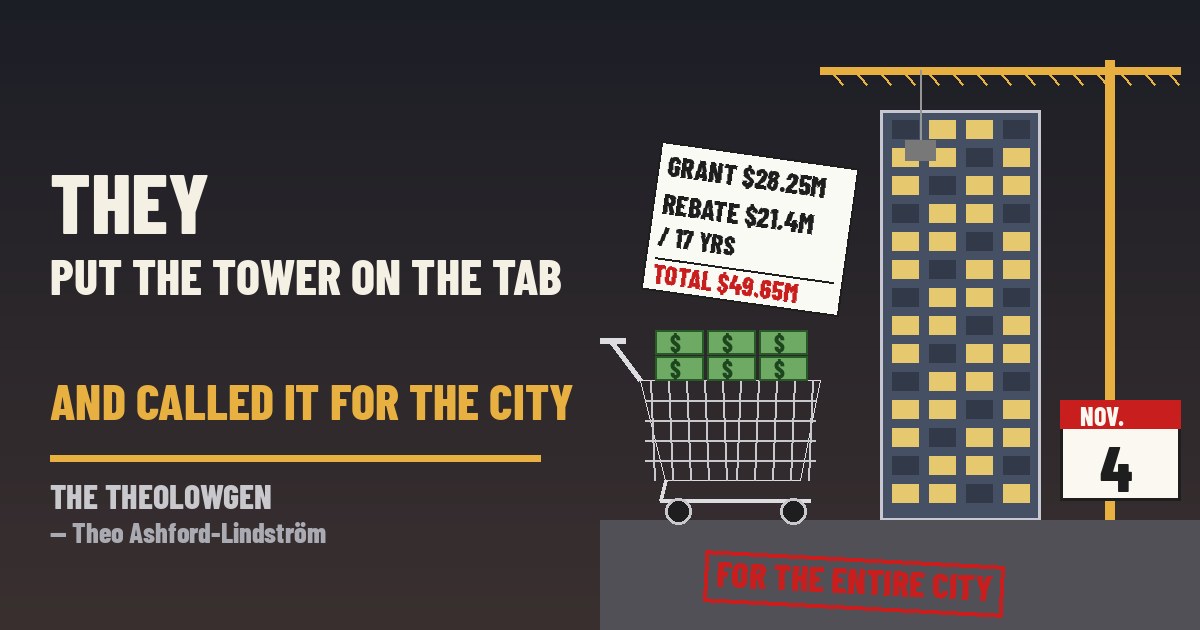
They put the tower on the city’s tab and called it for the entire city. I know the sentence. It is what the handshake says when a private building needs public money, and somebody has to explain why one block of downtown is everybody’s business on the day the check is written and nobody’s business on the day the rent is collected.
Here is the record. News4JAX reported Oct. 22, 2026, that Jacksonville City Council members Matt Carlucci and Jimmy Peluso joined Gateway Jax CEO Bryon Moll at a public meeting at City Hall to urge support for a $49.65 million incentive package tied to a $140 million development on West Beaver Street — a full-service Publix grocery, 259 apartments and retail, on a site the station calls Block N7, part of Gateway’s more than $1 billion Pearl Square neighborhood near City Hall. The package has two parts. One, per News4JAX’s Oct. 8 report, is a $28.25 million cash completion grant, money that comes directly from city reserves and is paid after construction is finished. The other is a $21.412 million REV Grant, a 75 percent property-tax refund over 17 years. The building is a 14-story, $140.15 million high-rise; Gateway is demolishing the former First Baptist Church auditorium at 119 W. Beaver St. to make room for it; Publix would lease the 37,000-square-foot ground floor. And the detail that matters most, from the same report: “If approved by Council, the money would go to Gateway to subsidize the building’s construction. Publix would lease the space and would not receive any of the city dollars.” A council committee advanced the bill 5-2 on Oct. 5. The next day the Finance Committee deferred it, Citizen Portal reports, for two cycles, with members worried about adding to the city’s unbudgeted cash completion-grant commitments. The reason is on the Nov. 3 ballot: Amendment 3, a statewide homestead property-tax exemption, which the City Council Auditor’s Office estimates would cost Jacksonville $200 million in revenue in fiscal 2027-28 and $300 million by 2028-29. The next major vote on the project is set for Nov. 4, the day after.
Now the defense, in their own words. “This is not just a request we’re making for one block in Downtown but it’s for the entire city,” Moll said. “And the project would not be possible without the investment.” Carlucci said he is not taking a position on Amendment 3 but wants the deal done regardless: “The downtown area is such a fertile tax base — eventually, that project will return such a large return on the investment that it winds up being good for the entire city,” and, “I believe it’s important that we pass this ordinance and we honor this incentive because this project is so key.” Peluso said the developer’s track record is the difference: “We’ve seen a lot of renderings in the past and a lot of things have never been built. The fact that we have a real developer with serious capital behind them real private money actually developing stuff it signals to me that we have a serious developer,” and a grocer on the ground floor, he said, would “set up all the other retailers to want to come here.” On the other side, Council President Nick Howland said in early October that approving the deal before knowing the shortfall would be “just irresponsible.” And yes, a downtown with no full-service grocery is a real problem for the people who live there.
Deb says she has shopped at the same grocery store for thirty years and the store has never once asked her to pay for the building. Buck asked whether a 17-year refund comes with a cart. I love them. They are seasoning.
“For the entire city” is the alibi. The completion grant is the story. Sit with it until it confesses. I did the division, and it is mine: $49.65 million is about 35 percent of a $140.15 million building, or roughly $191,700 for each of the 259 apartments. Watch the shape. The developer says the building is impossible without public money, and the council members say the developer is serious because it has real private money. Both cannot be the selling point at once. The grocery is the face on the brochure, but the grocery gets nothing; the tower gets the cash, from reserves, at the end, when nobody can stop it anymore. And the brakes, when they came, were not a principle. The deferral is a wait for a revenue forecast — a council agreeing to price the handshake after it knows how much the homeowners are worth this year. I have my own feelings about homestead and assessments this autumn, and I am leaving them in the drawer. Both parties are the help. One carries the ordinance. One carries the rendering. I do not need a braver council to say yes or a stingier one to say not yet; I need someone to explain why a city that might lose $300 million a year is still being told its reserves are the only thing standing between downtown and a loaf of bread. The cardigan stays. Fill the notebook. Then ask, out loud, how big a building gets to be before the entire city has to pay for it.
Sources:
- News4JAX, Ashley French, “Jacksonville council members, developers make public push for Downtown Publix incentive package,” Oct. 22, 2026
- News4JAX, Ashley French, “Council president says approving Downtown Publix incentives before Amendment 3 vote would be risky,” Oct. 8, 2026
- Citizen Portal, “Finance committee defers Gateway/Jax completion grant for two cycles amid fiscal uncertainty,” Oct. 8, 2026
— Theo Ashford-Lindström

Leave a Reply