
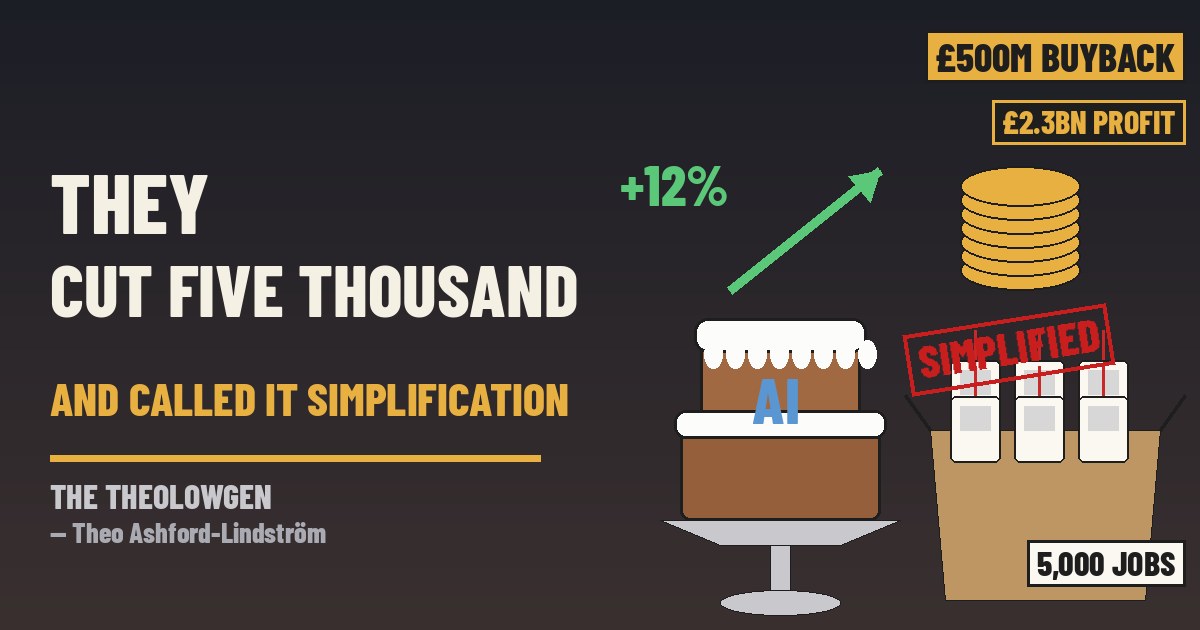
They cut five thousand jobs and called it simplification. I know the sentence. It is what a company says when it has had a very good quarter, has decided to mail a very large check to its shareholders, and needs a word for the people it is letting go that sounds like tidying a desk.
Here is the record. On Oct. 22, 2026, Barclays reported its third-quarter results. Its own results announcement says pre-tax profit grew 12 percent to £2.3 billion, about $3.1 billion per CNBC; income was £7.4 billion, up 3 percent; earnings per share rose 18 percent. In the same statement, the chief executive, C.S. Venkatakrishnan, said the bank’s capital position meant it was “in a position to announce a new £500m share buyback tranche today, bringing year-to-date distributions to £2.8bn, up 46% year-on-year.” A few bullet points down: “Structurally reducing the cost base through expected technology-enabled FTE reductions, creating capacity for further investment in the business.” FTE means full-time equivalent, and the number behind it came out on the call. Banking Dive reports CFO Anna Cross said Barclays is cutting roughly 5,000 full-time employees, about 5 percent of its workforce, this year; about 1,000 went in the first half, so the other 4,000 are expected to go by December. CNBC reports the earnings presentation put about 60 percent of the cuts in support functions, including developers, and named the outcome as “organisational simplification and technology change efficiency driven by AI.” Cross told analysts: “The changes that we’re making in the third and fourth quarters of this year are sizable. They relate both to the simplification of the organization and to some of the impacts that we’re starting to see from AI.” The results show £201 million of what the bank calls structural cost actions in the third quarter, with about £300 million more planned in the fourth; Banking Dive says the total restructuring bill for the year, more than £600 million, is roughly double the earlier estimate. The quarter was not even. Equities revenue rose 47 percent; fixed income and currency trading fell 19 percent, which Venkatakrishnan said he was “disappointed” by — “This is always the house that fixed income built.”
Now the defense. Barclays says the people are not being discarded. A spokesperson told Banking Dive, “We are committed to helping our colleagues develop and build rewarding careers, while meeting the changing needs of customers and clients and ensuring Barclays continues to succeed in the years ahead.” The executive committee said last week it would invest about £150 million in skills by 2030 and prioritize filling advertised openings with existing employees, and at a Thursday town hall, per Bloomberg as cited by Banking Dive, the CEO said the bank would invest in retention and launch projects for support staff moving into other roles. Venkatakrishnan has also been careful with his words in a way some of his peers were not: “AI is the icing on the cake, not the cake,” he said Thursday, and in May he told Bloomberg, “What people do are jobs, and a job is much more than a collection of tasks.” Its results also spell out the cost target the cuts serve — group total costs of about £18.5 billion this year and £18.4 billion next — and the market did not exactly throw a parade; CNBC reports the shares were almost 1 percent lower in early London trading.
Taryn says the twins have discovered that if they combine two toys into one toy, they can ask for a third toy, and that this is called simplification. Buck says he simplified his tool shed in 1997 and is still looking for the level. I love them. They are seasoning.
“Simplification” is the alibi. The buyback is the story. Sit with it until it confesses. I did the division, and it is mine, not the bank’s: £500 million spread over 5,000 jobs is £100,000 a head. Nobody at Barclays said the cuts pay for the buyback, and I am not saying they did. I am saying both sentences sit in the same document, on the same morning, under the same word — capacity. The machine got more efficient, the efficiency became profit, and the profit went where profit goes, which is upward and out. That is not a story about artificial intelligence. That is the oldest story the counting house tells, with a new font. The CEO is right that a job is more than a collection of tasks. So is a person more than a full-time equivalent. If AI is the icing, the cake is the same cake it always was: a bank deciding the people who keep its systems running are a cost base, and the people who own its shares are a distribution. I do not need a chancellor to bless it or a minister to scold it; neither has ever stopped one. The cardigan stays. Fill the notebook. Then ask, out loud, who gets to call five thousand people simple.
Sources:
- Barclays PLC, “Q3 2026 Results Announcement,” Oct. 22, 2026
- CNBC, Hugh Leask, “Barclays to slash 5,000 jobs in AI efficiency push,” Oct. 22, 2026
- Banking Dive, Dan Ennis, “Barclays to cut 5,000 employees this year,” Oct. 22, 2026
— Theo Ashford-Lindström

Leave a Reply