
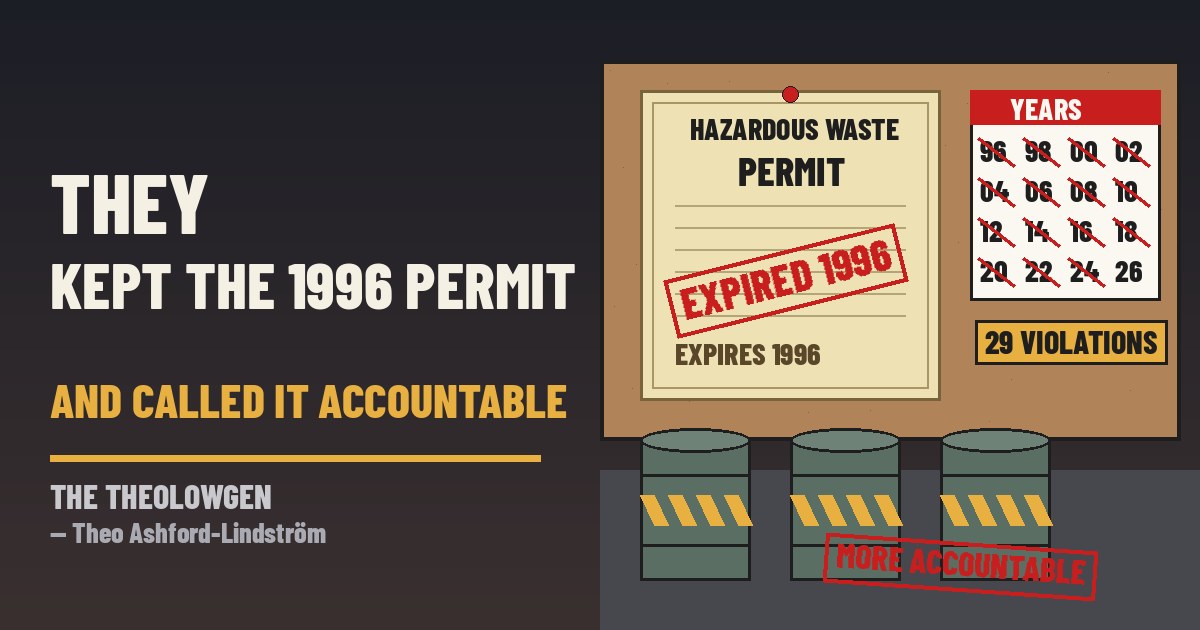
They left the plant on a 1996 permit and called it more accountable. I know the sentence. It is what an oversight board says when it has caught the regulator it oversees getting the paperwork wrong, has said so out loud in a public hearing, and has then handed the paperwork back to the same regulator and let the plant keep running on a permit that expired when I still owned a Discman.
Here is the record. CalMatters reported Oct. 23, 2026, that for nearly 30 years an electronic waste processor in Los Angeles County, Phibro-Tech, has operated on a permit that expired in 1996, while neighbors — some living 550 feet away — say it harms their community. The state Department of Toxic Substances Control renewed that permit last year, for the first time in the facility’s history. The same department recorded 29 violations at the plant between 2013 and 2022, for things like failing to clean up leaks and treating waste its permit doesn’t allow; officials say the facility has since improved, but the state is still suing over alleged violations of hazardous waste laws. A neighborhood group, Neighbors Against Phibro-Tech, represented by Earthjustice, appealed the renewal to the Board of Environmental Safety — a board lawmakers created in 2022 to address the department’s history of flawed oversight. It was the first time in the board’s five-year history that residents asked it to pull a facility’s permit. On Thursday, Oct. 22, the board agreed with the neighbors that the record was incomplete and that the department didn’t show it completely reviewed the company’s compliance history. The board chair, Andrew Rakestraw, put it plainly: the department itself “recognizes that there’s a significant concern for (Phibro-Tech’s) ability or willingness to comply,” and “what I would have expected to see here is some connection between this significant concern … and their subsequent decision to grant this permit.” Then the board voted to let the facility keep operating while regulators reassess. The board’s attorney, Greg Forest, said it has the authority to ask the department to deny permits. The board didn’t discuss that option. Earthjustice attorney Byron Chan: “They agreed with us that permitting violated the law in three different ways in issuing this permit. How many illegal acts does permitting have to do until (the board denies) the permit?”
Now the defense, and there are two of them, because there are two defendants of a sort. The department’s permitting chief, Wayne Lorentzen, told the board the complete record “was accessible to the public and contained the documents that permitting relied on and considered when making its permit decision,” and that it “provides specific evidence to refute the allegation” that the department ignored the compliance history. The company says the opposite problem: in a 2024 cross-complaint it argued the department “inspected (Phibro-Tech) over the past (10 years) considerably more frequently than other permitted facilities” and “disproportionately cited” it as a result. The board granted the company’s appeals too, telling the department to justify why it issued a five-year permit instead of the ten the company wanted and to remove waste-treatment rules that don’t apply; board member Rhys Williams said, “What we’re asking for is not a specific term, but to show the work.” A week before the hearing, the company and regulators settled a separate dispute by extending the plant’s tank certification from three years to five, which Chan said undermined the appeal process; the department didn’t comment on that. The renewed permit is paused while the appeals continue — which means the plant runs on the original one. Rakestraw, in a statement, said the board has made the department “more fiscally stable, more transparent, and more accountable to the public,” and also: “Many stakeholders view the board as California’s hazardous waste watchdog. In reality … we have decision-making authority in a handful of areas.”
Deb says she has a grocery coupon that expired in 1996 and the store still won’t take it, so she would like to know which counter Phibro-Tech uses. Buck says he ran a riding mower for thirty years on one spark plug and called it maintenance. I love them. They are seasoning.
“More accountable” is the alibi. The 1996 is the story. Sit with it until it confesses. The state’s whole theory of itself is that the permit is the leash: you may handle the dangerous thing because we wrote down the terms, and when the terms run out, so do you. Here the terms ran out before the internet was in most kitchens, and the leash turned out to be a suggestion that renews itself by staying in a drawer. The state built a regulator. The regulator failed for long enough that the state built a board to watch the regulator. The board watched, found the regulator broke the law three ways by the neighbors’ lawyers’ count, said through its own chair that it expected to see a connection it did not find, handed the work back to the regulator, and gave itself thirty days to write that down. Meanwhile the plant hums. I am not recruiting the company as the wronged party; its complaint is that the thermometer kept reading a fever. I am not asking for a softer statute or a harder one; the one on the books already says the permit expires. I am asking why a bureaucracy that can find me in a week when a form is late cannot find a 1996 expiration date in thirty years. The cardigan stays. Fill the notebook. Then ask, out loud, what in your county is still running on paper that died before your kids were born.
Sources:
— Theo Ashford-Lindström

Leave a Reply