
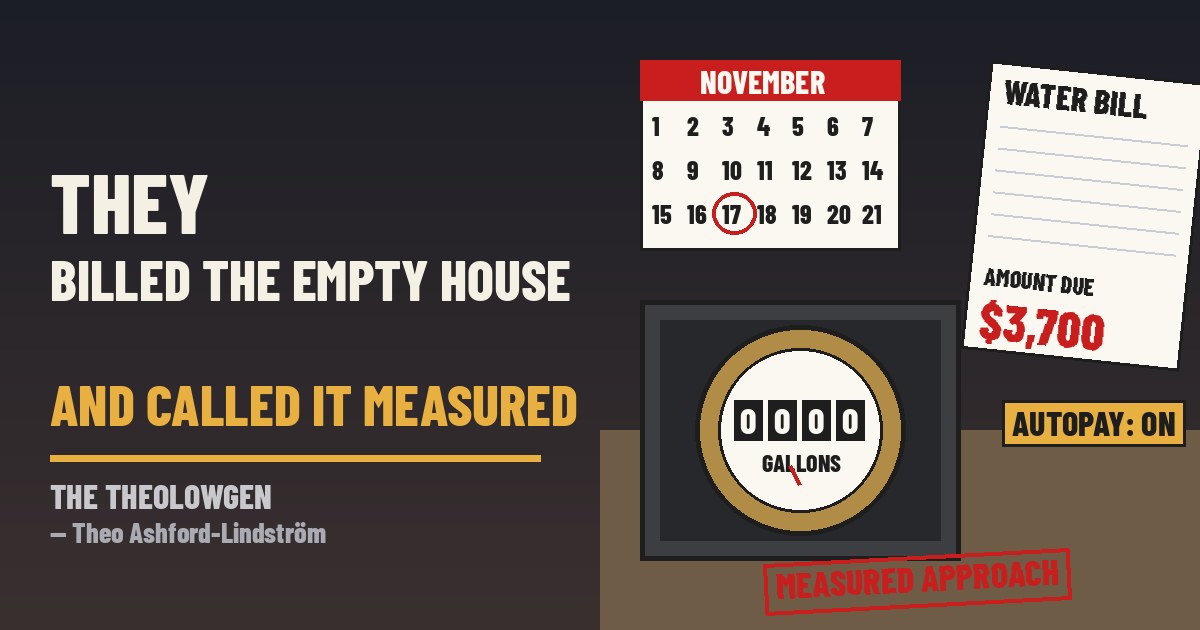
They billed the empty house and called it a measured approach. I know the sentence. It is what a city says when a woman leaves her home for an entire month, uses no water because she is not there to use it, and the bill climbs from $29.05 to more than $100 anyway — and the plan to find out why arrives as six bullet points and a promise to come back in November. Nobody wore a mask. Nobody kicked in a door. A meter in a box in the ground stopped telling the truth, and the city kept cashing what it said.
Here is the record. The Mid Valley Times reported Oct. 24, 2026, that residents filled the Fowler City Council chambers on Oct. 23 for a workshop on the city’s water meters. City Manager Michael Reid said that of around 2,500 water connections, more than 900 meters are older models that have to be checked by hand and need replacing. When a meter shows zero, the city has charged the baseline rate of $29.05 for 12,000 gallons. Resident Sophia Suarez said her bill usually runs about $40; October’s came in at more than $3,700 if paid after Oct. 15. She said she “almost had a heart attack,” and that she only learned the problem was citywide from other residents’ Facebook posts. Resident Torivio Mondragón said he had two months with a zero read and still somehow paid around $500, because the bill was on autopay and it took him months to notice. Mayor Pro Tem Amarjeet Gill told the story of the woman who was gone a month. And then the line that should keep the finance office up at night: Reid said the goal is for water bills to cover 100% of water costs, but the city is recovering only 50% and pulling from reserves to make up the difference. So the meters overcharge some households, apparently undercharge others, and the town loses money on the whole arrangement. That is not a billing system. That is a slot machine with a city seal on it.
Now the defense, and it is a real one, so I will read it in full. Public Works and Utilities Manager David Koons laid out six objectives: an account-level review of manual reads with settings validation through the metering service Neptune 360, investigation and repair of failed radio-read meters, calibrated verification instruments with a documented testing protocol, reconciling the audit with billing records, confirming the scope and money for phase two of meter modernization, and reporting corrections back to council. “The city is taking a measured approach to validate information used for our billing, address any confirmed discrepancies and replace older infrastructure,” he said. Reid said the city has not cut off anyone’s service for non-payment on the high bills. Councilmember Karnig Kazarian said he was encouraged: “It’s time we put this to bed.” Fine. Then Mayor Juan Mejia asked how long it takes staff to read 900 meters, and the paper reports neither man had an answer. Mejia, who said he spent five years as a meter reader, told the paper two people could “easily” do it in a day. “The accountability to our residents has failed,” he said, and then he delivered the sentence I would carve over every utility window in this country: “It’s incredible how slow we are to correct a meter, but how quick we are to bill.” That is the state, in one breath. The bill is automatic. The correction is a work order. Suarez said she opened one and got no explanation of what would happen next or whether anyone would contact her. Gill worried aloud about seniors on autopay: “we’re kind of dipping into her grocery bills.” The money leaves on schedule. The answer waits for Nov. 17, when staff are expected to bring a contract to replace some — some — of the remaining meters.
Deb read the story out loud at the kitchen table and then went outside and stared at our meter lid like it owed her money, which, in fairness, it might. Buck offered to read all 900 for the city himself, no charge, “in a day, with a thermos,” which is the most public-spirited thing he has said this decade and I will not be repeating it to him. Taryn asked whether the twins count as two connections or one. Cricket laminated the phrase “settings validation” and stuck it to the fridge, where it is currently validating a magnet. I love them. They are seasoning.
“A measured approach” is the alibi. The unmeasured bill is the story. Sit with it until it confesses. A government that cannot read its own meters still has no trouble reading your bank account, and it trusts the box in the ground more than the woman who was not home. That is not a party problem; I have stopped pretending either one owns the cure. It is a power problem: whoever holds the autopay holds the benefit of the doubt. The cardigan stays. Fill the notebook. Then ask, out loud, at the Nov. 17 meeting or at your own: who reads the meter, how often, how many accounts get corrected and refunded, and why does the bill always arrive before the answer?
Sources:
— Theo Ashford-Lindström

Leave a Reply