
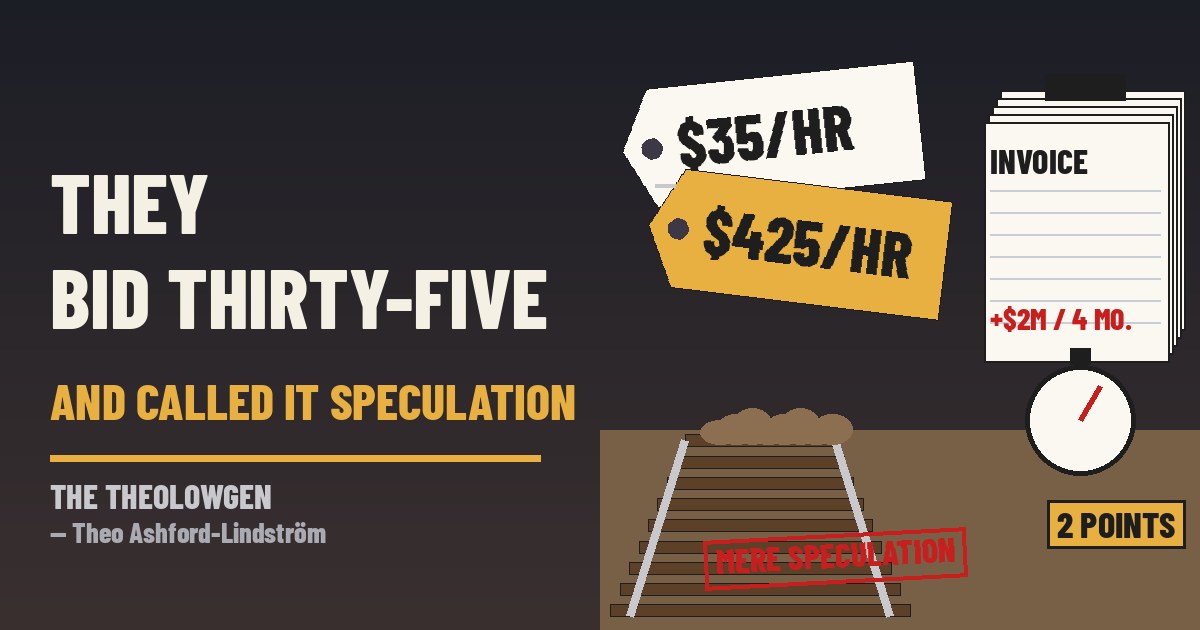
They bid thirty-five dollars an hour and called it mere speculation. I know the sentence. It is what the handshake says when a firm writes down a number nobody intends to pay, the state scores the number, a rival points at the number, and the state’s own referee says pointing is speculation — and then, please, whatever you do, don’t pay more than the number.
Here is the record. CBS California reported Oct. 23, 2026, on the California High-Speed Rail Authority’s $24 million, four-year consulting contract with KPMG. Under KPMG’s existing contract with the authority, managing directors billed $450 an hour, managers $375 and senior associates $295. In its winning bid for the new contract, those three classifications dropped to $35 an hour, and the lowest-experience class, associate, rose from $45 to $425. Because the state scores a weighted average of expected rates, the $35 positions pulled KPMG’s average down; CBS reports the bid averaged roughly $200 an hour while its billed average was more than double that. The runner-up, CohnReznick Advisory, scored higher on technical qualifications and lost by two points on price. Its protest accused KPMG of offering low rates for positions it didn’t intend to staff, and a review of the bid confirms KPMG never assigned anyone to the three $35 positions; the authority’s own evaluators flagged that and questioned whether the firm could stay on budget. The Department of General Services denied the protest. Its hearing officer wrote that “any argument that KPMG intends to charge more than it bid or to substitute an individual to perform work at a higher hourly rate classification is mere speculation” — and then put the authority on notice that its contract managers must make sure “no more than that classification rate is paid.” Across seven task orders CBS reviewed, the authority assigned more than 9,000 hours to managers and senior associates, and KPMG billed thousands of them at the $425 associate rate, roughly $2 million more over four months. The bid listed managers at $36.05 an hour in years three and four; the signed contract lists $453.20, and DGS says it has received no amendment. One year in, KPMG had billed nearly half the $24 million. All this on a project that, per CBS’s earlier reporting, has spent more than $15 billion over nearly three decades and still hasn’t laid a mile of high-speed track.
Now the defense, and it is a remarkable one. KPMG did not deny the findings. A spokesperson said its December 2024 bid “detailed the people who would work on the engagement, their job classifications aligned to the state’s definitions, and the associated billing rate for each person” — in other words, the authority knew. KPMG also said it is “investigating the facts and circumstances related to the proposal process and contract” and that any violations by its personnel “will be addressed appropriately.” The authority, answering the protest at the time, argued KPMG employees’ actual job titles didn’t have to match the state’s contract classifications. DGS says its review covers procedural compliance and that it lacks authority, once a contract is signed, to oversee the rates an agency actually pays. After the inspector general’s travel investigation, the authority announced it would rebid the KPMG contract early. And after CBS published, the authority’s board chair said he would ask the inspector general for an independent review of the contract, the billing and the authority’s own oversight. The authority’s executives did not answer CBS’s questions; its public relations team instead demanded a correction, saying the program has “advanced significantly, turning the corner from planning to implementation, consistent with global best practices.” CBS declined.
Buck says he once bid the Hendersons $35 to mow and then charged $425 for “associate-level edging,” and Deb made him give it back. He would like it noted that nobody made KPMG. I love them. They are seasoning.
“Mere speculation” is the alibi. The $35 is the story. Sit with it until it confesses. A bid is supposed to be the one moment in the whole arrangement when the firm has to tell the truth about price, because someone else is standing there offering a different truth. Here the truth was a rate for positions with no one on the staffing list, a referee who called the obvious a guess, and an agency that was warned in writing and paid anyway. This is what consulting sells the state: its own competence, back, by the hour, at a markup, in a font nicer than the state can afford. And this is what the state sells the consultants: a counterparty that will not read the invoice. Both parties are the help. One signs the task order. One bills the associate. Neither lays track. I am not asking for a nobler agency or a humbler firm; I have met both and they bill the same. I am asking why the people who will never ride this train are the only ones in the deal who paid list price. The cardigan stays. Fill the notebook. Then ask, out loud, what your state is paying thirty-five dollars for that costs four hundred and twenty-five.
Sources:
- CBS News California, Julie Watts and Tyler Horst, “Did California High-Speed Rail help a consulting giant “manipulate” its bid to win a lucrative contract?,” Oct. 23, 2026
- CBS News California, Julie Watts and Tyler Horst, “California High-Speed Rail consultants commute from out of state on taxpayers’ dime, receipts show,” Oct. 15, 2026
— Theo Ashford-Lindström

Leave a Reply