
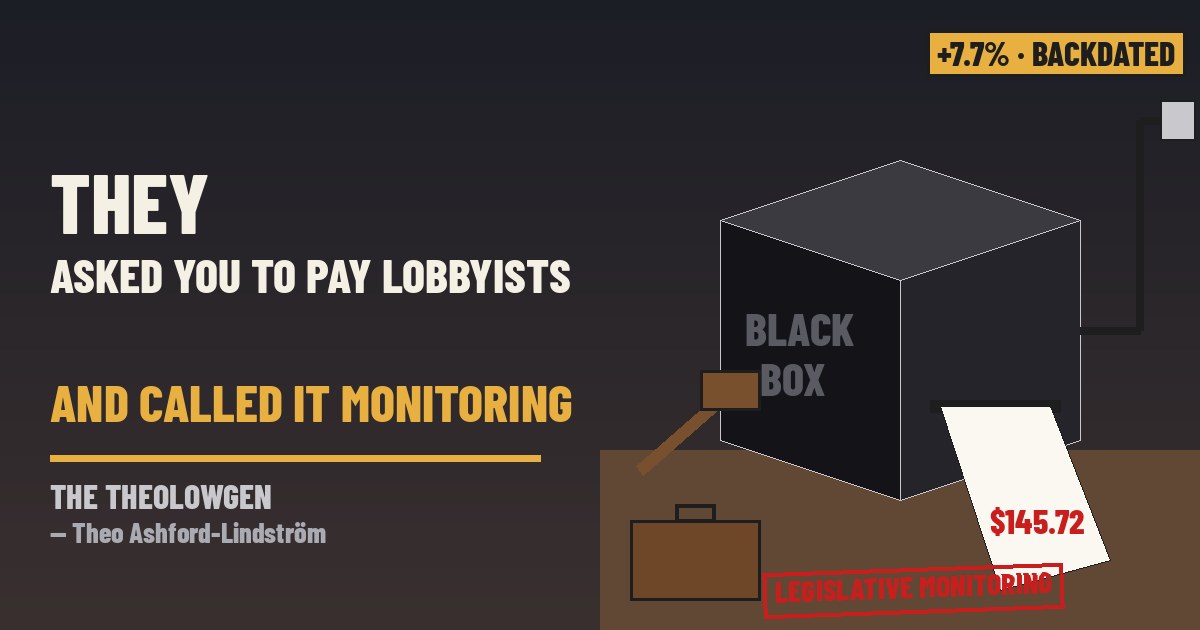
They asked you to pay the lobbyists and called it legislative monitoring. I know the sentence. It is what a utility calls the payroll of employees registered to lobby legislatures, when it would like the people who pay the light bill to cover it. And then everyone who was supposed to be on the other side of the table sat down, agreed on a number, and sealed the reasoning in a box. Not a metaphor. That is the actual industry term: a “black box” settlement.
Here is the record. The Energy and Policy Institute reported Oct. 22, 2026, on Southwestern Electric Power Company, which serves more than 191,000 Texas customers. SWEPCO filed a base rate case with the Public Utility Commission of Texas on Oct. 14, 2025, asking for a $95 million increase — about 12%, or $16.43 a month, on a residential bill — and a higher authorized return on equity of 10.75%. In September it reached a black-box settlement with PUCT staff and all intervenors. The settlement halves the increase to $47.5 million but still raises the authorized return on equity from 9.25% to 9.53%. A customer using 1,000 kWh a month would go from $135.28 to $145.72, a 7.7% increase, plus a surcharge that backdates the new rates to March 2026, partly offset by a $28.5 million refund owed from a previous case. Customers would also pay $10.6 million in rate-case legal expenses over two years — the utility’s lawyers and expert witnesses who argued for the increase, and the intervenors’, including $1.6 million for a coalition of municipalities called Cities Advocating Reasonable Deregulation. The analysis says AEP, SWEPCO’s parent, saw profits rise 48% from 2021 to 2025, and SWEPCO’s rose 61%, to $391 million. AEP’s board awarded its CEO $36.6 million for 2025, the highest of any utility in the country by EPI’s count.
Now the defense, because the utility made one and the rules partly back it. SWEPCO’s vice president of external affairs testified that the company may recover lobbyists’ personnel costs as “legislative monitoring” under a 1995 commission precedent, which defined monitoring as reviewing legislation to prepare for its impact, as opposed to advocacy, which “focuses on affecting the outcome.” The application sought to recover $403,365 of $547,954 in payments to registered lobbyists, including almost $400,000 in payroll for five employees registered as lobbyists in Texas, Arkansas and Louisiana. On $463,938 in Edison Electric Institute trade-group dues, SWEPCO’s regulatory director said the company “has already excluded or adjusted for the portion of dues attributable to lobbying.” And the rules allow a utility to charge customers up to three-tenths of 1% of gross receipts for advertising, contributions and donations; SWEPCO sought $1,796,659. Here is the handshake. The commission’s rules forbid recovering legislative advocacy costs, and a 1995 precedent, as SWEPCO reads it, leaves a door marked “monitoring.” The commission’s own staff signed the deal. The cities’ coalition — the one with “deregulation” in its name, whose job was to push back — signed the deal and gets its legal bill paid by the same customers. And the settlement, EPI reports, does not disclose whether the lobbyist payroll, the trade dues or the civic and political spending made it into your rates. The state wrote the loophole, the corporation walked through it, and the referees agreed not to show the replay.
Deb wants to know if she can bill the electric company for the hours she spends monitoring the electric company. Buck says he’d pay for a lobbyist if it got the porch light fixed, and then remembered the porch light is ours. Taryn has started reading the meter to the twins as a bedtime story; they are not yet sold on the plot. I love them. They are seasoning.
“Legislative monitoring” is the alibi. The black box is the story. Sit with it until it confesses. Nobody in this deal had to lie. They only had to agree, in private, on a total, and let the public see the number that comes out and none of the reasons that went in. The settlement is still pending before the PUCT, which means there is still a moment when somebody could ask to open the lid. The cardigan stays. Fill the notebook. Then ask, out loud, of every regulator and every city that signs on your behalf: what exactly is inside the box, which line is the lobbyists, and who agreed you should pay for both sides’ lawyers?
Sources:
— Theo Ashford-Lindström

Leave a Reply