
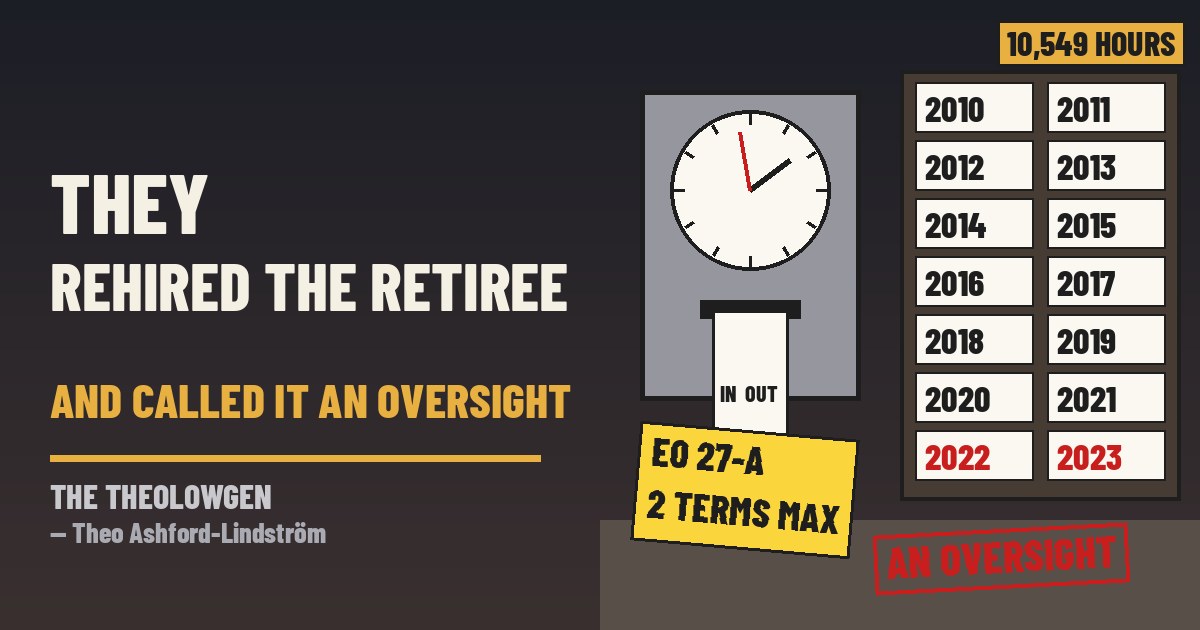
They rehired the retiree for thirteen years and called it an oversight. I know the sentence. It is what a government says when it writes itself a rule, signs the rule, files the rule, builds a procedure around the rule, and then discovers the procedure only ever looked at one half of it. Nobody stole anything here. Nobody hid a body in the payroll system. A temporary arrangement simply kept getting renewed, one agency to the next, until “temporary” had a longer résumé than most of the permanent staff — and the department in charge of the state’s human resources didn’t notice, because its checklist was built to count this year and never to look at the calendar.
Here is the record. Inside Investigator reported Oct. 27, 2026, on an audit of the Connecticut Department of Administrative Services released Oct. 14 by the state Auditors of Public Accounts, covering the fiscal years ended June 30, 2021 and 2022. The rule is Executive Order 27-A, signed by Gov. Jodi Rell in October 2009: retirees temporarily rehired by the state may not work more than 120 days, or 960 hours, in a calendar year, and “no more than two 120-day terms may be approved for any rehired retiree.” Auditors reviewed all 21 retirees DAS rehired in 2020 and 2021 and found one who had worked as a rehired retiree for over ten years — Norwalk Community College in 2010 and 2011, the University of Connecticut in 2012 and 2013, Southern Connecticut State University from 2014 to 2020, and DAS from 2020 through 2023 — for a total of 10,549 hours and approximately $371,490. In 2022 and again in 2023 the retiree logged 936 hours, $32,760 each year: 24 hours under the annual cap, every time. The auditors’ effect line: “Rehired retirees are able to work in state positions in excess of established limits while collecting state pensions.” The cause: DAS monitors the 960-hour limit, but its “procedures do not consider the two 120-day term limit in their design.” And DAS is not some side office. Under Gov. Ned Lamont’s Executive Order No. 2, the audit notes, it took over statewide human resources, and on Aug. 28, 2020, all executive-branch HR personnel transferred to it.
Now the defense, and it is short, which I respect. DAS told the auditors: “We agree with the finding, as this was an oversight. We will work on a standard operating procedure for establishing controls to confirm whether a retiree has already served as a retiree prior to hiring as well as for time monitoring.” Then a note: “We did however have the approval of the office of the governor through CY 2023.” The auditors’ concluding comment is the best sentence of the year: “The department obtained approval from the Office of the Governor. However, at the time of the request, DAS did not accurately present the amount of time the retiree worked for the state.” So the sign-off was real, and the paperwork that earned it was not. I have no quarrel with the retiree, who apparently did the work and stayed under every hourly line anybody drew; showing up is not the scandal. The scandal is that this is not a one-off. Inside Investigator notes a May audit of Connecticut State Community College that found at least ten rehired retirees employed “for between three and 14 years, including five who were reemployed for more than ten years,” a finding it says auditors had flagged since 2016. And this same DAS report, which carries 23 recommendations, 11 of them repeats from the last audit, also checked public complaints about state-fleet drivers. Of 101 filed between July 16 and Dec. 7, 2021 — 43 for dangerous driving, 40 for speeding — DAS never got an outcome report on 84. Auditors pulled GPS data on ten vehicles and substantiated six speeding complaints and two for dangerous driving. DAS Fleet “respectfully disagrees,” citing “labor relations challenges and staffing constraints,” and says it held a statewide meeting about it in late March 2026.
Deb says Buck has been “temporarily” storing his ice-fishing house in her side yard since about the same year this retiree started, and that she has approved it twice, maximum, and lost count after that. Buck says the approval was verbal and therefore permanent. Cricket has offered to laminate a term limit. I love them. They are seasoning.
“An oversight” is the alibi. The calendar is the story. Sit with it until it confesses. When you are the one with the hours — the unemployment claim, the benefit renewal, the side job that has to be reported to the week — the state can count you to the minute and remember you for years. When the state is the one with the hours, it counts one year at a time, gets a sign-off on numbers it didn’t present accurately, and promises a standard operating procedure. When you are the one doing 54 in a 45, it mails you. When its own car does it, it convenes a meeting. That is not one party or the other; that is the house rule. The cardigan stays. Fill the notebook. Then ask, out loud, at the next budget hearing: who counts the state’s hours, who checks the state’s driving, and why does “temporary” only ever expire for us?
Sources:
- Inside Investigator, Brandon Whiting, “DAS audit finds ‘temporary’ rehire earned $371k over 13 years,” Oct. 27, 2026
- Connecticut Auditors of Public Accounts, “Auditors’ Report: Department of Administrative Services … Fiscal Years Ended June 30, 2021 and 2022,” Oct. 14, 2026 (PDF)
— Theo Ashford-Lindström

Leave a Reply