
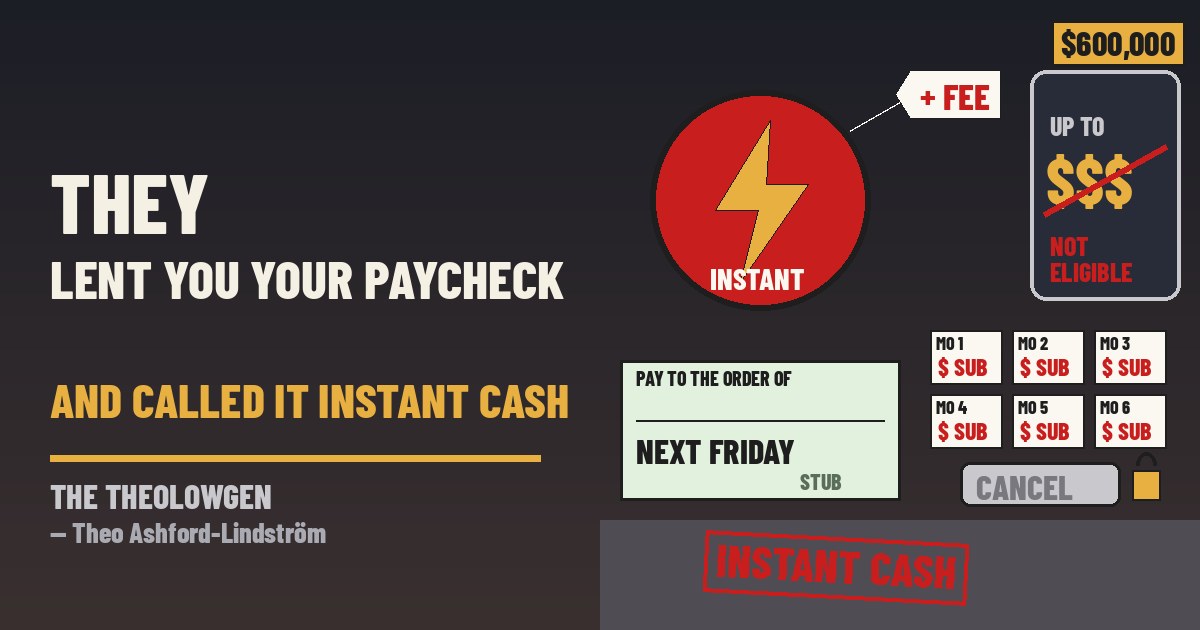
They lent you your own paycheck and called it instant cash. I know the sentence. It is what a company says when it finds a person who is three days short of payday and sells that person the three days. It does not call it a loan, because loans have licenses and rate caps and examiners. It calls it an advance — your own money, just early, what could be kinder — and then it puts the word “instant” on the button, and then, according to the state, it charges you again to make the button do what the word says. That is not a bridge to payday. That is a toll booth on it.
Here is the record. Maryland Attorney General Anthony G. Brown announced Oct. 27, 2026, that his Consumer Protection Division entered into a settlement with Bridge It, Inc., which does business as Brigit, a New York–based fintech that has offered an earned-wage-access product called “Instant Cash” in Maryland since 2019; the Capital Gazette’s Bridget Byrne reported it the same day. The settlement document, an Assurance of Discontinuance signed by Brigit’s counsel Oct. 21 and by the state Oct. 26, lays out the Division’s allegations. Between December 2019 and October 2023, it says, Brigit misled consumers by “offering consumers supposedly instant access to a cash advance, without clearly disclosing that consumers would have to pay additional fees (including, at times, a reoccurring subscription fee) to get the proceeds instantly”; by representing that consumers could access an advance amount “when, in fact, consumers generally could not qualify for the advertised amount”; and by “preventing cancellation of a subscription or reoccurring charge if a consumer had taken an EWA advance and not repaid it, thus causing the consumer to pay continued subscription fees.” The Division also contends that before Oct. 1, 2025, when Maryland’s new earned-wage-access law took effect, these products were loans that required a state lending license, and that Brigit offered them without one. Brigit applied for a lending license on April 2, 2024. As of the settlement, that application is still pending. Brigit must now disclose fees clearly, stop advertising amounts people can’t get, let customers cancel “at any time regardless of whether the consumer repays an EWA advance,” and pay $600,000 within 30 days.
Now the defense, and the document hands it over in writing. “Brigit asserts that its business practices have at all relevant times complied with all applicable laws in Maryland,” and it agreed to the terms “without trial of any issue of fact or law.” Nothing here has been proven, and the Capital Gazette reports Brigit’s media representatives didn’t immediately respond. Fair is fair: a small advance can beat an overdraft fee, a payday storefront, or a shutoff notice, and plenty of people who used the app will tell you it got them to Friday. Fine. Then look at the three moves the state describes, because they are the whole business model of the shortfall economy in miniature. Call the loan an advance so it isn’t a loan. Call it instant, and charge for instant. Then, if the customer still owes you, keep the subscription meter running until they pay — which is the moment a person short on money can least afford a recurring charge. Brown says, “Marylanders living paycheck to paycheck cannot afford surprise charges on a cash advance.” Agreed. And now read paragraph 20: the $600,000 goes to the attorney general’s Consumer Protection Division, to be used “at the sole discretion of the Attorney General” for consumer protection purposes “or for any other lawful public purpose.” The Assurance I read has no line sending a dollar back to the people who paid the fees. The firm built the toll booth; the state collected a toll on the toll booth. I am not cheering the second one to punish the first.
Taryn says the twins have discovered earned wage access: they wake at 3 a.m. demanding the morning bottle early, then charge an instant-delivery fee in screaming. Joey wants to know if he can get an advance on a paycheck he doesn’t have. Rafal says no. I love them. They are seasoning.
“Instant Cash” is the alibi. The cancel button that wouldn’t work is the story. Sit with it until it confesses. A company that has to charge you extra to make “instant” instant, and won’t let you stop paying it while you’re short, has told you exactly what it thinks your shortfall is worth. And a state that let the license application sit for two and a half years, then settled for a check written to itself, has told you what it thinks your shortfall is worth, too. The cardigan stays. Fill the notebook. Then ask, out loud, before you tap the lightning bolt: what does instant cost, can I cancel today, and who gets the money when somebody finally says it was wrong?
Sources:
- Office of the Attorney General of Maryland, “Attorney General Brown Announces $600,000 Settlement with Earned Wage Access Company Brigit, Protecting Marylanders from Hidden Fees,” Oct. 27, 2026
- Maryland Consumer Protection Division v. Bridge It, Inc., d/b/a Brigit, Assurance of Discontinuance, executed Oct. 21 and Oct. 26, 2026 (PDF)
- Capital Gazette, Bridget Byrne, “Maryland reaches $600,000 settlement with cash advance company Brigit,” Oct. 27, 2026
— Theo Ashford-Lindström

Leave a Reply