
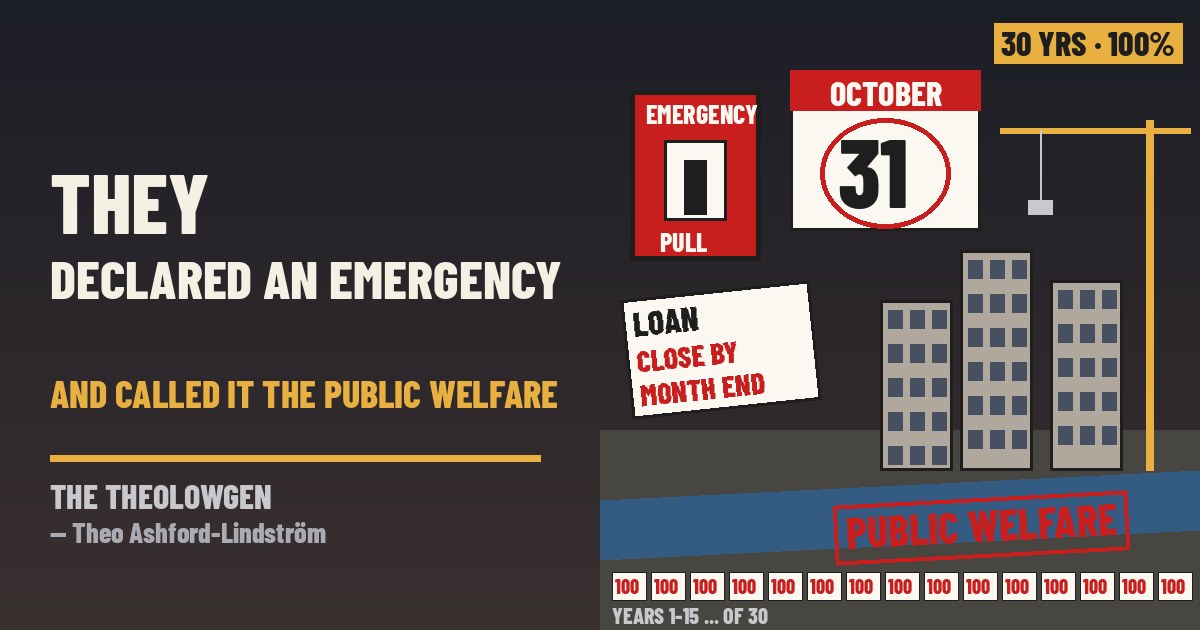
They declared an emergency for the lender and called it the public welfare. I know the sentence. Emergency is a beautiful word in a city charter. It means the water main burst, the bridge cracked, the roof came off the shelter. It means skip the second reading because people will get hurt if we wait. And on Monday night in Columbus it meant a bank wants its paperwork by Halloween. Not a fire. Not a flood. A closing date. And the city wrote it down, in its own legislation, three times, in the same words, and then passed it on the consent agenda, which is the part of the meeting reserved for things nobody needs to talk about.
Here is the record. Pique reported Oct. 23, 2026, that Columbus City Council would take up emergency legislation Oct. 26 for WestBend, a development by WestBend QOZB, LLC, an affiliate of Thrive Companies, which plans to privately invest nearly $200 million in about 895 apartment units “including affordable housing units,” up to 8,000 square feet of retail, surface parking, and about 17 acres of green space and bikeways on the former Buckeye Auto Parts brownfield — 50.28 acres between the Scioto River and the New York Central Railroad at Fisher Road and McKinley Avenue. The city’s legislative record and DocketCity’s meeting record show council adopted all three pieces Oct. 26 as consent items: a resolution organizing the developer-petitioned WestBend Community Authority “as a body politic and corporate”; an ordinance creating the WestBend TIF, a 100% exemption from real property taxes on the improvements for up to 30 years in each of three phases, each clock starting once $5 million of new building value hits the tax rolls; and an ordinance authorizing agreements under which the city uses those diverted payments to reimburse bonds the community authority issues for roads, utilities, parks, recreation and community centers, and land acquisition, plus a utility deal putting the site on a master meter. Columbus City Schools are held harmless — they get what they would have gotten. Everything else goes to the TIF fund. In the city’s own words: “The City is foregoing one hundred percent (100%) of the real property tax revenue that it would have received from development on the WestBend TIF parcels.” Because part of the site is residential, Ohio law required the parcels to sit in a “blighted area” of an “impacted city”; the state certified Columbus an impacted city, and a blight study the city accepted found the parcels blighted. And the emergency, verbatim, in each measure: “the Developer’s lender is requiring the Developer to close on the apartment financing before the end of the month but the lender will not close unless the City first” acts — “all for the immediate preservation of the public health, peace, property, safety, and welfare.”
Now the defense, and I will give it its full height. A cleaned-up 50-acre auto-parts brownfield on the river is better than a dead one. Nearly 900 apartments in a city short of housing is real supply. The schools are protected on paper, which is more than a lot of TIFs bother with. The bonds pay for roads, pipes, and parks, not the developer’s lobby. And the city says, per the legislation, that without the financing “the apartments may be delayed beyond the deadline in the EDA causing a loss of new housing units and construction jobs.” Fine. Now read the dates. Council approved the economic development agreement July 31, 2023. The city and developer signed it April 19, 2024. They amended it June 22, 2026, and signed the amendment Aug. 19. The developer petitioned for its own community authority Aug. 28; council found the petition sufficient Sept. 14 and held the hearing Sept. 29; the legislation was filed Oct. 9. That is not an emergency. That is a three-year calendar that arrived at a bank’s month-end and was relabeled a public-safety crisis so nobody would have to wait for a second reading. The authority the developer petitioned for exists, per the resolution, to impose “community development charges” on the place it governs. The developer’s name carries the letters of the federal opportunity-zone program. The site had to be certified blighted for the residential break to be legal. Every layer of government touched this — the state certified, the city passed, the schools were notified, the new authority will bond — and not one of them asked the term sheet to wait. That is the handshake. Both parties are the help, and on Monday the help didn’t even need to pull up a chair.
I have my own reasons this fall to read anything with “100% exemption” in it twice, and they stay in the drawer. Deb read this one and asked whether her lender would declare an emergency if she missed a payment. We agreed it would, just not on her behalf. Buck wants to know if his ice-fishing house counts as a blighted area. It does. I love them. They are seasoning.
“The public welfare” is the alibi. The month-end closing is the story. Sit with it until it confesses. When you need the city — the permit, the variance, the fix on your street — you get the full process, two readings, the hearing, the wait. When a lender needs the city, the process becomes the emergency, and the emergency becomes a consent item. If the public is lending its taxes for thirty years to make a loan close by Halloween, say that, out loud, and debate it in the light. The cardigan stays. Fill the notebook. Then ask, at the next council meeting: whose deadline was this, how much is thirty years of 100% worth, and when did a bank’s calendar become the public’s emergency?
Sources:
- Pique, “Columbus Council Weighs Emergency Financing for WestBend Project on Fisher Road,” Oct. 23, 2026
- Pique, “Columbus City Council Weighs WestBend Redevelopment and Infrastructure Contracts,” Oct. 26, 2026
- City of Columbus, Legislation 0239X-2026 (WestBend Community Authority), full text
- City of Columbus, Ordinance 2895-2026 (WestBend TIF), full text
- City of Columbus, Ordinance 2896-2026 (WestBend TIF and utility cooperative agreements), full text
- DocketCity, Columbus City Council meeting record, Oct. 26, 2026
— Theo Ashford-Lindström

Leave a Reply