They pledged the new taxes to the stadium and called it the project paying for the project. I know the sentence. It is the most elegant sentence in public finance, because it is a circle, and a circle has no place where anybody pays. The project creates revenue; the revenue pays for the project; therefore nobody pays for the project. It is the sentence a city says when it wants you to stop asking whose credit is on the bond. I have sat through ribbon cuttings in better cardigans than this deal deserves. I have never once seen a building pay for itself. I have seen people pay for buildings and then be told they didn’t.
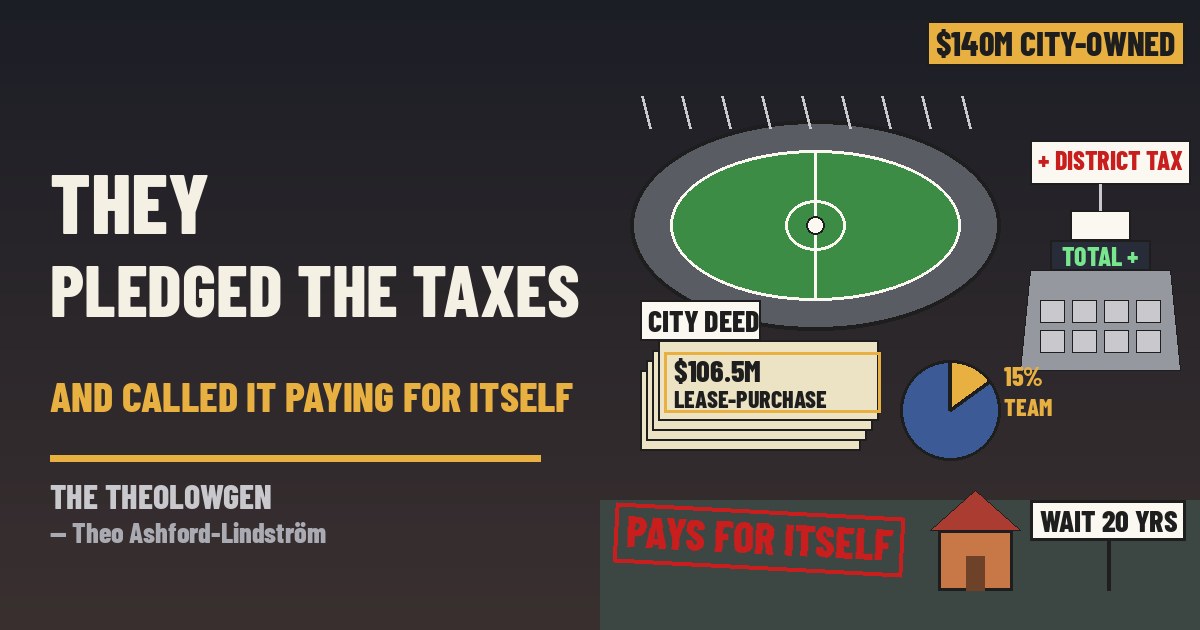
Here is the record. On Tuesday, Oct. 27, 2026, the Omaha City Council unanimously approved the redevelopment agreement and stadium lease for Union Omaha’s planned downtown stadium, Omaha.com’s Jen Rae Hein-Wang and Charles Isom report. The city will own the roughly $140 million stadium — about 6,500 fixed seats, room for about 8,500 — on a site at 10th and Izard north of Cuming Street, the anchor of a district expected to bring about $330 million in total investment. The Reader’s Jessica Wade, reporting for Nebraska Public Media ahead of the vote, describes 25 acres of former industrial land the city bought from Union Pacific, a $117 million redevelopment agreement, and $48 million in tax-increment financing the council had already approved unanimously this year. The team’s attorney, David Levy, laid out the money: about $23 million in team equity, $2 million a year in rent, and “incremental project revenues” such as sponsorships, naming rights, new sales taxes and property taxes. The city will put in $10.5 million for infrastructure and finance $106.5 million through lease-purchase and revenue bonds. “I do want to note a majority of the city participation in that is financing, not direct city dollars,” Levy said. The club’s own stadium FAQ spells out the rest: the tax-increment financing redirects new property taxes on the site to construction for 20 years before they go to “taxing entities such as the Omaha Public School District and the City”; an occupation tax adds “a small, additional sales tax applied only within the district”; and a state turnback lets “70 percent of new state sales tax generated near the stadium, up to $1.25 million per year for 20 years,” go “directly to bond debt payments.” Mayor John Ewing Jr.: “This is a big win for Omaha.” Owner Gary Green: “today we are a big step closer to giving professional soccer a permanent home in our city.”
Now the defense, and it is printed on the club’s website in bold. “Is existing taxpayer money being used?” The answer: “The only new public expenditure is for the stadium land and public infrastructure,” and beyond that “no taxpayer money is spent because the project pays for the project through new revenues.” “‘But for’ the project, these revenues do not exist.” The city can “borrow at lower rates than private developers.” And naming rights, parking and event income “serve as a backstop to debt shortfalls.” Fine. Some of that is true: the land is empty, and a new building on empty land does make new tax. But follow the circle around once. The land purchase is public money. The sewers are public money. The borrowing rate is cheap because it is the city’s credit, not the club’s — that is the entire point of the city doing the borrowing. The “new” sales tax is a tax, an extra one, paid by whoever buys a beer or a burger in the district, and it is pledged to a stadium before the first bar opens. Seventy percent of the state’s new sales tax there, up to $1.25 million a year, is pledged too, for two decades. The schools wait 20 years for the property tax. And the club’s own FAQ says the team’s equity is “approximately 15 percent of the cost of the stadium.” The private side gets a permanent home and the public side gets a deed and a debt schedule, and the word for that is ownership. I have my own reasons, lately, to read the word “new” on a tax line slowly. “But for” is a sentence nobody can ever prove wrong, because the world where the project didn’t happen never shows up to testify.
Buck wants to know whether a beer at the new stadium counts as him personally paying for the project, and if so, whether he gets a seat with his name on it. Deb says he has never in his life paid for a project. Joey has offered to build a stadium out of pizza boxes, no bonds, no foam core. I love them. They are seasoning.
“The project pays for the project” is the alibi. The bond with the city’s name on it is the story. Sit with it until it confesses. A city bought the land, will lay the pipes, will lend its credit, will add a tax and will park the schools’ share of the new property tax for twenty years, all for a third-division soccer club that put in about fifteen cents on the dollar — and the club’s FAQ calls this protecting taxpayers from risk. Maybe the stadium fills every night. I hope it does; Omaha deserves the soccer. But a city that has to tell you, in a FAQ, that no taxpayer money is being spent has already noticed that you are a taxpayer. The cardigan stays. Fill the notebook. Then ask the council, out loud, before the construction manager vote in December: if the district’s new taxes come in short, whose name is on the bond, and who pays the difference?
Sources:
- Omaha.com, Jen Rae Hein-Wang and Charles Isom, “City Council Approves Union Omaha Stadium Agreements,” Oct. 28, 2026
- The Reader / Nebraska Public Media, Jessica Wade, “Downtown Union Omaha soccer stadium looks to finalize financial plan,” Oct. 20, 2026
- Union Omaha, “New Stadium FAQ” (accessed Oct. 29, 2026)
— Theo Ashford-Lindström

Leave a Reply