They missed 5,872 kids and called it strong overall performance. I know the sentence. It is what a big agency says when the auditor has counted the misses and the agency would rather you counted the budget. You take a number that should embarrass a building — thousands of children who were supposed to get food over the summer and didn’t — and you set it next to a number so large it makes everything look small, and then you put out a press release before lunch. I have written that release. Back at the You Know Who Post I wrote the version for other people, in a cardigan that cost more than a summer of groceries, and the trick is always the denominator. Nobody misses 5,872 kids. They miss a rounding error.
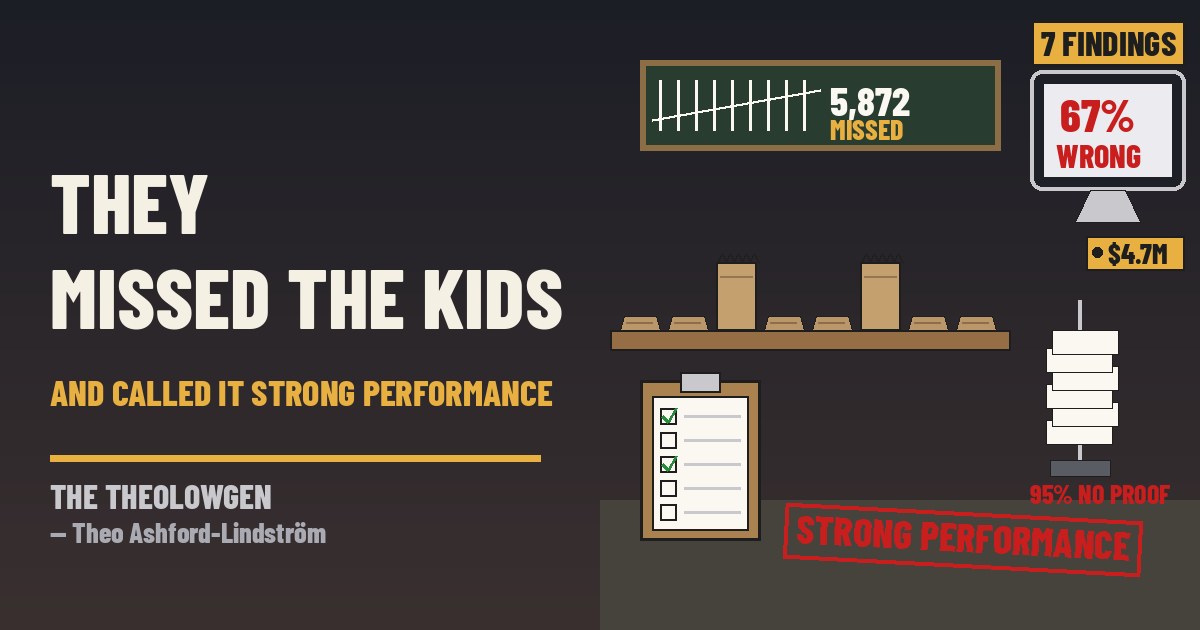
Here is the record. Prairie Public’s Danielle Webster reported Oct. 29, 2026, that a biennial audit of the North Dakota Department of Health and Human Services by State Auditor Josh Gallion’s office — a job Gallion says took a team of about five to seven people — found seven areas of concern. WDAY’s Chris Larson laid out the findings for the two years ending June 30, 2025. In the state’s summer food assistance program, auditors found 5,872 children who should have received the benefit and did not, and 1,610 children who received it and were not eligible. More than $1.4 million went to behavioral-health providers in the Free Through Recovery and Community Connect programs even when the required face-to-face engagement, or even attempts to contact participants, did not occur, and the department had no procedures to catch it. The programs’ one-time GAP payments — meant for short-term needs like cell phones and hygiene supplies — mostly lacked paperwork: 95% of Free Through Recovery receipts reviewed had no evidence anyone had determined the participant’s financial need, 92% had nothing showing other help had been exhausted, and some reimbursements went out without the required committee approval. Auditors warned the gaps could let providers buy things for themselves or submit the same receipt for more than one participant. An estimated $217,397 in improper payments went through a program helping child care workers pay for their own kids’ care to employees who didn’t meet the 25-hours-a-week requirement. For providers who work inside people’s homes, the audit projected a 41% error rate on background checks that had not been completed or even started, with different divisions following different rules. Thirty-four percent of in-home visits reviewed had no electronic proof they happened. And the department paid about $4.7 million to vendors for the electronic visit verification software meant to provide that proof, found the vendor data was wrong on 67% of the claims reviewed, and, auditors said, wasn’t using the information to check claims at all. Gallion, to Prairie Public: the goal is to make sure payments are caught and corrected “before overpayments are sent out.”
Now the defense, and the department had it out the same morning. In a release posted at 11:35 a.m. Thursday, North Dakota Health and Human Services said it “is pleased to say the 2025 biennial audit released by the State Auditor’s Office shows strong overall performance across its programs, safeguards and operations.” Then the denominator: “In a biennial budget of nearly $6 billion, auditors identified only seven findings, which demonstrates effective oversight and responsible program management.” The audit, it says, “found no evidence of systemic failures or widespread improper payments,” only “documentation gaps, varying provider practices and opportunities to strengthen oversight,” and with thousands of providers and millions of interactions a year, that makes “the limited number of findings notable.” Commissioner Conner Swanson thanked the auditors for showing “the vast majority of our operations are sound” and for “targeted opportunities to make already strong programs even better.” Many fixes, it says, are already done or underway. Fine. I believe the vast majority of the checks cleared. I believe it is hard to run $6 billion of anything. But a finding is not a typo. One of the seven is 5,872 children, and a child who didn’t eat is not a documentation gap; she is the program. Another is a state paying providers for visits that didn’t happen and paying software vendors $4.7 million for a lock the department then left in the box. That is the state at its most honest: generous with other people’s money, strict about nothing, and pleased with itself by 11:35. The auditor is the state, too, and I will give him this much — he counted. Counting is the only part of this I trust.
Deb ran the vacation Bible school snack table for eleven summers and says she never once missed a kid, because she counted heads, not budgets. Buck says the 1,610 who got it anyway at least ate, which is the most generous thing he has ever said about a government program. I love them. They are seasoning.
“Strong overall performance” is the alibi. The 5,872 is the story. Sit with it until it confesses. An agency that can tell you its budget to the nearest billion could not tell which children were owed food, which providers actually showed up, which in-home workers had been checked or whether its own $4.7 million software was telling the truth, and its first public sentence about all of it was that it was pleased. Nobody voted for that tone. The cardigan stays. Fill the notebook. Then ask your legislator, out loud, before the next budget: who were the 5,872, did any of them ever get the benefit, which providers kept the $1.4 million, and what does the department think a weak performance would look like?
Sources:
- Prairie Public, Danielle Webster, “State audit of HHS shows millions of dollars in questionable payments,” Oct. 29, 2026
- WDAY Radio, Chris Larson, “Audit finds millions in questionable payments, oversight failures at North Dakota Health and Human Services,” Oct. 29, 2026
- North Dakota Health and Human Services, “North Dakota Health and Human Services responds to 2025 biennial audit,” Oct. 29, 2026
— Theo Ashford-Lindström

Leave a Reply