
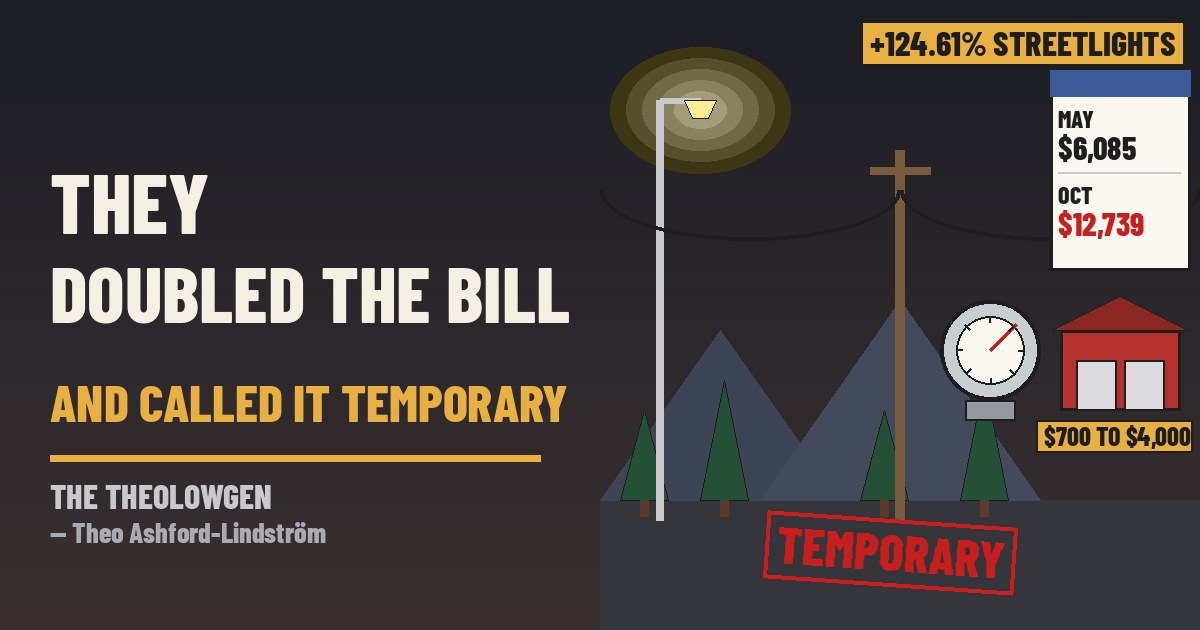
They doubled the streetlight bill and called it a temporary surcharge. I know the sentence. It is what a monopoly says when it needs a word that means forever but sounds like Tuesday. Temporary is a beautiful word on a bill. It tells you the pain has an end date and asks you not to do the arithmetic on how long three years is when you are retired, on a fixed income, in a mountain town, in January. I have paid a lot of utility bills in a lot of cardigans. I have never once had a choice of who sent them.
Here is the record. The Plumas Sun’s Ingrid Burke reported Oct. 28, 2026, that every seat was taken and people stood in the lobby at the Oct. 14 Portola City Council meeting, with more than 25 more watching remotely, over Liberty Utilities’ electric bills. Liberty, an investor-owned company, serves about 2,000 customers in Portola, about 300 of them commercial, out of roughly 50,000 total, most of them in the Lake Tahoe Basin. Residents described bills doubling and tripling, even compared with the same month last year; one speaker said hers went from $200 to $1,030 a month. Organizer Tony Hamilton said Portola’s median income is $44,000 a year and that he knows people whose bills now total $2,000 a month. The city is a customer, too: City Manager Ryan Bonk showed its streetlight bill rising from $6,085.79 in May to $12,739.49 in October on the same usage, about 6,500 kilowatt-hours — an increase of nearly 125%. The Beckwourth Peak Fire Protection District’s board president said bills went from about $700 to $4,000 a month at each of its seven stations. And here is what the city is allowed to do about it, per Bonk: it cannot set, cap, freeze or roll back rates, cannot reject an increase, cannot order Liberty to change billing or shutoffs, cannot tax or fine Liberty, and cannot go straight to court. The California Public Utilities Commission sets the price. Liberty asked it in September 2024 for a 19.1% increase. The commission approved a smaller one in March, and Liberty’s own customer FAQ says the average residential bill rises about $24 a month starting June 1, 2026, plus “a temporary surcharge of about $23 per month (approximately 11.3%) to recover costs for investments already made from January 2025 through May 2026,” retroactive to January 2025 and collected over three years. The Sun notes that this “doesn’t explain the doubling and tripling bills.” The Mountain Messenger’s Dana Loomis adds that Liberty, based in South Lake Tahoe, also serves areas in five other states, Bermuda and Chile, buys all the power it delivers in California from NV Energy under an agreement that expires at the end of 2027, and that Portola has had extended winter outages. When the Sun asked the CPUC how customers could push back and whether rates would come down, a representative sent links to assistance programs and payment plans and did not answer the questions.
Now the defense, and Liberty has a good one on paper. Most of its territory is high wildfire risk, and it is spending on covered wire, pole replacement, inspections, cameras and wildfire insurance; its FAQ says these “critical investments are needed to keep the community safe and the electric system reliable,” that its rates “are comparable to, and remain lower than, several of the state’s other investor-owned utilities,” and that “It’s an investment we are making together as a community.” Its account manager told the packed room, “We need to hear the voices, hear the stories,” and welcomed a forum: “The sooner, the better.” As of Oct. 27, no meeting had been scheduled. Fine. Nobody in Portola wants a spark in a pine forest, and I will not pretend the poles are free. But read the word “together” again. The community pays for the wire; the wire goes into the company’s books. The company’s shareholders are not paying $1,030 a month to make it safe. And “average” is doing the same job “temporary” is doing, because a $47 average does not explain a fire station going from $700 to $4,000. Then look at who signed off, because it is not only the firm. The state approved the sale of the town’s service to one company over the city’s own objection, left the town no power to say no, approved the price, made part of it retroactive, and holds its public comment in San Francisco, at a Thursday meeting where people watching online can’t speak. The firm holds the monopoly. The state wrote it and set the meter. The member-owned co-op next door says it would buy the territory if Liberty ever wants to sell, which is the closest thing to an exit anyone in Portola has been offered.
Deb has started unplugging the toaster between slices and calling it wildfire mitigation. Cricket laminated the streetlight bill so it could hang on the fridge without using any electricity. I love them. They are seasoning.
“Temporary surcharge” is the alibi. The streetlight bill is the story. Sit with it until it confesses. Same lights, same road, same 6,500 kilowatt-hours, twice the money, and a town that is legally forbidden to do anything but write letters, to a commission that answers questions with a link to a payment plan, about a company that says the whole thing is being done together. The anti-capitalist in me says a monopoly with a guaranteed customer is not a market. The libertarian in me says a state that sells the monopoly and then tells you to fill out a form is not a protector. They are both right tonight. The cardigan stays. Fill the notebook. Then ask Liberty and the CPUC, out loud, at the Portola forum nobody has scheduled: what would the October bill be without the surcharge, who owns the new poles when the three years are up, and why did the streetlights double when the rate went up by about a quarter?
Sources:
- The Plumas Sun, Ingrid Burke, “Portola residents ‘terrorized’ by high Liberty electricity bills,” Oct. 28, 2026
- The Mountain Messenger, Dana Loomis, “Portola Asks CPUC and Legislators for Help with Electric Bills,” Oct. 28, 2026
- Liberty Utilities (CalPeco), “Liberty CalPeco 2025 General Rate Case — Customer FAQ: Wildfire Safety, Reliability, and Your Rates” (updated May 7, 2026; accessed Oct. 29, 2026)
— Theo Ashford-Lindström

Leave a Reply